

Moving from the Czech Republic to Colombia (2026): Complete Guide

Relocating from the Czech Republic to Colombia is a long-haul, cross-continental move that combines EU export rules with South American import rules. On the Czech side you deal with the Celní správa ČR (Czech Customs Administration), the municipal registration office (ohlašovna) and the Finanční správa (tax authority). On the Colombian side you deal with the DIAN (customs and tax authority), Migración Colombia / the Ministry of Foreign Affairs (Cancillería), and — if you’re bringing pets — the ICA (agricultural institute). This guide is written for a Czech resident (citizen or long-term resident) moving household goods, pets and sometimes a family to Colombia, and closes with a short note on the reverse move back to the Czech Republic.
Key takeaways
- Your Colombian immigration status (visitor vs. migrant "M" vs. resident "R" visa) determines whether your shipment can qualify as duty-favoured menaje doméstico — you generally need to be establishing residence, not just visiting, to use it, per Cancillería’s visa-type overview.
- Czech citizens are visa-exempt for short stays in Colombia, but a short-stay entry does not give you menaje doméstico rights — confirmed by Cancillería’s Czech Republic bilateral page.
- To end Czech permanent residence you must notify your local ohlašovna in writing (fee 100 CZK, or 600 CZK if filed through a Czech embassy/consulate abroad), per the gov.cz "Ukončení trvalého pobytu" service.
- Czech tax residency ends only once you’re physically present in the Czech Republic under 183 days a year and your centre of vital interests has moved abroad — per Finanční správa’s 2026 methodological guidance.
- Goods leaving the EU customs territory require a formal export customs declaration filed through the AES system, per Czech customs’ e-declaration service on portal.gov.cz.
- Colombian menaje doméstico requires ≥24 months of continuous or discontinuous residence abroad in the prior 3 years, and the shipment must arrive between 1 month before and 4 months after you do, taxed at a flat 15% under tariff heading 9805.00.00.00 — per DIAN’s menaje doméstico page and its ABC guide.
- Cash or bearer instruments above €10,000 leaving the EU (via Czech customs) and above USD 10,000 entering/leaving Colombia (via DIAN Form 530) must both be declared — see Czech cash-control rules and DIAN’s traveller declaration form.
- Colombia bars import of used vehicles under the Andean Automotive Sector Complementation Agreement, with only a narrow exception for classic/antique cars at least 35 years old, per Cancillería’s official FAQ — plan to sell your car in the Czech Republic rather than ship it.
1. Your Colombian immigration status decides your customs treatment
Colombia’s customs concession for household goods (menaje doméstico) is not available to tourists — it is tied to establishing residence. Colombia’s visa system, set by the Cancillería under Resolución 5477 of 2022, has three tiers: Visitante (V), Migrante (M) and Residente (R). The M visa is for people establishing themselves in the country without yet meeting the conditions for the R visa (three continuous years on M-type visas count toward proof of settled residence), while the R visa carries indefinite validity (Cancillería, tipos de visa; Cancillería, Visa de Migrante tipo M). Czech citizens don’t need a visa for short tourist stays in Colombia (Cancillería bilateral page, Czech Republic), but that visa-free entry does not by itself qualify you for menaje doméstico — you need an M or R visa (or equivalent proof you are relocating) before DIAN will apply the household-goods regime instead of full commercial import duties. Get your visa approved before your shipment leaves the Czech Republic; the arrival window for the goods (1 month before to 4 months after you personally arrive) is fixed by DIAN and doesn’t bend for paperwork delays.
2. The Czech Republic side: deregistering and exporting
Customs authority. The Celní správa České republiky (Czech Customs Administration) is the body governing everything that physically leaves the EU customs union from Czech territory, including household effects (Celní správa, Stěhování fyzických osob).
Leaving the population register. As a Czech citizen (or foreign resident registered in the Czech Republic) you must formally end your trvalý pobyt (permanent residence registration) at your local ohlašovna, or at a Czech embassy/consulate if you’re already abroad. The notice must be in writing, the fee is 100 CZK in person (600 CZK if lodged through a Czech embassy or consulate abroad), and your ID card — which loses validity the moment your permanent residence ends — must be surrendered within 15 working days (gov.cz, Ukončení trvalého pobytu). This step matters for Colombia too: DIAN’s 24-month "resided abroad" clock for menaje doméstico starts running from when you actually leave, and a clean deregistration date gives you documentary proof of that.
Export declaration. Any consignment of household goods physically leaving EU territory for a non-EU country like Colombia requires a formal export customs declaration submitted electronically through the EU’s AES (Automated Export System) via Czech customs (portal.gov.cz, elektronické podání vývozního celního prohlášení). In practice, your moving company or its customs broker files this on your behalf as the declarant; you’ll need to supply an inventory and your Colombian arrival/visa documentation to support it.
Tax-residency exit. Ending your Czech tax residency is not automatic on the day you leave. Under Finanční správa’s methodology, you remain a Czech tax resident if you either keep a permanent home available in the Czech Republic under circumstances indicating intent to reside there, or spend 183+ days in the country in the calendar year. Residency ends only when both physical presence drops under 183 days and your "centre of vital interests" (family, main home, main economic ties) has genuinely relocated to Colombia; you should notify your locally competent tax office of the change of address/status and file a final return covering the resident period of the departure year (Finanční správa, GFŘ methodological guidance on tax residency, 2026).
Cash. If you’re carrying more than €10,000 in cash or equivalent bearer instruments out of the EU through a Czech airport or border crossing, you must proactively declare it in writing to Czech customs before departure (Celní správa, Kontrola hotovosti).
3. Ports and transit: realistic routing, not official figures
The Czech Republic is landlocked — it has no seaport of its own, so household goods bound for Colombia are trucked from your Czech address to a major North European container port, most commonly Hamburg or Bremerhaven in Germany (occasionally Koper in Slovenia for southern routings), for consolidation into an ocean container. From there, sea freight typically transits to Colombia’s main Caribbean gateway, Cartagena, or the Pacific port of Buenaventura; airfreight for smaller or time-sensitive shipments routes through Frankfurt or Amsterdam to Bogotá’s El Dorado airport. These are freight-industry planning estimates, not figures published by any customs authority: road haul Czech Republic → German port, roughly 1–3 days; ocean transit Northern Europe → Cartagena, roughly 3–5 weeks depending on carrier and transshipment; airfreight Prague → Bogotá, typically 5–10 days door-to-door including customs clearance. Build in buffer — DIAN’s menaje doméstico arrival window (1 month before to 4 months after you personally land) gives you some room, but sailing schedules and Colombian port congestion can still eat into it.
4. The Colombia import side: menaje doméstico through DIAN
Colombia’s household-goods import regime is called menaje doméstico, administered by the DIAN (Dirección de Impuestos y Aduanas Nacionales). To qualify, you must have lived outside Colombia continuously or discontinuously for at least 24 months during the 3 years immediately before your arrival, and be entering to establish residence; the regime is available once every 5 years per family unit (DIAN, Menaje doméstico). No prior import licence or registration is required. Goods must have been acquired while you lived abroad, must originate from the country you were living in (the Czech Republic, in your case), and must arrive within the window of 1 month before to 4 months after your own entry into Colombia. The whole shipment is declared under a single customs heading (9805.00.00.00) and taxed at a flat 15%, instead of the standard commercial import duty/VAT stack (DIAN, ABC para la Importación Menaje Doméstico). Declarations are processed electronically through DIAN’s MUISCA system; your Colombian customs agent will need your visa/residency proof, an itemised inventory, and your transport documents (bill of lading or air waybill) to lodge it. Separately, if you personally are carrying more than USD 10,000 in cash or negotiable instruments when you land, you must file DIAN’s Form 530 traveller declaration at the port, airport or border crossing (DIAN, Declaración de viajeros Formulario 530).
5. Pets: both ends
Exporting from the Czech Republic. There is no single bilateral certificate agreed between the Czech Republic and Colombia for pet exports. The Czech State Veterinary Administration (Státní veterinární správa, SVS ČR) requires that before you travel you check the destination country’s own import conditions — directly with the Colombian authority or a Colombian embassy — because a generic Czech veterinary export certificate is issued at the exporter’s own risk if it doesn’t match what Colombia actually requires (SVS ČR, cestování se zvířaty z ČR do třetích zemí). In practice this means booking a pre-export clinical exam and certificate with a Czech official veterinarian shortly before departure, built around Colombia’s requirements below.
Importing into Colombia. The ICA (Instituto Colombiano Agropecuario) requires an original sanitary certificate from the official veterinary authority of the country of origin, issued no more than 10 calendar days before the animal’s entry, confirming a clinical exam within the days prior to shipment and up-to-date vaccination status. On arrival, a Certificado de Inspección Sanitaria (CIS) is issued by ICA staff stationed at Colombia’s international airports, seaports and border crossings, after document verification and physical inspection (ICA, ingreso de perros y gatos a Colombia). Note that Colombian law (Ley 746 de 2002, Art. 108-E) bans the import of certain bull-terrier-type breeds (Staffordshire Terrier, American Staffordshire Terrier, Pit Bull Terrier, American Pit Bull Terrier) — check this before booking pet transport if you own one of these breeds.
6. Vehicles, money, and what people forget
Vehicles. Do not plan to ship your car. Colombia restricts vehicle imports to new models under the Andean Automotive Sector Complementation Agreement (among Colombia, Ecuador and Venezuela), which excludes used vehicles from any country. The only exception is for classic or antique vehicles at least 35 years old, certified as such by the Automóvil Club de Colombia (Cancillería, ¿Por qué no se pueden importar vehículos usados a Colombia?). Sell or otherwise dispose of your car in the Czech Republic before you go.
Money. Both legs have a €/USD 10,000-equivalent cash-declaration threshold, on separate forms with separate authorities — Czech customs on the way out (cash controls page), DIAN Form 530 on the way in (Formulario 530). Declaring lawfully-sourced cash is not itself taxed — it’s a reporting obligation, not a customs charge.
What people forget. The menaje doméstico arrival window is unforgiving in both directions — a shipment that arrives too early (before you’ve personally landed and can prove your visa status) or too late (past 4 months) risks losing the concession and being reassessed at full commercial duty. Keep your Czech deregistration paperwork, your Colombian visa approval, and your inventory/insurance documents together — Colombian customs brokers will ask for all three. And remember menaje doméstico is once every 5 years per family unit, so it isn’t a repeatable shortcut if you split your shipment.
How Flyto handles your Czech Republic to Colombia move
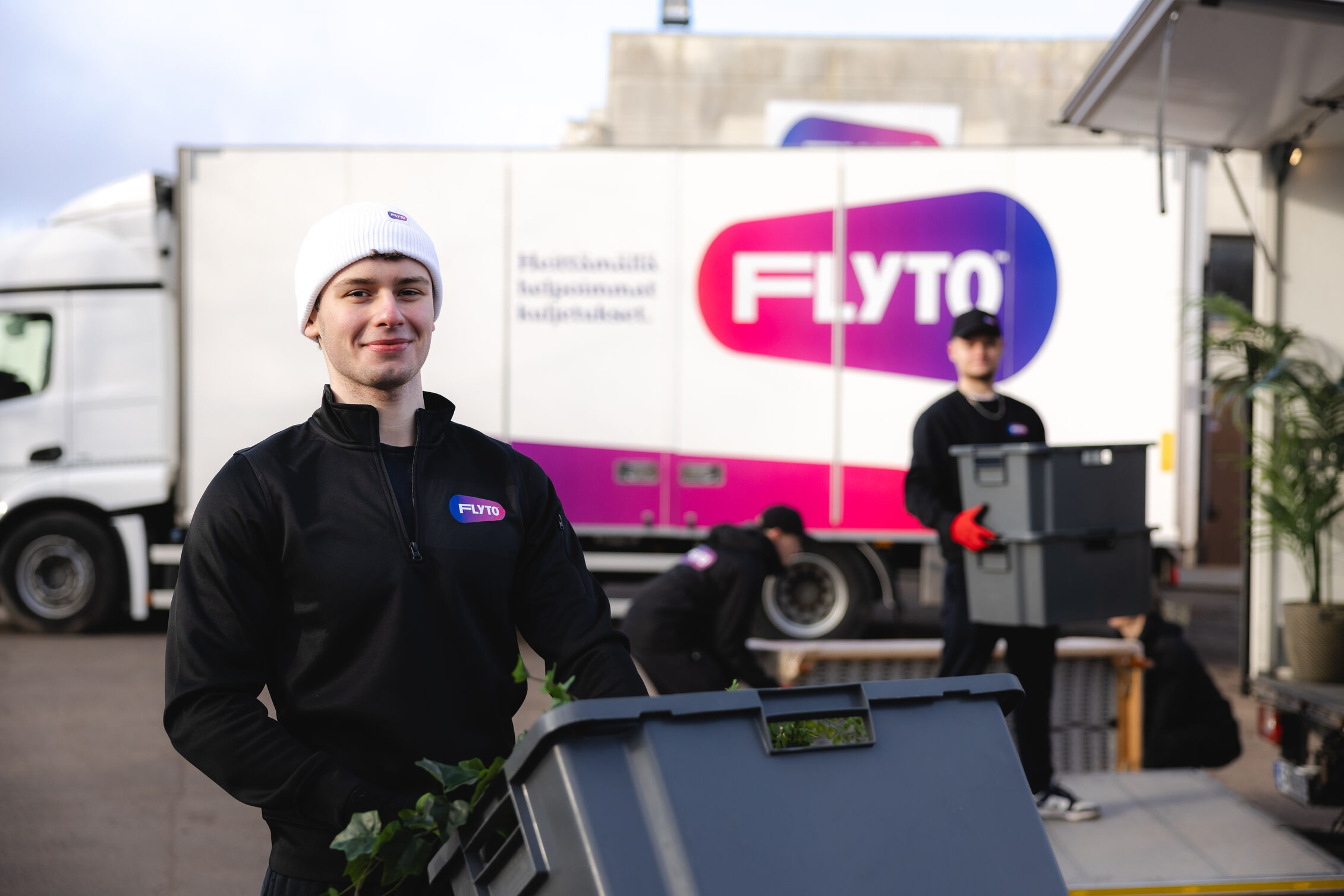
Flyto runs its own offices, warehouses, crews and vehicles across Northern, Central and Southern Europe, so the Czech collection, EU export declaration and consolidation to a North European port are handled in-house rather than handed off blind. For the ocean or air leg and the Colombian side, we work through a carefully vetted network of freight partners and subcontractors, plus trusted local partners in Colombia who handle DIAN clearance, menaje doméstico filing and final delivery — so you get one coordinated move instead of juggling separate Czech and Colombian agents yourself.
Frequently asked questions
Do I need a Colombian visa before my belongings can leave the Czech Republic?
You don’t need the visa in hand before your export declaration is filed, but you do need it (M or R, or documented residency intent) before DIAN will treat your shipment as menaje doméstico rather than a standard commercial import — get it moving early (Cancillería, tipos de visa).
Can I keep my Czech permanent residence registered while living in Colombia?
You can, but it will keep you exposed to Czech tax residency arguments and complicates the "24 months resided abroad" test Colombia applies for menaje doméstico. Most people deregister via their ohlašovna once they’ve actually relocated (gov.cz).
How is my household shipment taxed entering Colombia?
As menaje doméstico under tariff heading 9805.00.00.00, at a flat single tax of 15%, instead of Colombia’s normal import duty/VAT combination — provided you meet the residency and timing conditions (DIAN).
Can I bring my used car?
No. Colombia bars import of used vehicles from any country except classic/antique cars at least 35 years old, certified by the Automóvil Club de Colombia (Cancillería FAQ).
What about moving back from Colombia to the Czech Republic later?
The relief works the other way too: under EU Regulation 1186/2009, personal property you owned and used for at least 6 months before ending your residence outside the EU can re-enter the Czech Republic free of import duty and VAT — provided you had lived outside the EU continuously for at least 12 months, the customs declaration is lodged within 12 months of re-establishing your Czech residence, and the goods stay in your own personal use (not sold, lent or pledged) for a further 12 months (Celní správa, Stěhování fyzických osob). Pets travelling from Colombia back into the EU fall under the Czech rules for animals arriving from third countries, so check with SVS ČR on current entry requirements (rabies vaccination/titer timing in particular) before you fly.
Do I need to declare cash both times?
Yes — the Czech and Colombian thresholds (€10,000 and USD 10,000 respectively) are independent obligations on separate authorities, so a single cash transfer can trigger a declaration requirement on both ends of the trip.
Sources
- Celní správa ČR — Stěhování fyzických osob
- portal.gov.cz — Elektronické podání vývozního celního prohlášení
- Celní správa ČR — Kontrola hotovosti
- gov.cz — Ukončení trvalého pobytu
- Finanční správa ČR — Metodická informace k daňové rezidenci (2026)
- Státní veterinární správa — Cestování se zvířaty z ČR do třetích zemí
- DIAN — Menaje doméstico
- DIAN — ABC para la Importación Menaje Doméstico
- DIAN — Declaración de viajeros, Formulario 530
- Cancillería de Colombia — Tipos de visas en Colombia
- Cancillería de Colombia — Visa de Migrante (tipo M)
- Cancillería de Colombia — República Checa (relación bilateral)
- Cancillería de Colombia — ¿Por qué no se pueden importar vehículos usados a Colombia?
- ICA — Ingreso de perros y gatos a Colombia