

Moving from Finland to Colombia (2026): Complete Guide

Finland to Colombia is a two-continent, two-customs-regime move: an EU export out of a Finnish port or airport, a transatlantic transit, and a South American import governed by Colombian visa status. This guide walks through both halves in order — what Finnish Customs (Tulli), the Digital and Population Data Services Agency (DVV) and the Finnish Tax Administration (Vero) require before you leave, and what Colombia’s customs authority (DIAN), Migración Colombia and the Cancillería require on arrival — plus pets, vehicles, money and a short note on moving back. It’s written for a Finland-based resident (Finnish citizen or foreign resident of Finland) relocating to Colombia for work, retirement, family or investment.
Key takeaways
- Your Colombian visa category decides your customs treatment: only travelers who hold (or are certified as en route to) a Migrante (M) or Residente (R) visa, or Colombians returning from abroad, qualify for the reduced "menaje doméstico" household-goods regime — a plain tourist stay does not (Cancillería, visa types; DIAN, menaje doméstico).
- Before leaving, you must give Tulli an export declaration for your moving goods (tariff code 9905000000, procedure code C01 or C42) and keep the export certification and MRN in case you move back to Finland later (Tulli, moving abroad).
- You must notify DVV of your move abroad; a permanent move ends your Finnish "kotikunta" (home municipality) status and the rights tied to it, while a move under one year keeps it (DVV, muutto ulkomaille).
- Finnish citizens generally stay fully tax-liable in Finland for the move year plus three more years (the "three-year rule") unless they can show no substantial ties remain to Finland (Vero, tax residency for natural persons).
- Household goods clear Colombian customs under tariff heading 9805.00.00.00 at a flat 15% tax, must reach Colombia within a window around your arrival, and can only be imported duty-relieved once every five years per family unit (DIAN, menaje doméstico).
- Used vehicles cannot be imported into Colombia in normal circumstances — only new, current/next-model-year vehicles are allowed, under the 1993 Colombia–Venezuela automotive complementation agreement (Cancillería FAQ).
- Carrying €10,000 or more in cash out of the EU requires a declaration to Tulli; carrying USD 10,000 or more into or out of Colombia requires DIAN Form 530 (Tulli/Suomi.fi cash declaration; DIAN Form 530).
- Dogs and cats need a health certificate issued within 10 days of arrival, current vaccinations and antiparasitic treatment within 60 days of travel to enter Colombia (ICA, ingreso de perros y gatos).
1. Your Colombian immigration status decides your customs treatment
Colombia’s customs benefit for movers — the "menaje doméstico" (household-goods) regime — is not available to tourists. It exists only for people who are actually settling: Colombians returning after time abroad, or foreigners holding the right visa. Colombia groups visas into three families: Visitante (V, short stays, no settlement intent), Migrante (M, for people establishing themselves without qualifying for R — issued for up to three years, covering work, spouse/partner of a Colombian, retirees/rentistas, investors, independent professionals and more), and Residente (R, for people fixing permanent domicile in Colombia, which carries an open work permit) (Cancillería, tipos de visa). DIAN’s household-goods relief requires certification from the Ministry of Foreign Affairs that you are taking up residence in Colombia, so get your visa category settled before you book your shipment — it is the fact that determines whether your container is taxed at a flat 15% or treated as a full commercial import (DIAN, menaje doméstico).
2. The Finland export side: Tulli, DVV and Vero
Customs (Tulli). Household goods leaving Finland for a non-EU country are declared to Finnish Customs as "muuttotavarat" (removal goods) — submit an export declaration listing the goods (a general inventory such as "one bed, a television, 3 kg of clothes, dishes, books" is acceptable), and Tulli issues an exit confirmation. Personal moving goods are treated under tariff code 9905000000 ("personal property of natural persons changing their place of residence") using additional procedure code C01 if you travel with the goods or C42 if they’re sent ahead of you. Vehicles, firearms, cultural items and protected species need separate permits or clearance. Keep the export certification and the declaration’s MRN reference as proof of prior export, in case you ship goods back into Finland later (Tulli, moving abroad). Outside the household-goods regime, Finland’s general rule is that any consignment leaving the EU worth over €1,000 or weighing over 1,000 kg needs a standard export declaration regardless of contents — relevant if you’re shipping business goods or extra cargo alongside your move (Tulli, export declaration for individuals).
Deregistration (DVV). Everyone moving abroad must notify the Digital and Population Data Services Agency, either through the joint Posti–DVV online move notification (requires Finnish banking credentials or a mobile certificate) or the paper "maastamuuttoilmoitus" form, or via a Finnish mission abroad. A move of under a year is registered as temporary and your kotikunta (home municipality) — with its voting rights and municipal services — stays intact; a longer or open-ended move is permanent and ends your kotikunta status, though in some cases you can keep a "closer connection" to Finland classified as temporary for up to three years (DVV, muutto ulkomaille).
Tax residency exit (Vero). Moving out doesn’t end Finnish tax liability automatically, and the rule differs by citizenship. A Finnish citizen is treated as fully ("generally") tax-liable in Finland — taxed on worldwide income — for the year of the move plus the following three calendar years, the so-called three-year rule, unless they can demonstrate to Vero that they no longer have "substantial ties" to Finland (spouse, home, business interests, etc. remaining in Finland) and get limited-liability status confirmed earlier. A foreign citizen who has been resident in Finland is not subject to the three-year rule: their Finnish tax residency generally ends as soon as they move away, unless they keep their main home in Finland or continue to reside there for more than six months. Only after full tax liability ends does Finland tax you solely on Finland-sourced income (Vero, tax residency and non-residency for natural persons).
3. Ports and transit: realistic routing (industry estimate, not official)
Household goods leaving Finland for Colombia almost always move by sea container through HaminaKotka — Finland’s biggest port, handling containers, dry and liquid bulk, and RoRo traffic — or through the Port of Helsinki, Finland’s other major container gateway (HaminaKotka, biggest port in Finland). From either port, cargo is typically trucked or fed to a transshipment hub (commonly Rotterdam, Hamburg or Antwerp) before a transatlantic leg to Colombia’s Caribbean coast, most often Cartagena, operated by Sociedad Portuaria Regional de Cartagena (SPRC), which describes itself as one of the main hubs worldwide for international shipping lines, handling around 1.8 million TEUs a year (Puerto de Cartagena / SPRC); Pacific-coast cargo instead routes via Buenaventura, typically transiting the Panama Canal. Based on typical freight-industry scheduling rather than any official timetable, door-to-door sea freight transit commonly runs 6–10 weeks including transshipment and Colombian customs clearance, while air freight transit is a matter of days, with total door-to-door time driven mainly by customs processing on both ends rather than flight time. Always treat these as planning estimates from your freight forwarder, not fixed dates.
4. The Colombia import side: DIAN and menaje doméstico
Once your goods reach Colombia, they are cleared by DIAN under the "menaje doméstico" procedure: furniture, appliances and normal household accessories are declared under tariff subheading 9805.00.00.00 and pay a single flat tax of 15%, without needing an import registration or license, provided you (or the family unit) hold the qualifying visa or residency certification described above. Goods generally must arrive within a window running from one month before to four months after your own arrival in Colombia, and customs clearance must be completed within one month of arrival, extendable by one further month if DIAN authorizes it. The relief can only be used once every five years per family unit, so a repeat mover within that window pays ordinary import duties and VAT instead (DIAN, menaje doméstico). Separately, Colombians who lived abroad at least 24 months (continuous or discontinuous) within the three years before returning can use the same relief without needing an import license — useful if part of your household is a returning Colombian national and part is a foreign spouse.
5. Pets: both ends
Leaving Finland. A dog, cat or ferret must be individually identified with an ISO 11784/11785-compliant microchip and vaccinated against rabies (valid from 21 days after a first vaccination for animals over 12 weeks old); a vet issues an EU pet passport (or, for onward travel outside the EU, an equivalent veterinary health certificate) recording the identification, vaccination and any required rabies antibody test (Ruokavirasto, lemmikkieläinpassi; Ruokavirasto, lemmikkien vienti EU:n ulkopuolelle).
Entering Colombia. ICA (Instituto Colombiano Agropecuario) requires an original sanitary certificate issued or endorsed by the official animal-health authority of the country of origin, dated no more than 10 calendar days before the pet’s arrival, recording species, breed, sex, age, coat and microchip if applicable. It must confirm current vaccinations (dogs: rabies, distemper, canine hepatitis, leptospirosis, parvovirus, coronavirus and parainfluenza; cats: rabies, panleukopenia, rhinotracheitis and calicivirus), a first rabies vaccination given at least 21 days before travel, minimum age of 15 weeks, and internal/external antiparasitic treatment within the 60 days before travel. A pet only faces mandatory quarantine and local revaccination if it comes from a country that doesn’t vaccinate against rabies (ICA, ingreso de perros y gatos a Colombia).
6. Vehicles, money and things people forget
Vehicles. Do not plan to ship your Finnish car. Colombia bans the import of used vehicles from any country, a rule dating to the 1993 Colombia–Venezuela automotive sector complementation agreement; only new vehicles of the model year of import or the following year are normally allowed, and non-commercial classic/antique vehicles are the only recognized used-vehicle exception. Check with Cancillería and DIAN directly if you are a Colombian national returning from abroad, as narrower exemptions can apply to that group (Cancillería FAQ on used-vehicle imports).
Money. Anyone carrying €10,000 or more in cash or bearer instruments across the EU’s external border — which Finland’s border with a non-EU destination like Colombia is — must file a cash declaration with Tulli at the point of exit (Tulli/Suomi.fi, ilmoitus käteisvaroista). On the Colombian side, carrying USD 10,000 or more (or its equivalent) into or out of the country requires DIAN’s traveler declaration, Form 530 ("Declaración de Equipaje, de Dinero en Efectivo y de Títulos Representativos de Dinero – Viajeros"), available from airlines or at the port/airport customs desk (DIAN, Declaración de viajeros Formulario 530).
Easy to forget. Book your DVV move notification and your Vero tax-status conversation early — both affect pension letters, Kela benefits and future Finnish tax bills, and DVV data can’t be corrected retroactively once you’ve left. On the Colombian side, don’t ship goods before your visa/residency certification is in hand — arriving ahead of your menaje doméstico paperwork risks losing the reduced 15% rate. And remember the arrival window: goods that land in Colombia too far outside the one-month-before/four-months-after bracket around your own arrival fall outside the relief entirely.
How Flyto handles your Finland to Colombia move
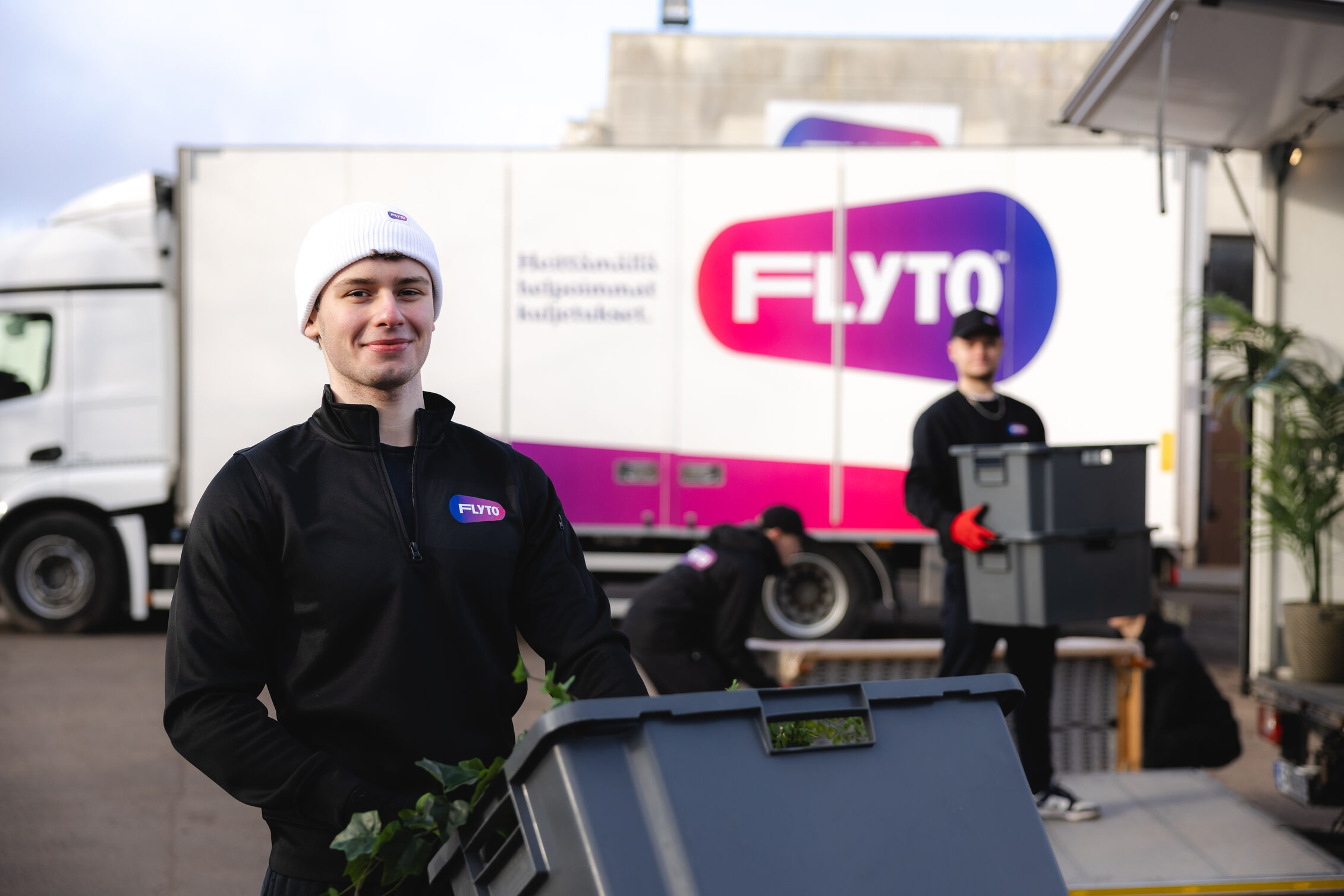
Flyto runs its own offices, warehouses, crews and vehicles across Northern, Central and Southern Europe, so the Finnish export leg — packing, Tulli export clearance, and trucking to HaminaKotka or Helsinki — is handled in-house end to end. For the ocean crossing and the Colombian import leg we work through a carefully vetted network of shipping lines and subcontracted partners, plus trusted local partners in Colombia who manage DIAN clearance, menaje doméstico paperwork and last-mile delivery, so you get one point of contact from your Finnish home to your new address in Colombia.
Frequently asked questions
Do I need a Colombian visa before I can ship my household goods? Effectively yes for the reduced-tax route: DIAN’s menaje doméstico relief requires certification that you’re taking up residence in Colombia, tied to a qualifying visa or returning-national status (DIAN; Cancillería).
Will I still owe Finnish tax after I move? Likely yes for a while. Finnish citizens generally remain fully tax-liable for the move year plus three more years under the three-year rule, unless they can show Vero that no substantial ties to Finland remain (Vero).
Can I bring my car? In practice, no. Colombia bars imports of used vehicles from any origin under a 1993 bilateral agreement, with only a narrow exception for non-commercial classic/antique cars; returning Colombian nationals should check directly with Cancillería and DIAN, since narrower exemptions can apply to that group (Cancillería).
How long does the shipment actually take? There’s no official transit time — plan on roughly 6–10 weeks door-to-door for sea freight from a Finnish port to Cartagena including transshipment and customs, based on typical freight-industry scheduling, with air freight taking days but adding its own customs processing.
Do I have to declare cash if I’m carrying savings with me? Yes, on both ends: €10,000+ leaving the EU needs a Tulli cash declaration, and USD 10,000+ entering or leaving Colombia needs DIAN Form 530 (Tulli/Suomi.fi; DIAN).
What about moving back from Colombia to Finland later? The process mirrors this guide: you’d notify DVV of your return, your goods would need to have been genuinely used abroad to qualify for Tulli’s duty-free "muuttotavarat" import relief into Finland, and any pet would need to meet Finland’s non-EU entry requirements (microchip, rabies vaccination, and possibly an antibody titre test depending on Colombia’s rabies-risk classification at the time) — check Ruokavirasto’s current country-specific rules before booking your return (Ruokavirasto; DVV). On departure from Colombia, pets need ICA’s exit paperwork rather than the entry rules above (ICA, salida de perros y gatos).
Sources
- Tulli — I am moving abroad
- Tulli — Export declaration for individuals
- Suomi.fi/Tulli — Ilmoitus käteisvaroista EU:n rajalla
- DVV — Muutto ulkomaille
- Vero — Tax residency, non-residency and residency in accordance with a tax treaty, natural persons
- Ruokavirasto — Lemmikkien vienti EU:n ulkopuolelle
- Ruokavirasto — Lemmikkieläinpassi
- HaminaKotka — Suurin yleissatama Suomessa
- Puerto de Cartagena / Sociedad Portuaria Regional de Cartagena — About
- Cancillería de Colombia — Tipos de visa en Colombia
- Cancillería de Colombia — ¿Por qué no se pueden importar vehículos usados a Colombia?
- DIAN — Menaje doméstico
- DIAN — Declaración de viajeros, Formulario 530
- ICA — Ingreso de perros y gatos a Colombia
- ICA — Salida de perros y gatos desde Colombia