

Moving from Spain to Colombia (2026): Complete Guide

Relocating from Spain to Colombia means closing out obligations with Spanish customs, tax and population-registration authorities on one end, and clearing Colombian immigration, customs (DIAN) and — if you’re bringing pets or a vehicle — agricultural and trade authorities on the other. This guide is for a Spain-based resident (Spanish national or foreign resident of Spain) moving household goods, pets and possibly a vehicle to Colombia, plus a short note on moving back the other way. It walks through both halves of the corridor in order: what you must do before you leave Spain, and what happens when your shipment and your paperwork land in Colombia.
Key takeaways
- Your Colombian immigration status determines your customs treatment: only people entering to establish residence — after 24 months (continuous or discontinuous) abroad in the prior 3 years — qualify for the duty-reduced "menaje doméstico" household-goods regime; everyone else is a standard commercial import (DIAN – Menaje doméstico).
- Any goods leaving the EU customs territory need a prior export declaration filed with Spain’s Agencia Tributaria (Aduanas) before departure (Agencia Tributaria – Régimen de exportación).
- Spanish nationals moving abroad do not need to deregister at their town hall first — you register at the destination consulate, which notifies Spain’s National Statistics Institute (INE) via the Padrón de Españoles Residentes en el Extranjero (PERE); foreign residents of Spain instead request a voluntary "baja" at their ayuntamiento (INE – PERE).
- Ending Spanish tax residency is communicated via Modelo 030; under Spain’s 183-day residency rule, leaving in the first half of the year and staying under 183 days in Spain that year backdates non-resident status to 1 January of that same year (Agencia Tributaria – Modelo 030).
- Carrying €10,000 or more in cash (or equivalent) out of Spain requires a prior Modelo S1 declaration to the Agencia Tributaria; undeclared cash can be seized (Agencia Tributaria – Declaración de medios de pago).
- Colombia’s household-goods import is taxed at a flat 15% ad valorem, must be declared under tariff heading 98.05.00.00.00, and must arrive between 1 month before and 4 months after you personally arrive (DIAN – ABC Importación Menaje Doméstico).
- Used vehicles cannot be imported into Colombia for ordinary residents — this is a near-blanket prohibition with only narrow exceptions (Cancillería – Por qué no se pueden importar vehículos usados).
- Entering or leaving Colombia with cash/negotiable instruments worth USD 10,000 or more requires Formulario 530 (DIAN – Declaración de viajeros Formulario 530).
1. Your immigration status decides your customs treatment
Colombia does not give a duty break to household goods just because they’re used and personal. DIAN’s "menaje doméstico" regime — import without a prior import registration or licence, at a single 15% ad valorem tax instead of ordinary import duties plus VAT — is reserved for people who have lived outside Colombia for at least 24 months, continuous or discontinuous, within the 3 years before arrival, and who are entering the country specifically to establish residence (DIAN – Menaje doméstico). That means your Colombian visa category matters before you book a single cubic metre of shipping: if you’re arriving on a short-stay visitor visa (Tipo V) rather than a migrant (Tipo M) or resident (Tipo R) visa, you won’t qualify for this regime and your shipment will be treated as a standard commercial import with full duties and VAT. Check your visa category against Colombia’s Ministry of Foreign Affairs classification before committing to a shipping date (Cancillería – Tipos de Visa).
2. The Spain export side
Customs authority. Exports from Spain fall under the Agencia Estatal de Administración Tributaria (Agencia Tributaria), specifically its Aduanas e Impuestos Especiales department. Any goods leaving the EU customs territory — Spain included — must be covered by a prior export declaration before they physically depart (Agencia Tributaria – Régimen de exportación), filed through the agency’s standard presentation and dispatch channels (Agencia Tributaria – Aduanas). For a household-goods shipment this is normally handled by your mover or its customs broker, but it’s a legal requirement, not optional paperwork.
Deregistration (padrón). Spanish nationals do not cancel their padrón entry at the ayuntamiento before leaving. Instead, once settled in Colombia you register at the Spanish consulate, which enters you in the Padrón de Españoles Residentes en el Extranjero (PERE); the consulate reports this to the INE via the Ministry of Foreign Affairs, which then notifies your municipality to process the "baja" automatically (INE – PERE). Foreign nationals registered on a Spanish municipal padrón do the reverse: request a voluntary baja directly at the town hall before leaving, and keep the historical padrón certificate — it’s often needed later to prove periods of Spanish residence.
Tax residency exit. You communicate a change of fiscal domicile using Modelo 030, normally within 3 months of the change (or when you file your next income tax return, if that deadline falls sooner), providing your DNI/NIE or passport and, where relevant, a tax-residency certificate from Colombian authorities (Agencia Tributaria – Modelo 030). Whether you count as a Spanish tax resident for the year, though, is governed separately by Spain’s 183-day rule: spend fewer than 183 days in Spain in a year and you’re a non-resident for IRPF purposes; if you leave in the first half of the year and stay under 183 days, that non-resident status is backdated to 1 January of that same year, whereas leaving after spending more than 183 days in Spain pushes non-residency to 1 January of the following year (Agencia Tributaria – Persona física residente en España).
Cash. If you or your household are carrying €10,000 or more in cash, bearer cheques or equivalent instruments out of Spain, you must file Modelo S1 with the Agencia Tributaria before crossing the border; failure to declare, or giving incomplete information, can lead to provisional seizure of the funds (Agencia Tributaria – Declaración de medios de pago). Bank transfers are not subject to this declaration, regardless of amount.
3. Ports, airports and transit — realistic estimates, not official figures
Spain’s main container gateways for an intercontinental household-goods shipment are the ports of Valencia, Algeciras and Barcelona, with Bilbao sometimes used for northern-Spain origins. On the Colombian side, sea freight typically clears through Cartagena, Buenaventura, Barranquilla or Santa Marta, depending on which coast is closer to your final destination (Bogotá, Medellín and the interior are usually routed via Cartagena). Air freight and accompanied baggage move through Madrid-Barajas (MAD) into Bogotá El Dorado (BOG) or another Colombian international airport.
These are freight-industry planning estimates, not official figures: sea freight from a Spanish Mediterranean port to a Colombian Caribbean port typically runs 4-6 weeks port-to-port (add 1-3 weeks for inland trucking and clearance at each end); airfreight typically transits 3-10 days door-to-door. Actual transit depends on carrier schedules, consolidation, and how quickly your paperwork clears DIAN.
4. The Colombia import side
Once your immigration status qualifies you (see Section 1), the operative DIAN form is the menaje doméstico declaration. Key rules straight from DIAN’s own guidance:
- You must have lived outside Colombia for at least 24 months (continuous or discontinuous) within the 3 years immediately before entering to establish residence.
- Goods are taxed at a flat 15% ad valorem in place of ordinary import duties and VAT, and are classified under tariff subheading 98.05.00.00.00.
- Your shipment must arrive within a window from 1 month before to 4 months after your own arrival date in Colombia.
- Items must have been acquired while you resided abroad and must originate from the country you were living in.
- Once you’ve imported a menaje, DIAN’s rules restrict a further menaje import for a period of years afterward — confirm the current waiting period with your customs broker or DIAN directly before assuming you can repeat the process on a later move.
(Source for all of the above: DIAN – ABC Importación Menaje Doméstico and DIAN – Menaje doméstico.) Plan your visa approval date and shipping schedule together — book too early or too late relative to your own arrival and the shipment falls outside the eligible window.
Separately, cash and negotiable instruments worth USD 10,000 or more entering or leaving Colombia must be declared to customs via Formulario 530 ("Declaración de Equipaje, de Dinero en Efectivo y de Títulos Representativos de Dinero – Viajeros"), presented before passing through immigration control; a related Formulario 532 covers cash transported by authorised non-traveller companies (DIAN – Formulario 530).
Visa and registration. The relevant visa categories run from short-stay Visitor (Tipo V) through Migrant (Tipo M) to permanent Resident (Tipo R) (Cancillería – Tipos de Visa). The Tipo R resident visa is valid 5 years, renewable, lets you work without a separate work permit, and is generally reached after 5 continuous years holding a Tipo M visa — or after just 2 continuous years if your Tipo M visa was held as the spouse or permanent partner of a Colombian national; it is lost automatically if you’re absent from Colombia for 2 consecutive uninterrupted years (Cancillería – Visa de Residente Tipo R). Once you have a visa authorising a stay of more than 3 months, you must apply for your cédula de extranjería with Migración Colombia within 15 calendar days of entering the country or of visa issuance; missing the deadline can trigger fines of up to 7 monthly minimum wages (SMMLV) (Migración Colombia – Trámite de cédula de extranjería).
5. Pets
Leaving Spain (export side). Spain’s Ministerio de Agricultura, Pesca y Alimentación (MAPA) requires your vet to request an official export health certificate through the CEXGAN system; you arrange this with the Animal Health Service of your province, or the veterinary service at the airport/port of departure. Requirements for entering Colombia specifically are set by Colombia’s authorities, not Spain’s, so MAPA’s own guidance directs owners to check the destination country’s rules before travelling (MAPA – Viajar con perros, gatos y hurones).
Entering Colombia (import side). Colombia’s Instituto Colombiano Agropecuario (ICA) sets the entry requirements for dogs and cats. In outline: an official sanitary certificate from the country of origin (valid up to 10 days, based on a clinical exam carried out within 8 days of embarkation) confirming the animal is free of infectious and parasitic disease; internal and external deworming within the 60 days before travel; a rabies vaccination given at least 21 days before travel if it’s the animal’s first dose; and, on arrival, a separate veterinary certificate no older than 3 days presented to ICA for document review and physical inspection at the port of entry (ICA – Ingreso de perros y gatos a Colombia). Note also that Colombian law (Ley 746 de 2002, art. 108-E) bans the import of certain dog breeds — including the Staffordshire terrier, American Staffordshire terrier, Pit Bull Terrier, American Pit Bull Terrier and their crosses or hybrids — so check your breed’s status before booking travel.
6. Vehicles, money, and what people forget
Vehicles. Importing your own used car is not a realistic option. Under the Andean Community’s Convenio de Complementación en el Sector Automotor (in force since 2000), member countries — Colombia among them — agreed to authorise only the import of new vehicles, of the current model year or the following one; used vehicles are excluded from ordinary import regardless of country of origin. The narrow exceptions that remain are classic/collector cars over 35 years old and vehicles brought in under diplomatic privileges (Cancillería – vehículos usados). Plan to sell or store your car in Spain.
Money. Both ends of this corridor have a cash-declaration threshold, and they are not the same currency or amount to remember: €10,000 leaving Spain via Modelo S1, and USD 10,000 entering or leaving Colombia via Formulario 530 (see Sections 2 and 4). Wire transfers avoid the cash-declaration process entirely and are the more practical route for larger sums.
What people forget. The two most common gaps: (1) not lining up the Colombian visa approval and the menaje shipping schedule, which can push a shipment outside the 1-month-before/4-months-after eligibility window and convert it into a full commercial import at standard duty and VAT rates; and (2) assuming a car, a large amount of cash, or a banned dog breed can simply travel with the rest of the household — each of those has a hard rule attached, covered above.
How Flyto handles your Spain to Colombia move
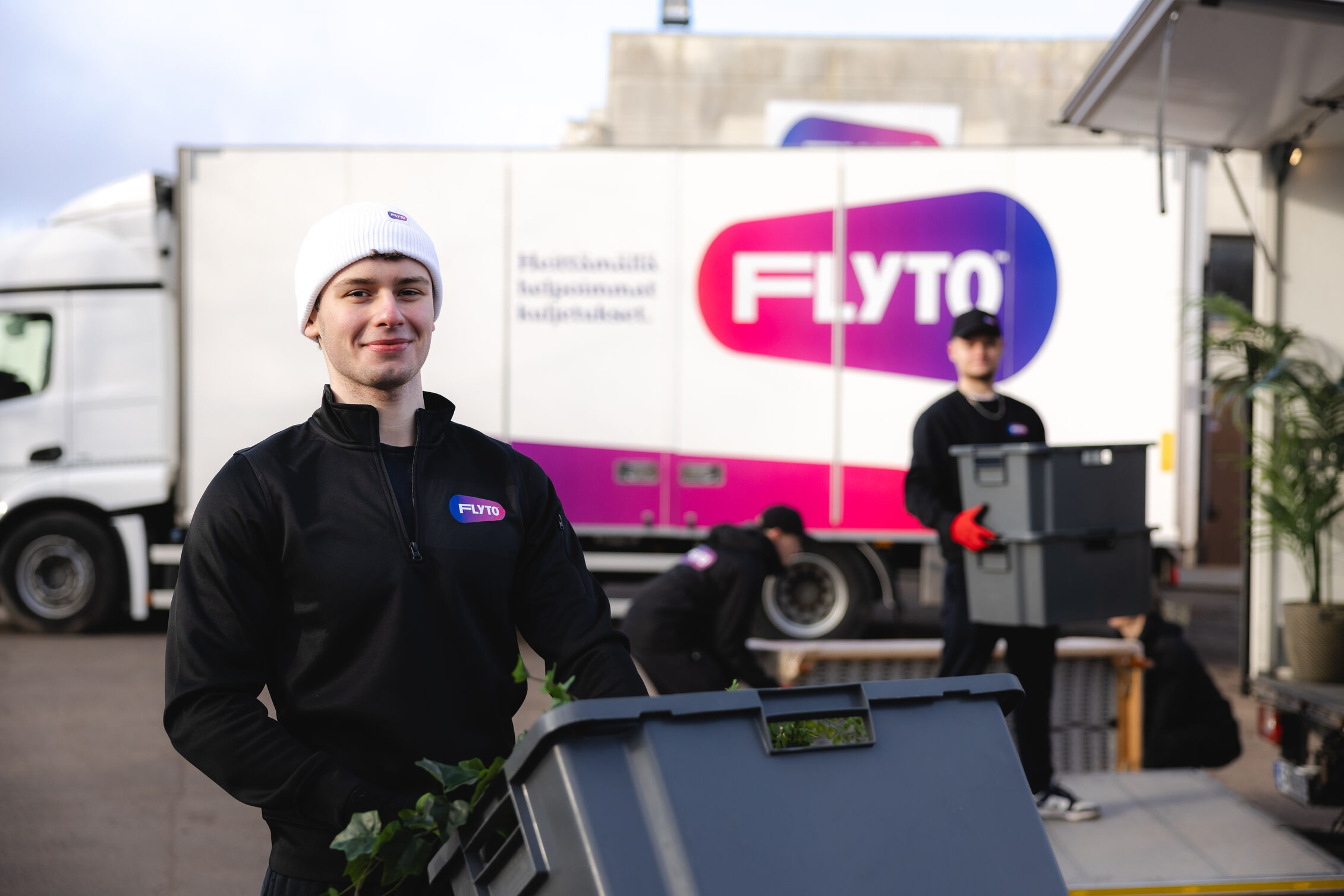
Flyto runs its own offices, warehouses, teams and vehicles across Northern, Central and Southern Europe, so the Spain side of your move — packing, export documentation, and getting your shipment to the port or airport — is handled by our in-house European operation. For the ocean or air leg and the Colombian side, we work with a carefully chosen network of freight partners and subcontractors, and, on the ground in Colombia, trusted local partners who handle DIAN clearance and last-mile delivery — so you get one point of contact managing both halves of the move, backed by our own infrastructure in Europe and vetted partners for the leg no single mover can run entirely in-house.
Frequently asked questions
Do I need to deregister from my Spanish town hall before moving to Colombia?
Only if you’re a foreign national registered on a Spanish padrón — you request a voluntary baja. Spanish nationals instead register at the Colombian consulate after arrival, which triggers the baja automatically through the INE (INE – PERE).
How much tax will I pay importing my household goods into Colombia?
If you qualify for the menaje doméstico regime (24 months abroad in the prior 3 years, entering to establish residence), a flat 15% ad valorem applies instead of standard duties and VAT (DIAN – ABC Importación Menaje Doméstico).
Can I bring my car with me?
Generally no — Colombia does not authorise import of used vehicles for ordinary residents; only new current/next-model-year vehicles, classic cars over 35 years old, or diplomatically-privileged vehicles qualify (Cancillería – vehículos usados).
When does my Spanish tax residency officially end?
You communicate the change via Modelo 030, but the effective date for tax purposes follows the 183-day rule: leave in the first half of the year and stay under 183 days, and non-residency can be backdated to 1 January of that same year (Agencia Tributaria – Modelo 030; Agencia Tributaria – Persona física residente en España).
How long do I have to get my Colombian ID card after arrival?
15 calendar days from entry or from visa issuance to apply for your cédula de extranjería with Migración Colombia, if your visa authorises a stay of more than 3 months (Migración Colombia – Trámite de cédula de extranjería).
What if I’m moving back from Colombia to Spain later?
Spain has a mirror-image franchise for people transferring their habitual residence into Spain: you must have lived outside the EU customs territory for at least 12 consecutive months, have owned/used your personal property for at least 6 months, and the duty/VAT exemption is requested directly through the Spanish customs office of entry, or the customs office nearest your new home (Agencia Tributaria – Traslado de residencia).
Sources
- Agencia Tributaria – Régimen de exportación
- Agencia Tributaria – Aduanas
- Agencia Tributaria – Traslado de residencia. Franquicias y exención de impuestos
- Agencia Tributaria – Modelo 030 (cambio de domicilio fiscal)
- Agencia Tributaria – Persona física residente en España (regla de los 183 días)
- Agencia Tributaria – Declaración de medios de pago (Modelo S1)
- INE – Padrón de Españoles Residentes en el Extranjero (PERE)
- MAPA – Viajar con perros, gatos y hurones
- DIAN – Menaje doméstico
- DIAN – ABC Importación Menaje Doméstico (PDF)
- DIAN – Declaración de viajeros, Formulario 530
- Cancillería (Ministerio de Relaciones Exteriores de Colombia) – Tipos de Visa
- Cancillería – Visa de Residente (Tipo R)
- Migración Colombia – Trámite de cédula de extranjería
- ICA – Ingreso de perros y gatos a Colombia
- Cancillería – Por qué no se pueden importar vehículos usados a Colombia