

Moving from Estonia to Colombia (2026): Complete Guide

Estonia to Colombia is a long, two-continent corridor: an EU exit process on one end, a South American customs and immigration process on the other, with weeks of ocean freight in between. This guide walks an Estonian resident through both halves of the move — deregistering and exporting from Estonia, then clearing customs and settling in Colombia — plus a short note on moving the other way, from Colombia back to Estonia. It is written for people relocating their household, not for short-term travellers or commercial shippers.
Key takeaways
- Your Colombian immigration status matters for customs: the household-goods import regime is for people entering Colombia to establish residence, not tourists — visa categories are set by Colombia’s Ministry of Foreign Affairs (Cancillería).
- Leaving Estonia legally means filing a notice of residence abroad with your local government within 30 days of relocating, per the Ministry of the Interior.
- Estonian tax residency does not end automatically — you must actively notify the Estonian Tax and Customs Board (EMTA) using Form R, or you stay liable for worldwide income tax.
- Goods of a commercial nature worth over €1,000 or weighing over 1,000 kg need a formal written export customs declaration when leaving the EU via Estonia, per EMTA.
- Colombia’s household-goods relief ("menaje doméstico") requires having lived abroad 24 months (continuous or accumulated) in the preceding 3 years, and charges a flat 15% tax on the declared value, per DIAN.
- Cash or monetary instruments over USD 10,000 must be declared on arrival in Colombia using Form 530, per DIAN.
- Used vehicles cannot be permanently imported into Colombia, under the Andean automotive agreement, per Cancillería.
- Pets need an ICA Sanitary Inspection Certificate to enter Colombia and equivalent EU-exit health documentation to leave Estonia, per ICA and Estonia’s Agriculture and Food Board.
1. Your immigration status decides your customs treatment
Colombia does not give household-goods relief to visitors. The tax-advantaged "menaje doméstico" regime is for people who enter Colombian territory to establish residence there — in practice this means holding an M (Migrante) or R (Residente) visa, or being a Colombian citizen returning after time abroad, rather than a tourist V (Visitante) visa. Colombia’s three visa families are set out by the Ministry of Foreign Affairs (Cancillería): the V (Visitante) visa for tourism, business and short stays; the M (Migrante) visa for people establishing themselves medium-term (work, self-employment, family ties, students); and the R (Residente) visa for permanent settlement. Because your immigration status when you arrive affects your customs options, settle your M or R visa before your shipment departs Estonia — a shipment can arrive at a Colombian port only 1 month before you personally enter the country, so the visa needs to be in hand well ahead of that window, per DIAN’s household-goods rules.
2. The Estonia export side
Customs authority. All export declarations and customs matters in Estonia are handled by the Estonian Tax and Customs Board (Maksu- ja Tolliamet, EMTA). Its guidance for people relocating out of the EU is published at emta.ee — Moving away from Estonia.
Declaring your shipment. Ordinary household effects being carried as personal baggage when leaving the EU via Estonia can be declared orally or simply by using the green "nothing to declare" channel. But once goods are of a commercial nature and exceed €1,000 in value or 1,000 kg in quantity — which typically covers a freight-forwarded household shipment — a formal written export customs declaration is required. Items needing special export authorisation (cultural property, for example) must always be declared regardless of value, per EMTA. EMTA also publishes general guidance on declaring goods when travelling at emta.ee — Declaration of goods.
Deregistering your address. The formal step that tells the Estonian state you have left is a notice of residence (elukohateade) filed with your local government. When relocating abroad you have 30 days to submit it — either in person or by post before leaving, or afterwards through an Estonian embassy, honorary consul, or the Ministry of Foreign Affairs, which forwards it to the population register. Full instructions are on the Ministry of the Interior’s site.
Ending your tax residency. Address deregistration and tax residency are two separate processes. Under Estonia’s Income Tax Act, as administered by EMTA, your unlimited Estonian tax liability does not lapse automatically just because you move — you must file Form R (application for determination of residency), through e-MTA, by email, or in person at a service bureau, to have EMTA formally confirm the change in your status. Details are at EMTA — Determining residency and the general EMTA — Tax residency page.
3. Ports and transit — realistic routing
The real ports handling Estonian export cargo are the Port of Tallinn‘s terminals: the container terminal at Muuga Harbour (three berths, an annual capacity in the range of 600,000 TEU depending on the source, with an adjoining free zone for customs-flexible logistics) and the ro-ro/multipurpose terminal at Paldiski South Harbour, per the Port of Tallinn. For a Colombia move, cargo typically leaves via one of two routes: containerised via Muuga onto a feeder or direct deep-sea service, or trucked to a major Northern European hub (Hamburg, Rotterdam, Antwerp) for a more frequent direct sailing to Colombia. On the Colombian side, the main receiving ports are Cartagena (Caribbean coast, the primary container gateway) and Buenaventura (Pacific coast).
Freight-industry estimate, not an official figure: sea freight transit on this corridor typically runs 6–10 weeks door-to-door once pickup, consolidation, ocean transit and Colombian customs clearance are all included; air freight for smaller shipments typically takes 1–3 weeks. These are indicative planning ranges from the moving industry, not published transit guarantees from any port or customs authority — always confirm current transit times with your forwarder.
4. The Colombia import side
The regime. Colombia’s household-goods relief is called menaje doméstico, administered by DIAN (Dirección de Impuestos y Aduanas Nacionales, the national tax and customs directorate). To qualify, you must have lived outside Colombia for at least 24 months, continuous or accumulated, during the 3 years immediately before arrival, and you must be entering to establish residence (matching your visa status from Section 1). Full official rules are at DIAN — Menaje doméstico and the detailed ABC guide (PDF).
Tax. Qualifying menaje doméstico is not duty-free — it is subject to a single flat tax of 15% of the declared value, rather than Colombia’s normal itemised import duties and VAT, and it does not require a separate import licence or registration, per DIAN.
Timing. Your shipment can arrive at a Colombian port no earlier than 1 month before, and no later than 4 months after, your own personal arrival date. Only one household shipment per family unit is allowed, cleared through a single customs point, per DIAN.
Smaller shipments. If you don’t meet the 24-month test, or your shipment is modest, the "unaccompanied baggage" (equipaje no acompañado) modality allows household, sport, or professional items up to a combined USD 3,000 in value, taxed at the same flat 15%, for travellers who have been outside Colombia at least 5 days, per DIAN — Modalidad de viajeros.
Money. Anyone entering (or leaving) Colombia carrying cash or monetary instruments over USD 10,000 (or equivalent) must file Form 530 — "Declaración de Equipaje, de Dinero en Efectivo y de Títulos Representativos de Dinero" — with customs, one form per family group, per DIAN — Formulario 530.
5. Pets
Leaving Estonia. Estonia’s Agriculture and Food Board (Põllumajandus- ja Toiduamet, PTA) sets EU pet-travel rules. Dogs, cats and ferrets must be microchipped before rabies vaccination, at least 21 days must pass after a first-time rabies vaccination before travel, and — since Colombia is outside the EU — an official veterinary health certificate issued or verified within the required pre-travel window is needed rather than the standard EU pet passport used for intra-EU moves. Details: PTA — Travelling with a pet.
Entering Colombia. The Instituto Colombiano Agropecuario (ICA) requires a Certificado de Inspección Sanitaria (CIS), issued after document review and physical inspection at the port of entry. You need an original sanitary certificate from the origin country’s official veterinary authority, valid for a maximum of 10 calendar days, confirming a clinical exam within 8 days before boarding, that the animal is free of infectious/parasitic disease, and is fit to travel, plus rabies immunity (with at least 21 days since a first-time rabies vaccination) and a 15-digit microchip ID. Full requirements: ICA — Ingreso de perros y gatos a Colombia.
6. Vehicles, money, and things people forget
Vehicles. Do not plan to ship your car. Under the Andean Community’s automotive complementation agreement, participating countries — including Colombia — only authorise the permanent import of new vehicles of the current or following model year; used-vehicle imports are not permitted on a permanent basis, with narrow exceptions for certified classic/antique cars and temporary imports. This is confirmed by Colombia’s Cancillería. Sell or store your car in Estonia rather than shipping it.
Money. Beyond the USD 10,000 Form 530 threshold on entry to Colombia (Section 4), also budget for the 15% menaje tax itself, which is payable before goods are released — plan liquidity for this in advance since it is charged on the full declared value, not just duty on an excess.
What people forget:
- The 24-month "lived abroad" clock for menaje doméstico is checked against your entry stamps/visa history — keep proof of your Estonian residence period.
- Your Colombian menaje declaration and your Estonian export declaration should list matching, itemised goods — mismatches slow down DIAN clearance.
- Deregistering your Estonian address (Section 2) and closing Estonian tax residency (Form R) are two separate filings — doing one does not do the other.
- Insurance for high-value items in transit is not automatic with standard freight contracts; confirm marine cargo insurance separately.
How Flyto handles your Estonia to Colombia move
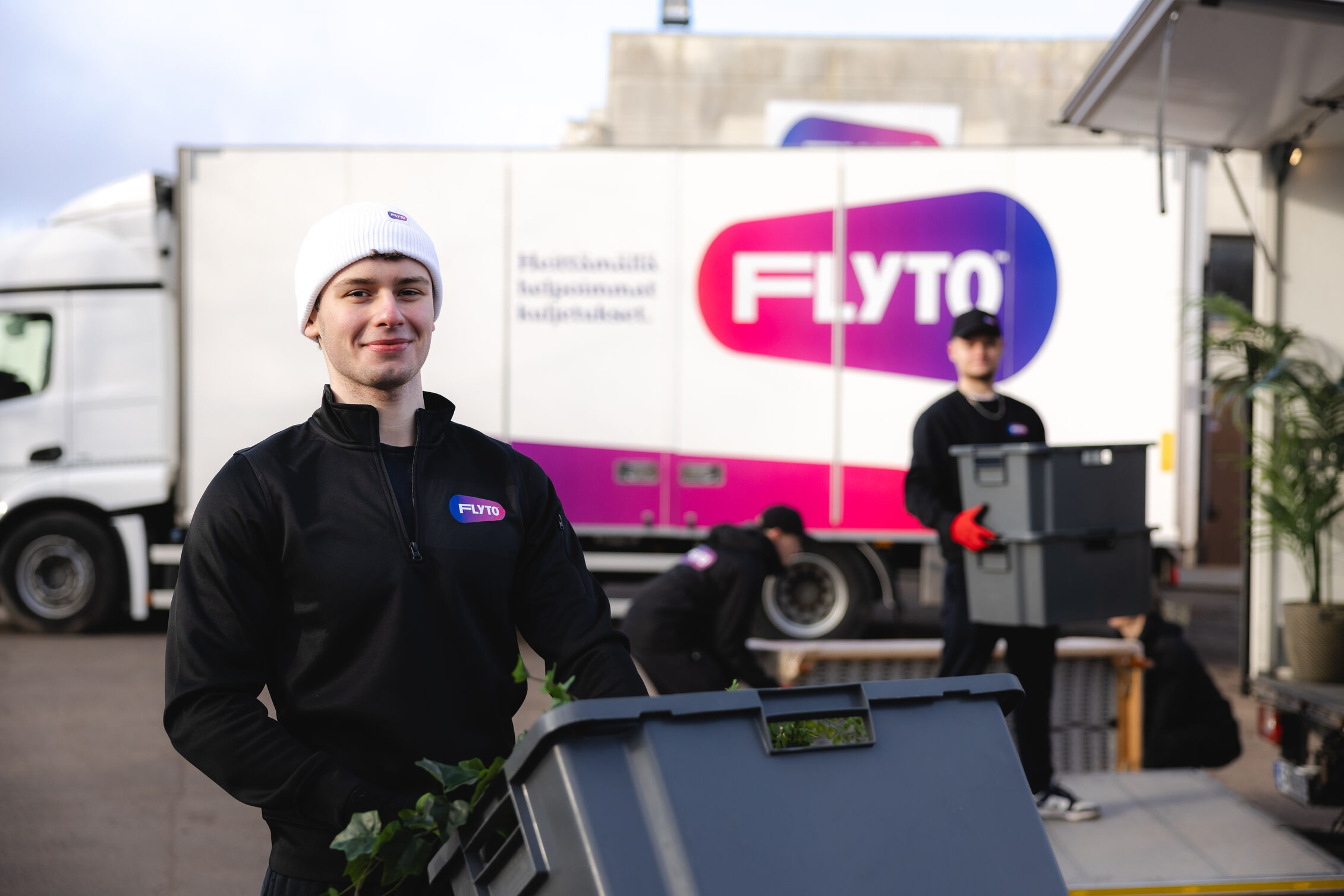
Flyto runs its own offices, warehouses, vehicles and moving teams across Northern, Central and Southern Europe, so the Estonian pickup, EU export paperwork and consolidation are handled directly by our in-house operation rather than handed off blind. For the ocean leg and the Colombian side, we work through a carefully vetted network of freight partners and trusted local agents in Colombia who handle DIAN clearance, menaje doméstico filing and final delivery — giving you one point of contact for a move we don’t claim to run end-to-end on our own equipment, but do actively manage at every handoff.
Frequently asked questions
Do I need a Colombian visa before I can import my household goods?
You need to be entering to establish residence, not visit — in practice this means holding an M or R visa rather than a tourist (V) visa, per Cancillería and DIAN.
What happens if I don’t file Estonia’s notice of residence?
You remain on the Estonian population register at your old address, which can complicate closing your Estonian tax residency and other official matters; the filing is required within 30 days of moving abroad, per the Ministry of the Interior.
Can I bring my car to Colombia?
No — permanent used-vehicle imports are not authorised under the Andean automotive agreement regardless of your visa or residency status, per Cancillería.
How much tax will I pay on my household shipment?
A flat 15% of the declared value under the menaje doméstico regime, rather than itemised Colombian import duty, per DIAN.
What if I haven’t lived abroad for 24 months?
You won’t qualify for menaje doméstico, but you can bring goods under the unaccompanied-baggage modality, up to a combined USD 3,000 in value, still taxed at 15%, per DIAN.
Moving back from Colombia to Estonia — is it different?
Yes, and simpler on the Estonian side: Estonia grants relief from import duty on personal property to anyone transferring their normal residence back from outside the EU, provided you lived outside the EU continuously for at least 12 months and owned the goods for at least 6 months before the move, under Council Regulation (EC) No 1186/2009, per EMTA — Moving to Estonia. On departure from Colombia, pets need an ICA exit sanitary certificate, per ICA — Salida de perros y gatos desde Colombia.
Sources
- EMTA — Moving away from Estonia
- EMTA — Moving to Estonia
- EMTA — Declaration of goods
- EMTA — Tax residency
- EMTA — Determining residency
- Estonian Ministry of the Interior — Submission of a notice of residence
- Estonian Agriculture and Food Board (PTA) — Travelling with a pet
- Port of Tallinn — Muuga Harbour
- DIAN — Menaje doméstico
- DIAN — ABC para la Importación de Menaje Doméstico (PDF)
- DIAN — Modalidad de viajeros (unaccompanied baggage)
- DIAN — Formulario 530, Declaración de viajeros
- Colombia Cancillería — Classes or categories of visas in Colombia
- Colombia Cancillería — Why used vehicles cannot be imported
- ICA — Ingreso de perros y gatos a Colombia
- ICA — Salida de perros y gatos desde Colombia