

Moving from Poland to Colombia (2026): Complete Guide

Poland–Colombia relocations are a long, two-continent corridor: an EU export out of a Baltic port or a Central European airport, several weeks of ocean transit (or a day of air freight), and a South American import governed by rules that hinge on your immigration status. This guide is written for a resident of Poland — Polish national or foreign resident registered in Poland — planning a household move to Colombia. It covers the Polish exit formalities (deregistration, customs export declaration, tax-residency exit), the Colombian entry side (visa-linked customs treatment, the household-goods declaration, pets, vehicles, and cash), and closes with a short note on the reverse move, Colombia back to Poland.
Key takeaways
- Your Colombian customs treatment for household goods depends on your immigration status: only people entering to establish residence (with the required prior time abroad) qualify for the single 15% "menaje doméstico" duty; the visa route matters before the shipment does — DIAN, Menaje doméstico.
- Leaving Poland for more than 6 months requires reporting your departure ("zgłoszenie wyjazdu za granicę") to your municipality or online via gov.pl — gov.pl, Zgłoś wyjazd za granicę.
- Goods leaving the EU customs territory from Poland need an export declaration (AES/ECS2) filed through the Polish customs platform PUESC, run by Krajowa Administracja Skarbowa (KAS) — PUESC, Złóż wywozowe zgłoszenie celne.
- Moving your center of life abroad ends Polish unlimited tax liability; you must notify your tax office of the change so you are taxed only on Polish-source income going forward — Biznes.gov.pl, Gdzie płacić podatki od dochodów zagranicznych.
- Colombian household goods must land 1 month before to 4 months after your own arrival, and must be legalized with DIAN within 2 months of arrival or DIAN can treat them as forfeited to the State — DIAN, ABC Importación Menaje Doméstico (PDF).
- Carrying more than €10,000 in cash across the Polish/EU border requires a written or PUESC e-declaration to Polish Customs or Border Guard — Straż Graniczna, Przewóz środków pieniężnych; the equivalent threshold entering or leaving Colombia is USD 10,000, declared on DIAN Form 530 — DIAN, Declaración de viajeros Formulario 530.
- Used cars generally cannot be imported into Colombia at all — plan to sell your car in Poland rather than ship it — Cancillería de Colombia, ¿Por qué no se pueden importar vehículos usados?.
- Dogs and cats need a sanitary certificate and, for animals identified by microchip, ICA inspection at the port of entry to receive a Certificado de Inspección Sanitaria (CIS) before clearing into Colombia — ICA, Ingreso de perros y gatos a Colombia.
1. Immigration status decides your customs treatment
Colombian customs law does not treat "moving your household goods" as a generic activity — it is a benefit tied to your migratory status. DIAN’s own definition of who may import menaje doméstico under the favourable single 15% ad valorem rate is a "resident abroad": someone who has lived outside Colombia for at least 24 continuous or discontinuous months within the 3 years before arrival, and who is entering the country to establish residence there (DIAN, Menaje doméstico). In practice this means the relevant Colombian visa category — a Migrante (M) visa tied to work, investment, pension, or family, or a Residente (R) visa — has to be settled, or at least in process with a clear residence intent, before your shipment’s customs clearance, because the customs officer needs to see that you qualify as someone relocating, not a tourist bringing in goods. Colombia’s visa framework (Visitante/V, Migrante/M, Residente/R) is set out by the Ministry of Foreign Affairs — Cancillería, Tipos de visas en Colombia. Sort your visa route first; it determines which customs door your container goes through.
2. The Poland export side
Deregistration. Any person leaving Poland’s permanent or temporary address for longer than 6 months must report the departure ("zgłoszenie wyjazdu za granicę"). It can be filed online via a gov.pl account, or in person at your local urząd gminy/miasta; reporting a permanent departure automatically closes your registration at that address, and there is no fee — gov.pl, Zgłoś wyjazd za granicę.
Customs authority and export declaration. Poland’s customs and tax administration is Krajowa Administracja Skarbowa (KAS). Any consignment of household goods leaving the EU customs territory from Poland by sea or air freight requires an export declaration filed in the AES/ECS2 system, accessed through KAS’s electronic platform PUESC (Platforma Usług Elektronicznych Skarbowo-Celnych) — PUESC, Złóż wywozowe zgłoszenie celne. In a professional relocation this filing is normally done by your moving company or its customs broker on your behalf, using an inventory and value list of the shipment; there is no fixed universal value or weight threshold below which the declaration itself is skipped — it depends on the goods, mode of transport and whether the shipment moves under a commercial or private "used household goods" declaration, which your mover’s broker should confirm at booking.
Tax residency exit. Poland taxes residents on worldwide income ("nieograniczony obowiązek podatkowy"). You stop being a Polish tax resident once your center of personal and economic interests (or your habitual presence, under the 183-day test) moves abroad — moving with your whole household to Colombia is normally sufficient, while moving alone and leaving a spouse and children in Poland usually is not. You must inform your Polish tax office of the change of residence — Biznes.gov.pl, Gdzie płacić podatki od dochodów zagranicznych.
Cash. If you or your household are carrying more than €10,000 in cash or its equivalent across the Polish border (an EU external border for this purpose, since Colombia is outside the EU), you must declare it in writing to Polish Customs or Border Guard, or pre-file electronically via PUESC — Straż Graniczna, Przewóz środków pieniężnych.
3. Ports and transit — realistic estimates, not official figures
Poland’s container exports to South America typically route through the Baltic deep-water terminals at Gdańsk (notably the Baltic Hub Container Terminal, formerly branded DCT Gdańsk) and Gdynia, both of which run regular container-line connections to global hub ports — Port of Gdynia, official site. From there, freight-industry practice (not an official published schedule) is:
- Sea freight (FCL/LCL), Gdańsk/Gdynia → Colombian port (Cartagena or Buenaventura, via a European or transatlantic hub): roughly 5–8 weeks door-to-port, depending on transshipment routing — this is an industry planning estimate, not a carrier guarantee.
- Air freight, Warsaw Chopin (WAW) → Bogotá (BOG): typically 3–7 days door-to-door for urgent household items, again an estimate that varies with carrier and customs dwell time at both ends.
Build in buffer at both ends: Colombian customs legalization has a hard 2-month deadline from arrival of the goods (see Section 4), so sea-freight timing should be planned backward from your own arrival date, not the other way around.
4. The Colombia import side
Once your goods and your own arrival are aligned with your visa status, the operative Colombian customs process is:
- Who qualifies: a "resident abroad" per DIAN’s definition (≥24 months abroad within the last 3 years) entering Colombia to establish residence, importing one household-goods set per family unit, through a single customs office — DIAN, ABC Importación Menaje Doméstico (PDF).
- Tax: a single 15% ad valorem tax on the household goods, no separate import license or registration required — DIAN, Menaje doméstico.
- Timing window: goods must arrive in Colombia between 1 month before and 4 months after your own arrival date; the shipment must be consigned in your name and cannot be declared before you yourself have entered the country.
- Legalization deadline: you have 2 months from the goods’ arrival to file the legalization declaration with DIAN, or the goods can be treated as abandoned property of the Colombian state — DIAN, ABC Importación Menaje Doméstico (PDF).
- Cash on arrival: amounts over USD 10,000 (or equivalent) carried as a traveler must be declared on DIAN’s Formulario 530, requested from your airline or at the port/airport of entry — DIAN, Declaración de viajeros Formulario 530.
5. Pets
Leaving Poland. Poland’s Główny Inspektorat Weterynarii (GIW, Main Veterinary Inspectorate) sets the rules for taking dogs, cats and ferrets out of the EU: your pet needs an EU pet passport (issued by an authorised vet) confirming microchip identification and a valid rabies vaccination, and — because Colombia is a non-EU destination — you should check Colombia’s specific entry health-certificate requirements before travel, since the EU passport alone does not satisfy the destination country — GIW, Podróż ze zwierzętami towarzyszącymi.
Entering Colombia. The Instituto Colombiano Agropecuario (ICA) requires an original sanitary certificate issued or endorsed by the official sanitary authority of the country of origin (in this case Poland/EU), dated no more than 10 days before the animal’s arrival, certifying species, breed, vaccination and deworming status, and the animal’s electronic identification (microchip) where it has one. ICA issues a Certificado de Inspección Sanitaria (CIS) after document review and physical inspection, and CIS issuance only happens at ICA offices located at Colombia’s international airports, seaports and border crossings — so your pet’s arrival point must be one with an ICA post — ICA, Ingreso de perros y gatos a Colombia.
6. Vehicles, money, and things people forget
Vehicles. Do not plan to ship your Polish car. Colombia’s Automotive Sector Complementation Agreement restricts vehicle imports to new vehicles of the current or following model year — used vehicles cannot generally be imported, including by returning residents bringing a car as part of household goods — Cancillería de Colombia, ¿Por qué no se pueden importar vehículos usados?. Sell or otherwise dispose of the car in Poland before departure.
Money. Both legs have a reporting threshold, not a prohibition: €10,000 leaving Poland/the EU (Straż Graniczna), USD 10,000 entering or leaving Colombia via Form 530 (DIAN). Declare, don’t avoid — undeclared cash above the threshold risks seizure at either border.
Things people forget: Colombia will not release or clear your menaje doméstico if it lands before you do, or after the 4-month window — coordinate the sailing date with your own flight, not the other way round. The 2-month DIAN legalization clock starts on the goods’ arrival, not on your arrival, so a delayed personal move after the shipment has landed eats into that window. On the Polish side, remember that closing your gov.pl registration and notifying your tax office are two separate administrative steps — one does not trigger the other automatically.
How Flyto handles your Poland to Colombia move
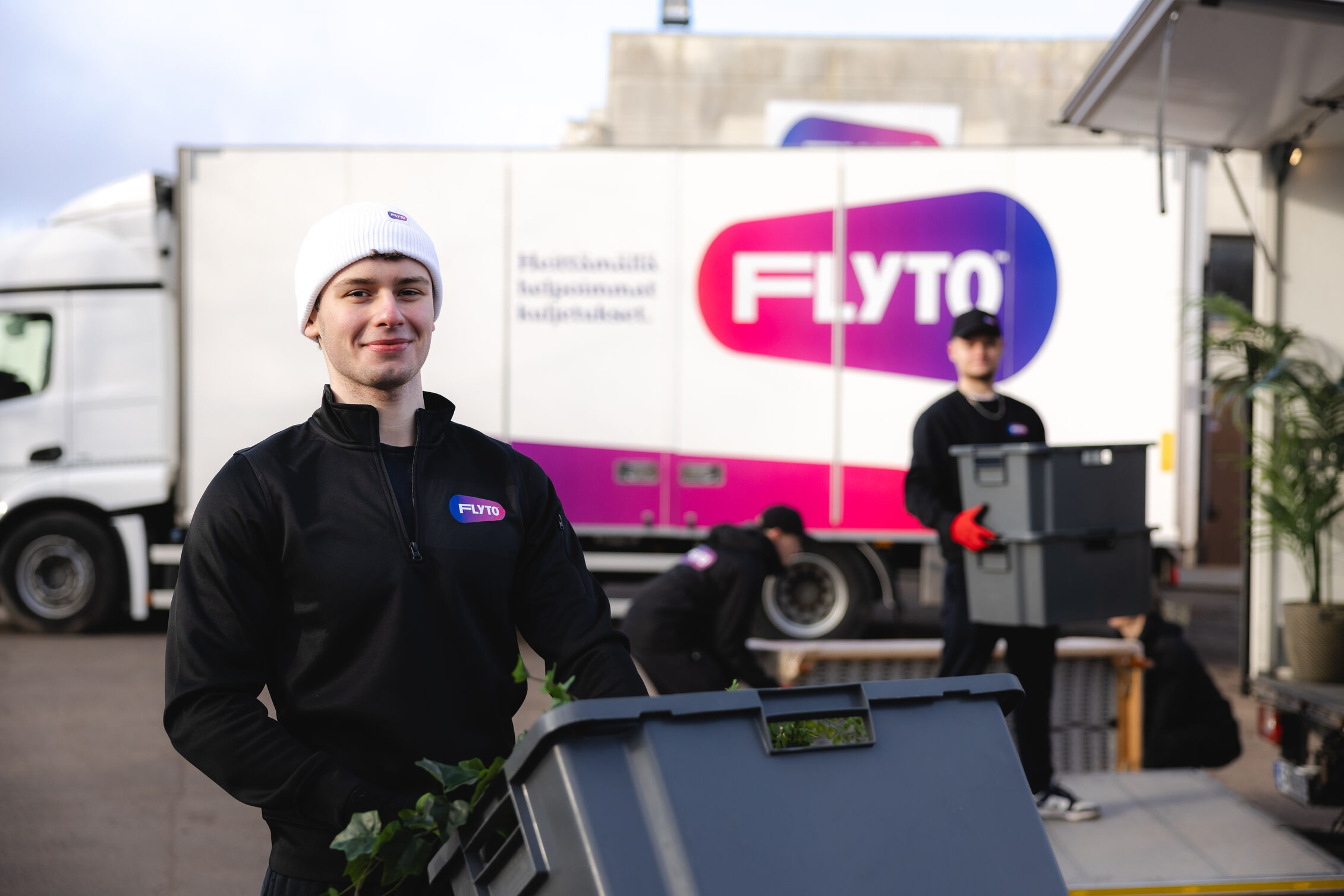
Flyto runs its own offices, warehouses, crews and vehicles across Northern, Central and Southern Europe, so the Polish collection, export customs paperwork through PUESC, and consolidation for ocean or air freight are handled by our in-house teams rather than handed off blind. For the ocean or air leg and for Colombian destination-country work — DIAN clearance, ICA pet formalities, final-mile delivery — we combine our own European network with a carefully vetted network of freight partners and, in Colombia, trusted local partners who handle the on-the-ground customs and delivery process under our coordination.
Frequently asked questions
Do I need a Colombian visa before I can bring my household goods in duty-reduced?
Yes in practice — the reduced 15% menaje doméstico rate is reserved for people entering to establish residence with the required prior time abroad, so your migratory situation (Migrante or Residente visa track) needs to support that status when the shipment clears — DIAN, Menaje doméstico.
Can my shipment arrive in Colombia before I do?
Yes, up to 1 month before your own arrival, but not before — and not more than 4 months after — per DIAN’s timing rule — DIAN, ABC Importación Menaje Doméstico (PDF).
What happens if I miss the DIAN legalization deadline?
DIAN can treat undeclared goods still sitting after 2 months from arrival as forfeited to the Colombian state, so this deadline should be treated as hard — DIAN, ABC Importación Menaje Doméstico (PDF).
Can I bring my car from Poland?
Practically no — Colombia’s vehicle-import rules limit imports to new vehicles of the current or following model year, so used personal vehicles generally cannot be imported, even as part of a household move — Cancillería, vehículos usados.
Do I still owe Polish tax after I move?
Only on Polish-source income, once your center of life has genuinely shifted to Colombia and you have notified your Polish tax office of the change — Biznes.gov.pl.
What about moving back from Colombia to Poland later?
Poland grants a customs duty exemption ("mienie przesiedlenia") for personal property brought back when transferring residence from outside the EU, provided you owned and used the goods for at least 6 months beforehand and can document at least 12 months of continuous residence abroad; the goods must not be sold or transferred for 12 months after import — Podatki.gov.pl, Mienie przesiedlenia – zwolnienie z cła.
Sources
- gov.pl — Zgłoś wyjazd za granicę
- PUESC (KAS) — Złóż wywozowe zgłoszenie celne i wykonaj inne obowiązki związane z wywozem towarów
- Biznes.gov.pl — Gdzie płacić podatki od dochodów zagranicznych
- Straż Graniczna (granica.gov.pl) — Przewóz przez granicę Polski (UE) środków pieniężnych
- Główny Inspektorat Weterynarii (wetgiw.gov.pl) — Przemieszczenia niehandlowe – podróż ze zwierzętami towarzyszącymi
- Podatki.gov.pl (KAS) — Mienie przesiedlenia – zwolnienie z cła
- Port of Gdynia — official site
- DIAN — Menaje doméstico
- DIAN — ABC para la Importación Menaje Doméstico (PDF)
- DIAN — Declaración de viajeros, Formulario 530
- Cancillería de Colombia — Tipos de visas en Colombia
- Cancillería de Colombia — ¿Por qué no se pueden importar vehículos usados a Colombia?
- ICA — Ingreso de perros y gatos a Colombia
- ICA — Requisitos para importar mascotas (perros y gatos)