

Moving to Boston from Abroad (2026): Complete Relocation Guide

Boston is where an unusually large share of the world’s academics, physicians, postdocs and biotech founders arrive from overseas. Greater Boston runs on universities and life sciences — Harvard, MIT, Boston University, Northeastern and a hospital-and-lab cluster in Cambridge’s Kendall Square that is one of the densest concentrations of biotech on earth — and that shapes who moves here and how. This guide covers the real mechanics of relocating to Boston from abroad in 2026: the visa routes that actually apply to researchers and specialists, how your household goods clear US customs and reach the Port of Boston, and the Massachusetts-specific traps around the state health mandate, taxes, driving and the notorious 1 September moving day. Every figure is drawn from an official source and linked inline.
Freshness note: verified in 2026 against USCIS, the US Department of State, CBP, USDA, the Massachusetts Department of Revenue, the Massachusetts RMV, the Massachusetts Health Connector, Massport, the MBTA and the City of Boston. US immigration rules and Massachusetts thresholds change — confirm the specific figure that applies to you on the linked authority before you rely on it. Flyto are international movers, not immigration or tax advisers; treat this as orientation and take professional advice before you file or ship.
Key takeaways
- Boston is an academia-and-biotech magnet, so the visa routes that matter most here are the H-1B specialty-occupation visa, the J-1 exchange visitor (research scholars and postdocs), the O-1 for people at the top of their field, the L-1 intracompany transfer, and the F-1 → OPT → H-1B student pipeline (USCIS).
- Your container arrives at Conley Terminal in South Boston — the only full-service container terminal in New England (Massport) — and air freight lands at Logan (BOS). Used household goods can enter duty-free on CBP Form 3299 (CBP).
- Massachusetts requires you to carry health insurance. The state’s individual mandate obliges most adults who can afford it to hold coverage meeting Minimum Creditable Coverage standards, or face a tax penalty (MA Health Connector; MA DOR TIR 26-1).
- Massachusetts income tax is a flat 5% from 1 January 2026, plus a 4% surtax on taxable income above $1,107,750 for 2026 (MA DOR; MA DOR — 4% surtax).
- Whether you can swap your foreign licence depends on your country. The RMV converts licences from a short reciprocity list (which includes Germany and South Korea); everyone else must pass the learner’s permit exam and road test (MA RMV).
- Roughly 70% of Boston leases begin on 1 September, producing a city-wide moving-day crush known locally as “Allston Christmas” — plan around it, and never book a truck onto Storrow Drive (City of Boston).
- No US credit history is a real barrier. Your European credit record does not transfer, so expect larger deposits and requests for a guarantor when renting (City of Boston).
1. Visas: the routes that actually apply in a university town
Boston’s demand for talent skews academic and scientific, so a handful of visa categories dominate. Flyto does not file immigration paperwork — that is work for you and a licensed US immigration attorney — but understanding which route applies helps you time the move. Our US visa pathways guide covers each in full; here is how they land in Boston.
H-1B — specialty occupation. The classic professional route for roles needing a degree in a specific field. It is capped at 65,000 plus 20,000 reserved for holders of a US master’s degree, and allocated by an annual electronic registration and lottery each spring (USCIS). A major 2026 planning point: a presidential proclamation issued 19 September 2025 imposed a one-time $100,000 payment on certain new H-1B petitions for beneficiaries entering from outside the US; per USCIS it does not apply to current H-1B holders or many change-of-status cases (USCIS). This is exactly the kind of fast-moving rule to confirm with counsel before assuming it does or does not affect you.
J-1 — exchange visitor (the postdoc and research-scholar route). This is the workhorse for Boston’s teaching hospitals and labs. The J-1 covers research scholars, professors, physicians and students on programmes sponsored by a designated institution, which issues Form DS-2019 (US Department of State). Watch one condition closely: some J-1 categories carry a two-year home-country physical-presence requirement before you can move to certain other statuses or a green card, unless you obtain a waiver (US Department of State). If a green card is your long game, factor this in from day one.
O-1 — extraordinary ability. For Europeans at the very top of the sciences, medicine or research — “sustained national or international acclaim.” There is no cap and no lottery, which makes it attractive to senior researchers and biotech founders who can document their achievements (USCIS).
L-1 — intracompany transfer. If you already work for a multinational with a US entity, the L-1 moves you to the US office after at least one continuous qualifying year abroad in the prior three. No lottery, dual intent permitted (USCIS). Common for pharma and tech groups with a Cambridge or Seaport footprint.
F-1 → OPT → H-1B — the student pipeline. This is the single most common long game in Boston, because the city graduates tens of thousands of international students each year. You study on an F-1 visa (US Department of State), then work under Optional Practical Training (OPT) — up to 12 months, extendable by a further 24 months for STEM degrees — and many then move to employer-sponsored H-1B or a green card (USCIS). Harvard, MIT and BU feed this pipeline directly into Kendall Square and the Longwood Medical Area.
Green cards. Permanent residence comes through employment (EB-1 for extraordinary ability and outstanding researchers, EB-2 including the National Interest Waiver, EB-3) or family sponsorship, and progress is governed by the monthly Visa Bulletin, which tells you when a visa number is actually available in your category (USCIS). Boston’s research base makes the EB-1B (outstanding researcher) and EB-2 National Interest Waiver especially relevant for academics.
Timing: ship your belongings only once your status and travel dates are confirmed, so your container does not dock before you can lawfully receive it.
2. Getting your household goods to the Port of Boston
Sea freight to Conley Terminal. International household shipments to Greater Boston clear through the Port of Boston’s Paul W. Conley Container Terminal in South Boston — the only full-service container terminal in New England, connecting the region to more than 30 ports globally and handling vessels in the 12,000–16,000 TEU range after a major modernisation (Massport). From Europe, a realistic door-to-door transit is roughly 4–8 weeks for a full container; from Asia, the Middle East or Australasia, longer — commonly 8–14 weeks once you account for consolidation, sailing, US customs clearance and final delivery. These are planning ranges, not guarantees.
FCL, LCL and lift vans. A full home usually travels as Full Container Load (FCL) in a 20ft unit (roughly 33 m³ usable, suiting a modest two-bedroom) or a 40ft unit (roughly 67 m³, for a larger family home). A smaller flat or a partial move goes as Less-than-Container-Load (LCL), consolidated with other shipments and billed by volume — economical for a studio or one-bedroom, but slower because it waits for consolidation. Our sea-vs-air shipping guide explains the trade-offs.
Air freight via Logan. For a faster subset of your belongings, international air cargo arrives at Boston Logan International (BOS), operated by Massport. Air is days rather than weeks but multiples more expensive per cubic metre, so it suits documents, laboratory or professional equipment you need on day one, and high-value items — not a whole home.
Customs is federal, and Boston does not change it. Massachusetts has no say over what you can import; your shipment clears through U.S. Customs and Border Protection. Used household goods and personal effects you owned and used abroad for at least a year can generally enter duty-free, declared on CBP Form 3299, Declaration for Free Entry of Unaccompanied Articles, with a detailed inventory (CBP Form 3299). Sea shipments also require an Importer Security Filing (“ISF 10+2”) transmitted to CBP at least 24 hours before the container is loaded in Europe (CBP). Our CBP Form 3299 walkthrough covers the paperwork in detail, and the whole corridor picture sits in our USA relocation hub.
USDA and restricted goods. There is no Australia-style quarantine, but the USDA and CBP restrict food, plants, seeds, soil and certain animal products, and any wooden packing material must be ISPM 15 heat-treated or fumigated and stamped (CBP agricultural items; USDA APHIS). Alcohol, firearms and certain foods are separately regulated (CBP prohibited & restricted items). We prepare a correct, itemised inventory so your shipment clears cleanly.
3. Your Massachusetts driver’s licence and the RMV
Whether you can simply swap your foreign licence for a Massachusetts one depends entirely on where it was issued. The Registry of Motor Vehicles (RMV) converts licences only from a short reciprocity list — which notably includes Germany and South Korea, alongside Canada, Mexico and the US territories (MA RMV; MA RMV — converting foreign licences).
If your licence is from a country not on that list — which is most of Europe — you cannot convert it. On becoming a Massachusetts resident you apply as a new driver: meet the identification requirements, pass the learner’s permit exam, then pass the road test (MA RMV). Note that an International Driving Permit cannot be converted to a Massachusetts licence; it only helps translate your licence while you are still a visitor. Practical point: many Bostonians never own a car and rely entirely on the “T” — if that is you, the RMV also issues a Massachusetts ID card without any road test.
4. Massachusetts income and sales tax
Income tax. Massachusetts levies a flat 5.0% personal income tax effective 1 January 2026 — simpler than the graduated brackets of many US states, but applied to most classes of income (MA DOR). On top of that sits the 4% surtax (the 2022 “Fair Share”/millionaire’s-tax ballot measure) on the portion of taxable income above $1,107,750 for tax year 2026 — a threshold that is adjusted for inflation annually, so only income over the line is surtaxed (MA DOR — 4% surtax). Remember this is on top of US federal income tax, and once you are a US tax resident the US taxes your worldwide income — see our settling-in guide on the Substantial Presence Test, FBAR and FATCA.
Sales tax. Massachusetts charges a 6.25% statewide sales tax with no separate local sales tax, and clothing is exempt up to $175 per item — a small but real relief compared with cities that stack local sales taxes on top. If you are arriving mid-year, have foreign income, or are unsure when you became a resident for tax purposes, get advice from a US tax professional; your residency start date materially changes your first-year bill.
5. Health insurance: the Massachusetts mandate
This is the section most European newcomers underestimate. The USA has no universal healthcare — and Massachusetts goes a step further than most states by legally requiring residents to carry insurance. Under the state’s individual mandate, most adults aged 18 and over who can afford it must hold coverage meeting Minimum Creditable Coverage (MCC) standards or face a tax penalty on their state return (MA Health Connector). The penalty is capped and no one deemed unable to afford coverage is penalised; the exact 2026 penalty schedule is set out in the Department of Revenue’s TIR 26-1.
How you actually get covered:
- Employer coverage is the most common route if you arrive on a job — universities, hospitals and biotech employers typically offer strong plans.
- The Massachusetts Health Connector is the state marketplace. Residents earning roughly 100–400% of the federal poverty level may qualify for subsidised ConnectorCare plans with low premiums and copays (MA Health Connector).
- MassHealth is the state Medicaid programme for lower-income residents (broadly at or below about 138% of the federal poverty level), subject to immigration-status eligibility rules (MassHealth).
Because eligibility for subsidised coverage turns on income and immigration status, arrange at least interim health cover for the gap between arrival and your first Massachusetts policy taking effect — being uninsured here is both a legal and a financial risk.
6. SSN, banking and the credit-history barrier
Your Social Security Number is the master key to American life — payroll, credit and most official dealings. Work-authorised newcomers apply on Form SS-5 with original identity and immigration documents; the SSA suggests waiting about ten days after arrival so it can verify your entry records, and there is no fee (SSA). If you are not eligible for an SSN but must file US tax, you use an ITIN instead.
You can often open a US bank account before your SSN arrives — banks must verify identity under the USA PATRIOT Act’s Customer Identification Program, but many accept a passport, visa and proof of a US address (FinCEN). The harder problem is credit: your European credit record does not transfer, and a thin US file makes renting and borrowing harder. A secured card early on, and a bank that reports newcomer accounts to the credit bureaus, are the usual first steps. Our settling-in guide covers this end to end.
7. Housing and the 1 September moving-day crush
Boston’s rental market is among the most expensive and fastest-moving in the country, and it has a quirk found almost nowhere else: roughly 70% of leases in the city begin on 1 September, timed to the academic year (City of Boston). The result is a compressed, city-wide moving day the locals half-affectionately call “Allston Christmas” — streets full of moving trucks, kerbs piled with discarded furniture, and neighbourhoods like Allston/Brighton, Fenway and Mission Hill at a standstill.
What that means for an international arrival:
- Avoid the 1 September window if you possibly can. A late-summer arrival competes with tens of thousands of students for movers, parking and truck access all on the same day. An off-peak move date is cheaper and far less stressful.
- Book a moving permit early. The City requires a moving-truck permit — apply online at least 15 days ahead (or in person at least three days ahead) to reserve kerb space (City of Boston).
- Never route a truck onto Storrow Drive. The parkway has a low clearance (about 10 feet) and overheight trucks regularly get their roofs peeled off — a mishap so common it has its own local verb, “getting Storrowed.”
- Expect the credit-history hurdle. Without US credit, landlords commonly ask for a larger deposit, several months’ rent up front, or a guarantor. Have proof of income, references and your visa paperwork ready (City of Boston).
Rent levels. Greater Boston consistently ranks among the priciest US rental markets, with median asking rents for a one-bedroom widely reported in the region of $3,000 per month or more in 2026, higher in Back Bay and central Cambridge and lower further out (indicative asking-rent data from private trackers such as Zumper — treat as planning figures, not official ones). For an official benchmark, the U.S. Census Bureau publishes median gross rent for the city (U.S. Census Bureau QuickFacts).
8. Neighbourhoods popular with international newcomers
This is practical guidance, not a ranking — where you land depends on budget, commute and which institution you are tied to:
- Cambridge — home to Harvard and MIT and the Kendall Square biotech cluster. Convenient and prestigious, and priced accordingly; the natural choice if you work in a lab or a Kendall company.
- Somerville — just north of Cambridge, long popular with academics and young professionals for (relatively) better value and a strong food-and-arts scene; the Green Line Extension has improved its transit links.
- Back Bay and the South End — central, elegant brownstone Boston, walkable to downtown and the Longwood Medical Area; premium rents.
- Brookline — a leafy town enclave surrounded by the city, favoured by families and medical staff for its schools and proximity to the Longwood hospitals.
- Allston/Brighton and Jamaica Plain — more affordable, student- and newcomer-heavy Allston/Brighton near BU; diverse, green Jamaica Plain a little further out.
Visit in person or on video before signing, and be wary of any listing that demands a deposit before you have seen the unit — sight-unseen rental scams target international arrivals.
9. Getting around, and surviving the winter
The “T”. Boston’s subway — the oldest in the US — along with buses, commuter rail and ferries is run by the MBTA, universally called the “T”. A subway one-way is $2.40, a local bus one-way $1.70, and a Monthly LinkPass $90.00; commuter rail runs $2.40–$13.25 by zone (MBTA). A rechargeable CharlieCard is the cheapest way to pay. Central Boston, Cambridge and Somerville are genuinely walkable and transit-rich, which is why so many residents skip car ownership entirely.
Winters and nor’easters. New England winters are real: expect cold, snow and periodic nor’easters — coastal storms that can dump heavy snow, drive coastal flooding and shut transport for a day or two (NWS Boston). If you are arriving from a milder climate, budget for proper winter clothing, understand that your building may bill you for winter heating, and learn the city’s snow-emergency parking rules early — cars left on marked routes during a declared snow emergency are ticketed and towed (City of Boston).
How Flyto handles your move to Boston
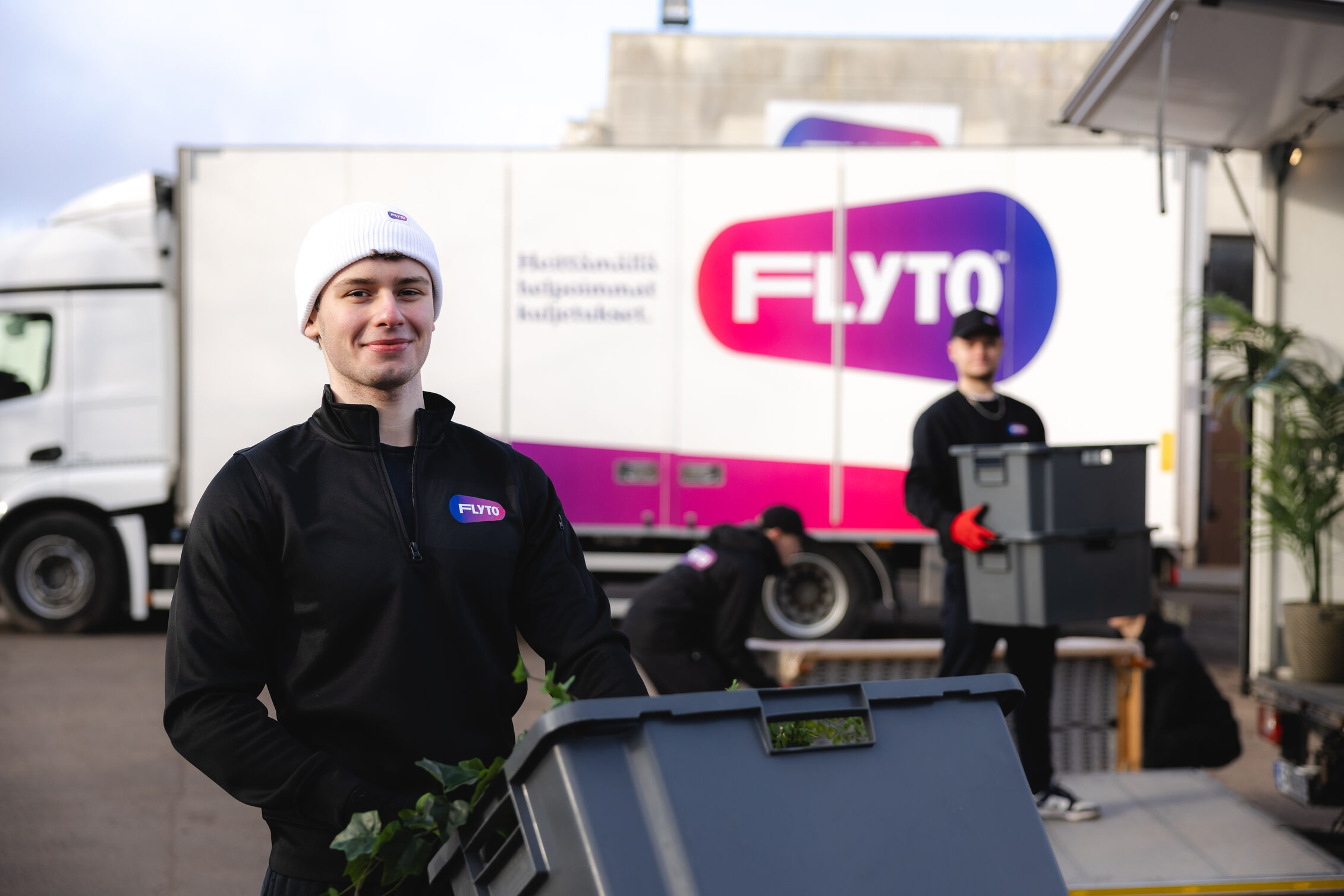
For an intercontinental move to Boston, Flyto operates on a door-to-door PLATINUM basis — overseas relocations are Platinum only, because a transatlantic move has no room for gaps between links. That means we manage the whole chain: professional export packing at your origin, sea freight into Conley Terminal or air freight into Logan, US customs clearance and CBP Form 3299 handling, and delivery, unpacking and furniture assembly at your new Boston, Cambridge or Brookline address. You get one coordinator and one accountable price rather than juggling a foreign packer, an ocean carrier, a customs broker and a local crew yourself.
The service is bidirectional — we handle moves both to and from the USA with a single point of accountability, so a researcher arriving on a J-1 and a family repatriating to Europe after a Boston posting are looked after the same way. We time the shipment to your visa and travel dates, and steer well clear of the 1 September crush wherever possible. Get an instant Boston moving quote (or go straight to the quote tool), browse our USA moving guides, and compare a nearby corridor in our New York City city guide or a country route such as moving from Germany to the USA.
Frequently asked questions
Which visa do most people relocating to Boston use?
It depends on your work. Academics and hospital researchers most often use the J-1 exchange-visitor visa or an H-1B; senior researchers and founders may qualify for the O-1; multinational staff use the L-1; and a huge share arrive first as F-1 students and move through OPT to H-1B (USCIS; US Department of State).
Does moving to Boston change my customs rules?
No. US customs is federal. Your household goods clear through CBP under the same national rules regardless of city, using CBP Form 3299 for used personal effects (CBP). Boston simply determines the port — Conley Terminal — and the local delivery.
Do I really have to buy health insurance in Massachusetts?
Yes, if you can afford it. Massachusetts has an individual mandate requiring most adults to carry coverage meeting Minimum Creditable Coverage standards, or pay a state tax penalty; subsidised ConnectorCare and MassHealth exist for lower incomes (MA Health Connector).
Can I swap my European driving licence for a Massachusetts one?
Only if your country is on the RMV reciprocity list — Germany and South Korea are, most of Europe is not. Otherwise you take the learner’s permit exam and road test as a new driver, and an International Driving Permit cannot be converted (MA RMV).
How much is Massachusetts income tax?
A flat 5% from 1 January 2026, plus a 4% surtax on the portion of taxable income above $1,107,750 for 2026 — on top of US federal tax (MA DOR; MA DOR).
What is “Allston Christmas” and should I move on 1 September?
About 70% of Boston leases start on 1 September, so the whole city moves at once — movers, trucks and parking are scarce, and discarded furniture piles up (“Allston Christmas”). Move off-peak if you can, and book a City moving permit at least 15 days ahead (City of Boston).
How long will my shipment take?
Plan for roughly 4–8 weeks door-to-door from Europe and 8–14 weeks from Asia or Australasia for sea freight, subject to consolidation and customs. Air freight into Logan is days but far pricier.
Do I need a car in Boston?
Often no. Boston, Cambridge and Somerville are walkable and served by the MBTA “T”; many residents rely on a Monthly LinkPass ($90) and skip car ownership, which also avoids the licence and snow-parking hassles (MBTA).
Sources
- USCIS — H-1B Electronic Registration Process
- USCIS — Proclamation on Certain Nonimmigrant Workers ($100,000 H-1B payment)
- US Department of State — Exchange Visitor (J) Visas
- US Department of State — J-1 Two-Year Home-Residence Waiver
- USCIS — O-1 Extraordinary Ability
- USCIS — L-1A Intracompany Transferee
- US Department of State — Student (F-1) Visa
- USCIS — Optional Practical Training (OPT) for F-1 Students
- USCIS — Employment-Based Green Cards
- US Department of State — Visa Bulletin
- Massport — Port of Boston / Conley Terminal
- CBP — Form 3299, Declaration for Free Entry of Unaccompanied Articles
- CBP — Importer Security Filing (“10+2”)
- CBP — Bringing Agricultural Items into the US
- USDA APHIS
- CBP — Prohibited and Restricted Items
- MA RMV — Transfer Your Driver’s License from a Foreign Country
- MA RMV — Converting Certain Foreign Driver’s Licenses
- MA Department of Revenue — Massachusetts Tax Rates
- MA Department of Revenue — 4% Surtax on Taxable Income
- MA Health Connector — Massachusetts Individual Mandate
- MA DOR — TIR 26-1, Individual Mandate Penalties for Tax Year 2026
- MassHealth
- SSA — Documents to Get a Social Security Card
- FinCEN — USA PATRIOT Act (Customer Identification Program)
- MBTA — Subway and Bus Fares
- City of Boston — Tips for the September 1 Move-In
- City of Boston — Moving (permits)
- City of Boston — Renting in Boston
- City of Boston — Snow and Winter Operations
- NWS Boston
- U.S. Census Bureau — QuickFacts, Boston city
Hiring an international mover? See our full International removals to the USA service — Flyto’s own European hubs, vetted local partners and one English-speaking coordinator, door to door.