

Moving from Estonia to Malaysia (2026): Complete Guide

Relocating from Estonia to Malaysia means managing two separate bureaucracies at once: Estonia’s exit formalities (population register, tax residency, customs export declaration) and Malaysia’s entry formalities (immigration pass, Royal Malaysian Customs Department clearance, and — for pet owners — a Department of Veterinary Services import permit). This guide is written for Estonian residents, expatriates in Estonia, or e-residents physically relocating their household to Malaysia for work (Employment Pass), long-term residence (Malaysia My Second Home), or family reasons. It covers both halves of the move plus a short note on moving back from Malaysia to Estonia.
Key takeaways
- Estonia has no exit permit as such, but you must file a notice of residence with your last Estonian municipality or the Estonian embassy within 30 days of moving abroad — this updates the Population Register.
- Non-commercial personal effects, or commercial goods up to €1,000 in value or 1,000 kg, can be declared orally or via the green channel when exporting from Estonia; above that, or for goods needing special authorisation, a formal customs declaration is required, per the Estonian Tax and Customs Board.
- You typically stop being an Estonian tax resident the day after you leave, provided you keep no home in Estonia and stay under 183 days in any 12-month period — but you should still file a residency-status application (Form R) with the Estonian Tax and Customs Board.
- Estonia’s main export harbour for containerised freight is Muuga Harbour, part of the Port of Tallinn, about 17 km east of Tallinn.
- On arrival, Malaysia’s Royal Malaysian Customs Department requires you to choose the Green or Red lane and declare taxable goods, prohibited items, and cash/negotiable instruments.
- Cash or bearer negotiable instruments worth USD 10,000 or more (or the equivalent in any currency) must be declared to Malaysian customs on Customs No. 22, per Bank Negara Malaysia.
- Dogs and cats need a Malaysian import permit from the Department of Veterinary Services, ISO-compliant microchipping, a rabies-valid veterinary health certificate, and a minimum 7-day quarantine on arrival — restricted/banned breeds do not qualify.
- Your Malaysian immigration pass type (Employment Pass, Dependant Pass, or MM2H) is what customs checks before treating a shipment as a genuine household relocation rather than a commercial import.
1. Your Malaysian immigration status determines your customs treatment
Malaysia does not have a single "moving visa." What you hold when your container lands is what Royal Malaysian Customs Department (RMCD) officers check before deciding how your shipment is treated. The Immigration Department of Malaysia (Jabatan Imigresen Malaysia) issues the Employment Pass for skilled employment tied to a Malaysian employer, the Dependant Pass for accompanying family members, and Malaysia My Second Home (MM2H) — a long-term residence visa requiring a fixed deposit (RM100,000 for applicants aged 50 and above, RM150,000 for those below 50, per current MM2H terms). Your pass (or approval letter, if it has not yet been issued) is one of the documents your shipping/customs agent submits alongside your passport and packing list at clearance, so apply for it — or at least secure the approval letter — before your sea freight departs Estonia, since Malaysian import processing moves faster once your residence status is confirmed. Tourists and short-term visa holders are not eligible to bring in unaccompanied household shipments under relocation terms; they fall under the general traveller’s baggage rules from the RMCD Traveller’s Guide instead.
2. The Estonia export side
Authority. Estonia’s customs authority is the Estonian Tax and Customs Board (Maksu- ja Tolliamet, MTA), which also administers income tax. Its guidance on moving away from Estonia is the primary reference for the export side of your move.
Deregistration. There is no formal Estonian "exit visa" process, but you are required to update your address. Estonia’s Population Register is maintained under the Ministry of the Interior, and when you move abroad you must submit a notice of residence (elukohateade) to your last municipal government in Estonia, or to an Estonian embassy if you have already left, within 30 days. This can be done in person, by post, by digitally signed email, or through the e-population register portal using an ID-card, Mobiil-ID or Smart-ID, and the Ministry of the Interior provides the official notice-of-residence guidance.
Export declaration. For non-commercial personal effects — household goods, bicycles, motorcycles, or a private vehicle — MTA allows oral declaration or passage through the green ("nothing to declare") channel provided the goods are non-commercial, or, if commercial in nature, do not exceed €1,000 in value or 1,000 kg. Above those thresholds, or for goods requiring special export authorisation (e.g. cultural property), a formal written customs declaration is mandatory. MTA also flags that export of EU-sanctioned goods to Russia and Belarus is prohibited, though this does not apply to a move to Malaysia. Full detail is on the MTA "Moving away from Estonia" page.
Tax residency exit. Under Estonian income tax rules, you are a tax resident if your place of residence is in Estonia or you stay at least 183 days within any 12 consecutive months (or if you are an Estonian diplomat in foreign service). If you settle abroad in a way that shows clear intent to relocate, keep no home in Estonia, and stay under 183 days going forward, you become a non-resident as of the day after your departure. If a tax treaty between Estonia and your new country of residence deems you resident there, that treaty date can override the general rule. Anyone whose residency status is about to change should file an application for determination of residency (Form R) with MTA — see the Estonian Tax and Customs Board’s residency guidance.
3. Ports, airports & transit — realistic estimates
Estonia’s principal freight gateway is Muuga Harbour, the main cargo harbour of the Port of Tallinn, located about 17 km east of Tallinn. It is one of the deepest and most modern ports in the Baltic Sea (up to 18 m depth) and, with its container, liquid-bulk and dry-bulk terminals, handles roughly half of Port of Tallinn’s total cargo volume — the port as a whole moves around 20 million tonnes a year, per Port of Tallinn’s cargo-handling information. Containers are also handled at Paldiski South Harbour. For air freight or accompanied baggage, Tallinn Airport (Lennart Meri Tallinn Airport) is the relevant departure point, connecting via European hubs to Kuala Lumpur International Airport (KLIA) or Port Klang (Malaysia’s main container port, near Kuala Lumpur) for sea cargo.
These transit times are freight-industry estimates, not official figures, since neither Estonia nor Malaysia publishes route-specific transit tables: sea freight (FCL/LCL) from Muuga to Port Klang, typically transshipped via a major North European hub such as Rotterdam or Hamburg, commonly runs 6–8 weeks port-to-port; air freight typically runs 7–14 days door-to-door once export/import customs are cleared on both ends. Add buffer time on both sides for MTA export processing and RMCD import clearance.
4. The Malaysia import side
RMCD administers imports under the Customs Act 1967. Every arriving passenger chooses the Green Lane (nothing to declare, duty-free allowance only) or Red Lane (goods, cash, or restricted items to declare), and must declare "all taxable goods, prohibited items, cash amounts, and negotiable monetary instruments," per the RMCD Traveller’s Guide. That guide sets personal duty-free allowances for goods carried with you (thresholds differ for arrivals by air versus by land/sea, and separate limits apply to alcohol, new clothing, footwear and food items) — check the current allowance table on the guide itself before you travel, since these figures are periodically revised.
For an unaccompanied household shipment arriving separately from you (the normal way a relocation move works), your shipping or customs agent lodges the formal import declaration with RMCD on your behalf, referencing your passport, your immigration pass/approval, and a full packing list; the relevant legislation and procedures are published on the RMCD customs procedure portal. Cash or bearer negotiable instruments totalling USD 10,000 or more (or the equivalent, combined across currencies) must be declared using Customs No. 22, available at counters before the customs checkpoint at every entry and exit point, per Bank Negara Malaysia; failure to declare, or a false declaration, can carry a fine of up to RM1 million and/or imprisonment. Separate Bank Negara Malaysia rules also govern how much physical Malaysian Ringgit residents and non-residents may carry across the border — check the current limit directly with Bank Negara Malaysia before travelling, as this is a distinct rule from the USD 10,000 cash-declaration threshold. Prohibited items — including narcotics and unlicensed prescription medicines — are listed under the Customs (Prohibition of Imports) Order, referenced on the same RMCD portal; carry any prescription medication with its original packaging and a doctor’s letter.
5. Pets
Leaving Estonia (EU rules). Estonia follows the EU rules on travelling with pets. Dogs, cats and ferrets need a microchip (or a clearly readable tattoo applied before 3 July 2011) implanted before rabies vaccination, a valid rabies vaccination, and — for onward travel outside the EU — an EU animal health certificate issued by an authorised vet. Requirements are detailed by the Estonian Agriculture and Food Board (PTA) and the European Commission’s Your Europe portal.
Entering Malaysia. Malaysia requires an import permit/licence from the Department of Veterinary Services (DVS) before your dog or cat departs — apply well in advance, as it must be obtained first, not on arrival. Animals must be at least 3 months old, identified with an ISO-compliant microchip, and accompanied by a veterinary health certificate, with rabies vaccination typically required at least 30 days before entry. On arrival, animals are placed in compulsory quarantine of not less than 7 days, and are subject to breed and country-of-origin restrictions that vary by exporting country. Full detail is in the DVS Malaysia regulations for importing dogs and cats, and permit status can be tracked via the DVS Animal Passport portal, which is also the best place to confirm the exact current requirements for pets travelling from Estonia specifically, since conditions vary by country of origin.
6. Vehicles, money, and things people forget
Vehicles. Bringing your own car is rarely worthwhile. A foreign-registered vehicle can only circulate temporarily under an International Circulation Permit (ICP) issued by Malaysia’s Road Transport Department (JPJ) on the free JPJK9 form — you’ll also need Malaysian third-party insurance. The permit runs for up to 90 days and can be extended by the relevant State JPJ Director for a further period, up to a maximum of 180 days in one calendar year; see the JPJ ICP procedure. Permanent import of a personal vehicle is separately regulated and restricted; most relocators sell their car in Estonia and buy locally in Malaysia instead.
Money. Beyond the cash-declaration rule above (Customs No. 22, USD 10,000 threshold), note that carrying large amounts of physical Malaysian Ringgit is separately governed by Bank Negara Malaysia’s Foreign Exchange Administration rules — confirm the current limit with Bank Negara Malaysia directly before travelling, since this is distinct from, and in addition to, the cash-declaration requirement.
Things people forget. Deregister from the Estonian Population Register even if you plan to keep an Estonian bank account or e-Residency — deregistration and tax residency are separate processes, and neither happens automatically from the other; both need their own filing with MTA and the Ministry of Interior as described above. Keep your rabies vaccination and microchip paperwork in the correct chronological order (chip before vaccine) — Malaysian DVS and EU rules will both reject a certificate with the wrong sequence. Apply for your Malaysian pet import permit before booking flights, since it cannot be obtained after departure.
How Flyto handles your Estonia to Malaysia move
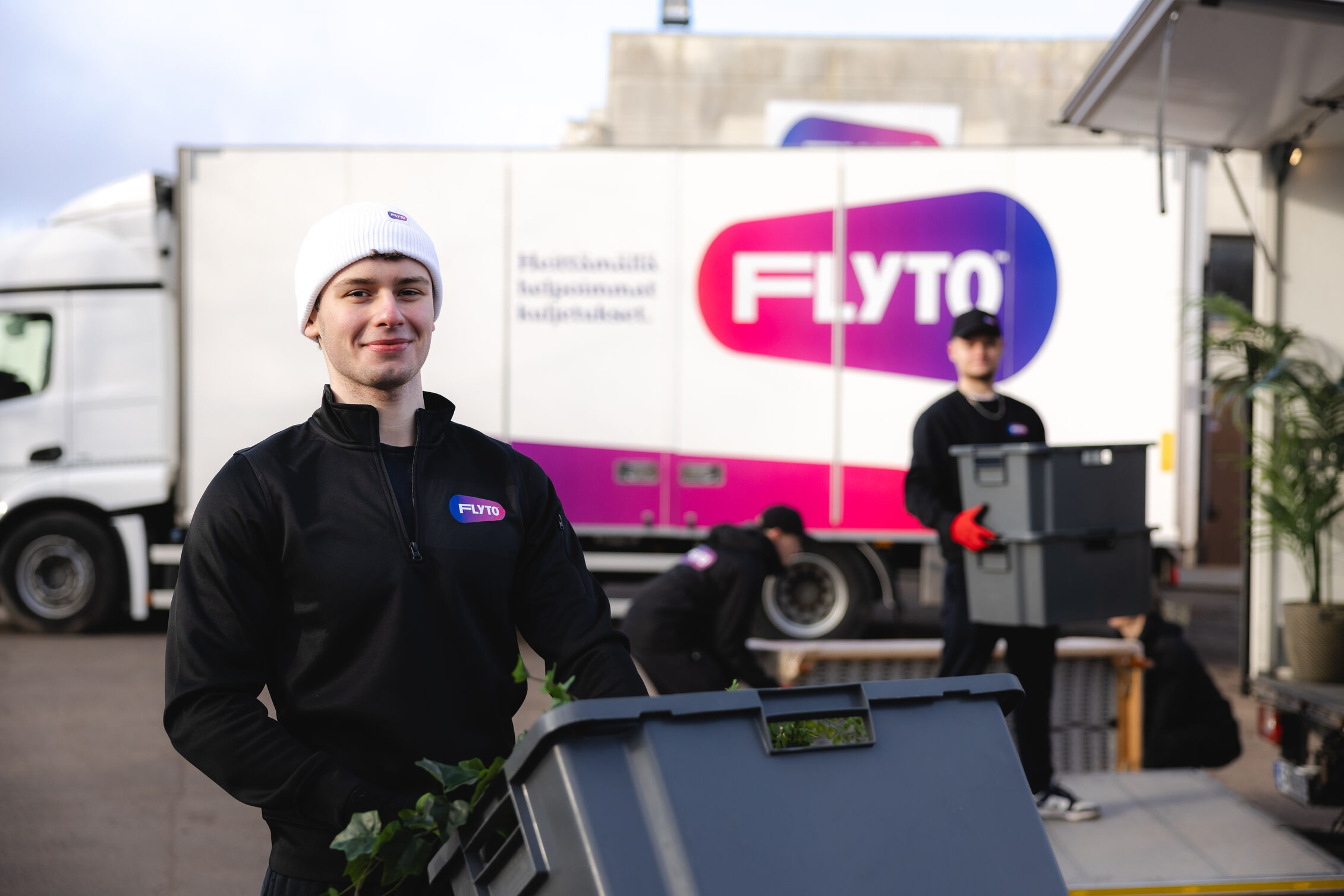
Flyto runs its own offices, warehouses, crews and vehicles across Northern, Central and Southern Europe, so the Estonian collection, export documentation, and consolidation leg of your move is handled in-house wherever our own network reaches. For the long-haul sea or air freight leg and Malaysian last-mile delivery, we work through a carefully vetted network of subcontractor carriers and, on the ground in Malaysia, trusted local partners who handle RMCD clearance, permit coordination, and delivery — giving you direct accountability on the European side and experienced local expertise where local knowledge matters most.
Frequently asked questions
Do I need to deregister from Estonia before I leave, or can I do it from Malaysia?
You can do either — submit your notice of residence to your last Estonian municipality in person before leaving, or to the Estonian embassy after you arrive, within 30 days of the move, per the Ministry of the Interior.
Will I automatically stop paying Estonian income tax once I move?
Not automatically — your resident status changes the day after departure only if you keep no home in Estonia and stay under 183 days per 12-month period going forward; file the residency application (Form R) with MTA to formalise it. See the Estonian Tax and Customs Board.
Can I bring my dog with me on the same flight?
You must have the Malaysian DVS import permit and correctly sequenced microchip/rabies paperwork arranged before travel, and your pet will still go through a minimum 7-day quarantine on arrival, per DVS.
How much can I bring in cash without declaring it?
Anything under USD 10,000 equivalent does not need declaring; at or above that, you must complete Customs No. 22 at the Malaysian border, per Bank Negara Malaysia. Carrying large amounts of physical Ringgit is a separate rule — confirm the current limit with Bank Negara Malaysia before you travel.
Is it worth shipping my car to Malaysia?
Generally no — permanent import is heavily restricted, and a foreign car can only be used temporarily on an ICP from JPJ (max 180 days/year); most people sell in Estonia and buy locally, per JPJ.
What visa do I need before my household goods can clear Malaysian customs as a relocation, not a commercial import?
An Employment Pass, Dependant Pass, or MM2H approval (or at least the approval letter) from the Immigration Department of Malaysia is what your agent presents to RMCD alongside your shipment documents.
Moving back from Malaysia to Estonia?
The process mirrors this guide in reverse: cancel your Malaysian pass and any MM2H/EP obligations with the Immigration Department, obtain RMCD export clearance for goods leaving Malaysia, and on the Estonian side register your new address in the Population Register and, if returning to reside, notify MTA of your resumed Estonian tax residency using the same MTA residency channel.
Sources
- Estonian Tax and Customs Board — Moving away from Estonia
- Estonian Tax and Customs Board — Determining residency
- Estonian Ministry of the Interior — Submission of a notice of residence
- Estonian Agriculture and Food Board (PTA) — Travelling with a pet
- European Commission, Your Europe — EU rules on travelling with pets
- Port of Tallinn — Muuga Harbour
- Port of Tallinn — Cargo handling
- Immigration Department of Malaysia — Malaysia My Second Home (MM2H)
- Royal Malaysian Customs Department — Traveller’s Guide
- Royal Malaysian Customs Department — Customs procedure
- Bank Negara Malaysia — New currency declaration requirement at all entry and exit points of Malaysia
- Department of Veterinary Services Malaysia — Regulations for the importation of dogs and cats (PDF)
- Department of Veterinary Services Malaysia — Animal Passport portal
- Road Transport Department Malaysia (JPJ) — ICP permit procedure for foreign vehicles