

Moving from the Netherlands to Indonesia (2026): Complete Guide

Relocating from the Netherlands to Indonesia means closing out one of Europe’s most digitised administrative systems on one end and navigating one of Southeast Asia’s most document-heavy customs regimes on the other. On the Dutch side you’ll deregister from the municipal population register, file an export declaration for your household goods, and settle your income tax for the year you leave. On the Indonesian side, what you can bring in duty-free depends entirely on the immigration status you enter under — VITAS/KITAS holder, returning Indonesian citizen, or short-term visitor — and is processed under Indonesia’s 2025 relocation-goods regulation. This guide is written for a Dutch resident (Dutch national or long-term resident) moving to Jakarta, Surabaya, Bali, or elsewhere in Indonesia, and covers both halves of the move plus what changes if you later move back.
Key takeaways
- Your Indonesian entry permit decides your customs treatment: duty-free "barang pindahan" (relocation goods) status requires a valid limited-stay visa/permit (VITAS→KITAS) or, for Indonesian citizens, 12 continuous months living abroad — under Regulation PMK 25/2025 (Bea Cukai).
- Before departure you must deregister ("emigratie") from the Dutch Basisregistratie Personen (BRP) at your municipality if you will live abroad 8+ months per year — see RvIG.
- Moving your household effects out of the Netherlands to a non-EU country requires an export customs declaration with an inventory list — see Dutch Customs (Douane).
- The year you emigrate you must file a Dutch "M-form" income tax return covering your part-year domestic tax liability — see Belastingdienst.
- Cars, motorcycles, boats and aircraft are explicitly excluded from Indonesia’s relocation-goods duty exemption, regardless of your visa — see Bea Cukai.
- Dogs and cats need an NVWA-endorsed health certificate and rabies vaccination (with a titre test for high-rabies-risk transit countries) on the Dutch side, plus Barantin quarantine clearance on arrival — see NVWA and Badan Karantina Indonesia.
- Since 1 October 2025, everyone arriving in Indonesia — including relocating expats — must file the unified "All Indonesia" arrival card up to 72 hours before landing — see Direktorat Jenderal Imigrasi.
- Cash of €10,000+ leaving the EU, or Rp100 million+ (foreign currency worth Rp1 billion+ additionally needs Bank Indonesia approval) crossing the Indonesian border, must be declared — see Douane and Bea Cukai.
1. Your Indonesian visa status decides your customs treatment
Indonesia does not give duty-free treatment to household goods simply because they belong to a "mover." Eligibility for the "barang pindahan" (relocation goods) exemption under Regulation PMK 25/2025 — effective 27 June 2025 and replacing the older PMK 28/PMK.04/2008 — is tied directly to your immigration status at the point of import:
- Foreign nationals (WNA) must be relocating to Indonesia for work or study, generally under a Limited Stay Visa (VITAS) that converts to a Limited Stay Permit (KITAS/ITAS) on arrival. VITAS applications run through the official eVisa portal, and under Government Regulation 48/2021, VITAS holders must apply to convert to KITAS/ITAS within 30 days of the entry stamp being issued — see Direktorat Jenderal Imigrasi.
- Indonesian citizens (WNI) returning home qualify only if they lived abroad continuously for at least 12 months before returning — see Bea Cukai.
- Goods must arrive together with the owner, or within 90 days before or after the owner’s own arrival in Indonesia; anything outside that window loses the exemption — see Bea Cukai.
In practice: get your VITAS/KITAS sponsorship and paperwork sorted before your shipment leaves the Netherlands. A shipment that arrives without the owner holding valid immigration status, or outside the 90-day window, is processed as an ordinary commercial import — full duties and taxes, no exemption.
2. The Netherlands: export and departure formalities
Customs authority. Dutch customs is Douane, part of the Belastingdienst (Dutch Tax and Customs Administration). Moving household effects from the Netherlands to a non-EU country such as Indonesia requires filing an export declaration with an inventory list of everything you’re taking, submitted through your moving company via Customs’ declaration system — see Douane: Moving things from the Netherlands. There is no blanket monetary threshold below which the declaration is skipped — it applies to the shipment of removal goods as such, though special conditions and restrictions apply to cultural goods (art, antiques) leaving the EU.
Deregistering from the BRP. Anyone who will live abroad for 8 months or more within a 12-month period must report their departure ("emigratie") to their municipality — you can do this online up to 5 days before leaving, and if your whole household is moving from one address you can typically file it digitally without an in-person appointment. Once processed, your record moves from the Basisregistratie Personen (BRP) into the Registratie Niet-Ingezetenen (RNI), the non-resident register — see RvIG.
Tax exit. Emigrating ends your unlimited Dutch tax liability and you become a foreign taxpayer, though income sourced in the Netherlands (e.g., a Dutch-registered home, certain benefits) may still be taxable there. For the calendar year in which you move, you file a special M-form (M-biljet) — either on paper or via "Mijn Belastingdienst" for the option covering taxpayers who lived outside the Netherlands part of the year; if it isn’t sent to you automatically you can request it from the Tax Authority’s foreign-residents phone line — see Belastingdienst.
Cash. If you’re carrying €10,000 or more in cash or gold when you leave the EU, you must declare it to Customs before checking in luggage (at Schiphol, at the Departure Hall 3 tax-refund/customs desk) — see Douane.
3. Ports and realistic transit times (freight-industry estimates)
Household shipments to Indonesia normally route through Rotterdam, the Netherlands’ — and Europe’s — largest seaport, or by air via Amsterdam Schiphol. On the Indonesian side, sea shipments typically clear at Tanjung Priok (Jakarta), Tanjung Perak (Surabaya), or Benoa/Ngurah Rai (Bali), depending on your destination city.
The following transit windows are industry estimates from moving/freight operators, not official government figures, and vary with carrier schedules, consolidation, and customs clearance speed:
- Sea freight (FCL/LCL), Rotterdam → Jakarta/Surabaya/Bali: roughly 5–7 weeks port-to-port, plus Indonesian customs clearance (which can extend materially if the VITAS/KITAS or 90-day-window documentation isn’t in order).
- Air freight, Amsterdam Schiphol → Jakarta (Soekarno-Hatta): typically 5–10 days door-to-door for smaller shipments needing speed.
Build in buffer time on both ends: Dutch export declarations and Indonesian barang-pindahan approval are sequential, document-driven processes, not same-day services.
4. Indonesia: import declaration and process
All travellers arriving in Indonesia — Indonesian and foreign — must now complete the unified All Indonesia arrival declaration, which since 1 October 2025 applies nationwide at every airport, seaport and land border post and has absorbed the former Electronic Customs Declaration (e-CD) and health-pass processes into one filing covering immigration, customs and health data, submitted online up to 72 hours before landing — see Direktorat Jenderal Imigrasi and the official portal, All Indonesia.
For your household goods shipment specifically, the process (governed by PMK 25/2025) runs separately from the personal arrival card:
- File an electronic import notification through Bea Cukai’s barang-pindahan system, submitted by you or your customs broker.
- Attach travel/residency documents proving your VITAS/KITAS status (or, for WNI, proof of 12 months abroad), a relocation certificate, and an itemised inventory.
- Ensure the shipment arrives with you or within the 90-day window around your own arrival date.
- Approved relocation goods are exempt from import duty; note that VAT and income tax (PPh) can still apply depending on the goods and current tax rules — see Bea Cukai.
Separately, ordinary personal luggage/purchases (not relocation goods) carry a standard duty-free allowance of USD 500 (FOB) per person per arrival, with a flat 10% import duty plus VAT (and income tax, at reduced rates if you hold an Indonesian tax ID) on the value above that — this is a different rule from the barang-pindahan exemption and applies to what you’re carrying with you, not your shipped household effects — see Bea Cukai.
5. Pets
Leaving the Netherlands. Taking a dog or cat to a non-EU country like Indonesia requires a microchip, a valid rabies vaccination, and an EU health certificate or EU pet passport — plus a rabies-antibody blood test if your pet transits a high-rabies-risk country. Exact document requirements are set by the destination country and can be checked via the NVWA’s export tools; preparation can take anywhere from a few weeks to over six months, so start early and verify current rules before booking transport — see NVWA.
Entering Indonesia. Pet imports are supervised by Badan Karantina Indonesia (Barantin). For dogs, cats and other rabies-vector animals, the owner/shipper must submit a prior notice online (via Barantin’s notice system) before departure, and the animal must travel with a health certificate from a competent authority in the country of origin, vaccination records and a rabies-antibody titre test result. On arrival, the pet is surrendered to quarantine officers at the port of entry for document and health inspection; only animals that pass are issued a quarantine release certificate. Barantin does not publish one fixed number of quarantine days on its website — pet-relocation specialists commonly cite a holding period of roughly 7–14 days at the Jakarta or Surabaya quarantine stations, with the exact duration set case by case by the quarantine veterinarian — see Badan Karantina Indonesia.
6. Vehicles, money and things people forget
Vehicles. Don’t plan to bring your Dutch car or motorcycle. Indonesia’s relocation-goods duty exemption explicitly excludes motorised vehicles and water/air vessels — they are simply not covered, regardless of how long you’ve lived abroad or what visa you hold — see Bea Cukai. Plan to sell or otherwise dispose of vehicles before leaving the Netherlands and buy or lease locally in Indonesia.
Cash and money instruments. On departure from the EU, cash/gold of €10,000+ must be declared to Dutch Customs — see Douane. On the Indonesian side, carrying cash or payment instruments (rupiah or foreign currency) worth Rp100 million or more into or out of Indonesia must be reported to Bea Cukai, and foreign banknotes worth Rp1 billion or more additionally require Bank Indonesia permission — see Bea Cukai.
Things people forget: confirming your VITAS/KITAS sponsorship is finalised before your shipment departs (it directly gates your duty exemption); keeping a full item-by-item inventory for both the Dutch export declaration and the Indonesian relocation-goods filing; and remembering that the 90-day import window runs from your own arrival date, not your shipment’s departure date.
How Flyto handles your Netherlands to Indonesia move
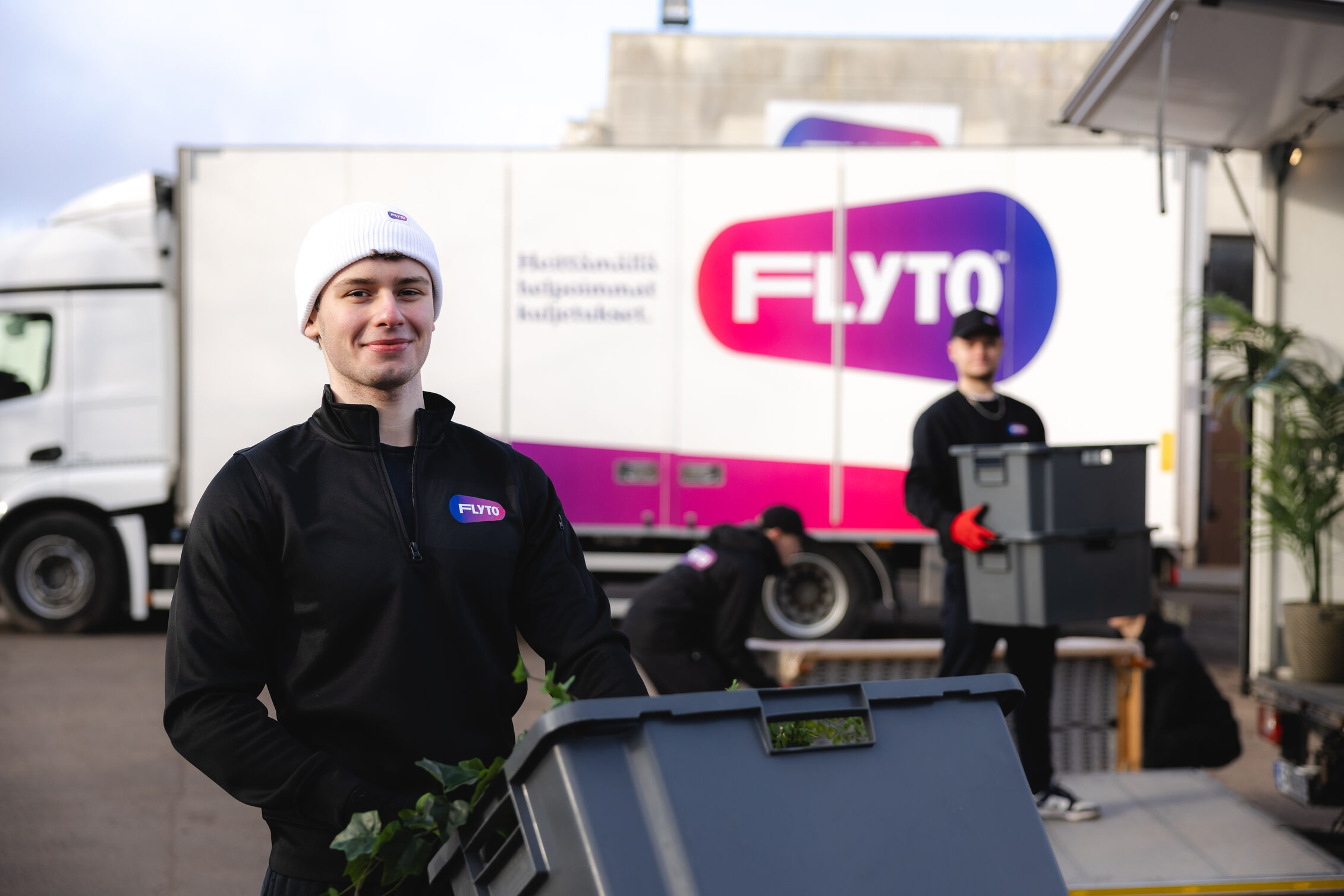
Flyto runs its own offices, warehouses, vehicles and moving crews across Northern, Central and Southern Europe, so the Dutch export side of your move — BRP deregistration guidance, the customs export declaration, packing and consolidation out of the Netherlands — is handled in-house by our own teams. For the ocean/air freight leg and the Indonesian import side, we work through a carefully vetted network of freight partners and trusted local agents in Indonesia who manage barang-pindahan clearance, port handling and last-mile delivery, so you get single-point coordination from Flyto even though we don’t operate our own crews on the ground in Indonesia.
Frequently asked questions
Do I need to deregister from the Netherlands before I can get my KITAS? No, the two processes are independent — but you must deregister from the BRP if you’ll live abroad 8+ months a year, regardless of your Indonesian visa timeline. See RvIG.
Can I import my household goods before my KITAS is issued? Only within the 90-day window around your own arrival, and the exemption depends on holding (or being in the process of obtaining) valid immigration status — arriving goods without it are treated as an ordinary commercial import. See Bea Cukai.
Is my car covered under relocation-goods exemption? No — motorised vehicles and water/air vessels are excluded outright. See Bea Cukai.
Will my cat go straight home or into quarantine? Barantin assesses documentation and physical health on arrival; the animal is held at a quarantine station until cleared, with pet-relocation specialists reporting typical stays of roughly 7–14 days depending on the case. See Badan Karantina Indonesia.
Do I still owe Dutch tax the year I leave? You file a part-year M-form covering income up to your emigration date, and continue to be taxed on specific Dutch-source income after that. See Belastingdienst.
What if I move back to the Netherlands from Indonesia later? The process runs in reverse: you’d re-register with a Dutch municipality (ending your RNI status), file a Dutch import declaration for your removal goods if returning from outside the EU (again via your mover, potentially duty-free if you’ve lived outside the EU 12+ months and meet the other conditions), and on the Indonesian side you would need to check Bea Cukai’s export rules before shipping — see Douane: Moving to the Netherlands and RvIG.
Sources
- Dutch Customs (Douane) — Moving things from the Netherlands
- Dutch Customs (Douane) — Moving to the Netherlands (non-EU)
- Dutch Customs (Douane) — Entering or leaving the EU with €10,000 or more
- RvIG — Ik ga verhuizen naar het buitenland (emigration/deregistration)
- Belastingdienst — Aangifte doen over het jaar van emigratie (M-form)
- NVWA — Mijn hond of kat mee naar een land buiten de EU
- Direktorat Jenderal Bea dan Cukai — Barang Pindahan (PMK 25/2025)
- Direktorat Jenderal Bea dan Cukai — Ketentuan Barang Bawaan Penumpang (duty-free allowance & cash reporting)
- Direktorat Jenderal Imigrasi — eVisa portal (VITAS)
- Direktorat Jenderal Imigrasi — WNA dengan VITAS wajib konversi ke ITAS sebelum 30 hari
- Direktorat Jenderal Imigrasi — Mulai 1 Oktober, deklarasi kedatangan wajib di aplikasi All Indonesia
- All Indonesia — official arrival card portal
- Badan Karantina Indonesia (Barantin) — Prosedur karantina hewan kesayangan dari luar negeri