

Moving from Sweden to Thailand (2026): Complete Guide

The Sweden-to-Thailand corridor is one of the most popular long-haul relocation routes out of the Nordics, driven by retirees, remote workers, and families with Thai partners. But a move like this has two customs borders and two tax systems, and getting one half wrong is expensive. This guide covers both halves: the Swedish export and departure formalities handled by Tullverket (Swedish Customs) and Skatteverket (the Swedish Tax Agency), and the Thai import and immigration side handled by the Thai Customs Department and the Department of Livestock Development. It closes with a short note on the reverse direction. It is written for a resident of Sweden physically relocating to Thailand, not for holidaymakers.
Key takeaways
- Your Thai immigration status decides your customs treatment: only a "resuming resident" holding a one-year non-immigrant visa or a work permit valid for at least one year qualifies for duty-free changing-of-residence treatment (Thai Customs).
- On the Swedish side you must file an export declaration with Tullverket, using commodity code 9905 00 00 and procedure code 1000 for an emigrant’s personal property (Tullverket).
- Notify Skatteverket if you are moving abroad for a year or more, using the "Moving Abroad" notification (SKV 7665b in English); you are then removed from the population register as "emigrated" (Skatteverket).
- Deregistration does not by itself end your Swedish tax liability; a Swedish pension paid to a non-resident is taxed under SINK, which the Riksdag has reduced from 25% to 22.5% from 1 January 2026 (and 20% from 2027) (Skatteverket).
- Thailand’s import window is one month before to six months after your arrival, goods must be owned and used, you must show you lived abroad at least one year, and only one unit of each electrical appliance is duty-free (two for a family move) (Thai Customs).
- Pets need an import permit (Form Ror. 1/1) from the Department of Livestock Development, an ISO-standard microchip, and rabies vaccination at least 21 days before departure (Royal Thai Embassy Canberra).
- Declare foreign currency over USD 20,000 when entering or leaving Thailand; Thai baht is capped at THB 50,000 when travelling to non-neighbouring countries (Royal Thai Embassy Bern).
- Sea freight almost always leaves through the Port of Gothenburg, Scandinavia’s largest container port, which handles around 57% of Sweden’s container trade (Port of Gothenburg).
1. Your Thai visa status determines the customs treatment
Before you book a shipment, settle your immigration status, because it decides whether your container is duty-free or taxed. Thai Customs grants duty and tax exemption on used household effects only to a person who is resuming residence in Thailand. For a non-Thai, that means holding either a one-year non-immigrant visa issued by the Immigration Bureau, or a work permit valid for at least one year; a Thai national must show an overseas posting of at least a year (Thai Customs).
Most Swedes moving to Thailand arrive on a Non-Immigrant "O" or "O-A" (retirement) visa. The retirement route is typically issued for one year and requires proof of financial means — the thresholds most commonly applied are an 800,000 baht Thai bank deposit or 65,000 baht in monthly income, and some consulates also require qualifying health insurance. Exact requirements vary between embassies and consulates, so confirm with the office handling your application (Royal Thai Embassy Lima). The practical point: a tourist entry or a fresh 90-day stamp does not make you a resuming resident. Get the one-year permission first, then time your shipment to it.
2. The Swedish export side — Tullverket, Skatteverket and your tax exit
Customs export. Sweden’s customs authority is Tullverket. When you move to a country outside the EU, you must file an export declaration for your belongings. You can do this yourself at a border customs office or hand it to your removal or forwarding company (Tullverket). For an emigrant’s personal property you write commodity code 9905 00 00, and enter procedure code 1000 for a regular export of personal belongings; capital goods such as vehicles, televisions, computers, and refrigerators must be listed individually, while ordinary items can be grouped as "books, household goods, linen and clothing" (Tullverket). Firearms and ammunition must be declared on a separate form at a customs border, and certain cultural goods need an export authorisation handled through the Swedish National Heritage Board. Tullverket sets no weight or value threshold for exporting personal belongings.
Deregistration. If you are leaving Sweden for a year or more, notify Skatteverket. The "Moving Abroad" notification (SKV 7665b in English) should be printed, signed, and filed before you leave; you are then removed from the population register as "emigrated" (Skatteverket). This is also the document Thai Customs and your mover will use to prove you genuinely relocated.
Tax exit. This is the step people underestimate. Being removed from the population register does not by itself end your Swedish tax liability — you can be deregistered and still owe Swedish tax on Swedish-source income. A Swedish pension paid to a non-resident, for example, is normally taxed in Sweden under SINK (special income tax for non-residents), a flat final tax that the Riksdag has decided to reduce from 25% to 22.5% on 1 January 2026, and to 20% from 1 January 2027 (Skatteverket). Because the interaction between Swedish tax rules and the Sweden-Thailand tax treaty is genuinely complex, confirm your position with Skatteverket before you sell property or shares.
3. Ports and transit times
Sea freight is the normal choice for a full household. In practice your container is trucked to the Port of Gothenburg (Göteborgs Hamn), Scandinavia’s largest container port, which handles around 57% of Sweden’s container trade (Port of Gothenburg). Smaller volumes may consolidate through Stockholm, Helsingborg, or Malmö before feeding to Gothenburg. On the Thai side, deep-sea cargo almost always discharges at Laem Chabang, the country’s main deep-water port serving Bangkok, with some cargo cleared at Bangkok Port (Klong Toey). Air freight moves from Stockholm Arlanda to Bangkok Suvarnabhumi.
Transit times below are freight-industry planning estimates, not official figures, and vary with sailing schedules, transhipment, and congestion:
- Full-container sea (Gothenburg → Laem Chabang): roughly 30–45 days port-to-port, plus collection and Thai clearance.
- Groupage / shared container (LCL): typically longer, often 45–60+ days, because of consolidation and deconsolidation.
- Air freight (Arlanda → Suvarnabhumi): typically 5–10 days door-to-door.
Build in a buffer, and remember the Thai six-month import deadline in Section 4 when scheduling a slow sea move.
4. The Thai import side — the changing-residence process
Thailand grants duty and tax exemption on used/second-hand household effects to resuming residents who meet all of the following (Thai Customs):
- You owned, possessed and used the effects before returning to Thailand to resume residence, with evidence you lived abroad no less than one year.
- The goods are imported not earlier than one month before, and not later than six months after, your arrival.
- The quantities are reasonable for a household. Critically, only one unit of each electrical appliance (radio, television, refrigerator, microwave, oven, air conditioner, etc.) is duty-free; a family change of residence is allowed two units each. Extra units are taxed at normal rates.
Clearance is done on an Import Declaration, supported by your original passport, the immigration or labour-department document proving your one-year status, the Bill of Lading or air waybill, an invoice and packing list, and an application for duty exemption (Thai Customs). A detailed, valued inventory that matches the Swedish export list makes or breaks a clean clearance. Note that retirement-visa holders should not assume automatic exemption — eligibility turns on being classified as a resuming resident, so confirm your case with a Thai broker before shipping.
5. Pets
Both ends are regulated, and Thailand’s rules are strict. On the Thai side the authority is the Department of Livestock Development (DLD). You must obtain an import permit in advance using Form Ror. 1/1 (ร.1/1), submitting documents to the Animal Quarantine Station at your port of entry (Department of Livestock Development, Royal Thai Embassy Canberra). Core requirements:
- An ISO-standard microchip for pet identification.
- Rabies vaccination given at least 21 days before departure, with the pet old enough (generally at least 12 weeks) at vaccination.
- Dogs must test negative for leptospirosis within 30 days of departure, alongside their core vaccinations; cats need rabies and feline panleukopenia (Royal Thai Embassy Canberra).
- A veterinary health certificate completed in English and endorsed by the government veterinary authority of the exporting country.
- Pit Bull Terriers and American Staffordshire Terriers are prohibited, and pets must be at least four months old (Royal Thai Embassy Canberra).
Apply for the import permit well in advance of arrival. On the Swedish side, an official export health certificate is issued by an official veterinarian; arrange this through your veterinarian and the Swedish Board of Agriculture well ahead of travel, because the 21-day rabies window and the leptospirosis test dictate your timeline.
6. Vehicles, money, and things people forget
Vehicles. Importing a car into Thailand is difficult and heavily taxed; it is generally not covered by the household-effects exemption and often costs more in duty than the vehicle is worth. List any vehicle individually on the Swedish export declaration if you do ship one (Tullverket), and get a specialist Thai quote first.
Money. You must declare foreign currency exceeding USD 20,000 (or equivalent) when bringing it into or out of Thailand — failure to declare is a criminal offence. Thai baht is limited to THB 50,000 when travelling to non-neighbouring countries and THB 500,000 to bordering countries (Royal Thai Embassy Bern).
Easily forgotten: keep the Swedish export declaration and your Skatteverket "moving abroad" notification with your shipping file; align the Thai import window with your visa start date; do not ship prohibited items; and keep original receipts for high-value electronics, since Thai Customs values excess appliances at normal rates.
How Flyto handles your Sweden to Thailand move
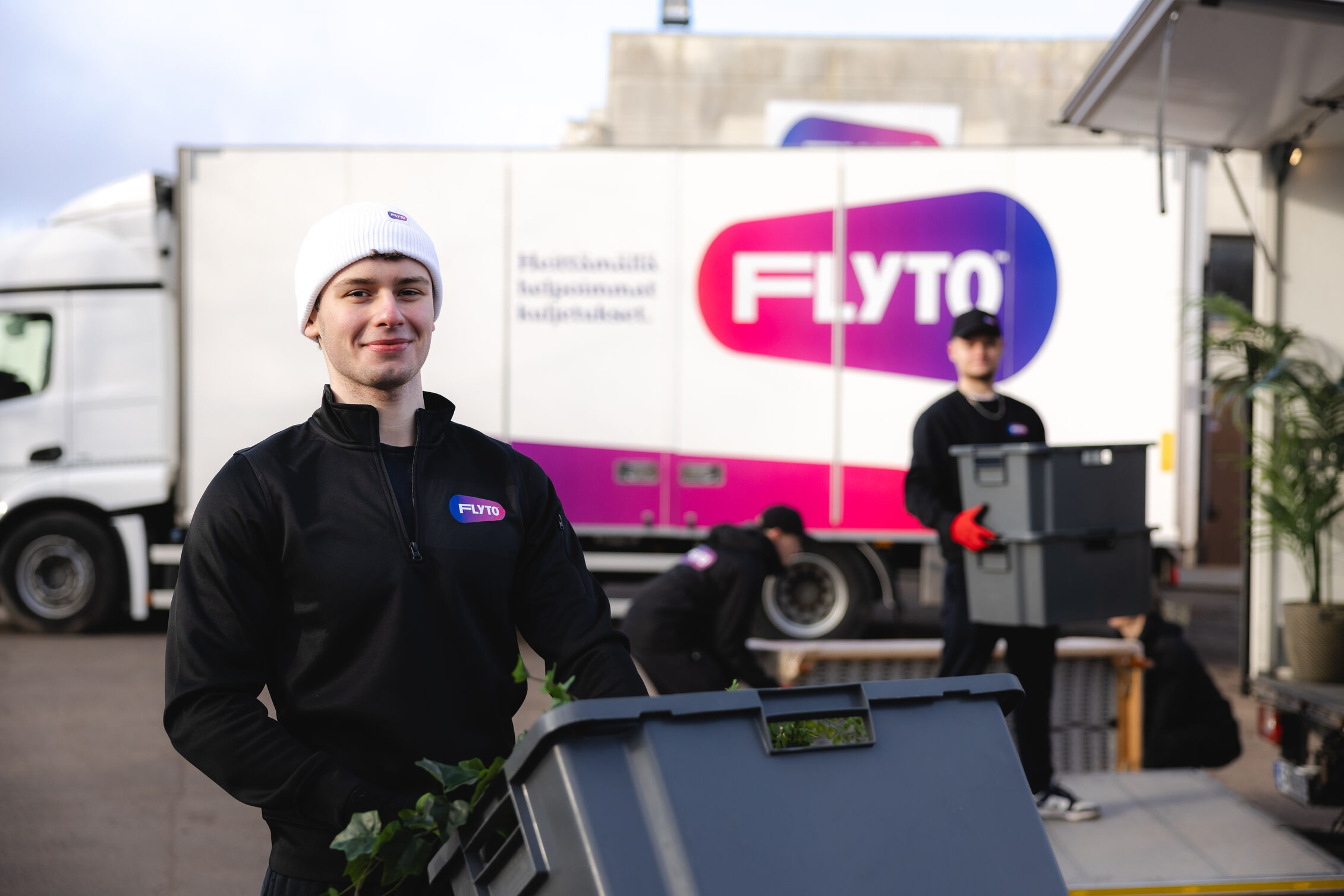
Flyto runs strong in-house European operations — our own offices, warehouses, teams, and vehicles across Northern, Central, and Southern Europe — so collection, packing, and export handling out of Sweden stay under our direct control. For the long-haul leg and the Thai side we combine a carefully chosen partner and subcontractor network with trusted local partners in Thailand for customs clearance and delivery. We coordinate the whole corridor end to end; we do not claim to do every step ourselves.
Frequently asked questions
Do I have to be in Thailand before my container arrives?
Your goods must be imported no earlier than one month before, and no later than six months after, your own arrival, so plan to enter Thailand on your one-year visa around the same time as the shipment (Thai Customs).
Does a retirement (O-A) visa guarantee duty-free household goods?
No. Exemption depends on qualifying as a resuming resident with one-year status and meeting the ownership and quantity rules; confirm your specific case with a Thai broker before shipping (Thai Customs).
Am I finished with Swedish tax once I deregister?
No. Deregistration from the population register does not by itself end your tax status; Swedish-source income such as a pension can still be taxed under SINK (Skatteverket).
How early should I start my pet’s paperwork?
At least a few months out. Rabies vaccination must be at least 21 days before departure, dogs need a negative leptospirosis test within 30 days of travel, and the DLD import permit must be arranged in advance (Royal Thai Embassy Canberra).
Which Swedish port will my container leave from?
Almost always the Port of Gothenburg, Scandinavia’s largest container port (Port of Gothenburg). Transit to Thailand is roughly 30–45 days by sea — an industry estimate, not an official figure.
Can I bring my Swedish savings in cash?
You may, but any foreign currency over USD 20,000 must be declared to Thai Customs on arrival (Royal Thai Embassy Bern). A bank transfer is usually simpler and safer.
Reverse direction: Thailand → Sweden
Moving back reverses both borders. On the Thai side you file an export declaration with Thai Customs; the same USD 20,000 currency-declaration and Thai-baht limits apply on departure (Royal Thai Embassy Bern). On the Swedish side, Tullverket grants duty and VAT relief on personal belongings when you move to Sweden from outside the EU, provided you have lived outside the EU and have owned and used the goods, subject to Tullverket’s conditions (Tullverket). Pets travelling to Sweden must meet EU import rules, and you re-register with Skatteverket on your return (Skatteverket).
Sources
- Tullverket — Moving from Sweden to a country outside the EU
- Tullverket — Duty and VAT relief when moving to Sweden
- Skatteverket — Civil de-registration (moving abroad)
- Skatteverket — SINK, special income tax for non-residents
- Port of Gothenburg — Container services
- Thai Customs Department — Household Effects Import Clearance
- Royal Thai Embassy, Bern — Bringing money in or out of Thailand
- Department of Livestock Development — official website
- Royal Thai Embassy, Canberra — Bringing pets to Thailand
- Royal Thai Embassy, Lima — Non-Immigrant Visa "O" (Retirement)