

Moving from the Netherlands to Ecuador (2026): Complete Guide

Relocating from the Netherlands to Ecuador means clearing two very different administrative systems: Dutch export procedures on the way out, and Ecuadorian customs and immigration rules on the way in. This guide is written for a Netherlands resident — Dutch national or long-term resident — planning a household move to Ecuador, whether for retirement, remote work, or a rentista visa. It covers what Dutch Customs and your municipality need before you leave, what Ecuador’s customs service and immigration authority require before your shipment and pets can enter, and a short note on moving back the other way.
Key takeaways
- Ecuador’s duty-free "menaje de casa" (household goods) import regime is tied to your residence visa status, not your nationality — foreign nationals holding a temporary or permanent Ecuadorian residence visa can qualify, but only Ecuadorian citizens may include a vehicle in the exemption (SENAE via gob.ec).
- You must deregister from the Basisregistratie Personen (BRP) with your Dutch municipality if you’ll be abroad more than 8 months in a 12-month period; you can report departure from 5 days before you leave, via DigiD if the whole household moves together (RVIG).
- Dutch Customs (Douane) does not tax genuine used household effects leaving the EU, but the export declaration is normally filed through Customs’ systems by your mover or customs broker, not by you personally (Douane).
- The year you emigrate, you file a Dutch "M-form" (M-biljet) splitting the tax year into a resident and non-resident period with the Belastingdienst (Belastingdienst).
- Ecuador’s SENAE requires a legalized sworn declaration (declaración juramentada), a physical goods inspection, and — for returning Ecuadorians — proof of at least 2 years abroad and filing within 60 months of return (Aduana del Ecuador).
- Dogs and cats need an ISO microchip and a Certificado Zoosanitario de Exportación issued within 10 days of travel to enter Ecuador; cargo-hold pets additionally need an import permit filed 72 hours ahead (Agrocalidad).
- Carrying €10,000 or more in cash or gold out of the Netherlands to a non-EU country requires a declaration to Dutch Customs before departure, with fines up to €21,750 for skipping it (Douane).
- Entering or leaving Ecuador with US$10,000 or more in cash, negotiable instruments, or precious metals requires the online Formulario de Registro Aduanero (FRA), regardless of transport mode (Aduana del Ecuador).
1. Your Ecuadorian visa status decides your customs treatment
Ecuador’s household-goods relief is not automatic for anyone who simply moves there — it is a residence-visa benefit. To bring a shipment in duty-free under the "menaje de casa" regime, you generally need a valid Ecuadorian temporary or permanent residence visa (or Ecuadorian nationality with returning-migrant status), issued by the Ministerio de Relaciones Exteriores y Movilidad Humana through its e-VISAS platform (Cancillería). Common routes for a Dutch applicant include the rentista visa, which requires provable monthly passive income equal to at least 3 unified basic salaries (SBU), and various work or investor categories (gob.ec rentista visa). If your visa is still in process when your shipment arrives, SENAE allows you to withdraw goods against a guarantee rather than waiting. Decide your visa category before you book freight — the customs exemption request is filed against that visa, and the wrong category (or no visa yet) can turn a duty-free move into a fully taxed import.
2. The Netherlands: export, deregistration and tax exit
Customs authority. Export declarations in the Netherlands are handled by Douane, the Dutch Customs service under the Ministry of Finance. For a household move to a non-EU country like Ecuador, Douane does not charge export duty on genuine used personal and household effects, and in practice the declaration is filed through Customs’ declaration systems by your moving company or customs broker on your behalf rather than by you as a private individual (Douane). Keep an inventory list and proof of EU residence handy — brokers need it to code the shipment correctly.
Deregistering with your municipality. Before or when you leave, you must report your departure ("emigratie") to your gemeente so you are removed from the Basisregistratie Personen (BRP) — mandatory once you will live outside the Netherlands for more than 8 months within a year, even if you keep a Dutch address. You can file this from 5 days before departure at the earliest; if your whole household is moving together you can often do it digitally with DigiD instead of visiting the town hall. Once processed, your record moves into the Registratie Niet-Ingezetenen (RNI) (RVIG).
Tax residency exit. For the calendar year you emigrate, the Belastingdienst requires an "M-form" (M-biljet) — a combined return that splits the year into the period you were a Dutch tax resident and the period you were not, so income and deductions are apportioned pro rata. After that year you’re treated as a foreign taxpayer for any remaining Dutch-source income, and any double taxation with Ecuador is governed by the applicable treaty rules (Belastingdienst).
Reverse direction — moving back to the Netherlands. If your Ecuador posting is temporary and you later relocate back, Douane’s relief for returning residents requires that you lived outside the EU for at least 12 consecutive months, that you owned and used the goods for at least 6 months before the move, and that you import them within 12 months of re-establishing Dutch residence — the same non-EU import declaration process, run in reverse (Douane).
3. Ports and realistic transit times
Sea freight to Ecuador from the Netherlands typically routes through the Port of Rotterdam, Europe’s largest container port with direct deep-sea connections to over 1,000 ports worldwide, or occasionally the Port of Amsterdam as a secondary Dutch gateway (Port of Rotterdam). The transit times below are freight-industry estimates, not figures published by any port or customs authority, and vary with carrier, routing (direct vs. transshipment via a US or Caribbean hub), and season:
- Sea freight, Rotterdam → Guayaquil (Ecuador’s main container port): roughly 25–40 days transit, plus Ecuadorian customs clearance time.
- Air freight, Amsterdam Schiphol → Quito or Guayaquil: roughly 2–5 days transit, before clearance.
Build in extra buffer on the Ecuador side: SENAE’s physical inspection and sworn-declaration process (below) adds days to weeks beyond pure transit time.
4. Ecuador: the import process (SENAE and Ecuapass)
Ecuador’s customs authority is the Servicio Nacional de Aduana del Ecuador (SENAE), operating through the Ecuapass electronic customs window. Household-goods imports are declared under the "menaje de casa" regime using the tariff subheading for household effects, applying the tax exemption where the importer qualifies.
Eligibility and documents. For Ecuadorian citizens returning after time abroad, the exemption requires proof of having lived abroad more than 2 years, not having spent more than 180 days (consecutive or not) in Ecuador during that period, and filing the import request within 60 months of returning. Foreign nationals qualify through a valid temporary or permanent residence visa instead of returnee status; the exact supporting documents can vary by visa category, so confirm the current checklist with your customs agent or SENAE directly (Aduana del Ecuador).
Core steps:
- Legalize a sworn declaration (declaración juramentada) — sworn before an Ecuadorian consulate or notary — stating your intent to establish domicile in Ecuador and listing family members covered by the shipment.
- Request your Certificado de Migrante Retornado (returnees) or present your residence visa (foreign nationals) at the relevant SENAE customs district.
- Submit the request, commercial invoice/inventory, and inspection request to SENAE; hire a licensed customs agent (aforador/agente de aduana), who is required to transmit the import declaration.
- Attend the physical inspection ("aforo") of the shipment.
- Collect the authorized goods from temporary storage once SENAE clears the declaration (gob.ec — SENAE).
Limits that apply. Clothing and footwear are capped at 200 kg per family member. The list of admissible household items is set by SENAE resolution (most recently Resolución SENAE-SENAE-2024-0083-RE, issued 31 July 2024) — check it against your inventory before shipping anything unusual (tools, business equipment, large appliances), since goods outside the admissible list are cleared under ordinary import rules, not the migrant exemption.
5. Pets: leaving the Netherlands, entering Ecuador
Exporting from the Netherlands. The NVWA (Netherlands Food and Consumer Product Safety Authority) requires your dog or cat to have an ISO microchip and a valid rabies vaccination (chipped before vaccination, or the vaccination doesn’t count), plus an EU pet passport issued by your vet. Because Ecuador is outside the EU, check NVWA’s country-specific "Exportassistent" tool for any extra Ecuador-specific requirements and whether document legalization at an NVWA office is needed — start the process weeks to several months ahead, since requirements and processing time vary by destination (NVWA).
Importing into Ecuador. Only dogs and cats count as conventional companion animals under Ecuadorian rules. You need a Certificado Zoosanitario de Exportación issued by the official veterinary service of the country of origin (the Netherlands), in Spanish or English, confirming a clinical exam performed no more than 10 days before travel that found the animal free of transmissible disease, plus an ISO microchip. If your pet travels with you in the cabin or is handed over with your checked baggage, nationalization at arrival needs only that certificate; if it travels as cargo, you additionally need a Permiso Zoosanitario de Importación, with documents submitted at least 72 hours before arrival. Agrocalidad staff inspect all incoming pets at the authorized airport or port of entry (Agrocalidad).
Reverse direction. Bringing a pet from Ecuador back into the EU/Netherlands follows the EU’s non-EU pet entry rules (microchip, rabies vaccination, and — depending on Ecuador’s EU-assigned rabies risk listing at the time — possibly a rabies antibody titer test); check current requirements with NVWA before booking travel, and note Agrocalidad also publishes separate pet-export requirements from Ecuador’s side (Agrocalidad — salida de mascotas).
6. Vehicles, money, and what people forget
Vehicles. Do not plan to ship your Dutch car as part of your household move. Foreign nationals may not import a vehicle under the menaje de casa exemption at all — only Ecuadorian citizens can, and even then it’s capped (model year within 5 years, value up to 80 unified basic salaries for a car, 25 for a motorcycle) (gob.ec — SENAE). Selling in the Netherlands before departure and buying locally in Ecuador is almost always simpler.
Cash — leaving the Netherlands. Carrying €10,000 or more in cash or gold to a non-EU destination requires a declaration to Douane before you check in luggage or clear security — at Schiphol, at the Customs desk in departure hall 3. Skipping it risks a fine between €1,000 and €21,750 (Douane).
Cash — entering/leaving Ecuador. Travelers carrying cash, bearer negotiable instruments, or precious metals worth US$10,000 or more must file the online Formulario de Registro Aduanero (FRA) and present the resulting QR code at the customs checkpoint, for any mode of transport (Aduana del Ecuador).
Other things people forget: book a licensed Ecuadorian customs agent early — SENAE requires one for menaje de casa clearance and they’re not interchangeable with your Dutch mover; get your sworn declaration legalized at an Ecuadorian consulate in the Netherlands before you fly, since doing it after arrival adds delay; and confirm your residence visa will be valid (or provably "in process" with a guarantee available) by the time your container lands, not just by the time you fly.
How Flyto handles your Netherlands to Ecuador move
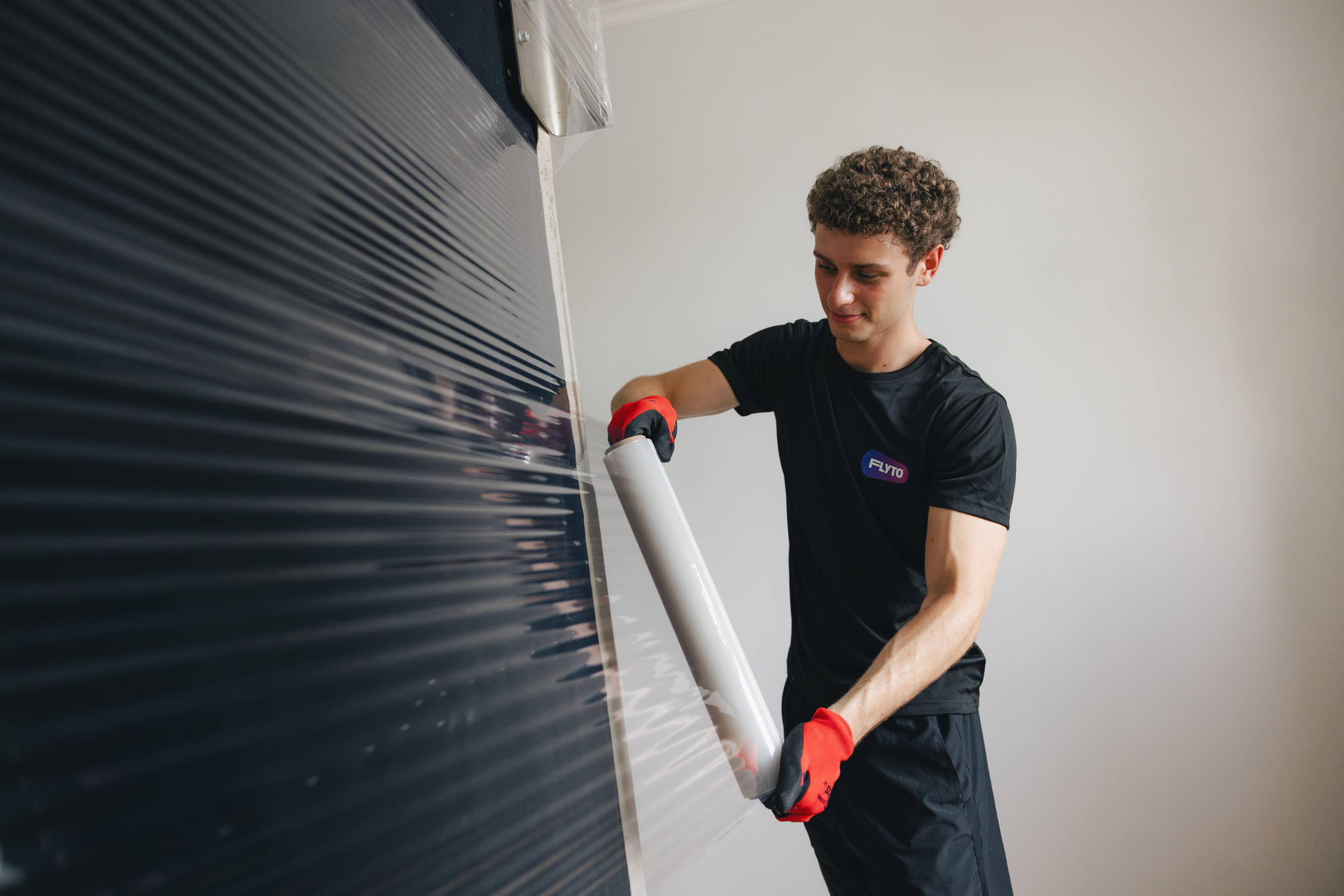
Flyto runs its own offices, warehouses, and moving teams across Northern, Central and Southern Europe, so your packing, Dutch export documentation, and consolidation into Rotterdam or Amsterdam is handled in-house rather than outsourced. For the ocean or air leg to Ecuador and last-mile delivery, we work through a carefully vetted network of freight partners and subcontractors, plus trusted local partners on the ground in Ecuador who understand SENAE’s sworn-declaration and inspection process. That combination keeps the European side under our direct control while giving you experienced local handling for Ecuadorian customs clearance.
Frequently asked questions
Do I need an Ecuadorian residence visa before I can ship my household goods duty-free?
Yes for foreign nationals — the menaje de casa exemption for non-Ecuadorians is granted against a valid temporary or permanent residence visa, or a guarantee if the visa is still in process (Aduana del Ecuador).
Can I bring my car from the Netherlands to Ecuador?
Not duty-free if you’re not an Ecuadorian citizen — foreigners are excluded from importing a vehicle under the menaje de casa regime entirely (gob.ec — SENAE).
What happens to my Dutch tax return the year I leave?
You file the M-form (M-biljet) for that year, splitting it into a resident and non-resident period; afterward you file as a foreign taxpayer for any remaining Dutch-source income (Belastingdienst).
Do I need to deregister from my Dutch municipality even if I keep my house there?
Yes, if you’ll be outside the Netherlands more than 8 months in a 12-month period — keeping the property doesn’t exempt you from BRP deregistration (RVIG).
How much cash can I carry when I fly out?
Above €10,000 (or equivalent) leaving the Netherlands, declare it to Douane before departure; above US$10,000 entering or leaving Ecuador, file Ecuador’s FRA online (Douane; Aduana del Ecuador).
Can my pet fly in the cabin with me into Ecuador?
Yes, if your dog or cat travels in-cabin or is handed over with checked baggage, nationalization only needs the origin country’s Certificado Zoosanitario de Exportación — cargo-hold pets need an additional import permit filed 72 hours ahead (Agrocalidad).
Sources
- Douane — Internationaal spullen verhuizen (overview)
- Douane — Spullen verhuizen naar Nederland vanuit een niet-EU-land (returning-resident relief)
- Douane — Aangifte bij €10.000 of meer
- RVIG — Ik ga verhuizen naar het buitenland
- RVIG — Wanneer moet ik mij uit de BRP laten uitschrijven
- Belastingdienst — Aangifte doen over het jaar van emigratie (M-biljet)
- NVWA — Mijn hond of kat mee naar een land buiten de EU
- Port of Rotterdam — Container shipping
- Cancillería del Ecuador — Visa residencia temporal
- gob.ec — Visa de residencia temporal rentista
- gob.ec — SENAE: Autorización de despacho y nacionalización de menaje de casa
- Aduana del Ecuador (SENAE) — Para Migrantes
- Aduana del Ecuador (SENAE) — Viajeros por vía aérea (FRA cash declaration)
- Agrocalidad — Ingreso al Ecuador de animales de compañía (perros y gatos)
- Agrocalidad — Salida de animales de compañía (perros y gatos)