

Moving from Estonia to Qatar (2026): Complete Guide

Relocating from Estonia to Qatar means moving your life out of the European Union’s customs territory and into a Gulf Cooperation Council (GCC) state built almost entirely around employer-sponsored residence. That makes this a two-sided move: an export/departure process governed by the Estonian Tax and Customs Board and the Population Register, and an import/arrival process governed by Qatar’s General Authority of Customs and its sponsorship system. This guide covers both halves in order, plus a short note on returning to Estonia. It is written for a resident of Estonia — an Estonian citizen or a long-term foreign resident — shipping household goods, and possibly a pet or vehicle, to Doha.
Key takeaways
- Used personal effects and household items enter Qatar duty-free; general goods carry a 5% GCC tariff. Personal belongings and used household appliances are exempted, while ordinary cargo pays 5% on CIF value (Invest Qatar – Customs; trade.gov – Qatar Import Tariffs).
- Your Qatar residence status controls everything. Duty-free clearance requires a valid Qatar ID (QID) or residence permit and a sponsor’s no-objection letter, both tied to employer sponsorship, and used household goods must be imported within six months of arrival (Invest Qatar – Customs).
- On the Estonia side, small consignments leave freely; larger ones need an export declaration. Goods of a commercial nature above €1,000 or 1,000 kg must be declared; below that they can pass the green channel (EMTA – Declaration of goods).
- Update the Estonian Population Register. A notice of residence must be submitted within 30 days when relocating to a foreign state (Ministry of the Interior).
- End your Estonian tax residency formally with Form R. Leaving does not automatically change your status (EMTA – Determining residency).
- Pets need paperwork on both ends: an EU pet passport, microchip and rabies vaccination from Estonia (PTA), plus a Qatar import permit and health certificate (Hukoomi – government services portal).
- Declare cash and valuables of QAR 50,000 or more to Qatar customs on arrival (GAC – Travellers currency declaration).
1. How your Qatar immigration status determines customs treatment
In Qatar, customs treatment of your shipment is inseparable from your immigration status. Nearly all expatriates live and work in Qatar under an employer-sponsored Work Residence Permit (RP), which produces the Qatar ID (QID). When your unaccompanied household goods arrive, the General Authority of Customs (GAC) processes the import under your personal name, and clearance of used personal effects depends on you holding that residency and providing a no-objection letter from your Qatari sponsor or employer — typed in Arabic on company letterhead — together with your residence permit and a list of items (Invest Qatar – Customs; GAC – Exemptions for individuals).
Because residency procedures must be completed after you enter Qatar, timing matters: if your container arrives before your QID is issued, clearance can stall and storage charges accrue. The practical sequence is to enter on your work visa, complete RP formalities, obtain the QID, then time the sea shipment to land afterwards. Non-Qatari residents are generally expected to import their used household items within six months of arrival. Personal effects and used household items are exempt from the 5% duty, but that exemption is applied through your residency-linked clearance — it is not automatic for anyone.
2. The Estonia export side
The authority. Estonia’s customs and tax administration is the Estonian Tax and Customs Board (Maksu- ja Tolliamet, EMTA). All goods leaving the EU customs territory must be covered by a customs declaration or equivalent act (EMTA – Export).
Export declaration and thresholds. For a private person, goods of a commercial nature not exceeding €1,000 and not exceeding 1,000 kg may be declared orally or by passing through the green "nothing to declare" channel. Where the value exceeds €1,000 or the quantity exceeds 1,000 kg — or where a special authorisation applies — you must lodge an export declaration, filed electronically in the e-MTA environment (Customs → Export → Export declarations (AES)), on paper, or through a licensed customs agency (EMTA – Declaration of goods). A full household container shipped by sea will almost always exceed these limits, so budget for a formal export declaration, typically handled by your freight forwarder.
Deregistration / leaving process. The act that officially tells the Estonian state you have left is updating your address in the Population Register (rahvastikuregister). When you settle abroad you must submit a notice of residence within 30 days of relocating to a foreign state, giving your new foreign address and the date of the move (Ministry of the Interior – Notice of residence). You can do this online via the state portal (Eesti.ee) or at your local municipality. This step is also what protects you from being treated as still resident for various obligations.
Tax-residency exit. Departure alone does not end your Estonian tax residency. You notify EMTA by submitting the application for determination of residency (Form R); EMTA then issues a decision, and your status changes to non-resident from the day following your departure if you no longer meet the residency tests (a place of residence in Estonia, or 183 days over 12 consecutive months). If you move to a country with which Estonia has a tax treaty, provide a foreign tax-residency certificate to avoid double taxation. You may also need to file a final income tax return covering income up to the date residency ends (EMTA – Determining residency). Note that Estonia and Qatar’s tax relationship differs from EU-internal moves, so confirm your specific situation with EMTA.
3. Ports and transit times
In Estonia, the country’s main cargo gateway is Muuga Harbour, part of the Port of Tallinn, located about 17 km east of Tallinn. It is Estonia’s biggest cargo port — one of the deepest (natural depth up to 18 m) and few ice-free ports in the region — handling containers, Ro-Ro and general cargo (Port of Tallinn – Muuga Harbour). Air freight and accompanied baggage move through Tallinn Airport.
In Qatar, sea cargo arrives at Hamad Port, Qatar’s principal deep-water seaport south of Doha, operated by Mwani Qatar (Mwani Qatar – Hamad Port). Air shipments arrive at Hamad International Airport’s cargo terminal (Hamad International Airport – Cargo).
Transit times — freight-industry estimates, not official figures. There is no direct container line from Estonia to Qatar, so sea freight is routed via a hub (commonly a Northern European or Mediterranean transhipment port). As a planning estimate only, allow roughly 5–8 weeks door-to-port for sea freight and 1–2 weeks for air freight, plus clearance time on each end. These ranges are typical forwarder estimates and are not published by either customs authority; actual timing depends on sailing schedules, transhipment and inspections. Note that Qatar may subject shipments to physical inspection, which adds time at Hamad Port.
4. The Qatar import side
Qatar clears customs through Al Nadeeb, the electronic Customs Clearance Single Window, which handles declaration submission, clearing-agent authorisation, duty calculation and payment (Invest Qatar – Customs; Hukoomi – Al Nadeeb). Your appointed clearing agent lodges the customs declaration in Al Nadeeb on your behalf.
For a household move, expect to provide: a detailed inventory/packing list; a no-objection letter in Arabic from your sponsor/employer on company letterhead; copies of your passport and QID / residence permit; and an online authorisation for your clearing agent before the goods arrive (Invest Qatar – Customs). Used personal effects and household items are exempt from the 5% duty, while any new or commercial goods are dutiable at 5% of CIF value (Invest Qatar – Customs; trade.gov – Qatar Import Tariffs). Verify that nothing in your shipment is restricted or prohibited — alcohol, pork products and certain media are controlled — before packing.
5. Pets
Leaving Estonia (EU side). Estonia’s competent authority is the Agriculture and Food Board (Põllumajandus- ja Toiduamet, PTA). Dogs and cats need a microchip, a valid rabies vaccination given after microchipping and no earlier than 12 weeks of age, and an EU pet passport issued by an authorised vet. For a non-EU destination you must also obtain the veterinary export certificate required by the destination country, applied for through the PTA customer portal or a county veterinary office (PTA – Travelling with a pet).
Entering Qatar. Qatar’s Ministry of Municipality (Animal Resources Department) issues the mandatory pet import permit. Dogs and cats must generally be microchipped, vaccinated against rabies, and travel with a health certificate from the country of export; depending on the country of origin, a rabies neutralising antibody titre test (RNATT) from a recognised laboratory may also be required, so confirm the current requirement before travel. The import permit must be obtained before arrival and is typically short-dated, so time your application to your travel (Hukoomi – government services portal). Qatar also restricts certain dog breeds, and large or dangerous breeds require additional permission — confirm your breed is permitted before booking. For EU-side rules and certificate models, the European Commission’s guidance is the reference point (European Commission – Bringing a pet into the EU from a non-EU country).
6. Vehicles, money and things people forget
Vehicles. Unlike used household effects, a car is not duty-exempt — vehicles are dutiable. Qatar also applies conformity and age controls on imported used vehicles, and the owner must be a Qatar resident before registration. Because these rules are technical and change, confirm eligibility and any certificate-of-conformity requirement directly with the GAC before shipping any car — for many movers, selling in Estonia and buying locally is simpler.
Money. You must complete a customs declaration when entering or leaving Qatar carrying cash, negotiable instruments, precious metals or precious stones valued at QAR 50,000 or more (about USD 13,700), under Qatar’s anti-money-laundering rules (GAC – Travellers currency declaration). On the EU side, cash of €10,000 or more must be declared when leaving the Union.
Easily forgotten items. Cancel or transfer your Estonian health insurance and Health Insurance Fund (Tervisekassa) entitlements once you deregister; settle any final EMTA obligations; keep documents proving prior ownership and use of goods (useful for a future return); and do not attempt to ship alcohol, pork or restricted media into Qatar. Because RP procedures in Qatar must be completed shortly after entry, line up your sponsor paperwork before you fly.
Reverse direction (Qatar → Estonia). Returning to Estonia from outside the EU, you can import personal property free of import duty under transfer-of-residence relief, provided your normal place of residence was outside the EU for a continuous period of at least 12 months and you owned and used the goods for at least 6 months before the move. Goods may arrive in several consignments within 12 months of settling, but cannot be sold or transferred during that period without notifying customs (EMTA – Moving to Estonia).
How Flyto handles your Estonia to Qatar move
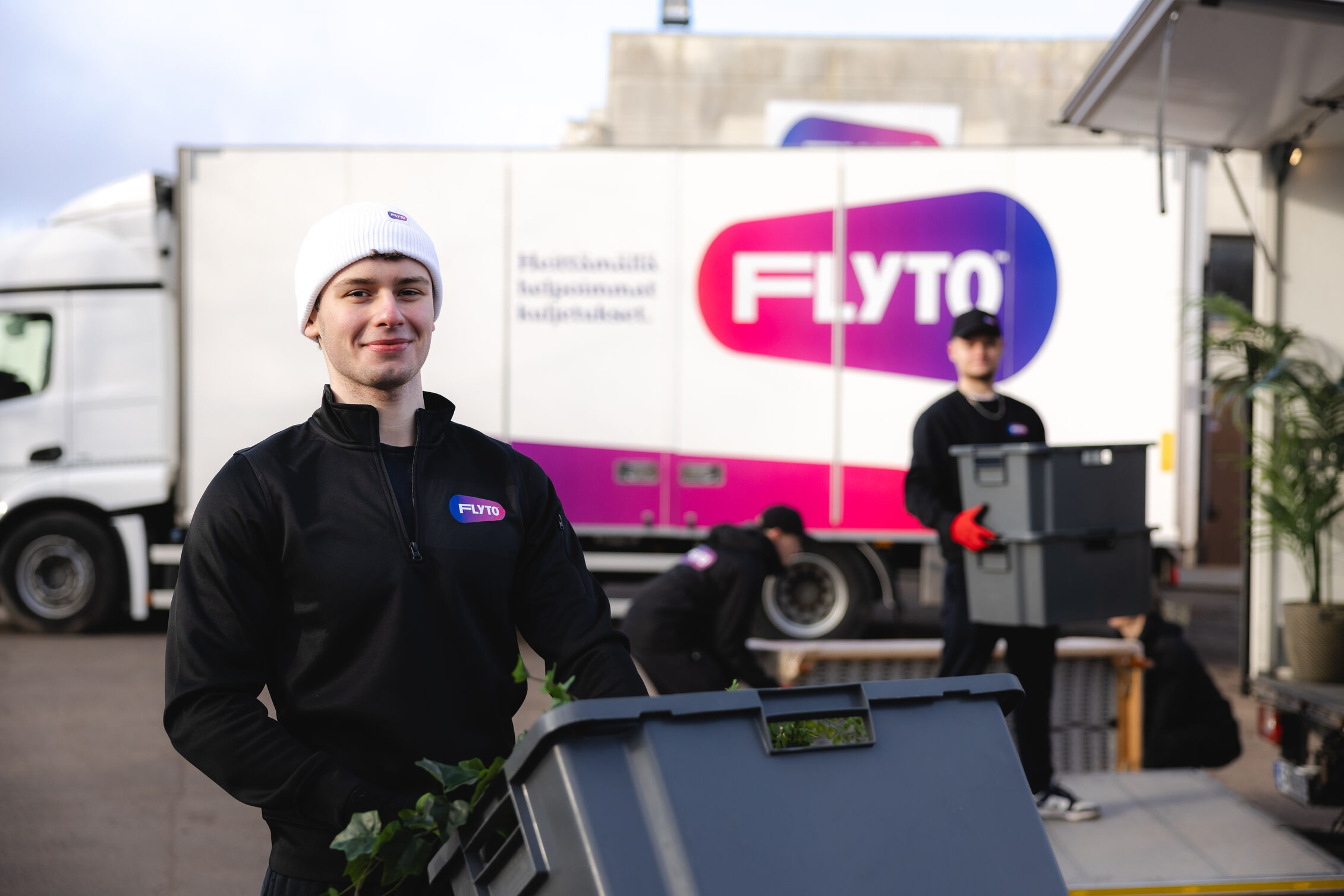
Flyto runs strong in-house operations across Europe — our own offices, warehouses, teams and vehicles in Northern, Central and Southern Europe handle collection and export from Estonia directly. For the long-haul leg and the Qatar arrival we combine a carefully chosen network of vetted freight partners and subcontractors with trusted local agents in Doha for customs clearance and delivery. We coordinate the whole corridor end to end, but we are honest that the Gulf leg relies on our partners rather than our own trucks.
Frequently asked questions
Do I pay customs duty on my used furniture in Qatar?
No. Used personal effects and household items are exempt from Qatar’s 5% duty, provided they clear under your residency with a sponsor’s no-objection letter (Invest Qatar; trade.gov).
Do I need a residence permit before my goods arrive?
Effectively yes. Clearance requires your QID/residence permit and sponsor letter, so time the sea shipment to arrive after your RP is issued (Invest Qatar).
Do I have to file an export declaration in Estonia?
For a full household shipment, yes — goods over €1,000 or 1,000 kg need an export declaration, filed in e-MTA or via an agent (EMTA).
How do I stop being an Estonian tax resident?
Submit Form R to the Estonian Tax and Customs Board and update the Population Register; departure alone is not enough (EMTA; Ministry of the Interior).
Can I bring my dog?
Yes, with a microchip, rabies vaccination, health certificate (and, depending on origin, an RNATT titre test), plus a Qatar import permit obtained before arrival — and only if the breed is permitted (PTA; Hukoomi).
How much cash can I carry into Qatar?
There is no set limit, but QAR 50,000 or more in cash or valuables must be declared to customs on arrival (GAC).
Sources
- EMTA – Declaration of goods (leaving the EU)
- EMTA – Export
- EMTA – Determining tax residency (Form R)
- EMTA – Moving to Estonia (transfer-of-residence relief)
- Estonian Ministry of the Interior – Submission of a notice of residence
- Eesti.ee – State portal
- Agriculture and Food Board (PTA) – Travelling with a pet
- European Commission – Bringing a pet into the EU from a non-EU country
- Port of Tallinn – Muuga Harbour
- General Authority of Customs – Exemptions for individuals
- General Authority of Customs – Travellers / currency declaration
- Hukoomi – Al Nadeeb Customs Clearance Single Window
- Hukoomi – Government services portal
- Invest Qatar – Customs laws and regulations
- Mwani Qatar – Hamad Port
- Hamad International Airport – Cargo
- trade.gov – Qatar Import Tariffs