

Best International Moving Companies in Spain 2026

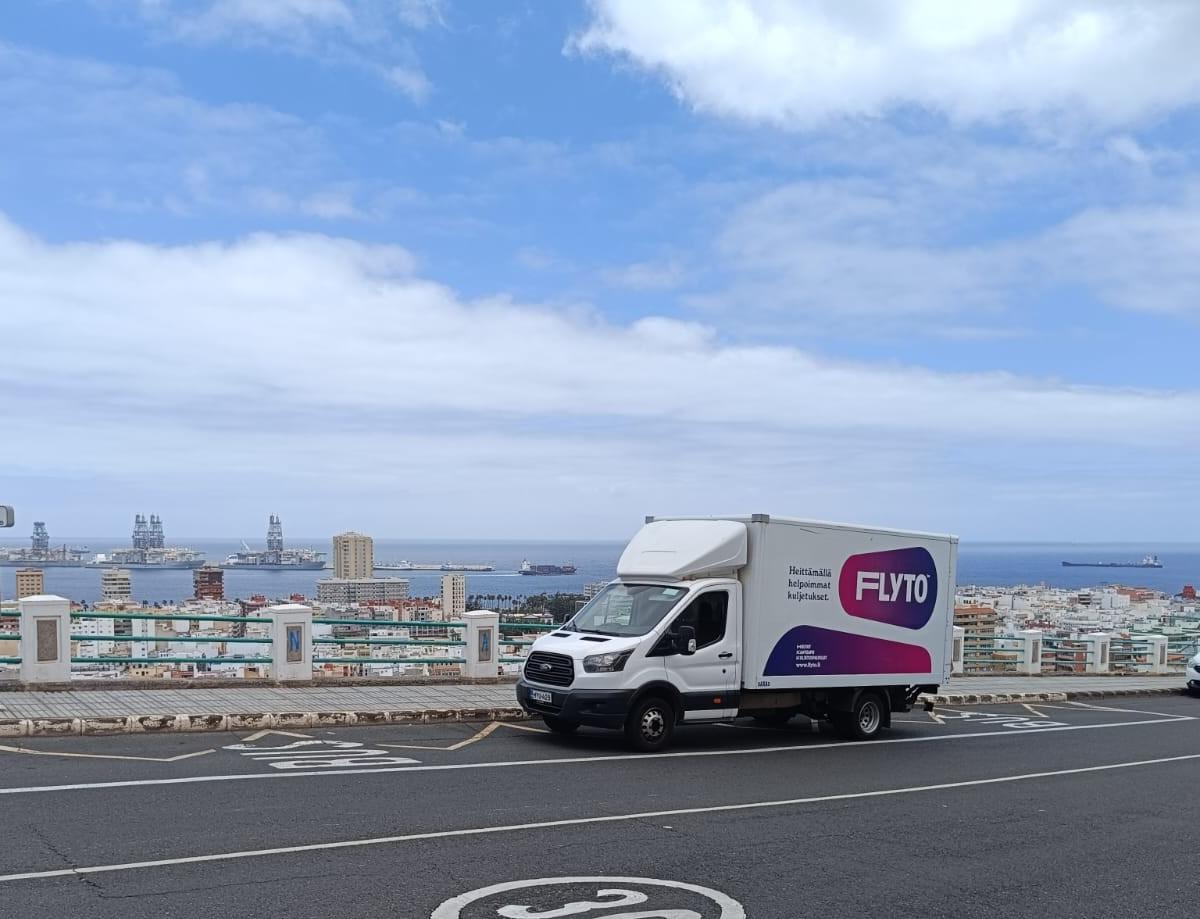
International removals to Spain — what a move costs and how it works
Spain is the busiest international removals destination in Europe: retirees to the Costa del Sol and Alicante, families to Madrid and Barcelona, remote workers to Valencia and Málaga. Flyto arranges door-to-door removals to Spain from the UK, Ireland, the Nordics, Germany, the Netherlands and the rest of Europe through its own hubs in Northern, Central and Southern Europe — with one fixed price agreed before loading.
Indicative 2026 market ranges (not a Flyto quote — every move is priced on volume, distance and access): a one-bedroom flat of 10–15 m³ typically lands at €1,800–€3,500 from Northern Europe; a family home of 25–35 m³ at €4,000–€8,000. UK origins add customs paperwork since Brexit — household goods you have owned for 6+ months are duty-free under Transfer of Residence, but the declaration must be right. Groupage (shared load) keeps smaller moves affordable; a dedicated vehicle is faster. Typical transit: 3–7 days from the UK or Germany, 5–10 days from the Nordics.
Get an exact price in two minutes: instant quote for your removal to Spain. Below you will find the criteria we use to compare international removal companies for Spain, and where Flyto fits.
What this page is, and what it is not
Most ”best international moving companies in Spain” pages are a list of ten logos with a star rating next to each. This one is written by a company that moves households to and from Spain every week, and it tries to answer the questions that actually decide whether a Spanish move goes well: which route your goods will take, when the trucks run, what the Spanish end of the move looks like street by street, what a realistic budget is, and how to tell a serious removals company from a lead-generation website. We name competitors where it is useful and we say plainly where Flyto is the wrong choice.
How removals to Spain actually run
Spain is at the end of Europe’s road network, which shapes everything. From the UK and Ireland, a truck crosses the Channel at Calais or takes the ferry from Portsmouth to Bilbao or Santander, then runs down the A-1 or the Mediterranean corridor; from the Netherlands, Belgium and Germany it comes through France on the A-7/AP-7 to Barcelona and Valencia or through the Basque Country to Madrid; from the Nordics it is a two-day drive before the truck even reaches Germany. That is why Spain moves are almost always consolidated: several households on the same corridor share one vehicle, loaded over two or three days in the origin region and delivered over two or three days along the Spanish coast.
Flyto runs this from its Southern European hub. Loads from the UK, Ireland, the Nordics, the Netherlands, Belgium and Germany are collected by our crews or vetted partners, brought to the hub, and delivered on the Costa del Sol, Costa Blanca, in Madrid, Barcelona, Valencia and the Balearics by teams that do this route every week. A dedicated vehicle – your goods only, fixed loading and delivery dates – is available for larger homes or tight deadlines and costs more per cubic metre.
Transit, door to door: 3–5 days on a dedicated vehicle from the UK, Netherlands or Germany; 6–10 days consolidated; 7–12 days from Finland, Sweden or Norway. The Balearics and Canaries add a ferry leg and two to four days.
Where people move to, and what each destination costs
The Costa del Sol – Málaga, Torremolinos, Fuengirola, Mijas, Marbella, Estepona – takes the largest share of British, Irish, Dutch and Scandinavian arrivals, followed by the Costa Blanca (Alicante, Torrevieja, Jávea, Dénia), Madrid and Barcelona for professionals, Valencia for remote workers, and the Balearics. Flyto’s own enquiry data confirms it: Spain is the destination in 17 % of all international moving enquiries we receive across Europe, and the Netherlands→Spain corridor alone is the single largest route in our data.
Indicative 2026 market ranges, door to door, for a consolidated move (not a Flyto price list – every move is priced on volume, route and access):
| From | 1-bed flat, 10–15 m³ | 3-bed house, 25–35 m³ | Typical transit |
|---|---|---|---|
| UK (London / South) | £1,900–£3,400 | £4,200–£7,500 | 5–10 days |
| UK (North / Scotland) | £2,200–£3,800 | £4,800–£8,200 | 6–11 days |
| Ireland | €2,400–€4,200 | €5,000–€8,800 | 6–11 days |
| Netherlands / Belgium | €2,000–€3,600 | €4,200–€7,800 | 4–8 days |
| Germany / Switzerland | €2,100–€3,800 | €4,500–€8,500 | 4–8 days |
| Sweden / Norway / Finland | €2,800–€4,800 | €5,500–€9,500 | 7–12 days |
Get your fixed price (2 min) →
A dedicated vehicle typically adds 30–60 % to these figures and removes the delivery window. The Balearics add €400–€900 for the ferry. Prices exclude storage if your Spanish property is not ready, and any town-hall parking permit or exterior lift needed at the delivery address – both of which we price in advance rather than invoice afterwards.

The Spanish end of the move: what goes wrong, and why
Almost every problem on a Spanish move happens at the delivery address, not on the motorway. Urbanisations on the Costa del Sol and Costa Blanca have gates, delivery hours and internal roads built for cars; a 7.5-tonne truck cannot enter, so the crew shuttles from the road with a smaller vehicle – if that has been planned. Old-town streets in Málaga, Nerja, Altea, Palma and the Barcelona Gothic quarter take a 3.5-tonne van at most, and Marbella, Málaga and Fuengirola require a town-hall street-occupation permit ordered weeks ahead (Málaga a month). Apartments in Torremolinos, Benidorm and Benalmádena have lifts that take a person, not a sofa – an exterior lift (elevador) is normal and costs €150–€350. Fincas inland mean tracks, gradients and reversing a truck onto a yard.
We ask about all of this before we quote – urbanisation name, street width, floor, lift, parking – and put the answer into the fixed price. A cheap quote that did not ask is a quote that will be corrected on the day.
Customs and paperwork: EU origins versus the UK and non-EU origins
From an EU country – the Netherlands, Belgium, Germany, Ireland, the Nordics – there is no customs on household goods. From the UK, Switzerland or Norway there is. Household goods owned for at least six months are imported into Spain duty- and VAT-free when you move your residence, under Transfer of Residence relief, but only with the right paperwork: your NIE, proof of at least 12 months’ residence outside the EU, proof of your Spanish address (escritura, rental contract or padrón) and an itemised inventory in Spanish. The goods must arrive within 12 months of establishing residence and cannot be sold for a year. New items, alcohol and anything for a second home rather than a residence are taxed at 21 % VAT plus duty.
Since Brexit, British citizens also need a visa to live in Spain – non-lucrative, digital nomad, work or family – applied for from the UK, two to three months in advance. The single most common mistake we see is booking the truck before the visa and NIE exist. We sequence the move around the paperwork, not the other way round.
What separates a removals company from a lead-generation site
Search for movers to Spain and the first page is mostly comparison and quote-matching sites – Sirelo, MoveHub, reallymoving and their equivalents in Dutch and German. They are useful for collecting quotes; they do not move anything, and the companies behind the quotes vary enormously. The questions that separate a serious mover from the rest:
- Who loads and who delivers? A company that names its Spanish delivery partner and can describe the delivery address’s constraints has done the route before.
- Is the price fixed before loading? Volume-based fixed pricing with the access conditions written in is the standard; hourly or ”estimated” quotes are where surprise charges live.
- What happens with customs? For UK, Swiss and Norwegian origins, a mover that cannot explain Transfer of Residence in one paragraph should not be handling it.
- Insurance: transit insurance by declared value, not just the carrier’s liability per kilogram.
- Verifiable reviews: a Google Business Profile with hundreds of reviews and a company registration you can check, rather than star badges on the company’s own site.

Who else moves to Spain – an honest map of the market
From the UK: PSS International Removals, Britannia Movers International, Simpsons International Removals and Bournes are established British international removers with regular Spain services; online marketplaces such as AnyVan and part-load specialists cover the budget end. Global networks: AGS, Crown and Santa Fe have Spanish branches and suit corporate-paid moves. Spanish firms: Gil Stauffer, Grupo Amygo, Mudinmar, La Vascongada and Mudanzas Flippers run the domestic end and inbound routes from Europe. Where Flyto fits: households moving to Spain from the Nordics, the Benelux, Germany, the UK and Ireland who want one contract, a fixed price and a company that actually plans the delivery address – and who do not need a global corporate-mobility programme. If you need a Spanish company with a depot in Marbella for a local move, we are the wrong choice and will say so.
A Spain move, step by step
8–10 weeks before: volume estimate (room-by-room calculator or a 15-minute video survey), fixed quote, decision between consolidated and dedicated, visa and NIE started if you are coming from the UK. 4–6 weeks before: dates confirmed, packing materials delivered, Transfer of Residence paperwork assembled, town-hall permit ordered for the Spanish address. 1–2 weeks before: packing (yours or ours), inventory with photographs, customs declaration filed for non-EU origins. Moving day: loading, inventory signed, goods to the Southern European hub or straight onto the dedicated vehicle. Delivery: crew arrives in the agreed window, shuttle vehicle or exterior lift if planned, furniture reassembled, packing material removed, inventory signed off.
A worked example: a two-bedroom flat from Manchester to Fuengirola
Volume estimated by video survey at 18 m³ – sofa, two beds, wardrobes, kitchen boxes, bikes. Consolidated load, collected in Manchester on a Tuesday, delivered to a fourth-floor flat in Fuengirola with a lift that takes boxes but not the sofa. What the fixed price covers: collection with two crew, blankets and stretch wrap on furniture, 25 boxes of packing material, Channel crossing, UK export and Spanish Transfer of Residence declaration prepared from the photographed inventory, town-hall parking permit for the delivery street, an exterior lift for the sofa and wardrobes, delivery within a three-day window nine days after collection, reassembly and removal of packing material. Indicative market cost for this profile in 2026: £3,000–£4,200. What is not in it, and would be quoted separately: storage if the flat’s keys came late, and packing of the kitchen if the customer preferred not to do it. The same move on a dedicated vehicle with a fixed delivery day: roughly £4,500–£5,800.

Spain-specific practicalities that change what you bring
Appliances: Spain runs on 230 V with Schuko sockets, so European appliances work with no adapter and British ones with a plug change; gas appliances certified for the UK are not legal to connect to Spanish butane or mains gas. Cars: an EU-registered car can be re-registered in Spain within six months; a UK right-hand-drive car can be imported duty-free under Transfer of Residence but must be re-registered, tested and, in practice, is a compromise most people sell before they move. Pets: EU pet passport from an EU origin; from the UK an animal health certificate issued within 10 days of travel, microchip and rabies vaccination. Furniture: Spanish flats are smaller than Northern European houses and often furnished; a video survey usually removes a third of the volume once people see the floor plan. Climate: untreated wood and leather suffer in coastal humidity; we wrap and ventilate, but a wardrobe that has stood in a dry Finnish house for twenty years will move in a Málaga summer.
Moving from Spain back home
The same corridors run in reverse every week: Spain to the UK (UK Transfer of Residence relief, ToR1, applied for before the goods travel), Spain to the Netherlands, Belgium and Germany (no customs), Spain to the Nordics. Return moves are often smaller – furniture bought for a Spanish flat rarely fits a Northern European house – and consolidate well. If you are leaving Spain, tell the Agencia Tributaria and the padrón, close the NIE-linked bank account after the last bills, and book four to six weeks ahead outside the summer.
Seasonality: when to move to Spain
Demand peaks from June to September and at month-ends; February and November are the quietest and cheapest. In our own enquiry data, 63 % of planned European moves fall in July, August and September. If your dates are flexible, a consolidated move in the off-season is the best value on this route; if you must move in August, book eight weeks ahead and accept a delivery window rather than a day.
Frequently asked questions
How long do international removals to Spain take?
Three to five days door to door on a dedicated vehicle from the UK, the Netherlands or Germany; six to ten days consolidated; seven to twelve days from the Nordics. Add two to four days for the Balearics.
Do I pay import duty on my furniture?
Not from an EU origin. From the UK, Switzerland or Norway, household goods owned six months are duty- and VAT-free under Transfer of Residence relief, provided you are moving your residence and have the NIE and address paperwork. Second-home moves are taxed.
Can you deliver to a gated urbanisation or an old-town flat?
Yes. We plan the shuttle vehicle, the exterior lift and the town-hall parking permit in advance and include them in the fixed price.
Is a consolidated (part-load) move safe?
Yes. Each household’s goods are labelled, inventoried and photographed separately, and transit insurance covers the full route.
When should I book?
Four to six weeks ahead outside the peak; eight weeks ahead for June–September. UK origins should start visa and NIE two to three months before the move.
Do you move from Spain back to the UK, the Netherlands or the Nordics?
Yes – the same crews and routes run in reverse, and we handle UK Transfer of Residence (ToR1) for moves home to Britain.
Get a fixed price for your move
Enter your volume and both addresses and you get a door-to-door price in about two minutes – in your language, with access conditions, ferries, tolls and customs paperwork included. No volume yet? The calculator estimates it room by room.