

Moving from Poland to Kazakhstan (2026): Complete Guide

Relocating from Poland to Kazakhstan means exiting the European Union’s customs and tax system on one end and entering the Eurasian Economic Union (EAEU) customs system on the other — two frameworks with different authorities, forms, and deadlines. This guide is for a resident of Poland — an employee transferring with a company, a family joining a spouse, or anyone relocating long-term to Almaty, Astana, or elsewhere in Kazakhstan. It covers both halves: what Poland requires as you leave (deregistration, tax residency, export customs), and what Kazakhstan requires as you arrive (passenger customs declaration, duty-free allowances, vehicle and pet rules), plus a short note on the reverse move, Kazakhstan back to Poland.
Key takeaways
- Poland’s customs authority is the Krajowa Administracja Skarbowa (KAS) — National Revenue Administration — which administers all export declarations through the PUESC electronic platform (gov.pl – KAS; puesc.gov.pl – export services).
- You must report your departure abroad (zgłoszenie wyjazdu za granicę) no later than the day you leave, either online or at your local urząd gminy; a permanent departure deregisters you from both permanent and temporary residence, while a departure over six months without permanent intent clears only the temporary registration (gov.pl – Zgłoś wyjazd za granicę).
- Your Polish tax residency ends only when you no longer meet either of two independent tests: more than 183 days present in Poland in a tax year, or a "centre of vital interests" (personal or economic) still in Poland (biznes.gov.pl – taxing foreign income).
- Carrying €10,000 or more in cash (or equivalent) into or out of the EU must be declared to customs (Your Europe – carrying cash).
- Kazakhstan’s duty-free personal baggage allowance depends heavily on how you cross the border: up to €10,000 / 50 kg by air, but only €500 / 25 kg by any other mode of transport or on foot — anything above that is charged 30% duty on the excess, minimum €4/kg (State Revenue Committee (KGD) – information for individuals).
- A full duty exemption for a household-goods "permanent resettlement" is documented for people who hold kandas (ethnic-Kazakh repatriate) status — an ordinary work or residence permit does not automatically unlock it, so most Polish movers should plan around the standard baggage allowances above (egov.kz – rules for importing goods for personal use).
- Pets need a veterinary health certificate and current rabies vaccination; Poland’s exporting authority explicitly defers to the destination country’s rules, and Kazakhstan’s import rules are set by the Committee for Veterinary Control and Supervision (wetgiw.gov.pl – travel with pets outside the EU; gov.kz – Committee for Veterinary Control and Supervision).
- Bringing a car into Kazakhstan means meeting the Euro-5 emissions class in force since 2018, a temporary-import customs procedure, and registration with the traffic police using the customs import declaration (egov.kz – vehicle registration).
1. Why your Kazakhstan immigration status decides your customs treatment
Kazakhstan applies the EAEU Customs Code, under which the duty treatment of your belongings depends first on how you are classified when you cross the border, not simply on the fact that you’re moving house. An ordinary traveller — including someone arriving on a work or residence permit — clears personal effects under the standard accompanied/unaccompanied baggage allowance (see thresholds below). A separate, more generous exemption for "permanent resettlement" exists, but Kazakhstan’s own guidance ties it most explicitly to kandas (ethnic-Kazakh repatriate) status under the Voluntary Resettlement Programme (egov.kz – rules for importing goods for personal use). A Polish national moving for work or family should not assume an automatic duty-free household shipment — budget for the standard allowance and confirm your case with the State Revenue Committee or a licensed broker beforehand. Foreign individuals and companies generally cannot lodge formal cargo customs declarations directly in Kazakhstan; that must be done by a Kazakhstan-registered entity or a licensed customs broker (kgd.gov.kz – customs clearance).
2. The Poland export side: authority, deregistration, tax exit
Customs authority. All Polish customs matters — including export declarations for goods leaving the EU customs territory — sit with the Krajowa Administracja Skarbowa (KAS), the National Revenue Administration (gov.pl – about KAS). Because Kazakhstan is outside the EU customs union, household goods leaving Poland cross the EU’s external customs border and must go through an export declaration on PUESC (Platforma Usług Elektronicznych Skarbowo-Celnych), Poland’s electronic customs and tax portal. Since 31 October 2024, Poland’s export system runs as AES/ECS2 PLUS; the exit-confirmation message is now called CC599C, carrying the movement reference number (MRN) and confirmed exit date, and it replaced the older IE599 message (puesc.gov.pl – export of goods). A mover or customs agent normally files this, but it is your MRN — keep the confirmation for Kazakh customs on arrival.
Deregistration. Polish law requires you to report a departure abroad — zgłoszenie wyjazdu za granicę — if leaving permanently, or for longer than six months without intending to return. Report no later than the day you leave, either online (via the gov.pl profile) or in person at your local urząd gminy. A permanent departure deregisters you from both permanent and temporary residence; a departure over six months without permanent intent only clears the temporary registration, and you must report your eventual return (gov.pl – Zgłoś wyjazd za granicę).
Tax residency exit. Poland taxes residents on worldwide income under "unlimited tax liability." You stop being a Polish tax resident only once you no longer satisfy either of two independent tests: presence in Poland exceeding 183 days in the tax year, or a "centre of vital interests" — personal or economic ties — still located in Poland (biznes.gov.pl – where to pay tax on foreign income). Selling a Polish property, closing bank relationships, and moving your family with you are the kind of evidence that shows your centre of interests has genuinely shifted to Kazakhstan; the tax office can reassess residency retroactively if ties to Poland persist, so keep documentation.
3. Ports and transit: real routes, industry-estimated timings
Kazakhstan is landlocked, so a Poland-to-Kazakhstan move never involves a direct sea leg to a Kazakh port — it is either full multimodal routing (sea/land plus transshipment) or airfreight. Poland’s three container-handling seaports are Gdańsk, Gdynia, and the twin port of Szczecin-Świnoujście, each run by its own port authority (Port of Gdańsk; Port of Gdynia; Port of Szczecin-Świnoujście). Since the Belarus–Russia land corridor has been avoided by most Western freight forwarders since 2022, current routing for Poland–Kazakhstan moves typically runs via the "Middle Corridor" (road/rail to the Black Sea or Georgia, ferry across the Caspian, arrival at Kazakhstan’s Caspian ports of Aktau or Kuryk) or by direct airfreight into Almaty or Astana.
The following transit windows are freight-industry estimates only, not official published figures: airfreight from the Warsaw/Gdańsk area to Almaty or Astana runs roughly 1–2 weeks door-to-door including consolidation and customs; multimodal Middle Corridor groupage or full-container shipments run roughly 5–8 weeks, depending on Caspian ferry schedules and border dwell time. Build in extra buffer given the current geopolitical routing constraints.
4. The Kazakhstan import side: passenger declaration and process
Kazakhstan’s customs administration sits with the State Revenue Committee (SRC / KGD) of the Ministry of Finance. Individuals crossing the EAEU customs border into Kazakhstan use the passenger customs declaration system, with duty-free thresholds that differ sharply by transport mode (kgd.gov.kz – information for individuals; egov.kz – passenger customs declaration service):
| Mode | Value limit | Weight limit |
|---|---|---|
| Air | €10,000 equivalent | 50 kg |
| Any other mode / on foot | €500 equivalent | 25 kg |
| International mail / courier | €200 equivalent | 31 kg |
Exceeding these limits triggers a customs duty of 30% on the value above the threshold, minimum €4 per kilogram on any weight overage (egov.kz – rules for importing goods for personal use). A written declaration is mandatory once you exceed these thresholds, carry restricted or commercial-quantity goods, or carry cash or traveller’s cheques above USD 10,000 equivalent (kgd.gov.kz – information for individuals). Because these limits are modest against a full household shipment, most movers will pay some duty on goods above the personal allowance unless they qualify for the Section 1 resettlement exemption — plan for it, and use a licensed local broker for anything shipped separately as unaccompanied baggage or cargo (kgd.gov.kz – customs clearance).
5. Pets: rules on both ends
On the Poland side, there is no single Polish exit rule — the Główny Inspektorat Weterynarii (GIW), Poland’s Chief Veterinary Inspectorate, states plainly that rules for bringing a companion animal into a third country are set by that destination country, and lists country-specific veterinary certificate requirements for outbound travel (wetgiw.gov.pl – travel with pets outside the EU). In practice, this means securing an export veterinary health certificate from a Polish official veterinarian shortly before travel, matching Kazakhstan’s entry requirements.
On the Kazakhstan side, animal-health oversight belongs to the Committee for Veterinary Control and Supervision under the Ministry of Agriculture (gov.kz – Committee for Veterinary Control and Supervision), and the accompanying veterinary document issued at origin must travel with the animal. An import permit is generally required only beyond a small personal number of animals (more than one or two pets, or any commercial import). Build in the rabies-vaccination waiting period and a valid, dated certificate, and reconfirm current requirements with the Kazakh consulate shortly before departure, since animal-health rules can change without much notice.
6. Vehicles, money, and things people forget
Vehicles. A car brought into Kazakhstan must meet the Euro-5 emissions class, in force since 2018. It can be registered on a temporary-import basis, subject to customs procedures, and must then be registered with local traffic police using the customs import declaration as proof (egov.kz – vehicle registration). Confirm current requirements and duration limits with a broker before shipping, since terms change.
Money. Entering or leaving the EU with €10,000 or more in cash (or equivalent) requires a declaration (Your Europe – carrying cash). Entering Kazakhstan, cash and traveller’s cheques at or below USD 10,000 equivalent need not be declared (though you may declare voluntarily); above that, a written declaration on arrival is mandatory (kgd.gov.kz – information for individuals).
Things people forget. Deregistering your Polish address (Section 2) is easy to overlook until it blocks something else — banks, insurers and the tax office all check it. Alcohol above 5 litres (for those aged 18+) and caviar above 250 g are treated as commercial goods in Kazakhstan regardless of your personal allowance (kgd.gov.kz – information for individuals). And since most household shipments exceed Kazakhstan’s modest baggage allowance (Section 4), have an itemised, dated inventory with receipts ready before goods arrive — it directly affects how customs values, and taxes, your excess goods.
Reverse direction: Kazakhstan to Poland. Moving back the other way, the logic flips: you exit through Kazakhstan’s SRC/KGD system and enter the EU through KAS. As an EU citizen returning to reside in Poland (or a third-country national relocating there), Polish household goods brought from outside the EU may qualify for the "mienie przesiedlenia" (transfer-of-residence) duty and VAT exemption — conditional on the goods having been owned and used for at least six months before the move, uninterrupted residence outside the EU for at least twelve months, and no disposal of the goods for 12 months after import (podatki.gov.pl – mienie przesiedlenia, transfer-of-residence exemption). You would also re-register your address in Poland and re-establish tax residency once you again meet the 183-day or centre-of-interests test above.
How Flyto handles your Poland to Kazakhstan move
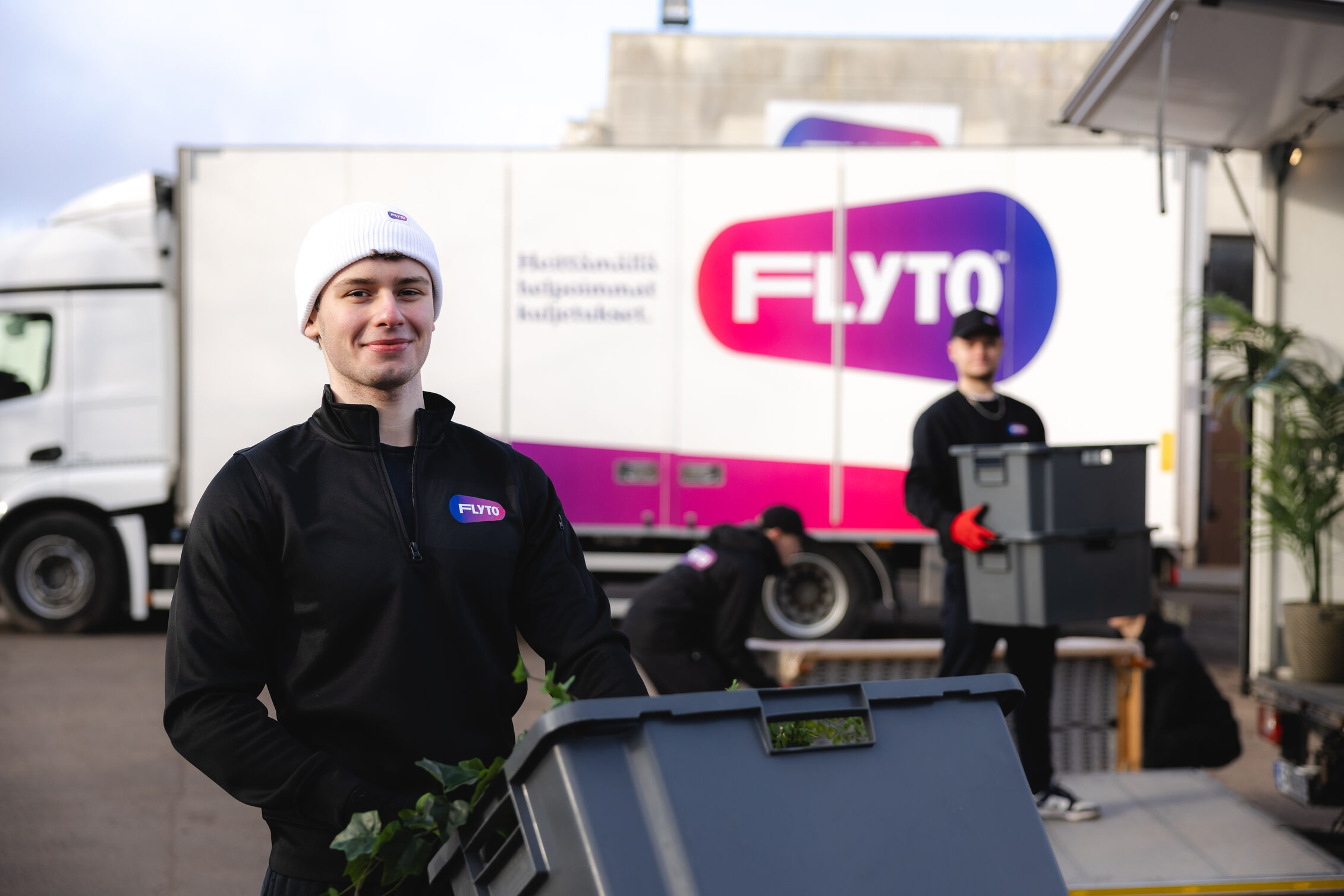
Flyto runs its own offices, warehouses, crews and vehicles across Northern, Central and Southern Europe, so most of the Polish side of your move — packing, transport to the port or airport, and coordinating the KAS/PUESC export declaration — is handled by our own in-house teams. Beyond that, we work with a carefully chosen network of subcontracted freight partners for the long multimodal leg into Kazakhstan, and with trusted local partners on the ground in Kazakhstan who handle the SRC/KGD import declaration and last-mile delivery. You get one point of contact managing both halves of the corridor, even though no single company can realistically own every kilometre between Warsaw and Almaty.
Frequently asked questions
Do I need a customs broker in Kazakhstan? For personal baggage within standard allowances, no — self-declare at the border. For a full unaccompanied household shipment, generally yes: formal cargo declarations must be lodged by a Kazakhstan-registered entity or a licensed customs broker (kgd.gov.kz – customs clearance).
Will my Polish household goods be duty-free in Kazakhstan? Not automatically. Unless you hold kandas status, expect to clear goods under the standard personal baggage allowance (Section 4) and pay duty on anything above it (egov.kz – rules for importing goods for personal use).
When exactly must I report my departure from Poland? No later than the day you leave your place of residence, online or at your urząd gminy (gov.pl – Zgłoś wyjazd za granicę).
How much cash can I take out of Poland without declaring it? Up to just under €10,000 (or equivalent); at or above that, declare it to customs (Your Europe – carrying cash).
Can I drive my Polish car into Kazakhstan? Yes, on a temporary-import basis if it meets Euro-5 emissions standards, followed by registration with local traffic police using your customs import declaration (egov.kz – vehicle registration).
Does Poland set the rules for taking my pet to Kazakhstan? No — Poland’s veterinary authority (GIW) explicitly defers to the destination country’s requirements; you need a Polish export veterinary health certificate meeting Kazakhstan’s entry rules, set by Kazakhstan’s Committee for Veterinary Control and Supervision (wetgiw.gov.pl; gov.kz – vetcontrol).
Sources
- gov.pl – National Revenue Administration (KAS), about us
- puesc.gov.pl – Export of goods (AES)
- gov.pl – Zgłoś wyjazd za granicę (report departure abroad)
- podatki.gov.pl – Mienie przesiedlenia, transfer-of-residence customs exemption
- biznes.gov.pl – Where to pay tax on foreign income
- Your Europe (europa.eu) – Rules for carrying cash
- wetgiw.gov.pl – Travelling with companion animals outside the EU
- Port of Gdańsk – official site
- Port of Gdynia – basic data
- Port of Szczecin-Świnoujście – official site
- kgd.gov.kz – State Revenue Committee, information for individuals
- kgd.gov.kz – Customs clearance
- egov.kz – Rules for importing goods for personal use
- egov.kz – Passenger customs declaration service
- egov.kz – Vehicle registration service
- gov.kz – Committee for Veterinary Control and Supervision