

Moving from Switzerland to Jordan (2026): Complete Guide

Relocating from Switzerland to Jordan is a two-country project, and both halves have to line up before your shipment moves. On the Swiss side you deregister, settle your tax and social-insurance affairs, and clear your household goods for export through the Federal Office for Customs and Border Security (BAZG). On the Jordanian side, your right to bring belongings in duty-free depends heavily on your nationality and residence status, and clearance runs through Jordan Customs. This guide walks a Switzerland-based mover through the export and departure side and the Jordan import and arrival side, with a short note on the reverse direction for anyone who may come back. It is written for private individuals moving a home — families, returning Jordanian nationals, and foreign professionals taking up work or residence in Amman.
Key takeaways
- Leaving Switzerland permanently means deregistering at your commune’s residents’ registration office; you will need that deregistration confirmation for customs and other formalities (FDFA — Emigrating).
- Exporting removal goods from Switzerland is light-touch: you submit an inventory list in duplicate to the customs office; the heavy paperwork (form 18.44) applies to importing into Switzerland, not leaving (BAZG — FAQ removal goods).
- Since 1 January 2026, commercial export declarations in Switzerland go through BAZG’s digital Passar system, which your mover or forwarder files (BAZG — Exportation from Switzerland).
- In Jordan, the once-in-a-lifetime duty exemption on used household effects is designed for returning Jordanian nationals who have lived abroad a year or more; foreigners are treated differently (Jordan Government Portal — Clearance of expatriates’ furniture).
- Switzerland is landlocked; sea shipments leave via the Rhine port at Basel and connect to deep-sea ports such as Rotterdam and Antwerp (Port of Switzerland). Jordan’s only seaport is Aqaba on the Red Sea (UN Logistics Cluster — Port of Aqaba).
- Dogs and cats leaving Switzerland for a non-EU country need an ISO microchip, a valid rabies vaccination and an official veterinary health certificate (FSVO — Travelling with dogs, cats and ferrets); Jordan additionally requires an import permit from its Ministry of Agriculture.
- Cash is unrestricted but disclosable in Switzerland at CHF 10,000 on request (BAZG — Cash, foreign currency, securities); Jordan requires a written declaration for cash of JOD 10,000 or more on arrival (Jordan Customs).
- Jordan does not grant a blanket duty-free concession for privately owned cars; vehicle import is a separate, taxed and regulated process (Jordan Customs).
1. Your Jordanian status decides how customs treats your goods
Before anything else, establish which category you fall into, because it determines everything on the import side. Jordan’s headline concession — clearance of used personal belongings, household furniture and used electrical appliances free of duty and tax — is built around returning Jordanian nationals. The Government of Jordan lists the conditions plainly: the person must have resided outside the Kingdom for a year or more, the goods must be used rather than new, and the exemption is granted only once — a citizen who later leaves Jordan to reside abroad again can qualify for a further exemption only after at least five years have passed since the first (Jordan Government Portal — Clearance of expatriates’ furniture). The owner or spouse must be present at clearance to answer the inspector’s questions, and shipments are subject to physical inspection (Jordan Customs).
Foreign nationals moving to Jordan for work or residence generally do not receive that once-only national exemption. Their household goods are handled as an ordinary import, with duty and tax assessed on the customs value unless a specific concession applies — for example, diplomatic status or a special agreement between an employer and a government body. If you hold a work or investor residency, ask your relocation provider to confirm your exact treatment with Jordan Customs before the container sails, because the difference between "exempt" and "duty-paid" changes both your paperwork and your budget. Whatever your status, keep every ownership and residence document: the passport showing the national ID number for returning nationals, and residence or work-permit evidence for foreigners.
2. The Switzerland export side: deregister, declare, and exit your tax residency
Switzerland’s customs authority is the Federal Office for Customs and Border Security (BAZG) — formerly the EZV/FCA — which handles all import, export and transit of goods.
Deregistration first. If you are leaving permanently, you deregister ("Abmeldung") at your commune’s residents’ registration office. You can typically do this shortly before departure, and you should keep the written confirmation of deregistration — it is the document later needed for customs formalities abroad and for closing Swiss administrative matters (FDFA — Emigrating). Within 90 days of leaving, register with the competent Swiss embassy or consulate so you remain reachable as a Swiss abroad (FDFA — Emigrating).
Exporting your removal goods. The physical export of a private household is deliberately simple. BAZG’s own guidance says that to take removal goods out of Switzerland "all you need to do is submit an inventory list in duplicate, indicating your addresses, to the customs office" during opening hours (BAZG — FAQ removal goods). There is no private-mover duty or value threshold to leave; the duty questions all sit on the Jordanian import side. Where a formal commercial export declaration is produced — typical when a professional forwarder handles the shipment — it is filed electronically through BAZG’s Passar platform, which since 1 January 2026 is the sole system for export declarations (BAZG — Exportation from Switzerland). Note that form 18.44 is the household-effects application for importing into Switzerland — you will only meet it again if you move back (BAZG — Relocation import procedure).
Tax-residency exit. Deregistering at your commune ends your Swiss residence for tax purposes from your departure date; you will normally file a final tax return covering the part-year you were resident, and you should formally close or convert Swiss obligations — mandatory health insurance, and your occupational pension (pillar 2) and AHV/AVS position — through the relevant offices. These are commune- and canton-specific, so confirm the exact steps locally; the federal starting point is the emigration checklist (FDFA — Emigrating).
3. Ports and transit: how a Swiss household actually reaches Jordan
Switzerland has no coastline. Its gateway to the sea is the Port of Switzerland at Basel — the Rhine port operating the Kleinhüningen, Birsfelden and Muttenz sites — which links Swiss cargo down the Rhine to the great North Sea ports of Rotterdam and Antwerp (Port of Switzerland). A sea move therefore travels Basel and the Rhine to Rotterdam or Antwerp, then on through the Mediterranean and Red Sea to Aqaba, Jordan’s only seaport, on the Gulf of Aqaba (UN Logistics Cluster — Port of Aqaba). From Aqaba, goods clear and move roughly 350 km inland by road to the Amman area. Air freight runs from Zürich (ZRH) or Geneva to Queen Alia International Airport near Amman.
Transit times below are freight-industry estimates, not official figures, and vary with sailing schedules, consolidation and customs queues:
- Sea (FCL/LCL), door-to-door: roughly 6–10 weeks, of which port-to-port is often 3–5 weeks. Consolidated (shared-container) loads sit at the longer end.
- Air freight, door-to-door: roughly 1–2 weeks once collected and declared.
Build slack into your plans: neither the sailing calendar nor Jordanian inspection timing is something any mover controls precisely.
4. The Jordan import side: the actual process
On arrival, your shipment is lodged with Jordan Customs (part of the Ministry of Finance) at the port or airport of entry. For returning nationals, the relevant government service is the Clearance of expatriates’ furniture (personal belongings, household furniture and used electrical appliances), which sets out the documents and conditions (Jordan Government Portal). Expect to provide a valid passport (for returning nationals, one showing the national ID number and a cancelled residence permit or ended work contract abroad), a detailed packing and inventory list, the bill of lading or air waybill, and evidence of a home in Jordan such as a property deed, utility bill, or a school-enrolment certificate for children (Jordan Customs).
Two operational points recur in the official conditions and matter in practice. First, the owner or spouse must attend clearance; absence can trigger charging duties from the security deposit. Second, all shipments are liable to full physical inspection, so packing lists must be honest and specific. Where the exemption does not apply — foreign nationals, or a national who has already used the once-only concession and is not yet eligible for a repeat — duty and tax are calculated on the assessed customs value. New items, commercial quantities, and restricted goods are excluded from any personal-effects concession and handled separately.
5. Pets: the rules at both ends
Leaving Switzerland. The competent authority is the Federal Food Safety and Veterinary Office (FSVO/BLV). For travel to a non-EU third country like Jordan, a dog or cat needs an ISO 11784/11785-compliant microchip, a valid rabies vaccination (with the chip implanted before vaccination), and — because the pet passport is an EU document — an official veterinary health certificate for the destination, plus whatever the destination itself demands (FSVO — Travelling with dogs, cats and ferrets). Because Jordan sets its own conditions, coordinate the certificate with your cantonal veterinary office and Jordan’s requirements together.
Entering Jordan. Jordan’s animal-health authority is the Ministry of Agriculture, which issues the required import permit; entry also rests on a valid rabies vaccination, an ISO microchip, and an endorsed veterinary health certificate from a licensed vet, with parasite treatment shortly before travel. Because the precise vaccination windows and permit lead time are set by the Ministry of Agriculture and can change, obtain the current requirements directly from that authority — and confirm airline conditions if flying — well before you book the animal’s travel. Give this several weeks of lead time; the rabies-vaccination waiting period alone can delay a pet’s departure.
6. Vehicles, money and things people forget
Vehicles. Do not assume your Swiss car travels duty-free. Jordan does not offer a general duty-free concession for privately owned vehicles; importing a car is a distinct, taxed and tightly regulated process, and used vehicles are routed to the Zarqa Free Zone for inspection and eligibility testing before any release (Jordan Customs). Foreigners can, in some cases, bring a vehicle in on a temporary-admission basis rather than paying full duties. For most movers it is cheaper and simpler to sell in Switzerland and buy locally.
Money. Out of Switzerland, cash and equivalents are unrestricted, but if you carry CHF 10,000 or more you must, on request, disclose the origin, purpose and beneficial owner (BAZG — Cash, foreign currency, securities). Into Jordan, a written declaration is mandatory for cash or bearer instruments of JOD 10,000 or more (or the foreign-currency equivalent) under Jordan’s anti-money-laundering law (Jordan Customs).
Easily forgotten. Keep the deregistration confirmation and several certified copies; cancel Swiss health insurance and utilities from the departure date; keep prescriptions and medication records; hand-carry valuables, documents and jewellery rather than shipping them; and check restricted-goods rules (alcohol, certain electronics, drones) before packing them into the container.
How Flyto handles your Switzerland to Jordan move
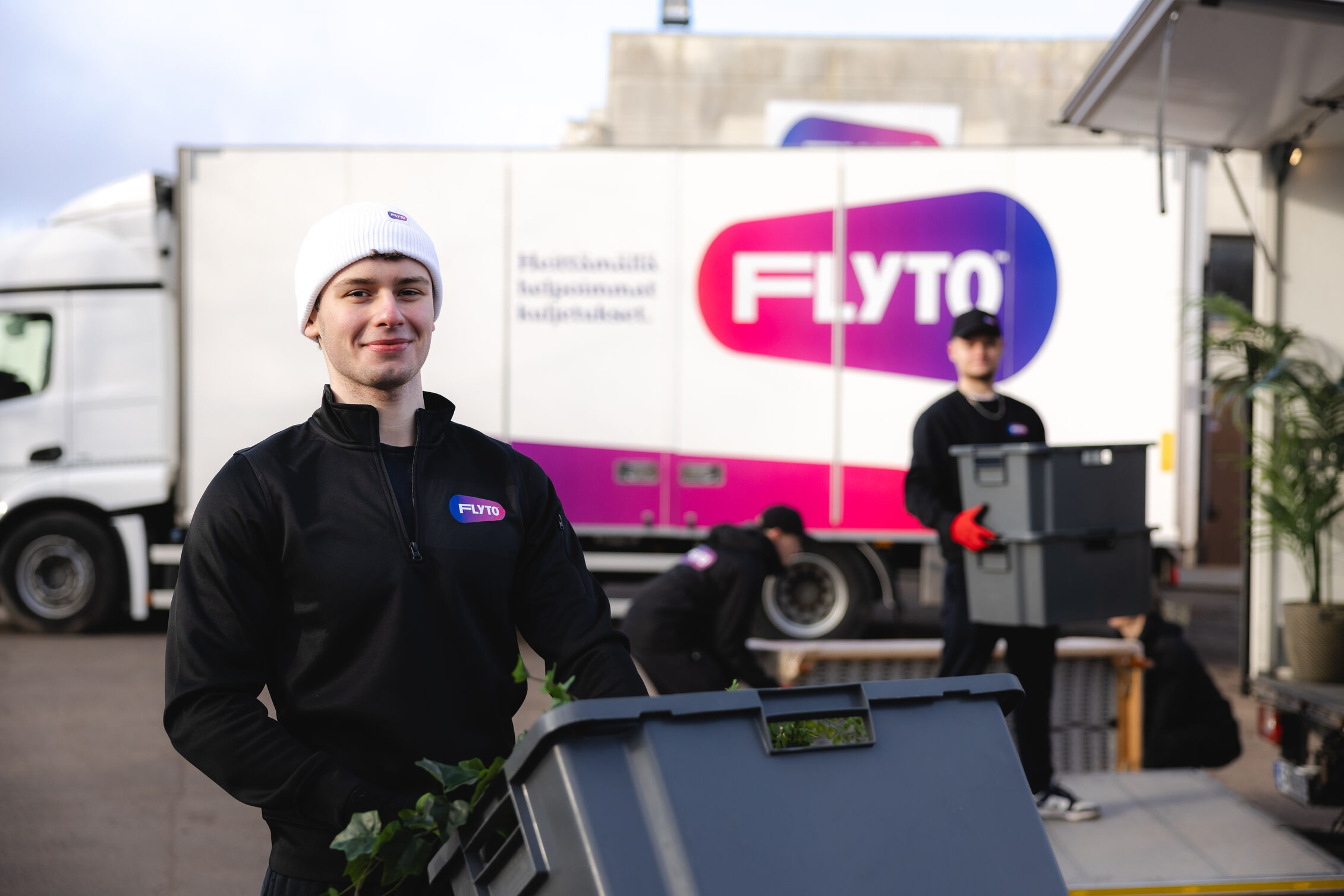
Flyto runs strong in-house European operations — our own offices, warehouses, teams and vehicles across Northern, Central and Southern Europe — so origin service, packing and export handling out of Switzerland stay under our direct control. These are complemented by a carefully chosen network of vetted partners and subcontractors for line-haul and specialist legs. In Jordan we work through trusted local partners for customs clearance and final delivery, so your shipment is coordinated end to end without us pretending to do every step ourselves.
Frequently asked questions
Can I bring my used furniture into Jordan duty-free?
If you are a Jordanian national returning after a year or more abroad, used household effects can qualify for the once-only exemption, subject to the conditions and your presence at clearance (Jordan Government Portal). Foreign nationals generally import as duty-paid unless a special concession applies.
Do I need to do anything with Swiss customs to leave?
For a private household, you submit an inventory list in duplicate to the customs office; there is no departure duty (BAZG — FAQ removal goods). A forwarder handling a formal export files it through Passar (BAZG).
Which ports will my shipment use?
By sea, out via Basel and the Rhine to Rotterdam or Antwerp (Port of Switzerland) and in through Aqaba, Jordan’s only seaport (UN Logistics Cluster). By air, via Queen Alia International near Amman.
How long does it take?
Industry estimates only: roughly 6–10 weeks door-to-door by sea, or 1–2 weeks by air. Actual timing depends on sailings, consolidation and inspection.
What about my dog or cat?
Out of Switzerland you need a microchip, rabies vaccination and an official health certificate (FSVO); into Jordan you also need an import permit from the Ministry of Agriculture. Start several weeks ahead.
And if I move back to Switzerland later?
Reverse the customs logic: Switzerland lets you import removal goods duty-free if you transfer your domicile back, have used the items at least six months, and file form 18.44 at the customs office of importation within two years of the move (BAZG — Relocation import procedure). On the Jordanian end, you simply export the goods.
Sources
- BAZG — FAQ removal goods
- BAZG — Relocation import procedure (form 18.44)
- BAZG — Exportation from Switzerland (Passar)
- BAZG — Cash, foreign currency, securities
- FDFA — Emigrating
- FSVO/BLV — Travelling with dogs, cats and ferrets
- Port of Switzerland (Basel Rhine ports)
- Jordan Government Portal — Clearance of expatriates’ furniture
- Jordan Customs — FAQs
- Jordan Customs — official site
- UN Logistics Cluster — Jordan Port of Aqaba