

Moving from Belgium to Ghana (2026): Complete Guide

Belgium and Ghana are connected by centuries of trade through the North Sea ports, and today a steady flow of professionals, missionaries, NGO staff and returning Ghanaian nationals move between the two countries. This guide is for a Belgian resident — Belgian national or long-term resident of any nationality — relocating a household to Ghana in 2026. It walks through both halves of the move: closing things down correctly on the Belgian side (municipal deregistration, tax exit, export declaration) and getting your shipment, pets and vehicle through Ghanaian customs and immigration on arrival. A short final section covers the reverse move, Ghana to Belgium.
Key takeaways
- You must report your departure in person to your Belgian municipality (commune/gemeente) at the latest the day before you leave; this triggers your removal from the National Register, confirmed by the IBZ deregistration rule and, in Brussels, issued as a "model 8" certificate.
- Moving your household goods out of Belgium to a non-EU country such as Ghana requires an export declaration and an itemised goods list filed with FPS Finance Customs, lodged through the AES (Automated Export System), which fully replaced Belgium’s older PLDA export system in October 2024 — see FPS Finance’s export guidance.
- Leaving Belgium does not automatically end your tax obligations there — you must settle your position with FPS Finance and may need to file a non-resident tax return afterwards.
- Ghana’s duty-free "removal articles" concession is explicitly reserved for citizens who lived abroad continuously for at least 12 months — a Belgian national moving to Ghana on a work/residence permit does not automatically qualify, per the GRA customs FAQ; motor vehicles are excluded from this concession regardless of who imports them.
- Goods arriving separately from you must be declared on the Passengers’ Unaccompanied Baggage Declaration (PUBD) within 48 hours of your arrival, per the Ghana Revenue Authority.
- All Ghana customs declarations, whatever your status, are now processed through ICUMS, Ghana’s single-window electronic customs system, run by the GRA Customs Division.
- Pets need an EU pet passport plus a health certificate for departure from Belgium (FASFC) and a signed veterinary import permit from Ghana’s Veterinary Services Directorate, with rabies vaccination at least 30 days before travel (VSD Ghana).
- Right-hand-drive vehicles are barred under normal Ghanaian customs rules and duty is assessed on CIF value with an age-based depreciation, per GRA Vehicle Importation; a separate, still-evolving vehicle-standards rule is due to further restrict older used-vehicle imports from 1 October 2026, so confirm current thresholds before you ship a car.
1. Your immigration status decides your customs treatment
Before anything is packed, establish what legal status you will hold in Ghana, since it determines how your shipment is treated at the border. The Ghana Immigration Service (GIS) issues several categories relevant to relocating foreigners: work permits (via your employer or as a GIPC-registered investor), dependant residence permits for accompanying family, student permits, and — for those settling permanently — Indefinite Residence status. Entry requires a visa obtained in advance from a Ghanaian mission (there is no general visa-free entry for Belgian passport holders), and all travellers aged nine months and older must be vaccinated against yellow fever at least 10 days before travel and carry proof of it, per Ghana’s diplomatic missions; under WHO rules a valid certificate is recognised for life, so a decades-old one still counts.
The critical nuance is on the customs side. Ghana’s "removal articles" duty exemption — the concession that lets you bring a used household in tax-free — is written for "a citizen who was previously resident outside the country," who has lived abroad for a continuous period of at least twelve months and is over eighteen, per the GRA customs FAQ. A Belgian national relocating for work is not covered by that specific concession. In practice this means most expatriate shipments into Ghana are assessed for import duty and VAT through the normal ICUMS process unless a separate exemption applies (for example, registered diplomatic staff, or investors with a GIPC exemption certificate). Confirm your exact status and any applicable exemption with GIS and a licensed customs broker before shipping — it changes your landed cost materially.
2. The Belgium export side: deregistration, customs and tax exit
Customs authority. Belgian customs is run by FPS Finance’s Customs and Excise administration (Douane en Accijnzen / Douane et Accises). When your goods leave the EU customs territory for Ghana, they must be covered by a pre-departure export declaration lodged at the competent customs office of export, processed through the AES (Automated Export System), which fully replaced the older PLDA export system as of the end of October 2024. For a household move, FPS Finance’s guidance on moving from Belgium states that when relocating to a country outside the EU you must lodge an export declaration and submit a list of the goods you are taking with you — your moving company or customs agent typically files this on your behalf.
Municipal deregistration. Belgium requires every resident — Belgian or foreign national — who is settling permanently abroad to report their departure in person to the municipal administration of their place of residence, at the latest the day before leaving, under the rule set out by FPS Home Affairs (IBZ). Family members leaving with you must also report in person. In Brussels, this is processed at the Brucity Administrative Centre, at one of the liaison offices, or by email, is free of charge, and results in issuance of a "proof of removal from the national register (model 8)" — keep this document, since Ghanaian immigration or your employer may ask for proof you have formally left Belgium. Other communes run the equivalent procedure under their own local administration; the underlying federal rule and deadline are the same everywhere.
Tax residency exit. Deregistering from the population register does not by itself close your Belgian tax file. FPS Finance’s "Leaving Belgium" guidance explains that your remaining obligations depend on where you are domiciled going forward and whether you continue to receive Belgian-sourced income. If you keep Belgian income after departure — wages, a pension, rental income — you will generally need to file a non-resident income tax return, with any applicable Belgium–Ghana tax treaty position determining where that income is ultimately taxable. Settle this with FPS Finance, or a Belgian tax adviser, before your final departure so you are not chased for outstanding filings from Accra.
3. Ports & transit: Belgium to Ghana by sea and air
Belgium’s export gateway for a move to West Africa is the Port of Antwerp-Bruges — the merged port authority (since 2022) combining Antwerp, roughly 80 km inland on the tidal Scheldt, and the deep-water coastal port of Zeebrugge. Between them they offer more than 300 liner services to over 800 destinations worldwide, and Antwerp is one of Europe’s leading gateways for cargo to and from Africa, making Belgium a strong departure point for a Ghana-bound container.
Ghana’s principal receiving port is Tema, near Accra, with Takoradi as a secondary port further west; the main international gateway for air freight and accompanied baggage is Kotoka International Airport (Accra).
Indicative transit times (freight-industry estimates only — not official government figures, and always confirm with your carrier):
- Sea freight, Antwerp-Bruges to Tema: roughly 3–5 weeks door-to-port, depending on transshipment routing (West African services typically connect via a European or North African hub rather than sailing direct).
- Air freight, Brussels Airport to Kotoka International Airport: typically 1–4 days transit, though customs clearance in Ghana can add several additional days on top of flight time.
4. The Ghana import side: declaration, ICUMS and duty
All formal imports into Ghana — whether commercial cargo or a relocating household’s container — pass through ICUMS (Integrated Customs Management System), Ghana’s electronic single-window platform introduced in June 2020 and run by the Customs Division of the Ghana Revenue Authority (GRA). Your clearing agent submits the declaration in ICUMS with the required documentation before or on arrival of the goods; the system classifies, values and approves the declaration, duties and taxes are paid through a participating bank against the tax bill ICUMS generates, and the shipment is then released via a red (physical exam), yellow (document/scan) or green (immediate release) channel.
For the traveller side, GRA’s guidance for passengers requires anyone whose personal effects travel separately — sent ahead or arriving after them — to declare this on the Passengers’ Unaccompanied Baggage Declaration (PUBD) form, made immediately on arrival or within 48 hours of it; missing this window can mean forfeiting any concession you might otherwise be entitled to. As set out in section 1, the duty-free "removal articles" concession for effects belonging to a returning resident applies to citizens who have lived abroad continuously for at least 12 months, per the GRA customs FAQ; it also explicitly excludes arms, ammunition, spare parts, building materials and motor vehicles regardless of who is importing. Foreign nationals moving to Ghana should expect their household shipment to be assessed for import duty plus Ghana’s 15% VAT under standard ICUMS valuation unless a specific exemption (diplomatic, NGO, or investor) applies to their case — confirm this with GRA or a licensed clearing agent before you ship, since it drives your landed cost.
5. Pets: official rules on both ends
Leaving Belgium. Under FASFC (Federal Agency for the Safety of the Food Chain) rules for departure from Belgium, your pet needs to be identified by microchip and carry the identification and vaccination records required for the destination country; travelling within the EU uses the standard EU pet passport, but for a non-EU destination like Ghana it is the destination country’s conditions that govern, so plan the Ghanaian import permit first and work backwards from its requirements and lead times.
Entering Ghana. Dogs and cats can only be imported into Ghana on a signed Veterinary Import Permit issued by Ghana’s Veterinary Services Directorate, under the Ministry of Food and Agriculture. Rabies vaccination must be administered at least 30 days before travel (and generally not more than 12 months prior), and a veterinary health certificate must accompany the animal; dog importers must additionally provide test results for diseases including Brucella canis, Trypanosoma evansi and Babesia gibsoni before a permit is issued. Apply well ahead of your travel date — processing a complete application is commonly described as taking around 72 working hours once all documents are in order, but delays are common if paperwork or lab results are incomplete.
6. Vehicles, money and things people forget
Vehicles. Import duty and 15% VAT are assessed by GRA Customs (with registration handled by the DVLA) on a vehicle’s CIF value, to which an age-based depreciation of 0–50% is applied before duty is calculated — get your specific vehicle valued through a licensed agent rather than assuming a flat rate. Right-hand-drive vehicles are barred under normal customs rules — GRA states plainly that right-hand-steering vehicles are not allowed into the country, with only a narrow policy dispensation available on application, reserved for the Minister of Trade to grant, and any vehicle let through on that basis must still be dismantled and refitted to left-hand-drive before it can be driven on Ghanaian roads. Separately — and directly relevant if you are shipping a car in 2026 — Ghana’s standards regulator has been tightening a distinct, age-based restriction on used-vehicle imports due to take effect 1 October 2026; as reported in Ghanaian media in August 2026, the cutoff was revised from an initially announced 10-year limit to 15 years, with vehicles already shipped before that date exempted even if they arrive later. This rule is separate from the GRA duty calculation above, has been amended more than once in recent weeks, and is not fully settled — confirm the current threshold and any grace period directly with GRA, GSA or a licensed clearing agent before committing to ship a car. As with household goods, the "removal articles" duty exemption never covers motor vehicles, for citizens or foreigners alike.
Money. Ghana caps undeclared cash movement at US$10,000 (or the equivalent in other currencies) per traveller; amounts above that must be declared in full on the Customs Division’s Foreign Currency Declaration Form, per the Bank of Ghana’s currency notice, in force since 1 September 2025. Outbound travellers carrying more than US$50,000 must additionally support the declaration with forex-bureau or bank documentation, and undeclared amounts above the threshold can be seized on the spot — so declare rather than risk it.
Things people forget. Your yellow fever certificate is checked before boarding, not just on arrival. Keep the original Belgian model 8 certificate — employers and landlords often ask for proof you formally left Belgium. And since Ghana’s returning-resident concession is citizenship-based, a mixed-nationality household may see different customs treatment for each partner’s share of the shipment — plan the paperwork, and declared ownership of goods, accordingly.
How Flyto handles your Belgium to Ghana move
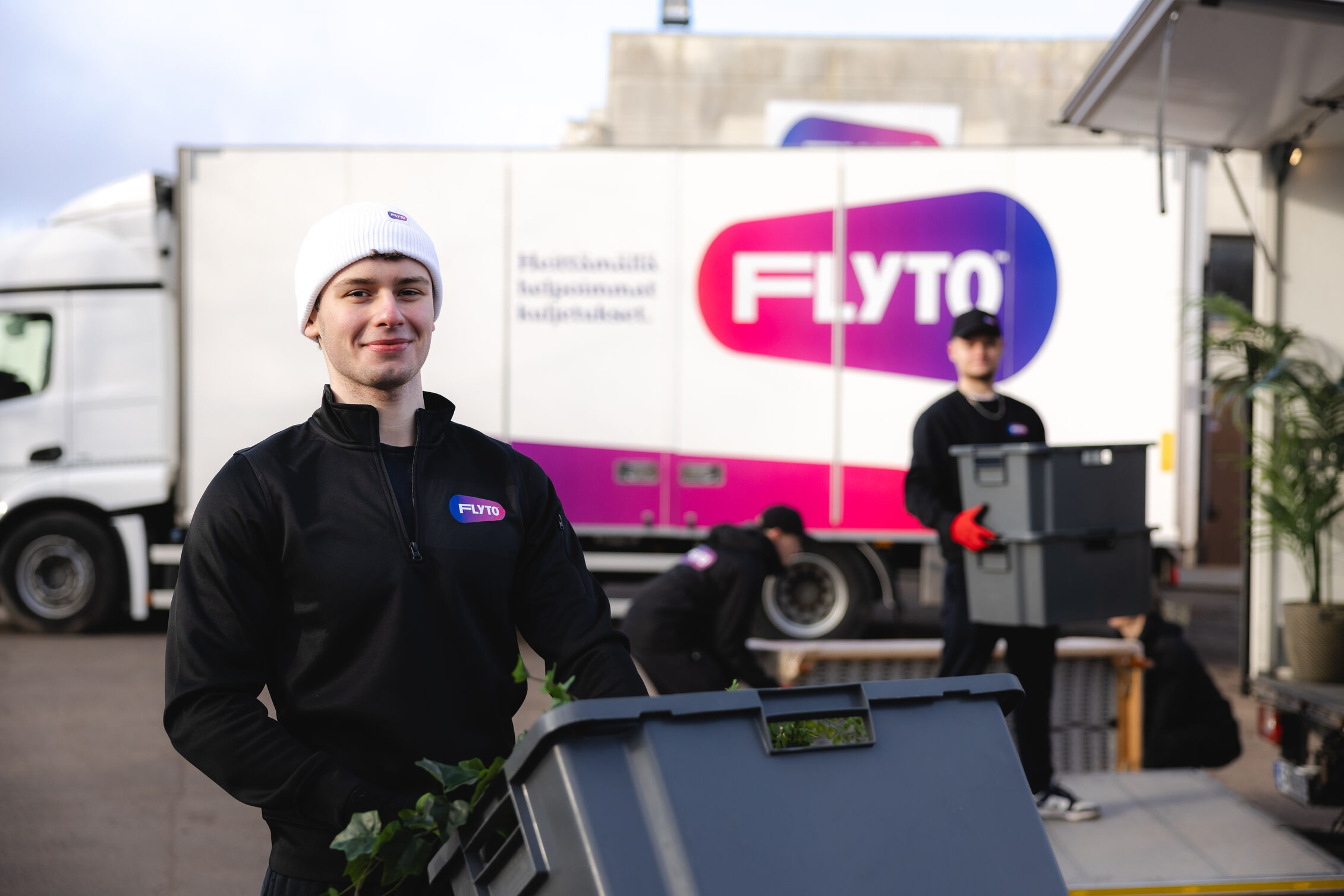
Flyto runs its own offices, warehouses, crews and vehicles across Northern, Central and Southern Europe, so the Belgian collection, export documentation and Antwerp-Bruges port handling for your shipment stay in-house end to end. For the ocean leg and the Ghanaian side, we work through a carefully vetted network of freight partners and subcontractors, plus trusted local partners on the ground in Ghana who handle ICUMS clearance, delivery and the practicalities of settling in. That combination gives you a single point of contact in Belgium with genuinely experienced local execution at the Ghana end.
Frequently asked questions
Do I need to be physically in Belgium to deregister? Yes — the declaration of departure must be made in person at your municipal administration, at the latest the day before you leave, per IBZ.
Will I still owe Belgian tax after I move to Ghana? Possibly, if you retain Belgian-sourced income such as rent, a pension or wages — you’ll likely need to file a non-resident return; see FPS Finance.
Can I bring my household goods into Ghana duty-free as a foreigner? Not automatically. The removal-articles exemption is written for returning citizens who lived abroad 12+ months; foreign nationals should expect duty and VAT to apply under normal ICUMS assessment unless a specific exemption applies — check with GRA or a broker.
What happens if my container arrives before I do? Declare it on the PUBD form within 48 hours of your own arrival in Ghana, per GRA, or risk forfeiting any applicable concession.
Can I ship my car to Ghana? Only if it is left-hand-drive — right-hand-drive vehicles are barred outright except for a narrow ministerial exception. Duty and VAT are assessed on CIF value with an age-based depreciation; a separate, tightening age-restriction on used-vehicle imports takes effect from October 2026, so confirm current rules with GRA Vehicle Importation or your clearing agent before you ship.
Moving back from Ghana to Belgium — what changes? The direction reverses: you’ll register your arrival at your new Belgian commune and may qualify for Belgium’s own duty relief for personal property transferred from a non-EU country, provided you’ve lived outside the EU for 12+ months and owned the goods for 6+ months, per FPS Finance’s guidance for moving to Belgium. Ghana-side, you would go through the standard export process with GRA/ICUMS rather than the returning-citizen concession, since you’d be leaving rather than arriving.
Sources
- IBZ – Compulsory deregistration for EU citizens and their family members when leaving Belgium
- City of Brussels – Departure abroad (removal)
- FPS Finance – Leaving Belgium
- FPS Finance – Leaving Belgium: Tax return
- FPS Finance – Moving from Belgium
- FPS Finance – Moving from a non-EU country to Belgium
- FPS Finance – Export from a Belgian seaport
- Port of Antwerp-Bruges – Maritime shipping
- FASFC – Travelling with your pet: Departure from Belgium
- Ghana Revenue Authority – Passengers’ Obligations at Customs
- Ghana Revenue Authority – Customs FAQ
- Ghana Revenue Authority – ICUMS
- Ghana Revenue Authority – Vehicle Importation
- Ghana Immigration Service – Permits
- Veterinary Services Directorate, Ghana – Import Requirements
- Ghana High Commission (South Africa) – Yellow Fever Vaccination Requirement for Travellers
- Bank of Ghana – Notice on the Importation and Exportation of Foreign Currency