

Moving to Helsinki (2026): The Complete Relocation Guide

Helsinki is Finland’s capital and by far its largest city — around 675,000 people in the city itself and roughly 1.6 million across the greater Helsinki region — and it is the country’s main landing point for international arrivals. It is also a genuinely Nordic city to move into: much of the desirable housing sits in early-1900s Jugend blocks and 1950s walk-ups with no lift and tight stairwells, the classic city block wraps around an inner courtyard, your moving truck cannot simply reserve the kerb outside the door, and for a large part of the year the loading itself happens on snow and ice in the dark. This guide covers the practical mechanics of moving to Helsinki in 2026 — the truck-and-building logistics only a mover knows, where to live and what rent really costs, how to find a flat and register at DVV, and what monthly life actually costs — with official sources throughout.
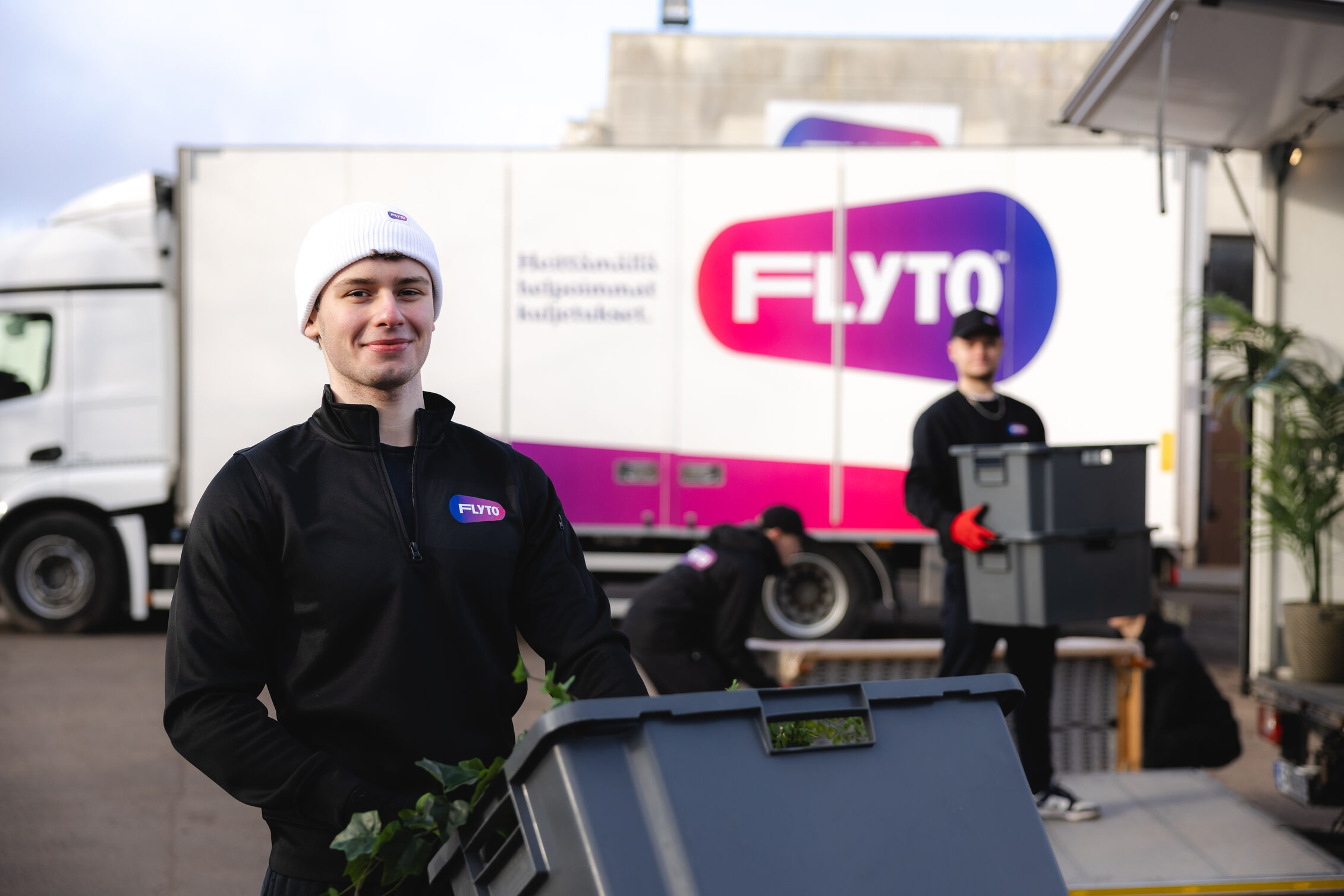
Freshness note: prices and rules verified against hel.fi, suomi.fi, dvv.fi, International House Helsinki, HSL, Tilastokeskus, the Finnish Meteorological Institute and Helsinki city statistics in 2026. Fees and rents move — confirm figures with the linked authorities before you rely on them.
Quick answer: moving to Helsinki in 2026
What does it cost to move to Helsinki? An international household move (a full flat) typically lands in the low-to-mid four figures from within Europe and higher from overseas, driven mostly by volume, distance and access. Because Helsinki’s access difficulties — no-lift Jugend buildings, courtyards, winter conditions — add real cost, get a fixed quote for your specific address rather than a generic estimate: get a Flyto quote here.
How long does the move take? Road moves from within the EU are usually a few days to about two weeks door-to-door; overseas sea freight runs several weeks. The two Helsinki-specific quirks everyone underestimates: nearly half of the city’s apartment buildings have no lift (Helsinki city statistics), so a bulky sofa often has to go in through a window on an external furniture lift (muuttonostin); and there is no free ”book a spot” for the truck — for a disruptive move you take out a paid permit to use the public area (City of Helsinki area-use permit).
Key takeaways
- Nearly half of Helsinki’s apartment buildings have no lift. At the end of 2018 about 46% of the city’s apartment buildings — roughly 4,900 buildings holding some 90,000 flats — had no elevator, most of them older or mid-century walk-ups (Helsinki city statistics). This is exactly why an external furniture lift (muuttonostin / ulkohissi) is so often needed.
- Your moving truck cannot just reserve the kerb. You may briefly stop to load bulky items, but for a genuinely disruptive move you need a paid permit to take a street or public area into temporary use, granted by the Urban Environment Division (suomi.fi; application via hel.fi).
- Winter is a real operational factor. Permanent snow cover in the capital region normally sets in only after Christmas and clears on average around the turn of March–April (Finnish Meteorological Institute) — snow, ice and short, dark days make winter loading slower and worth planning carefully.
- Register at DVV to get your kotikunta and henkilötunnus. Newcomers register in the Population Information System at DVV — in Helsinki mainly by appointment at International House Helsinki — where you also apply for a personal identity code (henkilötunnus) and municipality of residence (kotikunta), which unlocks public healthcare, daycare and much else (International House Helsinki).
- Deposit is capped and usually 1–2 months. A rental deposit (vuokravakuus) is legally limited to at most three months’ rent (Act on Residential Leases, §8), and in practice landlords typically ask for one to two months (Vuokralaiset ry).
Planning the move itself as well? Costs, transit times and how to choose a mover are covered on our page about international moving companies in Finland.
1. The move into Helsinki — logistics only a mover knows
This is the part generic ”moving to Helsinki” guides skip, and it is exactly where a move goes wrong. Helsinki’s inner districts were built for courtyards and trams, not for a full-size removal truck, and half the year the weather is against you. Four things determine whether your move day runs smoothly.
Parking the truck: the loading exception and the area-use permit
Helsinki does not offer a simple online ”book a moving-van bay” service, and you cannot count on a free stretch of kerb outside the building. There are two legal routes:
- The brief loading exception. A vehicle may stop even on a footway or cycle path for the short time it takes to load or unload, but only when there is a compelling reason, the load is genuinely bulky (furniture, white goods, a piano — not hand-carried boxes), at least one metre is left clear for pedestrians, and the driver stays with the vehicle ready to move it (City of Helsinki, ”Sujuvaa pysäköintiä”). This covers a quick, simple move — it does not reserve you a space.
- The area-use permit. For a demanding move that will block a traffic lane or occupy a parking space for longer, you apply for a permit to take a public area into temporary use (lupa yleisen alueen käyttöön) from the Urban Environment Division. The service is paid, the same office that handles street works and events grants it, and you can arrange temporary no-parking signs to keep the space clear (suomi.fi; application form and contact hel.fi, luvat@hel.fi).
Knowing which route your address needs — and arranging the permit and signs in advance when it does — is the difference between a truck parked at the door and one stranded a block away.
Winter: snow, ice, darkness and frozen loading
This is the genuinely Nordic factor. In the Helsinki region, permanent snow cover typically arrives only after Christmas and disappears on average around the turn of March and April (Finnish Meteorological Institute), but sub-zero spells, ice and slush can bracket that window from November into April. A winter move means snow and ice on the access routes and courtyard, ramps and pavements that need clearing and gritting before anything heavy is carried, daylight that in December runs to only about six hours, and cold that makes long carries and lift set-up slower. None of this stops a move — Finns move house all winter — but it has to be planned for: earlier start times, clearing and salting the path, protecting floors from meltwater and grit, and allowing more time. A mover who works Helsinki winters builds this in; a generic van hire discovers it at 8 a.m. on a frozen loading bay.
Jugend blocks, 1950s walk-ups and the muuttonostin
Much of the housing people actually want in Helsinki sits in early-1900s Jugend (Art Nouveau) blocks in Kruununhaka, Ullanlinna, Eira, Punavuori and Katajanokka, or in the 1950s rintamamiestalo-era walk-ups further out. Many of these buildings have no lift, and where a lift exists it is often a small original cage that will not take a wardrobe. Citywide, roughly 46% of apartment buildings had no elevator at the end of 2018 — about 4,900 buildings and 90,000 flats (Helsinki city statistics).
The practical consequence: sofas, wardrobes, double beds and appliances frequently will not fit up a narrow, turning Helsinki stairwell. The standard solution is an external furniture lift (muuttonostin / ulkohissi) — a ladder hoist run up the facade to bring bulky items in through a window or balcony, reaching the upper floors and attic conversions. It needs its own space at the kerb, which is another reason the parking arrangement matters. A good mover measures the stairwell, the floor and the doorways before the day and books the lift in advance, rather than discovering the problem when the sofa is wedged on the second-floor landing.
Courtyards, gate arches and one-way streets
The classic Helsinki block is built around an inner courtyard (sisäpiha), reached through a gate arch (porttikäytävä) that is usually too low and too narrow for a truck to enter. A flat in the courtyard wing (piharakennus) can mean carrying every box a long way from the street, across the yard, and the yard itself is often reserved for residents’ parking and bins. Add the peninsula’s one-way streets, tram tracks and cycle lanes, and ”just park outside” is rarely simple. None of this is a problem if it is planned for — and all of it is a bad surprise if it is not.
2. Where to live — Helsinki neighborhoods by profile
Helsinki’s character changes district by district, and the water is never far. The figures below are indicative average asking rents (€/m²/month) for late 2025 from Asunnollehinta.fi, cross-checked against Tilastokeskus rent statistics (Statistics Finland) and Helsinki’s own market review (kaupunkitieto.hel.fi). The citywide average sits around €20/m²; smaller flats cost far more per square metre than large ones, so a studio in a ”cheap” area can still be dear.
Central and characterful:
- Kamppi / Kluuvi — the centre (~€23/m²) — maximum convenience: the main station, metro, trams, shops and offices at the door. You pay the top rents and get little neighbourhood calm; some blocks empty out after work.
- Kruununhaka (~€18/m²) — the dignified old town beside the harbour and university: Jugend and Empire buildings, quiet cobbled streets, older residents and academics. Beautiful and central, mostly no-lift stairwells, and short on nightlife.
- Punavuori (~€21/m²) — the design district: independent shops, cafés and bars in handsome early-1900s blocks. Young professionals and creatives; lively, walkable and pricey, with the usual weekend noise near the bar streets.
- Eira & Ullanlinna (~€17–22/m²) — the seaside establishment: villas, embassies and grand Jugend flats by the shore parks. Prestigious and calm; the per-m² average is pulled down by large family apartments, but small flats are expensive and rare.
Best for young professionals and nightlife:
- Kallio (~€21/m²) — the classic first Helsinki address: small flats, cheap eats and the densest bar scene in the city, historically working-class and now thoroughly mixed. Central and full of life, but noisy and short on space.
- Sörnäinen (~€21/m²) — Kallio’s edgier neighbour by the metro, with the Kalasatama towers and new-build rising nearby; convenient and buzzy, uneven street to street.
- Töölö (~€19–20/m²) — elegant and central, wrapping the bay and the big parks, opera and concert hall: refined 1920s–30s blocks, popular with professionals and families alike. Calmer and greener than Kallio, and priced for it.
Quieter, greener, good value:
- Vallila (~€18/m²) — brick 1920s blocks and a famous wooden-house enclave (Puu-Vallila); down-to-earth, well connected by tram, gentrifying steadily. Good value close to the centre.
- Kumpula & Käpylä (~€17–18/m²) — leafy, low-rise and family-friendly, with garden-city wooden houses and the university campus; calm and green, a little further out, below the city average for larger flats.
- Lauttasaari (~€19/m²) — the popular island suburb one metro stop west: sea on every side, 1950s–60s blocks and newer builds, beaches and quick access to the centre. A favourite of families and remote workers.
Neighbouring cities (same commuter region):
- Espoo — Tapiola (~€19–27/m²) — the western neighbour: green, spacious and family-oriented, home to Aalto University and much of the tech sector. Tapiola is a leafy garden city on the metro; Espoo’s citywide average is close to Helsinki’s (~€20/m²), with Pohjois-Tapiola among the priciest spots (~€27/m²).
- Vantaa (generally below Helsinki, top areas rarely above ~€25/m²) — the northern neighbour around the airport, well linked by the Ring Rail Line; more space for the money, plainer in places, a sensible pick if budget or commute to the airport matters.
3. The Helsinki housing market — how flats are actually found
Helsinki’s rental market is competitive but not chaotic; good central listings move fast, and the deposit-and-paperwork routine is where newcomers slip. Here is how it works.
- First-hand vs ARA vs private. Rentals fall into three broad camps: private/market-rate flats (most listings), large professional landlords, and state-subsidised ARA housing allocated by need and income (ARA). Students have their own dedicated stock through Hoas, the Helsinki region student housing foundation — apply early, as demand is high.
- Where to search. The mainstream portals are Vuokraovi, Oikotie and the large landlords’ own sites (Sato, Kojamo/Lumo, Heka for city housing). Newcomers should also read InfoFinland’s plain-language housing pages (InfoFinland).
- Deposit (vuokravakuus). Legally capped at three months’ rent (Act on Residential Leases, §8 — Finlex); in practice landlords usually ask for one to two months, paid before you get the keys and refunded at the end if the flat is undamaged and rent is paid (Vuokralaiset ry). Note that many landlords ask for a Finnish henkilötunnus and a credit check, which is another reason to prioritise DVV registration.
- Competition. Central small flats can draw many applicants; have your documents ready — proof of income or employment, ID, and your henkilötunnus — so you can apply the moment you view.
- Scam warning. Fake listings exist here too. Never pay a deposit or ”reservation fee” before you have viewed the flat and confirmed the landlord. Classic red flags: the ”owner is abroad”, keys promised by post against an advance payment, prices well below market, or pressure to pay to a foreign account or via a booking platform.
4. Registration at DVV — kotikunta and henkilötunnus
Registration with the Digital and Population Data Services Agency (DVV) is the master key to Finnish life: without a personal identity code you cannot easily open a bank account, sign an employment contract, get a phone subscription or use public services. The essentials:
- What you register. Newcomers enter their details in the Population Information System and, in the same visit, apply for a personal identity code (henkilötunnus) and a municipality of residence (kotikunta). DVV decides whether you can be given a kotikunta; with one, you are in most cases entitled to municipal services such as public healthcare and daycare (DVV — international moving).
- Where to do it in Helsinki. DVV serves newcomers mainly by appointment at International House Helsinki, a one-stop service point that also brings together the Tax Administration, Kela, pension and employment advice — a single visit covers much of the bureaucracy (International House Helsinki).
- What to bring. A valid passport or ID, and situation-specific documents (EU/EEA registration certificate or residence permit, proof of the reason for moving, and originals of foreign certificates where life events are being recorded). Book the appointment in advance and complete the form beforehand.
- If you are leaving Finland instead of arriving, the same identity code follows you — see our guide to your henkilötunnus after moving abroad. And if you are importing household goods from outside the EU, read our Finnish customs guide for household goods.
5. Cost of living in Helsinki (2026)
Helsinki is not cheap, but it is more affordable than London or Paris and the public services are strong. The current numbers:
- Rent is the big variable — see section 2. Budget roughly €17–18/m² in the quieter districts up to €23/m² in the very centre, against a citywide average near €20/m² (Asunnollehinta.fi; Statistics Finland).
- Public transport (HSL). A 30-day AB-zone season ticket (kausilippu) costs €73.90 in 2026 (up from €72.10), or €61.60 as the 30-day saver bought in the HSL app; a single AB ticket is €3.30 (HSL — 2026 fares). The AB zone covers Helsinki plus most of Espoo and Vantaa; with a kotikunta you get the resident fare.
- Utilities. In many Finnish rentals, water and building heating are included in the rent or a fixed charge, so the household’s own bills are mainly electricity and internet — smaller than in un-insulated countries but still meaningful in winter. Always confirm what is included before you sign.
- Everyday costs. Groceries, eating out and services run at Nordic levels; a home sauna, on the other hand, is effectively free and near-universal (see below).
6. Getting settled — transport, health, kids, internet, sauna
- Transport. HSL runs the metro, trams, buses, local trains and the Suomenlinna ferry as one ticketed network; the tram and metro make the inner city easy without a car, and Helsinki is flat and cyclable in the warmer months. One AB-zone ticket covers Helsinki, Espoo and Vantaa (HSL).
- Healthcare. Once you have a kotikunta you are assigned to a public health station (terveysasema) by address, your entry point to subsidised primary care; Helsinki lists the stations and how to book (City of Helsinki — terveysasemat). Many employers also provide occupational health, and private clinics are widely available.
- Schools and daycare. A kotikunta gives access to municipal early childhood education (varhaiskasvatus) and comprehensive school; fees for daycare are income-based, and English-language and international schooling exists but fills up, so apply early (DVV).
- Internet. Home broadband is fast and cheap by European standards; fibre and cable are widespread and mobile data is famously generous. Check what the building already supports and order in good time before move-in.
- Sauna. Not a luxury but a norm: most apartment buildings have a shared sauna and many newer flats have their own, and a sauna turn (saunavuoro) is part of ordinary life. It is one of the easiest ways to settle into the rhythm of the city.
7. How Flyto handles your move to Helsinki
Everything in section 1 is why a Helsinki move rewards a mover who actually knows the city — and it is where Flyto earns its keep. We assess building access in advance — stairwell width, floor, whether the lift takes furniture, courtyard and gate-arch distances — and bring an external furniture lift (muuttonostin) when the sofa will not make the stairwell, rather than discovering the problem mid-carry. We arrange the right parking solution for your address, including a public-area permit and no-parking signs where a demanding move needs them, so the truck has a legal place at the door. And we plan around the season — earlier starts, cleared and gritted paths, floor and meltwater protection, and realistic timing for a winter move on snow and ice. That is the honest difference between a generic van hire and a relocation partner who has done this street by street. Get a fixed quote for your Helsinki move, or browse our full Finland moving guides and customs guide for household goods.
Moving to Helsinki? Get a fixed quote.
Tell us your addresses and volume and we’ll price the whole move — including the furniture lift your no-lift building needs, the parking permit, and realistic timing for a winter move. No surprises on the day.
Frequently asked questions
Do I need a parking permit for my moving truck in Helsinki?
For a quick, simple move you can rely on the loading exception: a vehicle may stop briefly, even on a footway, to load bulky items if there’s a compelling reason, at least a metre is left for pedestrians, and the driver stays with the vehicle. But you cannot reserve the space in advance for free. For a demanding move that blocks a lane or occupies a parking space for longer, you take out a paid permit to use the public area (lupa yleisen alueen käyttöön) from Helsinki’s Urban Environment Division and can arrange temporary no-parking signs. Arrange it ahead of time.
Will my furniture fit up a Helsinki stairwell, or do I need a furniture lift?
Often you need a lift. About 46% of Helsinki’s apartment buildings had no elevator at the end of 2018 — roughly 4,900 buildings — and where a lift exists in an old Jugend block it is frequently a small original cage that won’t take a wardrobe. Large items then go in through a window or balcony on an external furniture lift (muuttonostin / ulkohissi). A good mover measures the stairwell, floor and doorways before move day and books the lift in advance.
Is it a bad idea to move to Helsinki in winter?
No — Finns move all winter — but it needs planning. Permanent snow cover in the capital region usually sets in after Christmas and clears around the turn of March–April, and sub-zero spells, ice and short, dark days can run from November into April. Expect to clear and grit the path, protect floors from meltwater and grit, allow more time, and start earlier in the limited daylight. A mover who works Helsinki winters builds all of this in.
How much is rent in Helsinki in 2026?
The citywide average asking rent is around €20/m²/month, ranging from roughly €17–18/m² in quieter districts like Kumpula, Vallila and Käpylä up to about €23/m² in the very centre (Kamppi/Kluuvi). Smaller flats cost far more per square metre than large ones, so a studio in a ”cheap” area can still be expensive (Asunnollehinta.fi; Statistics Finland).
How big a deposit can a Helsinki landlord ask for?
A rental deposit (vuokravakuus) is legally capped at three months’ rent under the Act on Residential Leases (§8), and in practice landlords usually ask for one to two months. It’s paid before you get the keys and refunded at the end of the tenancy if the rent is paid and the flat is undamaged.
How do I register and get a henkilötunnus and kotikunta?
Register with DVV — in Helsinki mainly by appointment at International House Helsinki — where you also apply for a personal identity code (henkilötunnus) and municipality of residence (kotikunta). Bring a valid passport and situation-specific documents (EU/EEA registration or residence permit, proof of the reason for your move). A kotikunta entitles you in most cases to municipal services like public healthcare and daycare, and the henkilötunnus is needed to open a bank account and sign contracts.
Which Helsinki area is best for families?
Töölö, Kumpula and Käpylä, Lauttasaari, and — just across the border — Espoo’s Tapiola are the classic family choices: greener, calmer, good schools and parks, with rents from about €17/m² up to low-€20s/m². Central party districts like Kallio and Sörnäinen are livelier but noisier and short on space.
Can I get by in Helsinki without a car?
Easily, in the inner city. HSL’s metro, trams, buses and local trains cover Helsinki, Espoo and Vantaa on one AB-zone ticket (a 30-day season ticket is €73.90 in 2026, or €61.60 as the app saver), and the centre is flat and walkable. A car is mainly useful further out or for trips beyond the region.
Official sources
- Suomi.fi — permit to use a public area (City of Helsinki)
- City of Helsinki — area-use permit application and contact
- City of Helsinki — ”Sujuvaa pysäköintiä” (parking guidance, incl. loading)
- Helsinki city statistics — apartment buildings without a lift
- Finnish Meteorological Institute — snow statistics (permanent snow cover)
- DVV — international moving, henkilötunnus and kotikunta
- International House Helsinki — registration, personal identity code, kotikunta
- HSL — 2026 ticket prices (AB season and single fares)
- Statistics Finland — rents of dwellings
- Helsinki city research — Helsinki rents
- Asunnollehinta.fi — Helsinki rents by area (2025)
- Finlex — Act on Residential Leases (deposit, §8)
- Vuokralaiset ry — rental deposit (vuokravakuus)
- ARA — state-subsidised housing
- Hoas — Helsinki region student housing
- InfoFinland — housing in Finland
- City of Helsinki — health stations (terveysasemat)
- Flyto — your henkilötunnus after moving abroad
- Flyto — Finnish customs for household goods
- Flyto — Finland moving guides
Hiring an international mover? See our full International removals to Finland service — Flyto’s own European hubs, vetted local partners and one English-speaking coordinator, door to door.