

Moving to Copenhagen (2026): The Complete Relocation Guide

Copenhagen is Denmark’s capital and largest city — around 660,000 people in the municipality and roughly 1.4 million across the wider urban area — and by far the most-searched destination for anyone relocating to Denmark. It is also, quietly, one of the harder Nordic cities to physically move into: the inner districts are dense blocks of lift-less old apartments with steep back stairs, the streets give cycle lanes priority over trucks, several of the best neighbourhoods sit on islands reached by bridge, and your moving truck cannot simply reserve the kerb outside your door. This guide covers the practical mechanics of moving to Copenhagen in 2026 — the truck and access logistics only a mover knows, where to live and what rent really costs, the large cash deposit reality, how to register for a CPR number, and what monthly life actually costs — with official sources throughout.
Freshness note: prices and rules verified against kk.dk, international.kk.dk, International House Copenhagen (ihcph.kk.dk), lifeindenmark.borger.dk, lejeloven.dk, BoligPortal, DOT/Rejsekort, m.dk and Statistics Denmark energy data in 2026. Fees and rents move — confirm figures with the linked authorities before you rely on them.
Quick answer: moving to Copenhagen in 2026
What does it cost to move to Copenhagen? An international household move (a full flat) typically lands in the low-to-mid four figures from within Europe and higher from overseas, driven mostly by volume, distance and access. Because Copenhagen’s inner-city access difficulties (see below) add real cost — furniture lifts, long carries, permits — get a fixed quote for your specific address rather than a generic estimate — get a Flyto quote here.
How long does the move take? Road moves from within the EU are usually a few days to about two weeks door-to-door; overseas sea freight runs several weeks. The one Copenhagen-specific quirk everyone underestimates: in the old inner districts there is often no lift and no room for a truck, so the furniture goes in through a window on an exterior lift (møbellift) and the truck needs a road-occupation permit (råden over vej) from Københavns Kommune arranged in advance (Københavns Kommune).
Key takeaways
- Budget for a huge cash deposit. Under the Danish Rent Act (lejeloven) a landlord may take a deposit of up to three months’ rent plus up to three months’ prepaid rent — so with the first month’s rent you can be asked for the equivalent of five to seven months’ rent before you get the keys (Lejeloven.dk).
- Your moving truck may need a road-occupation permit. To legally block kerb space for a large removal truck on a public road, the moving company applies for råden over vej from Københavns Kommune; the permit is only issued for work vehicles of at least 3,500 kg, not ordinary vans (Københavns Kommune).
- Old inner-city blocks usually have no lift. The classic 5–6 storey apartment buildings in Indre By, Nørrebro and Vesterbro typically have only a narrow main stair and an even steeper back stair (køkkentrappe), so bulky furniture goes in through a window on an exterior furniture lift (møbellift).
- Register for a CPR number fast. EU/EEA/Swiss citizens staying over three months must register within 3 months of arrival (6 months for Nordic citizens); you do it in person at International House Copenhagen once you have a Danish address, and you get MitID and a tax card at the same visit (International House Copenhagen).
- Copenhagen is a cycle city first. Inner streets prioritise cycle lanes and one-way flow over motor traffic, which is what constrains where a truck can stand — and why once you have a CPR number and a bike, you often will not need a car at all.
For the practical side of the move – crews, customs paperwork and a fixed price – start here: international movers to Denmark.
1. The move into Copenhagen — logistics only a mover knows
This is the part generic ”moving to Copenhagen” guides skip, and it is exactly where a move goes wrong. Copenhagen’s inner districts were built as dense five- and six-storey blocks around narrow streets and courtyards, long before removal trucks — and today those streets give cycle lanes and one-way flow priority over motor traffic. Three things determine whether your move day runs smoothly.
Råden over vej: the truck’s road-occupation permit
You cannot count on a free stretch of kerb outside a Copenhagen building, and on many inner streets there is no legal place for a full-size truck to stand at all without permission. To occupy road or pavement space with a large removal truck, a container or a furniture lift, you (in practice your moving company) apply to Københavns Kommune for a road-occupation permit — råden over vej. Key facts from the city itself (Københavns Kommune):
- Who applies: it is the moving or container company that applies for the permit and arranges any required signs and barriers — not the resident. This is a job you delegate to a mover who knows the process.
- Vehicle rule: the municipality only issues a permit for work vehicles weighing at least 3,500 kg. Ordinary vans and cars are not eligible, so a proper move needs a proper truck if you want to reserve road space legally.
- Public road only: a municipal permit covers public road areas the city controls. If the truck or lift has to stand in a private courtyard, on a private shared road or in a housing-association car park, you need separate permission from the owner or the ejerforening/andelsforening.
- Plan ahead: the permit, plus placing signs and coordinating with a møbellift, is not a move-day decision. It is arranged in advance, which is precisely why most people leave the whole permit-plus-lift job to their moving company.
You often need to think about space at both ends — the old address and the new one. This is the single most common thing international movers into Copenhagen underestimate, and there is no last-minute fix once the truck is circling a full one-way street.
No lift, the køkkentrappe, and the møbellift
Copenhagen’s most sought-after flats sit in the classic 5–6 storey blocks of Indre By, Nørrebro, Vesterbro and inner Østerbro — beautiful high-ceilinged apartments that very often have no elevator. Where there is a stair, there are usually two: a main staircase (hovedtrappe) at the front and a narrow, steep service stair (køkkentrappe) at the back, neither built for a three-seat sofa or a double wardrobe.
The practical consequence: large items frequently will not go up a Copenhagen stairwell or around its tight half-landings. The standard Danish solution is an exterior furniture lift (møbellift) — a ladder hoist run up the building’s facade that lifts sofas, wardrobes, beds and appliances straight in through a window or balcony, reaching the upper floors and loft (taglejlighed) conversions. The lift itself needs kerb or pavement space to stand, which is another reason the road-occupation permit and the lift have to be planned together, not improvised on the day. A good mover assesses this before move day — floor, stair width, whether a lift is needed — rather than discovering the wardrobe is stuck on the third-floor landing.
Bridges, islands and cycle-lane streets
Several of Copenhagen’s best neighbourhoods are not on the mainland at all. Christianshavn and the wider island of Amager (including Islands Brygge and Ørestad) are reached across bridges, and the historic canal quarter of Christianshavn has tight, listed streets with strict access. Add the city’s dense grid of protected cycle lanes — which a truck must not block and often cannot cross to reach a loading spot — plus one-way systems and pedestrianised stretches around Indre By, and ”just park outside” is rarely an option. None of this is a problem if it is planned for, and all of it is a bad surprise if it isn’t.
2. Where to live — Copenhagen neighborhoods by profile
Copenhagen’s character changes bridge by bridge and street by street. The rent figures below are indicative monthly asking rents for new lettings in 2026, drawn from the Investropa Copenhagen rent report (city-wide averages of about DKK 14,500 for a one-bedroom and DKK 20,000 for a two-bedroom), cross-checked against listings on BoligPortal. Treat them as ranges: rent varies sharply with size, condition and exact location.
Central and characterful:
- Indre By (the old city, DKK 240–300/m²/month) — cobbled streets, canals and the most central address in Denmark; gorgeous and walkable, but the priciest per square metre, the flats are small and lift-less, and it can feel touristy and quiet on weeknights.
- Christianshavn (premium) — a picture-postcard 17th-century canal district on Amager side, houseboats and cafés, home to Freetown Christiania next door; charming and central but expensive, with listed buildings and tight access that complicate any move.
Best for young professionals:
- Vesterbro (1-bed ~DKK 13,000–17,000) — the former meatpacking district turned hip: Kødbyen nightlife, independent shops and restaurants; buzzy and central, but noisy near the bars and gentrifying fast, so bargains are gone.
- Nørrebro (1-bed ~DKK 13,000–17,000) — the most multicultural, energetic part of the city around Nørrebrogade and Superkilen; great food and street life, genuinely mixed, but dense, loud and uneven street to street.
- Amager / Ørestad (mid-range, more space for money) — Islands Brygge’s harbour baths and the modern towers of Ørestad by the Metro; newer buildings (often with lifts), close to the airport and beach, though Ørestad can feel windswept and corporate compared with the old city.
Best for families:
- Østerbro (family 2–3-bed ~DKK 18,000–32,000) — leafy, calm and well-off around Fælledparken and the lakes; excellent for families and prams, with the trade-off of higher rents and a quieter, less edgy feel.
- Frederiksberg (premium, its own municipality) — a green, genteel enclave technically its own kommune inside the city; grand apartments, good schools and parks, popular with established families and worth the premium if you want space and calm.
- Valby (more affordable family option) — south-west of the centre, a down-to-earth residential district with houses and gardens, good value for families who want room and still a short ride into town.
Best for value:
- Nordvest / Nordvest-kvarteret (among the cheaper inner areas) — the still-affordable frontier just north-west of Nørrebro; industrial edges giving way to studios and young renters, cheaper than the postcard districts but plainer and a work in progress.
3. The Copenhagen housing market — the deposit reality
Copenhagen has one of Europe’s tightest rental markets: good listings attract many applicants and go quickly, and the search — plus the cash you need up front — is usually the hard part, not the move. Here is how it works.
- The upfront cash shock. Under the Danish Rent Act (lejeloven), a landlord may charge a deposit of up to three months’ rent and, separately, up to three months’ prepaid rent. Add the first month’s rent and you can legally be asked for the equivalent of five to seven months’ rent before move-in — on a DKK 15,000 flat that is well over DKK 75,000 in one go. The deposit is refundable (less any damage) when you leave; prepaid rent covers your final months (Lejeloven.dk).
- Know your tenure types. Danish housing splits into lejebolig (a normal rental), andelsbolig (a cooperative where you buy a share and pay a monthly fee — usually cheaper long-term but you buy in), and ejerbolig (owner-occupied, which you buy outright). Most newcomers start in a lejebolig.
- Where to search: the main portal is BoligPortal (subscription to contact landlords), alongside DBA/Facebook groups and, for a fee-based head start, relocation agents. Københavns Kommune’s official housing guide for internationals is a good orientation.
- Competition and speed. Expect many applicants per viewing. Have your documents ready — ID, proof of income or a job contract, and your CPR number if you have one — and be ready to decide quickly.
- Scam warning. Fake listings target newcomers. Never transfer a deposit or ”reservation fee” before you have viewed the flat in person and verified the landlord. Classic red flags: the ”owner is abroad”, keys promised by post against advance payment, prices well below market, or being pushed to pay to a foreign account or via a booking platform.
4. CPR registration — your key to Danish life
The CPR number (the Danish personal registration number) is the master key to everything in Denmark: a bank account (NemKonto), a tax card, a doctor, a phone contract, even a gym membership. You cannot get one until you have an address and actually live there. The rules:
- Who and when. If you stay more than three consecutive months you must register. EU/EEA/Swiss citizens have 3 months from arrival (Nordic citizens 6 months); non-EU citizens register within days of taking a Danish address after their residence permit (Life in Denmark — when you arrive).
- Where — International House Copenhagen. If you live in Copenhagen or a participating municipality, you register in person at the International Citizen Service (ICS East) inside International House Copenhagen, which handles CPR, EU residence document, tax card, health card and MitID in one place, free of charge — book an appointment first (International House Copenhagen; ICS East). Elsewhere you use your local Borgerservice.
- MitID and tax card same visit. Ask to set up MitID (the national digital ID used to log in to banks and public services) and your skattekort (tax card) at the same appointment — read the MitID instructions in your invitation email so you arrive ready.
- Your health card follows. About two weeks after registering, your yellow health insurance card (sundhedskort) arrives by post showing your CPR number and your assigned family doctor (læge) — see section 6.
For the full mechanics of the Danish CPR system — MitID, NemKonto and e-Boks — see our Danish CPR number guide, and the official portals ihcph.kk.dk and lifeindenmark.borger.dk.
5. Cost of living in Copenhagen (2026)
Copenhagen is one of Europe’s more expensive cities, but salaries and public services are high too. The current numbers:
- Rent is the big variable — see section 2. Budget around DKK 14,500/month for a one-bedroom and DKK 20,000 for a two-bedroom city-wide, more in Indre By, Christianshavn and the harbour, less in Valby, Nordvest and outer Amager (Investropa).
- Public transport. Copenhagen uses a single zone-based fare across Metro, bus, S-tog and harbour bus: a single ticket starts at DKK 24 for two zones, and one ticket is valid on every mode within the paid zones and time. A City Pass Small (zones 1–4, airport included) starts at DKK 100 for 24 hours (DOT; Copenhagen Metro). Note: the physical Rejsekort card is being phased out and closes on 29 June 2026, replaced by the Rejsebillet app and digital tickets (Rejsekort).
- Electricity. The residential electricity price was about DKK 2.80/kWh in late 2025 (GlobalPetrolPrices). From 1 January 2026 the electricity tax was cut to the EU minimum (0.8 øre/kWh), saving a typical 4,000 kWh household on the order of DKK 3,600 a year including VAT (The Local).
- Everyday costs. Groceries, eating out and alcohol are noticeably pricier than in most of Europe; a bike, a home-cooked kitchen and a public-transport habit are how most residents keep monthly costs sane.
6. Getting settled — health, kids, transport, bikes, internet
- Healthcare (læge and sundhedskort). Once your CPR registration is complete you are covered by the tax-funded Danish health system and are allocated a general practitioner (læge); most GP and hospital care is free at the point of use. Your yellow health card (sundhedskort) arrives by post about two weeks later and shows your GP’s name and address — there is also a ”Sundhedskortet” phone app (Life in Denmark — healthcare).
- Transport. The driverless Metro (including the M3 City Circle line) plus buses and the S-tog suburban trains cover the city densely, all on one zone fare (City of Copenhagen). With the Rejsebillet app you rarely need a car.
- Bike culture. Copenhagen is built for cycling, with protected lanes on most major streets and bridges like Cykelslangen and Inderhavnsbroen. A good used bike is one of the first things newcomers buy; for most people it is the fastest way across the inner city.
- Schools. Children get access to the municipal folkeskole once registered; Copenhagen also has international and private schools for expat families — apply early, as popular schools fill up. The city’s international portal lists options (international.kk.dk).
- Internet. Fibre and cable are widespread; main providers include TDC/YouSee, Norlys/Stofa, Telenor and Telia, with common speeds from 100 Mbit/s to gigabit. Check what the building already supports before you sign, and order early as installation can take a couple of weeks.
7. How Flyto handles your move to Copenhagen
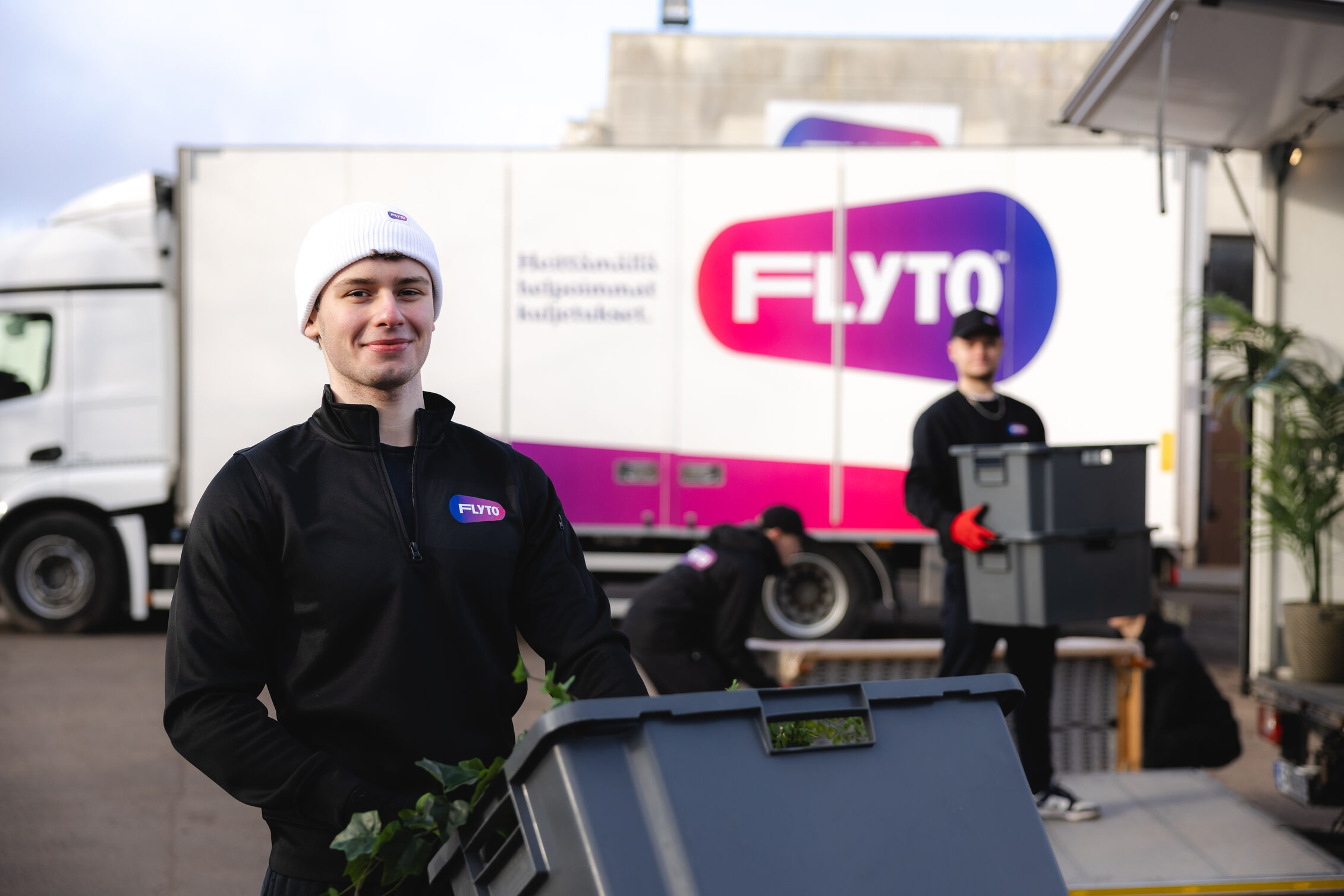
Everything in section 1 is why a Copenhagen move rewards a mover who actually knows the city — and it is where Flyto earns its keep. We arrange the road-occupation permit (råden over vej) with Københavns Kommune where the truck needs reserved space, with the right vehicle and lead time, so there is a legal place to stand on a cycle-priority street. We assess access in advance — floor, stair width, whether there is a lift or only a køkkentrappe — and bring an exterior furniture lift (møbellift) when the sofa won’t make the stairwell, rather than discovering the problem mid-carry. And we plan around Copenhagen’s bridges, island addresses on Amager and Christianshavn, one-way streets and protected cycle lanes so nothing on move day is a surprise. That is the honest difference between a generic van hire and a relocation partner who has done this street by street. Get a fixed quote for your Copenhagen move, or browse our full Denmark moving guides and customs guide for household goods.
Moving to Copenhagen? Get a fixed quote.
Tell us your addresses and volume and we’ll price the whole move — including the road-occupation permit and any furniture lift your lift-less block needs. No surprises on the day.
Frequently asked questions
How much deposit do I need to rent an apartment in Copenhagen?
A lot, up front. Under the Danish Rent Act (lejeloven) a landlord may take a deposit of up to three months’ rent plus up to three months’ prepaid rent. With the first month’s rent, that means you can be asked for the equivalent of five to seven months’ rent before you get the keys — often well over DKK 75,000 on a typical flat. The deposit is refundable (less any damage) and prepaid rent covers your last months, but you need the cash ready at signing (Lejeloven.dk).
Do I need a permit for the moving truck in Copenhagen?
Often yes. To reserve kerb or pavement space for a large removal truck, container or furniture lift on a public road, the moving company applies to Københavns Kommune for a road-occupation permit (råden over vej). The permit is only issued for work vehicles of at least 3,500 kg — not ordinary vans — and private courtyards or housing-association land need the owner’s separate permission. It’s arranged in advance, which is why most people leave it to their mover (Københavns Kommune).
Will my furniture fit up a Copenhagen apartment staircase?
Often not. The classic 5–6 storey inner-city blocks in Indre By, Nørrebro and Vesterbro usually have no lift and only a narrow main stair plus a steep service stair (køkkentrappe). Sofas, wardrobes and beds frequently have to go in through a window on an exterior furniture lift (møbellift). A good mover checks the floor, stair width and whether a lift is needed before move day and books it in advance.
How do I get a CPR number in Copenhagen?
Once you have a Danish address, you register in person at the International Citizen Service (ICS East) inside International House Copenhagen, which issues the CPR number and can set up MitID, your tax card and health card in one visit, free of charge. EU/EEA/Swiss citizens must register within three months of arrival (six for Nordic citizens); non-EU citizens within days of taking an address. Book an appointment first (International House Copenhagen).
How much does it cost to rent in Copenhagen in 2026?
City-wide, roughly DKK 14,500 a month for a one-bedroom and DKK 20,000 for a two-bedroom on new lettings. The most central areas — Indre By, Christianshavn and the harbour — run DKK 240–300 per m² per month, while Valby, Nordvest and outer Amager are cheaper. Rent varies sharply with size and condition (Investropa).
Which Copenhagen neighborhood is best for families?
Østerbro, Frederiksberg and Valby are the classic family choices — greener, calmer, with good schools and parks. Østerbro and Frederiksberg carry a premium (family two- and three-bedroom flats around DKK 18,000–32,000), while Valby and outer Amager/Ørestad give families more space for the money, often in newer buildings that actually have a lift.
Do I need a car in Copenhagen?
Usually not. The Metro, buses, S-tog and harbour buses share one zone-based fare (a two-zone single starts at DKK 24), and Copenhagen is built for cycling with protected lanes across most of the city. Most residents get around by bike and public transport; a car is more hassle than help in the inner districts. Note the physical Rejsekort closes on 29 June 2026, replaced by the Rejsebillet app (DOT; Rejsekort).
How do I get a doctor and health card after moving to Copenhagen?
Your healthcare follows automatically from CPR registration: once registered you are covered by the tax-funded system and allocated a family doctor (læge), and most care is free at the point of use. Your yellow health card (sundhedskort) arrives by post about two weeks later, showing your GP’s details, and there is a Sundhedskortet app (Life in Denmark).
Official sources
- Københavns Kommune — råden over vej (road-occupation permit for trucks, lifts, containers)
- City of Copenhagen — housing guide for internationals
- City of Copenhagen — public transport tickets and prices
- International House Copenhagen — registration & guidance (CPR, MitID, tax card)
- International House Copenhagen — main portal
- Life in Denmark (borger.dk) — ICS East in Copenhagen
- Life in Denmark (borger.dk) — when you arrive / CPR registration
- Life in Denmark (borger.dk) — healthcare and the sundhedskort
- Lejeloven.dk — the Danish Rent Act (deposit and prepaid rent limits)
- BoligPortal — rental listings portal
- DOT (Din Offentlige Transport) — Copenhagen public transport fares
- Copenhagen Metro — tickets and zones
- Rejsekort — prices and 2026 phase-out
- GlobalPetrolPrices — Denmark residential electricity price
- The Local — Denmark’s 2026 electricity tax cut
- Investropa — Copenhagen rent report 2026
- Flyto — Danish CPR number, MitID and NemKonto guide
- Flyto — customs for household goods
- Flyto — Denmark moving guides
Hiring an international mover? See our full International removals to Denmark service — Flyto’s own European hubs, vetted local partners and one English-speaking coordinator, door to door.