

Customs for Household Goods from Denmark 2026: Toldstyrelsen Rules and Documentation

Quick answer: Within EU/EEA goods move without customs. Third country (UK after Brexit, USA, Switzerland) requires export declaration via Toldstyrelsen and import exemption (typically >6 months use). Inventory list mandatory for non-EU.
Key takeaways
- EU/EEA: no customs.
- Third country export declaration.
- Removal-goods exemption >6 months use.
- Inventory list mandatory.
- Banned: weapons, live animals.
Denmark inside the EU customs union — what that means for movers
Unlike Norway, Denmark is part of the EU customs union. Moving household goods from Denmark to another EU member state involves no customs declaration and no duty regardless of value. The goods circulate freely under the principle of free movement (Article 28 TFEU). VAT does not apply on intra-EU removal goods because no taxable supply occurs — you are simply moving your own property.
Movements to non-EU destinations (UK post-Brexit, Switzerland, Norway, USA, Canada, Australia, etc.) require export declarations to Toldstyrelsen via the e-Eksport portal, plus import declarations and removal-goods documentation in the destination country. Most professional movers handle the paperwork through customs agents (toldspeditører) — DIY moves require direct registration as exporter with Toldstyrelsen.
Removal-goods exemption in non-EU destinations
For moves to non-EU countries, removal-goods relief operates under each country’s national rules. The key qualifying conditions are similar across most countries:
- The goods belonged to you for at least 6-12 months in Denmark;
- You transfer your normal residence to the destination;
- Goods will not be sold or transferred for at least 12 months after import;
- Goods imported within 6-12 months of arrival.
UK procedures: Transfer of Residence (ToR) relief under HMRC Notice 3. Apply ToR1 form before shipping; relief covers VAT and import duty. Switzerland: Form 18.44 for free import as removal goods. USA: Form 3299 with detailed inventory. Each requires precise documentation — see destination guides for specifics.
For the practical side of the move – crews, customs paperwork and a fixed price – start here: international movers to Denmark.
Restricted and prohibited items
| Item | Denmark export rule | Common destination rules |
|---|---|---|
| Firearms | Politiet permission, EU Firearms Pass | Strict registration in destination |
| Cultural property >50 years | Slots- og Kulturstyrelsen export permit | EU-wide free movement; non-EU restrictions vary |
| CITES wildlife | Miljøstyrelsen CITES permit | Destination CITES import permit |
| Alcohol > personal allowance | Excise refund possible if commercial | Destination excise applies if non-EU |
| Plants and seeds | Plantedirektoratet phytosanitary cert | EU plant passport or destination phytosanitary |
| Pets | Fødevarestyrelsen export certificate | EU Pet Passport with rabies vaccination + chip |
| Cash > EUR 10,000 equivalent | Declare to Toldstyrelsen | Declare at first non-EU port of entry |
Get your fixed price (2 min) →
Detailed inventory and customs valuation
For non-EU destinations, the inventory list (packlista) is the central document. Customs officers read it line by line. A vague entry (’household goods, 50 boxes’) invites delay; a specific entry (’Box 1: kitchen plates Royal Copenhagen Blue Fluted, 12 pieces, 2018, value DKK 8,000’) passes through. Investments of 4-8 hours in inventory pay back in border efficiency.
Number every box; reference the inventory. Keep one copy with the goods, one with the mover, one with you. Photograph valuables. Tag boxes containing electronics — destination customs may ask to inspect. Group categories logically (kitchen, bedroom, books, etc.) for easier verification.
VAT (moms) on Danish purchases shortly before move
Items bought in Denmark shortly before emigration may qualify for VAT refund through tax-free shopping for export to non-EU destinations. The 25% Danish moms is refundable on items bought above DKK 300 per receipt, exported within 90 days, unused. Most large retailers participate in Global Blue or Planet schemes. Customs validation is needed at the Danish border (airport, seaport) before final refund — bring receipts and items for inspection.
For EU destination moves, no VAT refund applies — moms is paid in Denmark and not reimbursed. Items purchased less than 6 months before emigration remain part of household goods regardless.
Container shipping vs. road transport
For EU destinations, road transport dominates: door-to-door from Copenhagen to Madrid takes 4-6 days, Lisbon 6-8 days, Athens 8-10 days. Pricing typically EUR 3,000-8,000 for a typical 3-bedroom household. For overseas (USA, Australia, Asia), 20-foot or 40-foot sea containers are standard, with 4-10 weeks transit. Customs clearance happens at destination port; you typically need to be present or use a destination clearance agent.
Hand-luggage and accompanied baggage
Personal effects in your accompanied baggage during the move flight or drive enjoy higher customs tolerance. EU travellers carry up to EUR 430 per person (air/sea) or EUR 300 (land) tax-free in addition to removal goods. Within Schengen, no border control applies — but airport customs spot-checks remain possible.
Mover liability and goods-in-transit insurance
Standard mover liability under CMR Convention (road) and Hague-Visby Rules (sea) is limited to 8.33 SDR per kg (~EUR 11/kg). For most household moves this is far below replacement value. Take out ’all-risks’ goods-in-transit insurance through your mover or a separate Danish provider (Tryg, Codan, Topdanmark, Alka, If) — typically 0.5-2% of declared value.
Storage and split-move scenarios
If the destination home is not yet ready, Danish movers offer up to 6 months storage before shipment. Customs treatment: goods remain in Danish customs status until shipped, so the 6-month removal-goods clock does not start until departure. After 6 months in storage, longer storage typically requires re-classification as warehouse goods — discuss with the mover for VAT and customs implications.
FAQ
EU move requires list?
Not mandatory but recommended.
UK after Brexit?
Export declaration + ToR1 in UK.
Car as removal goods?
Car handled separately.
Inventory language?
Danish or English.
Mover handles customs?
Yes, international movers include this.
Do I need to declare household goods when moving from Denmark to another EU country?
No customs declaration is required for intra-EU movements. The goods circulate freely under the EU customs union. Keep an inventory for insurance purposes, but no Toldstyrelsen or destination customs paperwork is needed.
Are there time limits to claim removal-goods relief in non-EU destinations?
Yes — UK Transfer of Residence relief requires arrival within 12 months of becoming resident (HMRC Notice 3). Switzerland and USA have similar 6-12 month limits. Plan shipment timing and ToR1 (UK) or equivalent application early.
Can I bring my wine cellar duty-free as removal goods?
Yes within EU; no duty applies. For non-EU destinations, removal-goods relief usually allows reasonable personal quantities (typically 5-30 bottles) duty-free; beyond that, destination excise duty applies. Document each bottle in inventory with vintage and value.
Is professional moving company required, or can I do a self-move?
Self-moves are legal but practical only for EU destinations with road transport. For non-EU destinations, professional movers handle Toldstyrelsen export, destination customs, removal-goods documentation, and inventory translation. The cost is typically 30-50% lower than the time and risk of self-clearance.
Use professional mover.
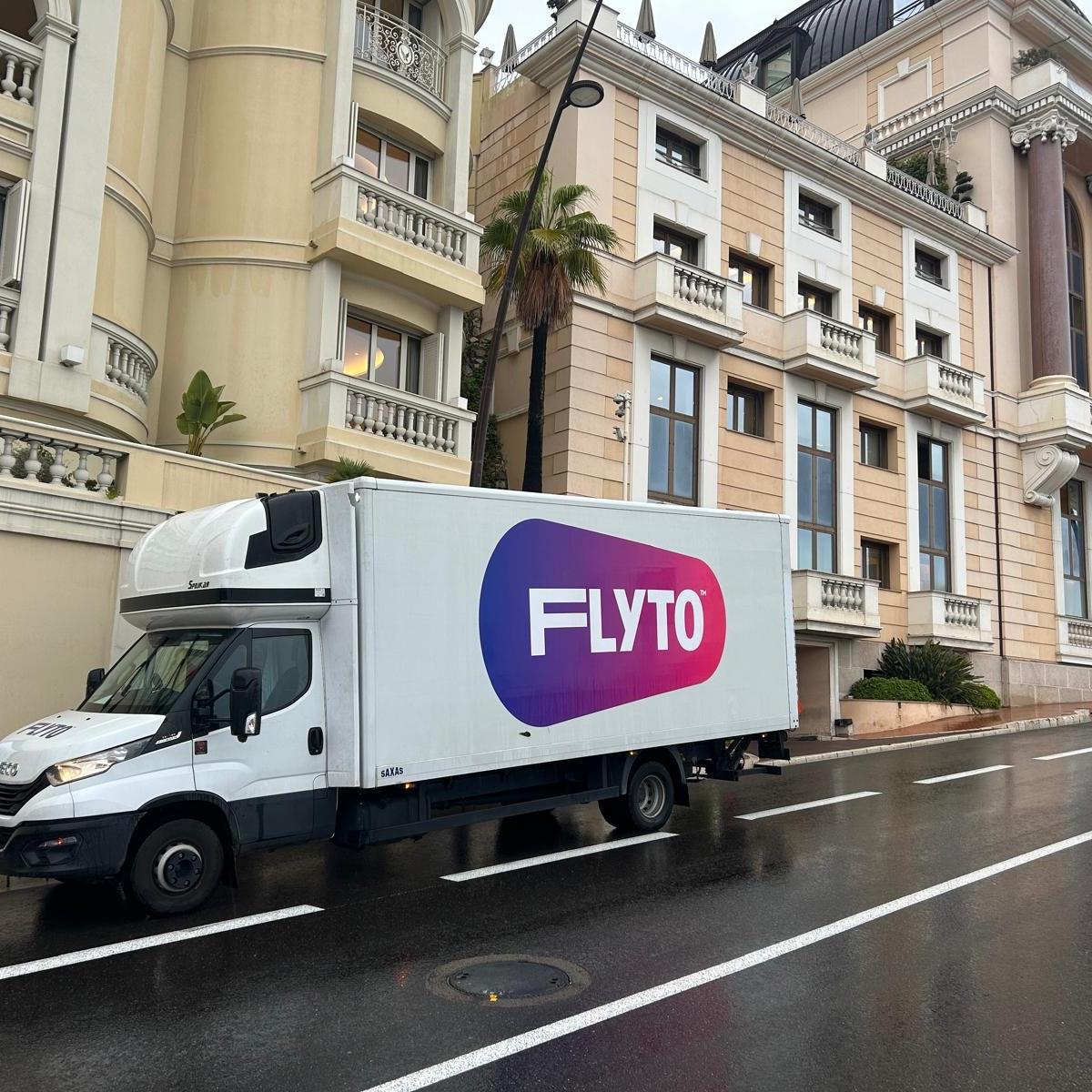
Flyto Relocation handles international moves and customs. Get a quote.
See also: All Denmark moving guides.
Official sources
- Toldstyrelsen (info.skat.dk) — indførsel af flyttegods (removal-goods rules)
- Toldstyrelsen — F.A.18.3 privatpersoners indførsel af personlige ejendele
- Skattestyrelsen / Toldstyrelsen (skat.dk) — Danish tax & customs authority
- CPR — moving from Denmark (deregistration underpins export)
- borger.dk — Flytning (moving hub)
- Your Europe — VAT rules for goods within the EU
- Your Europe — registering residence in another EU country
Ready to ship your belongings abroad?
We handle export customs and 20 European destinations