

Moving to Aarhus (2026): The Complete Relocation Guide

Aarhus is Denmark’s second city — around 378,000 residents in the municipality on 1 January 2026 and growing fast — and it feels nothing like Copenhagen. This is a compact harbour city built around a medieval core, Denmark’s biggest university, and a brand-new waterfront rising out of the old docks. It is also, quietly, one of the more awkward Danish cities to physically move into: the oldest streets are cobbled medieval lanes a removal truck cannot enter, many pretty old-town blocks have no lift and steep back stairs, and you cannot legally reserve kerb space for the truck without a road-occupation permit from the municipality. This guide covers the practical mechanics of moving to Aarhus in 2026 — the truck logistics only a mover knows, where to live and what rent really costs, how to get your CPR number and settle in, and what monthly life actually costs — with official sources throughout.
Freshness note: prices and rules verified against aarhus.dk, international.aarhus.dk, lifeindenmark.borger.dk, Midttrafik, lejeloven.dk and Aarhus University in 2026. Fees and rents move — confirm figures with the linked authorities before you rely on them.
Quick answer: moving to Aarhus in 2026
What does it cost to move to Aarhus? An international household move (a full flat) typically lands in the low-to-mid four figures from within Europe and higher from overseas, driven mostly by volume, distance and access. Because Aarhus’s old-town access difficulties (see below) add real cost, get a fixed quote for your specific address rather than a generic estimate — get a Flyto quote here.
How long does the move take? Road moves from within the EU are usually a few days to about two weeks door-to-door; overseas sea freight runs several weeks. The one Aarhus-specific quirk everyone underestimates: to park the truck legally you need a road-occupation permit (tilladelse til råden over vejareal) from Aarhus Kommune, which quotes up to about ten working days to process simple cases (Aarhus Kommune). In the Latin Quarter, no permit puts a truck on the lane at all.
Key takeaways
- Your moving truck needs a road-occupation permit. Placing a moving van (flyttebil) on a public road in Aarhus requires a permit for råden over vejareal from the municipality’s Teknik og Miljø department, with a precise marking plan (afmærkningsplan) attached, and up to about ten working days to process simple cases (Aarhus Kommune).
- The Latin Quarter bars trucks. Latinerkvarteret — Aarhus’s oldest quarter, with cobbled lanes such as Mejlgade and half-timbered houses — is too narrow and too pedestrianised for a full removal truck, so moves there are done by small van with a longer carry (VisitAarhus).
- Old blocks with no lift need an exterior furniture lift. Many central Aarhus blocks (Frederiksbjerg, Trøjborg, the old town) are early-1900s brick walk-ups with no elevator and steep, tight back stairs — so bulky items go in through a window on an exterior furniture lift (møbellift), which itself needs a kerb-space permit (Aarhus Kommune).
- Rent is cheaper than Copenhagen — but student demand is fierce. Aarhus rents run roughly DKK 170–220 per m² per month, with a one-bedroom in the centre around DKK 7,500–11,000; the city’s ~35,000-plus university students make August the tightest month of the year (relocate.me cost data, Aarhus University).
- Upfront housing costs are steep and legally capped. A landlord may take a deposit (depositum) of up to three months’ rent plus up to three months’ prepaid rent (forudbetalt leje) — so signing can mean paying the equivalent of several months at once (Lejeloven.dk).
For the practical side of the move – crews, customs paperwork and a fixed price – start here: international movers to Denmark.
1. The move into Aarhus — logistics only a mover knows
This is the part generic ”moving to Aarhus” guides skip, and it is exactly where a move goes wrong. Aarhus is a city of two halves: a medieval and early-industrial core built long before removal trucks existed, and a gleaming new harbour district built for cars and cranes. What works in one fails completely in the other. Three things determine whether your move day runs smoothly.
The road-occupation permit: your truck’s parking
You cannot count on a free stretch of kerb outside an Aarhus building, and you cannot simply block a lane on the day. To place a removal truck on a public road you apply for a road-occupation permit — officially a tilladelse til råden over vejareal for a moving van (flyttebil). Key facts from the municipality itself (Aarhus Kommune):
- Who grants it: the Råden over Vejareal team in Aarhus Kommune’s Teknik og Miljø (Byliv) department, at Karen Blixens Boulevard 7, 8220 Brabrand. Applications go through the municipal / Virk self-service portal (Virk).
- Lead time: the city quotes up to about ten working days to process smaller, simple cases — and longer for large or complex ones. That is roughly two calendar weeks, so apply well ahead rather than the week before.
- Marking plan required: you must submit an afmærkningsplan (a traffic-marking plan) that is ”precise, unambiguous and of high quality”, showing exactly where the truck and any signs will stand. This is a professional document — one more reason movers handle the permit rather than the customer.
- Private ground first: the municipality expects you to place the truck or equipment on private ground (a courtyard, driveway or private road) wherever possible, and to justify in the application why the public road is needed. On tight central streets it usually is.
Unlike some cities, Aarhus does not publish a flat, fixed fee for a moving-van permit on this page; the real cost is the set-up, signage and handling, which most people delegate to their moving company. You often need two permits — one at the old address and one at the new — and there is no last-minute fix on move day.
The Latin Quarter: where trucks simply cannot go
Latinerkvarteret (the Latin Quarter) is the oldest part of Aarhus — a knot of narrow, cobbled, largely pedestrianised lanes such as Mejlgade, Volden and Badstuegade, lined with half-timbered houses now full of cafés, boutiques and specialty shops (VisitAarhus). It is one of the most desirable places in the city to live and one of the hardest to move into. A full-size removal truck cannot fit down these lanes, cannot turn in them, and often is not allowed in at all during daytime hours.
The practical solution is a small-van shuttle: the main truck parks legally on a permitted spot on the nearest through-street, and a smaller van (or a hand-trolley team) ferries everything the last stretch through the lanes. It is slower and more labour-intensive, and it needs to be planned and priced in advance — turning up with a 12-metre truck at the mouth of Mejlgade is a wasted day. The same logic applies to the pedestrian core around the Cathedral and Store Torv.
No lift, steep back stairs, and the møbellift
Away from the new harbour, much of central Aarhus is early-1900s brick apartment stock — the four- and five-storey blocks of Frederiksbjerg, Trøjborg and the old town. These buildings are handsome, but many have no elevator and narrow, steep staircases, sometimes with a separate back stair (køkkentrappe) that is tighter still. Sofas, wardrobes, double beds and pianos frequently will not go up.
The standard solution is an exterior furniture lift (møbellift) — a ladder hoist run up the facade to lift bulky items straight in through a window or balcony. Placing one on a public road needs its own municipal permit (tilladelse til at opstille en lift/kran), again with a marking plan and up to about ten working days for simple cases (Aarhus Kommune). A good mover assesses this before the day — floor, stair width, window size — not when the sofa is stuck on the second-floor landing.
Aarhus Ø and the new-build contrast
The opposite problem waits on the waterfront. Aarhus Ø — the docklands district built out of the old container port, with landmarks like Isbjerget and the Lighthouse tower and room for around 7,000 new residents — is modern, with lifts, loading zones and wide access (Aarhus Inside). Here the challenge is not stairs but coordination: booked service lifts with time slots, loading bays shared with neighbours, building-management rules, and long internal carries from the bay to a high-floor flat. It is an easy move if you book the lift slot and clear the rules in advance, and a frustrating one if you assume you can just pull up. The honest point is that ”moving to Aarhus” means one thing in Latinerkvarteret and the exact opposite on Aarhus Ø — and your mover needs to know which.
2. Where to live — Aarhus neighborhoods by profile
Aarhus is compact enough to cross by bike, so ”neighbourhood” here is about character more than commute. The figures below are indicative: city-wide, rents run roughly DKK 170–220 per m² per month, with a one-bedroom in the centre around DKK 7,500–11,000 and DKK 5,500–8,500 further out (relocate.me). The dearest postcodes are Aarhus C, Risskov, Højbjerg and Aarhus N; the cheapest are Aarhus V, Åbyhøj, Viby and the outer suburbs. Check live listings on BoligPortal (private rentals) and AarhusBolig (public housing).
Best for city life:
- Midtbyen & Latinerkvarteret (top of the range) — the medieval core and the Latin Quarter: cobbled lanes, half-timbered charm, cafés and nightlife on the doorstep. The most atmospheric address in the city, and the priciest per m² — but expect no lift, small flats and the truck-access headaches above.
- Frederiksbjerg (upper-mid to high) — just south of the station, consistently rated one of the best places to live in Aarhus: late-1800s blocks, the food-and-bar street Jægergårdsgade, small parks and a genuine neighbourhood feel. Central, walkable and in demand, so not cheap.
- Aarhus Ø (high, new-build) — the harbour district: modern flats with lifts, sea views, a harbour bath and café life. Priciest for new, high-spec apartments; easy logistics but a young, still-forming community.
Best for families:
- Risskov (high) — leafy coastal suburb north of the centre with the Risskov forest and beaches; quiet, green, good schools and family houses, at a premium price and a slightly longer commute.
- Højbjerg (upper-mid to high) — established, well-off residential area to the south near the Marselisborg forest and coast; calm and green, popular with settled families.
- Trøjborg (mid) — ”a small town within the city” just north of the centre: early-1900s brick blocks, a walkable high street with shops and a cinema, close to the university. Good value for how central it is; note the no-lift walk-ups.
Best for students and value:
- Christiansbjerg (mid) — north of the centre and a short hop to the university; cosy residential streets and green space, popular with both students and young families.
- Åbyhøj (lower-mid) — a cosy, local-feeling area west of the centre with green space, cafés and good connections; popular with young families and students for the price.
- Viby (lower-mid) — south-west across the motorway, near Brabrand Lake; more affordable everyday living with quick light-rail and bus links into town.
3. The Aarhus housing market — how flats are actually found
Aarhus has a genuinely tight rental market, and the reason is the university. With more than 35,000 students — and the largest new intake in the university’s history in recent years — demand peaks hard every August as terms start, and that is the worst possible month to arrive without a plan (Aarhus University). Here is how it works.
- Where to search: the main private-rental portal is BoligPortal; for non-profit and public housing (a huge slice of Danish stock) you sign up and queue at AarhusBolig, and university-linked options exist for students. Good private listings move in hours, not days.
- Deposit and prepaid rent. Under the Danish Rent Act (Lejeloven), a landlord may require a deposit (depositum) of up to three months’ rent plus prepaid rent (forudbetalt leje) of up to three months — on top of the first month due at signing. That can mean paying the equivalent of several months’ rent at once, so budget for it before you commit (Lejeloven.dk).
- Your rights are strong. The Rent Act is mandatory law that cannot be signed away to your disadvantage, and unfair deductions from your deposit can be challenged at the rent tribunal (Huslejenævnet). Read the contract and any move-in report carefully, and document the flat’s condition on day one (Life in Denmark).
- Scam warning. Fake listings spike around the August student rush. Never transfer a deposit or ”reservation fee” before you have viewed the flat in person and verified the landlord. Classic red flags: the ”owner is abroad”, keys promised by post against an advance payment, prices well below market, or being pushed to pay to a foreign account.
4. CPR and registration — getting into the system in Aarhus
Your CPR number (civil registration number) is the master key to life in Denmark: without it you cannot easily get a bank account, a tax card, a doctor or a phone contract. In Aarhus this runs through International Citizen Service (ICS) West and Borgerservice at Dokk1, the waterfront library and civic centre (International Aarhus). The essentials for EU citizens (step-by-step guide):
- EU residence document first. EU/EEA citizens apply for an EU residence document from SIRI (via nyidanmark.dk) and attend an appointment at ICS West, Dokk1, Hack Kampmanns Plads 2, 8000 Aarhus C. This proves your right to reside and must be in hand before the CPR step.
- The three- and six-month rules. To get a CPR number your stay must exceed three months and you must have a permanent Danish address; you are required to register if you stay longer than six months. You register your address and get your CPR at Borgerservice (Dokk1) — book an appointment first (book here).
- What to bring: your EU residence document, passport or national ID, and proof of your Danish address (rental contract or ownership document), plus marriage and children’s certificates if relevant.
- MitID and Digital Post. After your CPR is issued, wait 24 hours, then activate MitID — the national digital ID used for banking, tax and public services — using your passport in the app (International Aarhus).
If you are instead leaving Denmark, the CPR, NemKonto and MitID admin runs the other way — see our guide to your Danish CPR number after emigration, and the official overview of arrival admin on Life in Denmark.
5. Cost of living in Aarhus (2026)
Aarhus is meaningfully cheaper than Copenhagen — most obviously on rent — while still being a Danish city, so expect high prices for eating out and services. The current numbers:
- Rent is the big variable — see section 2. Budget roughly DKK 170–220 per m² per month, with a central one-bedroom around DKK 7,500–11,000 and DKK 5,500–8,500 further out (relocate.me). That is the single biggest saving versus Copenhagen.
- Public transport. Aarhus is covered by Midttrafik buses and the Aarhus Letbane light rail, on a zone system with a minimum charge of two zones. A single adult ticket for 1–2 zones is DKK 26, or DKK 23 paying by Rejsekort/app — and you must always buy before boarding, as there are no ticket sales on the Letbane or on city buses (Midttrafik prices, zones).
- Utilities and everyday costs sit at Danish levels — electricity, heating and water are not cheap, and groceries and restaurants cost noticeably more than in most of Europe. A realistic single-person budget outside rent runs into several thousand kroner a month.
- Bike everything. Aarhus is compact and cycling is the default; a good second-hand bike pays for itself quickly against transit fares, and much of the city is a short ride away.
6. Getting settled — health, transport, university, internet
- Health card and doctor. When you register for your CPR you are assigned a general practitioner (læge) and receive a temporary cover, with the yellow health card (sundhedskort) arriving by post within roughly two weeks. The card gives you free access to your GP and public hospitals; general health information for residents is at sundhed.dk and Life in Denmark.
- Getting around. The Letbane light rail plus Midttrafik buses cover the city and region; most residents use a Rejsekort or the app rather than paper tickets. With the city this compact, you rarely need a car (Midttrafik tickets).
- University and schools. Aarhus University (AU) is the city’s centre of gravity, with tens of thousands of students and a large international staff and researcher community; if you are moving for AU, its international staff service handles much of the registration paperwork (au.dk). Public schools (folkeskole) are free, and international-school options exist for expat families.
- Internet. Danish broadband is fast and widely available; check what the building already supports (fibre is common) before signing, and order early as installation can take a couple of weeks.
7. How Flyto handles your move to Aarhus
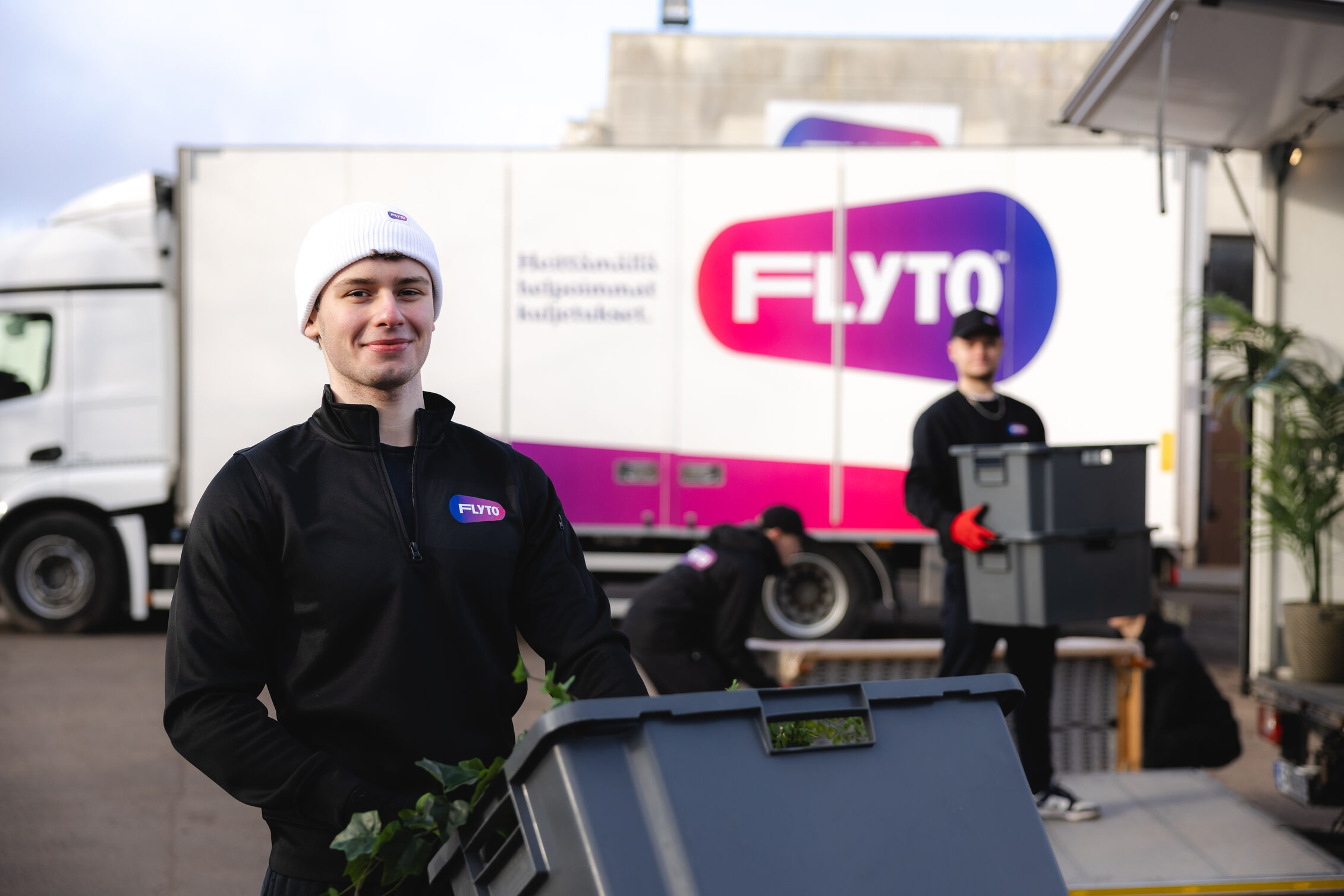
Everything in section 1 is why an Aarhus move rewards a mover who actually knows the city — and it’s where Flyto earns its keep. We handle the road-occupation permits at both addresses, in the right form with the marking plan the municipality requires and the lead time it needs, so there’s a legal, empty space when the truck arrives. We plan Latin Quarter and old-town moves as a small-van shuttle rather than turning up with a truck that can’t fit. We assess no-lift walk-ups in advance — floor, stair width, window size — and bring an exterior furniture lift (møbellift) when the sofa won’t make the stairwell. And we coordinate Aarhus Ø service lifts and loading bays so a high-floor harbour flat is a booked slot, not a surprise. That’s the honest difference between a generic van hire and a relocation partner who has done this street by street. Get a fixed quote for your Aarhus move, browse our full Denmark moving guides, or compare with our Copenhagen relocation guide.
Moving to Aarhus? Get a fixed quote.
Tell us your addresses and volume and we’ll price the whole move — including the road-occupation permits, any small-van shuttle for the old town, and the furniture lift a no-lift block needs. No surprises on the day.
Frequently asked questions
Do I need a permit for the moving truck in Aarhus?
In practice, yes. To place a removal truck (flyttebil) on a public road you apply to Aarhus Kommune for a road-occupation permit (råden over vejareal) through the municipal / Virk self-service portal, attaching a precise marking plan (afmærkningsplan). The municipality quotes up to about ten working days to process simple cases, so apply well ahead. The municipality expects you to use private ground first where possible, and you usually need a permit at both the old and new address.
Can a removal truck get into the Latin Quarter?
Usually not. Latinerkvarteret is a knot of narrow, cobbled, largely pedestrianised medieval lanes such as Mejlgade, where a full-size truck cannot fit, turn or park during the day. Moves there are done as a small-van shuttle: the main truck parks on a permitted spot on the nearest through-street and a smaller van or trolley team ferries everything the last stretch. It has to be planned and priced in advance.
Will my furniture fit up an old Aarhus staircase?
Often not. Much of central Aarhus — Frederiksbjerg, Trøjborg, the old town — is early-1900s brick walk-ups with no lift and steep, narrow stairs. Large items frequently have to go in through a window on an exterior furniture lift (møbellift), which needs its own municipal permit to stand on the road. A good mover checks the floor, stair width and window size before move day and books the lift in advance.
How much is rent in Aarhus in 2026?
Aarhus rents run roughly DKK 170–220 per m² per month, cheaper than Copenhagen. A one-bedroom in the centre is around DKK 7,500–11,000, and DKK 5,500–8,500 further out. The dearest areas are Aarhus C, Risskov, Højbjerg and Aarhus N; the cheapest are Aarhus V, Åbyhøj and Viby. Demand peaks hard every August with the university intake, so start early.
How much deposit will an Aarhus landlord ask for?
Under the Danish Rent Act (Lejeloven), a landlord may require a deposit (depositum) of up to three months’ rent plus prepaid rent (forudbetalt leje) of up to three months, on top of the first month due at signing. That can add up to the equivalent of several months’ rent at once, so budget for it. Unfair deposit deductions can be challenged at the rent tribunal (Huslejenævnet).
How do I get a CPR number in Aarhus?
EU citizens first apply for an EU residence document from SIRI and attend International Citizen Service (ICS) West at Dokk1, then register their address and obtain a CPR number at Borgerservice (Dokk1) — book an appointment first. You need a stay of more than three months and a permanent Danish address; registration is required for stays over six months. After the CPR is issued you activate MitID and receive a yellow health card (sundhedskort) by post.
Is Aarhus cheaper than Copenhagen?
Yes, mainly on rent, which is the biggest difference — a central Aarhus one-bedroom is well below Copenhagen levels. Other costs (groceries, eating out, utilities) are still at Danish levels. Aarhus is also compact and very bike-friendly, so many residents save further by not owning a car.
What is the best area of Aarhus for families?
Risskov and Højbjerg are the classic family choices — leafy, coastal and near forest, with good schools — at a premium price and a slightly longer commute. Trøjborg and Christiansbjerg offer a more central, walkable family life closer to the university, with the trade-off of older no-lift blocks. Frederiksbjerg suits families who want city life on the doorstep.
Official sources
- Aarhus Kommune — permit to place a moving van (flyttebil) on the road
- Aarhus Kommune — permit to place a lift/crane (møbellift)
- Virk — Aarhus road-occupation self-service application
- International Aarhus — EU citizen registration step-by-step
- International Aarhus — Citizen Service (Borgerservice) and ICS West
- International Aarhus — book a Borgerservice appointment
- International Aarhus — MitID, Digital Post and NemSMS
- Life in Denmark (borger.dk) — practical matters when arriving (CPR, health, bank)
- Life in Denmark (borger.dk) — renting a property
- Lejeloven.dk — the Danish Rent Act (deposit and prepaid rent)
- Midttrafik — adult ticket prices
- Midttrafik — tariff areas, zones and prices (Aarhus Letbane)
- sundhed.dk — Danish health service portal for residents
- BoligPortal — private rental listings (Aarhus)
- VisitAarhus — quarters of Aarhus (Latin Quarter and more)
- Aarhus Inside — the Aarhus Ø harbour district
- Aarhus University — key statistics (student numbers)
- Flyto — Danish CPR number after emigration
- Flyto — moving to Copenhagen guide
- Flyto — Denmark moving guides
Hiring an international mover? See our full International removals to Denmark service — Flyto’s own European hubs, vetted local partners and one English-speaking coordinator, door to door.