
Moving from Denmark to Germany (2026): Complete Guide

Denmark and Germany are neighbours, and moving between them is an intra-European move: both countries sit inside the EU customs union and the EU/EEA area of free movement, so this relocation looks nothing like a move to the UK, the US or Australia. There is no customs process for your furniture and boxes, and as an EU/EEA citizen you don’t need a visa or work permit to live in Germany — the real work is administrative: closing out your Danish registrations correctly and completing Germany’s residence, tax and healthcare registrations on arrival. This guide is written for a resident of Denmark relocating to Germany and walks through exactly what that paperwork looks like.
Key takeaways
- No customs, no duty, no import declaration. Denmark and Germany are both inside the EU customs union, so household goods move across the border under the EU’s free movement of goods — there is nothing to declare and nothing to pay (Council of the EU, the EU customs union).
- No visa or work permit needed. As an EU citizen you have the right to live, work or study in Germany without a residence permit (Your Europe, residence rights).
- You must de-register in Denmark from the CPR (folkeregister) before you leave if you’re moving for more than 6 months (CPR.dk, flytning til udlandet; Borger.dk, udrejse i mere end 6 måneder).
- Danish full tax liability normally ends once you no longer have a residence available to you in Denmark — Skattestyrelsen assesses this case by case (info.skat.dk, C.F.1.2.3 Hvornår ophører skattepligten ved fraflytning?).
- You must register your address in Germany (Anmeldung) within 14 days of moving in — this is a German legal requirement, not just an EU minimum (Service Berlin, Anmeldung).
- Your German tax ID (Steuer-ID) is issued automatically once you complete Anmeldung — no separate application needed (BZSt, Steuerliche Identifikationsnummer).
- Health insurance is compulsory in Germany from the moment your residence is there — statutory (GKV) or private (PKV) (Berlin.de Senatsverwaltung für Gesundheit, Krankenversicherung für EU-Bürger).
- Your Danish/EU driving licence stays valid in Germany — no mandatory exchange just because you moved (Your Europe, driving licence exchange and recognition).
1. Free movement in practice: what actually applies to your move
Because both Denmark and Germany are members of the EU customs union, the movement of your household goods across this border is treated the same as moving goods between two German cities: there is no customs declaration, no duty, and no import tax on used personal belongings (Council of the EU). This is fundamentally different from a move involving a non-EU/non-customs-union country — you will not need a "transfer of residence" customs procedure, an inventory submitted to customs, or duty-relief paperwork of the kind required for a move from, say, Switzerland or the UK.
The same principle applies to you as a person: as an EU citizen you have the right to move to Germany to live, work, study or retire without a visa or work permit (Your Europe, residence rights). What replaces the visa process is registration: after more than three months you may be required to register your residence with the relevant authority (Your Europe, registering residence abroad) — in Germany this happens immediately via Anmeldung, covered in Section 4.
In short: skip anything you may have read about customs clearance, import declarations, or "personal effects" duty relief. None of it applies to a Denmark–Germany move. The only real customs formalities in this corridor would appear if your route touched Switzerland (not in the EU/EEA customs union) or if goods were shipped via a non-EU/EEA third country — not relevant for a direct Denmark-to-Germany relocation.
If you still need to book the removal – price ranges, what is included and the questions to ask before you sign – see international movers to Denmark.
2. Leaving Denmark: what to close out
De-register from the CPR (folkeregister). If you’re moving abroad for more than six months, you must report your departure (udrejse) to your municipality before you leave, via borger.dk or your kommune’s self-service portal (CPR.dk; Borger.dk). Stays of six months or less can, in some cases, keep you registered if you retain full disposal of your Danish home — but that’s an exception, not the default, and it’s worth confirming with your municipality if it applies to you.
End your tax liability. Full Danish tax liability (fuld skattepligt) generally ceases once you no longer retain a residence available to you in Denmark; Skattestyrelsen’s own guidance treats retained control over a year-round home as the decisive factor, assessed case by case (info.skat.dk, C.F.1.2.3). If you’re renting out your Danish home rather than selling it, note that only an irrevocable multi-year lease that genuinely removes your access to the property is normally accepted as severing tax residence — a casual sublet is not enough, so get advice before you assume your tax liability has ended.
Hand back your health card. Once you’re no longer CPR-registered with a Danish address, you generally lose Danish public healthcare cover and should return your yellow health card (sundhedskort) to your municipality. Before you go, it’s worth having the blue EU health insurance card (EU-sygesikringskortet) for any transitional travel, though it’s a temporary-stay card, not a substitute for enrolling in German healthcare on arrival (Borger.dk, det blå EU-sygesikringskort).
Deal with your car, if you’re bringing or selling one. If you export a Danish-registered car permanently, deregister it via a licence-plate operator (nummerpladeoperatør) and you can typically claim back part of the Danish registration tax you paid (eksportgodtgørelse) once the car has left the country — Motorstyrelsen states this takes approximately 9 weeks from when adequate documentation is received (Motorstyrelsen, afmelding/eksport; Motorstyrelsen, eksport og registreringsafgift).
Notify the rest of your Danish life: employer, pension fund, e-Boks/digital post, and forward your Danish mail address if you keep a Danish bank account for the transition period.
3. How your household goods actually travel
Denmark and Germany share a land border on the Jutland peninsula, so most household-goods moves in this corridor go by road rather than sea freight. The typical routing for a full-service move:
- From Jutland or Funen: direct road via the E45, crossing the land border near Padborg/Ellund into Schleswig-Holstein, then onward via the A7 to Hamburg or further south.
- From Zealand/Copenhagen: road via the Great Belt (Storebælt) bridge to Jutland and then the same land crossing, or via the Rødby–Puttgarden ferry across the Fehmarn Belt to reach Hamburg/Berlin more directly.
- Further destinations (Munich, Frankfurt, Cologne): continued road transport south from Hamburg via the German Autobahn network.
These are freight-industry routing estimates, not government figures. As a rough guide, a dedicated road move between major Danish and German cities typically takes 1–3 days door-to-door depending on distance and whether goods are consolidated with other shipments; a groupage (shared-load) move can take longer. Because there’s no customs clearance step, the timeline is driven purely by distance and scheduling — not paperwork.
4. Arriving in Germany: registration, health, tax, driving
Register your address (Anmeldung). This is the single most important step and, unlike some EU countries, it’s mandatory in Germany regardless of nationality: you must register your new address at the local citizens’ office (Bürgeramt/Einwohnermeldeamt) within 14 days of moving in, bringing your passport or EU ID and a landlord confirmation (Wohnungsgeberbestätigung) (Service Berlin, Anmeldung). You’ll receive a stamped Anmeldebestätigung, which you’ll need for almost everything else — bank account, health insurance, phone contracts.
Your tax ID arrives automatically. Once your Meldebehörde (registration authority) processes your Anmeldung, it forwards your details to the Bundeszentralamt für Steuern (BZSt), which posts you your 11-digit Steuer-Identifikationsnummer — there’s no separate application (BZSt). If it hasn’t arrived within about three months, you can contact the BZSt directly and provide your personal details so it can trace it via your registration authority.
Enrol in health insurance. Health insurance is compulsory for everyone resident in Germany, regardless of nationality — what matters is your economic status and where you live, not your citizenship (Berlin.de Senatsverwaltung für Gesundheit). Most employees are enrolled automatically in the statutory system (gesetzliche Krankenversicherung, GKV) through their employer as soon as employment starts, with no qualifying waiting period for compulsory cover; your Krankenkasse may ask for proof of your previous Danish insurance as part of the registration paperwork, but this documents continuity rather than gating your start date (Your Europe, health insurance cover in your host country). If you’re not covered under GKV — for example if you’re self-employed or above the income threshold — you’ll need a private policy (PKV) with a Germany-licensed insurer.
Your driving licence stays valid — no mandatory swap for the move itself. EU rules mean you don’t need to exchange a Danish (EU) driving licence for a German one just because you’ve moved; you can drive on it as-is. Exchange only becomes mandatory if your licence is lost, stolen or damaged, or if you commit a traffic offence in Germany once you live there (Your Europe, driving licence exchange and recognition).
Re-registering a car you bring with you. If you’re bringing a Danish-registered car to keep in Germany long-term, the local Zulassungsstelle will need the original foreign registration documents (both parts, if it’s a two-part certificate), proof of a valid roadworthiness test, proof of ownership, a certificate of conformity, proof that VAT has been correctly accounted for, a German insurance confirmation number (eVB-Nummer), and a SEPA mandate for German vehicle tax, before issuing German plates (Your Europe, vehicle registration formalities).
5. Moving with pets
Dogs, cats and ferrets travelling between EU countries need an EU pet passport, a microchip meeting the EU traceability standard, and a valid rabies vaccination recorded in the passport — the microchip must be implanted before the rabies vaccination for the vaccination (and therefore the passport) to be valid (Your Europe, EU rules on travelling with pets). Puppies and kittens must be at least 12 weeks old for their first rabies vaccination, and you generally need to wait at least 21 days after that vaccination before travelling. Because this move stays entirely within the EU, there’s no quarantine and no separate import permit — just the passport and its up-to-date vaccination record, which your vet in Denmark can issue.
6. Money, banking, and what people forget
Denmark uses the Danish krone (DKK), not the euro — even though both countries are in the EU, this move does involve a currency change, unlike a move between two eurozone countries. Both Denmark and Germany are part of the Single Euro Payments Area (SEPA), so IBAN-based euro transfers between a Danish and a German bank work the same way as domestic transfers, even though your Danish account is denominated in kroner (European Commission, SEPA). Plan to open a German bank account early — you’ll need one for rent, German vehicle tax (which is collected via SEPA direct debit), and most utility contracts. Other things people commonly forget: redirecting Danish digital post (e-Boks) or setting up a forwarding address, checking whether your Danish employer pension continues or needs to be paused, and confirming whether your Danish mobile contract has an EU roaming policy that covers a permanent German number switch.
How Flyto handles your Denmark to Germany move
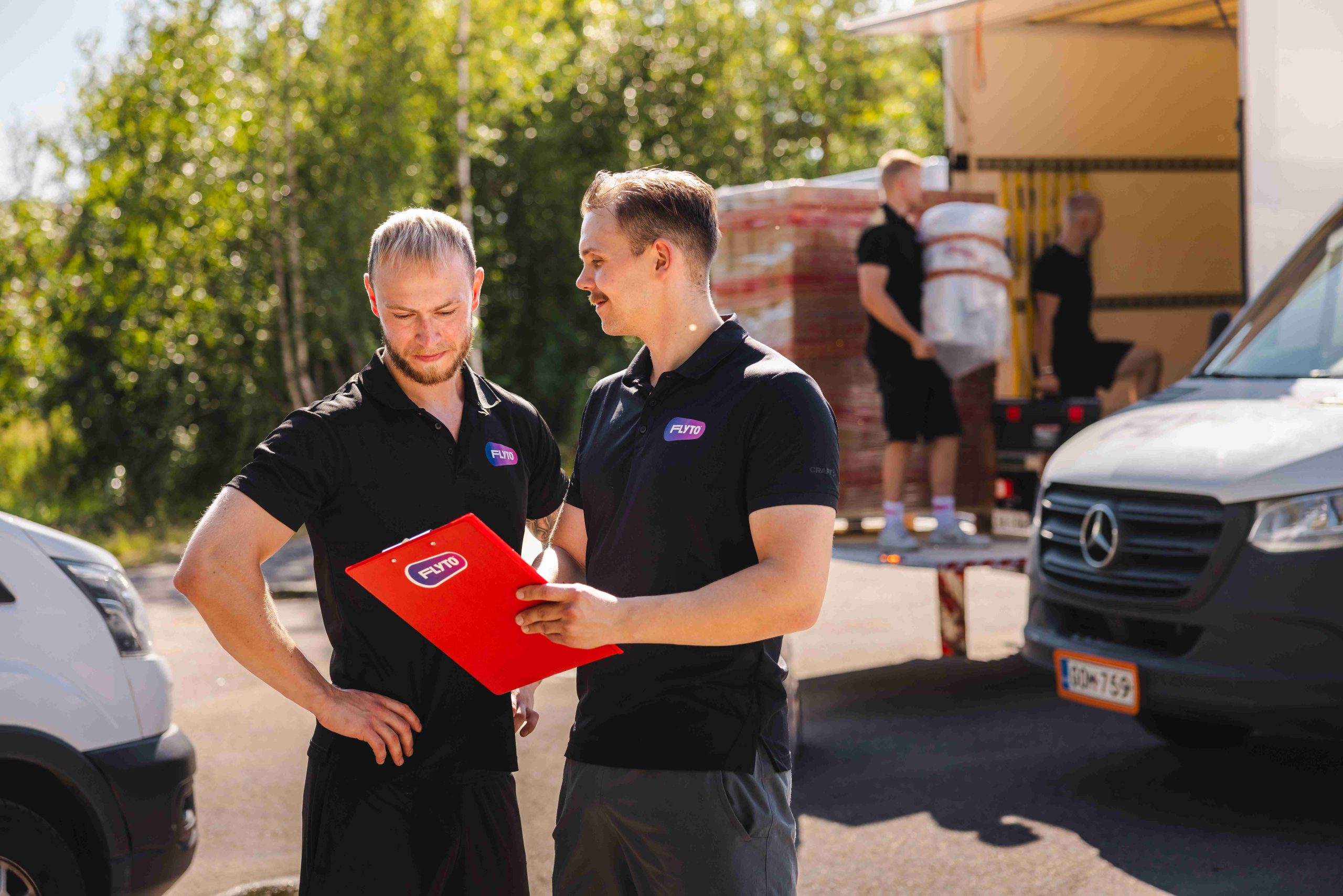
Flyto operates its own offices, warehouses, crews and vehicles across Northern, Central and Southern Europe, and this Denmark–Germany corridor runs largely on that in-house network rather than being outsourced end to end. Where it makes sense — a specific local pickup, a narrow delivery window, or extra capacity at peak season — we bring in a carefully vetted partner carrier, so you always get one point of contact and one quote covering the full door-to-door move.
Frequently asked questions
Do I need a visa or work permit to move from Denmark to Germany?
No. As an EU citizen you have the right to live and work in Germany without a visa or work permit; your main task is registering your address after you arrive (Your Europe, residence rights).
Will my furniture and boxes go through customs?
No. Denmark and Germany are both in the EU customs union, so there’s no customs declaration, duty or import tax on household goods moving between them (Council of the EU).
How soon do I have to register my address in Germany?
Within 14 days of moving into your new home, at the local Bürgeramt/Einwohnermeldeamt (Anmeldung) (Service Berlin).
Do I have to exchange my Danish driving licence for a German one?
No, not simply because you moved. Your EU driving licence remains valid in Germany; exchange is only required if it’s lost, stolen or damaged, or after a traffic offence while resident there (Your Europe).
What happens to my Danish health insurance when I move?
Once you’re de-registered from the CPR with no Danish address, you generally lose Danish public healthcare cover and should return your yellow health card; you then need to enrol in German health insurance (statutory or private) as soon as your residence is there (Berlin.de Senatsverwaltung für Gesundheit).
Can I get money back for the Danish registration tax on my car if I export it?
Yes — if you permanently deregister and export a Danish-registered car, you can typically claim export compensation (eksportgodtgørelse) from Motorstyrelsen, calculated from the registration tax with deductions applied, with payout roughly 9 weeks after adequate documentation is submitted (Motorstyrelsen).
Sources
- Council of the EU – The EU customs union
- Your Europe – Residence rights when living abroad in the EU
- Your Europe – Registering residence abroad after the first 3 months
- CPR.dk – Flytning til udlandet
- Borger.dk – Udrejse fra Danmark i mere end 6 måneder
- Skattestyrelsen (info.skat.dk) – C.F.1.2.3 Hvornår ophører skattepligten ved fraflytning?
- Borger.dk – Det blå EU-sygesikringskort
- Your Europe – Health insurance cover in your host country
- Motorstyrelsen – Afmelding, salg eller eksport
- Motorstyrelsen – Om eksport og registreringsafgift for bil, motorcykel og autocamper
- Service Berlin – Anmeldung eines Wohnsitzes
- BZSt – Steuerliche Identifikationsnummer
- Berlin.de Senatsverwaltung für Gesundheit – Krankenversicherung für EU-Bürgerinnen und -Bürger
- Your Europe – Documents and formalities for registering a car in the EU
- Your Europe – Driving licence exchange and recognition in the EU
- Your Europe – EU rules on travelling with pets and other animals in the EU
- European Commission – Single Euro Payments Area (SEPA)