

Moving from Belgium to Costa Rica (2026): Complete Guide

Belgium to Costa Rica is a full intercontinental relocation corridor: an EU export out of a Belgian port or Brussels Airport, and a Central American customs and immigration entry that treats your household goods differently depending on the residency status you hold on arrival. This guide walks through both halves in order — deregistering and exporting from Belgium, then clearing customs and settling in Costa Rica — plus a short note on moving back. It is written for a Belgian resident (Belgian national or long-term resident) relocating to Costa Rica for work, retirement, investment, or a rentista/pensionado visa.
Key takeaways
- Your Costa Rican immigration category (temporary residence as pensionado, rentista, investor, employee, etc.) determines whether your shipment can enter duty-free as menaje de casa — tourists and short-term visitors cannot use this regime (Ministerio de Hacienda / DGA policy).
- Before leaving, you must report your departure in person to your Belgian municipality (gemeente/commune) no later than the day before you leave, and hand in your residence documents (IBZ – FPS Home Affairs).
- Belgian customs (FOD Financiën / SPF Finances) requires a formal export declaration and an inventory list for personal effects leaving the EU for a non-EU destination such as Costa Rica (FOD Financiën – Moving from Belgium).
- Belgian export declarations are lodged electronically through the EU’s Automated Export System (AES), administered by Belgian customs (FOD Financiën – AES Export).
- Leaving Belgium changes your tax status from resident to non-resident taxpayer once your domicile and centre of economic interests move abroad, under the residency test in Belgium’s Income Tax Code (FOD Financiën – Leaving Belgium, tax return).
- Dogs and cats entering Costa Rica need microchip identification, an official sanitary certificate, up-to-date rabies (and core) vaccination, and deworming within 15 days of arrival, enforced by SENASA (Ministerio de Agricultura y Ganadería / SENASA).
- Anyone entering or leaving Costa Rica carrying cash or negotiable instruments worth USD 10,000 or more must declare it, under Article 35 of Law 8204 (SINALEVI – official text of Law 8204, Art. 35).
- Vehicle import taxes in Costa Rica are now calculated on the real CIF invoice value rather than fixed valuation tables, following customs resolution MH-DGA-RES-1897-2024 of 14 November 2024 (Ministerio de Hacienda – Resolución MH-DGA-RES-1897-2024).
1. Why your immigration status comes first
Costa Rican customs does not treat "moving your household" as a generic category — it treats it as a privilege attached to a specific immigration status. The menaje de casa (household-goods) duty-relief regime administered by the Dirección General de Aduanas is explicitly restricted: tourists, people in transit, and unauthorized categories cannot use it, while foreign nationals holding a valid residence or work/study permit are authorized to import their household effects under this modality (DGA policy MH-DGA-PRO01-POL-001). In practice this means the sequence matters: you (or your immigration attorney) apply for the relevant category with the Dirección General de Migración y Extranjería (DGME) — temporary residence as an employee of a registered company, an investor (minimum USD 150,000 in qualifying assets, reduced from the earlier USD 200,000 threshold), a rentista (minimum USD 2,500/month in demonstrable external income, guaranteed for at least two years), or a pensionado (minimum USD 1,000/month in lifetime pension income) are the routes most relocating professionals and retirees use (DGME – Regularización; ICT – law on attracting investors, rentistas and pensionados). Only once that status (or an approved application) exists does your shipment qualify for the duty-relieved household-goods channel rather than being treated — and taxed — as a standard commercial import.
2. The Belgium export side
Authority. The relevant body is the Belgian customs administration, the Algemene Administratie van de Douane en Accijnzen / Administration générale des Douanes et Accises (AAD&A), which sits under the FOD Financiën / SPF Finances (Federal Public Service Finance). For any move to a country outside the EU, FOD Financiën is explicit: you must lodge an export declaration for your personal goods with Customs and submit a list of the goods you are taking with you, and you’re advised to also check the customs formalities required by the destination and any transit country (FOD Financiën – Moving from Belgium). This export declaration is filed electronically through the EU-wide Automated Export System (AES), which Belgian customs operates domestically (FOD Financiën – AES Export); an international mover normally handles the AES filing on your behalf as your customs representative. Excise goods, vehicles, pets, and cultural goods each carry their own extra formalities on top of the standard personal-effects declaration.
Deregistration. Separately from customs, you must deregister from the Belgian population register. FPS Home Affairs (IBZ) requires that you report your departure in person to the municipal administration (gemeente/commune) where you are registered, no later than the day before you leave — this cannot be done online. You must hand in your Belgian residence permit/ID documents, and the municipality removes you from the population registers (IBZ – Compulsory deregistration).
Tax exit. Belgian tax residency hinges on two tests: where you have established your actual domicile, and where you have the primary location of your assets/economic interests ("seat of fortune"). Once both shift abroad, FOD Financiën treats you as a non-resident taxpayer for subsequent years, with different filing obligations depending on whether you still receive Belgian-source income after departure (FOD Financiën – Leaving Belgium, tax return). Because the residency test is functional rather than automatic on the date you deregister, keep documentation (foreign lease/deed, foreign employment contract, foreign tax residency certificate) that supports the change, and check your specific situation with a tax adviser — the rules around Belgian-source income and any newer capital-related taxes evolve and are easy to get wrong from general guides alone.
3. Ports, airports, and realistic transit times
Belgium’s seaborne exports for a move like this normally route through the Port of Antwerp-Bruges — the merged port authority (Havenbedrijf Antwerpen-Brugge) formed by Antwerp and Bruges/Zeebrugge, Europe’s second-largest seaport, with dedicated deep-sea container terminals on both the Antwerp Right Bank/Left Bank and in Zeebrugge (Port of Antwerp-Bruges — container cargo). Air freight and accompanied baggage typically move via Brussels Airport (Zaventem).
Freight-industry estimates, not official figures: door-to-port sea freight from Belgium to Costa Rica (arriving at Puerto Limón/Moín on the Caribbean side or Puerto Caldera on the Pacific side) commonly runs in the range of roughly 4–7 weeks depending on routing, transshipment hub, and sailing frequency, with air freight taking a few days to just over a week including customs handling on both ends. Treat any specific quote from your mover as the figure to plan around — these ranges are industry planning estimates, not published customs or port-authority transit guarantees.
4. The Costa Rica import side
The Dirección General de Aduanas (part of the Ministerio de Hacienda) runs the menaje de casa modality through a dedicated internal policy and procedure (MH-DGA-PRO01-POL-001). Under it, an authorized foreign resident (valid work or residence permit) can bring in used personal and household effects; the process is built around presenting your customs agent (agencia aduanal — a licensed broker is mandatory for this kind of import) with your immigration documentation, a detailed itemized inventory, and the shipping documents (bill of lading/airway bill), after which the DGA reviews and clears the shipment against the household-goods classification rather than as new commercial merchandise (DGA – Menaje de casa policy). Because the exact list of accepted supporting documents, item exclusions, and any time window relative to your residency approval are set out in that internal DGA procedure and can be updated, always confirm current requirements with your customs broker or the DGA directly before packing, rather than relying on secondhand summaries.
5. Pets
Leaving Belgium: for travel to a non-EU country, your veterinarian issues a health certificate close to departure (the exact window depends on the destination country’s own rules, commonly up to about ten days before travel), and that certificate must then be checked and signed by an official FASFC/AFSCA veterinarian from your province before the animal can leave (FASFC — Travelling with your pet).
Entering Costa Rica: SENASA (Servicio Nacional de Salud Animal, under the Ministerio de Agricultura y Ganadería) requires dogs and cats to have been clinically examined by a vet within two weeks before travel; to carry an official sanitary certificate from the country of origin’s competent authority recording vaccine brand, batch, and validity dates; to be individually identified by microchip (number stated on the certificate); to be currently vaccinated against rabies (mandatory over three months of age) and, for dogs, against distemper, hepatitis, parvovirus, and leptospirosis (cats: rhinotracheitis, calicivirus, and panleukopenia) as age-appropriate; and to have been dewormed against internal and external parasites within 15 days before arrival, with product, batch, and validity also declared. If the pet travels as cargo (rather than accompanying you in cabin/hold on your own flight), a prior import permit must additionally be processed through a licensed customs agency (MAG/SENASA — pet import requirements).
6. Vehicles, money, and things people forget
Vehicles. Importing a car into Costa Rica is expensive and worth costing out before you commit. Under customs resolution MH-DGA-RES-1897-2024, issued by the Dirección General de Aduanas on 14 November 2024, the old fixed "tax class" valuation tables were eliminated: vehicle import taxes are now assessed on the real CIF value (invoice price plus freight and insurance) rather than a preset Hacienda table (Ministerio de Hacienda — Resolución MH-DGA-RES-1897-2024). Combined selective consumption tax, VAT, and related charges routinely add a large share on top of the vehicle’s value — for most people relocating, it is cheaper to sell in Belgium and buy locally in Costa Rica than to ship a car.
Cash. Carrying cash or negotiable financial instruments worth USD 10,000 or more into or out of Costa Rica must be declared to customs/migration authorities on the official form; failure to declare can result in seizure, under Article 35 of Law 8204 (the law creating the Instituto Costarricense sobre Drogas, ICD) (SINALEVI — official text of Law 8204, Art. 35).
What people forget. The Belgian export declaration and inventory list needs to be prepared before your goods leave — not assembled retroactively once the container is already at sea. Belgian deregistration is an in-person, non-digital process, so it can’t be handled the week you fly out if you’re busy packing. On the Costa Rica side, your menaje de casa eligibility is tied to your immigration approval, so shipping before your residency application is far enough along can turn a duty-free move into a taxed commercial import. And appliances built for Belgium’s 230V/50Hz mains need checking against Costa Rica’s 120V/60Hz standard before you ship them rather than after.
Reverse direction: Costa Rica back to Belgium
Moving back works in mirror image. On the Costa Rican side you close out your residency/import status with DGME and, if relevant, your customs obligations tied to any duty-relieved goods. On re-entry to Belgium, FOD Financiën publishes separate guidance for people moving to Belgium from a non-EU country, covering the import declaration for your personal effects (FOD Financiën — Moving to Belgium), and you re-register with your new Belgian municipality to re-enter the population register. If you’re bringing a pet back, FASFC/AFSCA publishes dedicated requirements for travelling with pets to and from Belgium alongside its outbound guidance (FASFC — Travelling with your pet).
How Flyto handles your Belgium to Costa Rica move
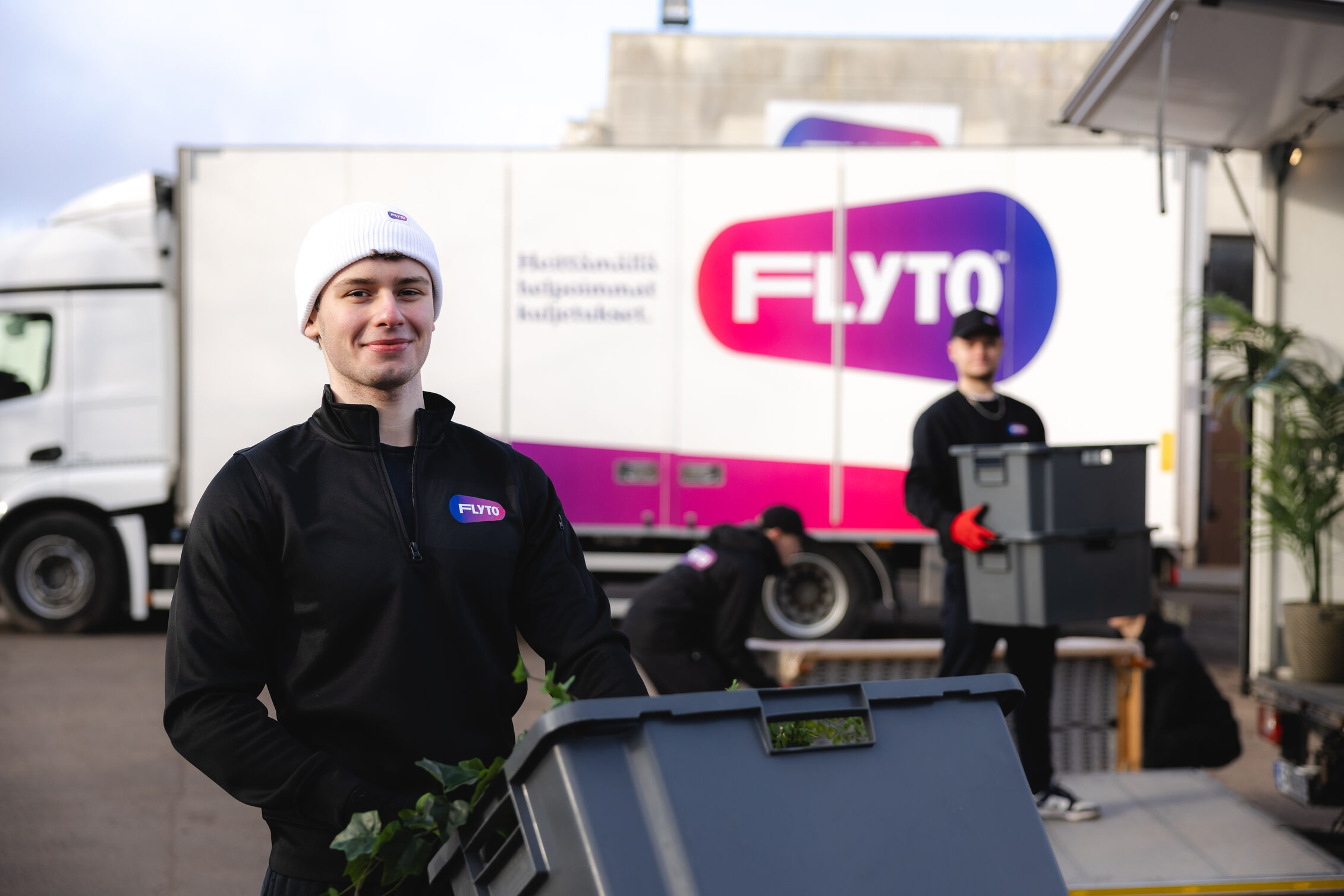
Flyto runs its own offices, warehouses, crews, and vehicle fleet across Northern, Central, and Southern Europe, so the Belgian collection, export documentation, and port handling through Antwerp-Bruges are managed in-house end to end. For the ocean leg and the Costa Rican side, we work through a carefully vetted network of shipping-line and freight partners plus trusted local partners in Costa Rica who handle customs brokerage, menaje de casa clearance, and last-mile delivery on the ground — so you get one coordinated move without us overstating what we do ourselves outside Europe.
Frequently asked questions
Do I need Costa Rican residency before I can ship my household goods duty-free?
You need an authorized immigration category (temporary residence, work permit, etc.) — the DGA’s menaje de casa modality is not open to tourists or people without an authorized status (DGA policy).
When do I deregister from my Belgian municipality?
In person, no later than the day before you leave — it is not an online procedure (IBZ).
Does leaving Belgium automatically end my Belgian tax liability?
No — it depends on where your actual domicile and centre of economic interests end up, assessed by FOD Financiën, not simply on the date you deregister (FOD Financiën).
Is it worth shipping my car to Costa Rica?
Usually not — since November 2024, import taxes are charged on the real CIF invoice value rather than fixed valuation tables, and typically add a very large share to the vehicle’s cost, so most relocating families sell in Belgium and buy locally (Ministerio de Hacienda — Resolución MH-DGA-RES-1897-2024).
How much cash can I carry into Costa Rica without declaring it?
Under USD 10,000 (or equivalent) in cash or negotiable instruments; at or above that, you must declare it under Article 35 of Law 8204 (SINALEVI).
What’s the single biggest pet-import mistake people make?
Leaving the SENASA sanitary certificate, microchip registration, or the 15-day pre-arrival deworming window too late — all three have to line up with your travel date, not just the rabies vaccination (MAG/SENASA).
Sources
- FOD Financiën — Moving from Belgium
- FOD Financiën — Leaving Belgium, tax return
- FOD Financiën — Moving to Belgium
- FOD Financiën — AES Export
- IBZ (FPS Home Affairs) — Compulsory deregistration for EU citizens leaving Belgium
- FASFC — Travelling with your pet
- Port of Antwerp-Bruges — Container cargo
- Ministerio de Hacienda / DGA — Política de importación de menaje de casa (MH-DGA-PRO01-POL-001)
- Ministerio de Hacienda — Resolución MH-DGA-RES-1897-2024 (valoración de vehículos importados)
- Dirección General de Migración y Extranjería — Regularización
- Instituto Costarricense de Turismo — Ley de atracción de inversionistas, rentistas y pensionados
- Ministerio de Agricultura y Ganadería / SENASA — Requisitos sanitarios para importación de perros y gatos
- SINALEVI (Costa Rica’s official legal information system) — Texto completo, Ley 8204, Art. 35 (declaración de dinero)