

Moving from Switzerland to Poland (2026): Complete Guide

Switzerland to Poland is a well-travelled European relocation corridor, typically run by road through Germany and the Czech Republic. It isn’t a "Swiss abroad" move like relocating to the US or Australia: Switzerland and Poland sit inside the same European free-movement space for people, so no visa or work permit is needed. But Switzerland is not in the EU or the EU customs union, so — unlike a move between two EU countries — your household goods do cross a real customs border, with a specific, well-defined relief procedure. This guide is for Swiss residents (Swiss or EU/EFTA nationals) relocating to Poland, covering exactly what applies here: free movement of people, customs relief for goods, registration in Poland, healthcare, driving licences, vehicles, pets, and banking.
Key takeaways
- You don’t need a visa or work permit. Switzerland and the EU/Poland operate under the Agreement on the Free Movement of Persons (AFMP), so Swiss and EU/EFTA citizens can live and work in each other’s territory. The task is registration, not immigration.
- Your household goods DO cross a customs border, because Switzerland is outside the EU customs union. If you have lived outside the EU (i.e. in Switzerland) for at least 12 months and have owned your belongings for at least 6 months, they qualify for duty-free import as "mienie przesiedlenia" (relocation property) under EU Regulation 1186/2009, confirmed on the Polish side by podatki.gov.pl. Duty relief does not automatically mean VAT/excise relief — that is assessed separately, and the goods can’t be sold, lent or given away for 12 months after clearance.
- On departure, you must deregister from your Swiss commune ("Abmeldung") if you’re leaving permanently or for an extended period — see the overview at ch.ch and the practical explainer from Comparis.
- In Poland, EU/EFTA citizens staying over 3 months must register their stay at the local Urząd Wojewódzki (voivodeship office), which triggers assignment of a PESEL number — see e.g. Podlaski Urząd Wojewódzki and the gov.pl PESEL service for foreigners.
- Healthcare continues seamlessly for most movers: as an EU/EFTA national residing in Poland you’re covered under Polish/EU coordination rules per NFZ, and pensioners keep formal Swiss coverage abroad via an S1 certificate issued by their Swiss insurer, per KVG Gemeinsame Einrichtung.
- Your Swiss driving licence can be exchanged for a Polish one without a driving test, since Switzerland is named alongside EU/EFTA states in the Polish exchange procedure — see Warszawa19115.
- A car brought from Switzerland is a genuine import, not an EU-to-EU re-registration: expect Polish customs/excise/VAT formalities, a Polish technical inspection, and registration within 30 days — Swiss vehicle export starts with returning your plates and clearing customs, per BAZG.
- Pets travel more easily than you might expect. Switzerland is a "listed" (low-rabies-risk) non-EU country under EU pet-travel rules, so your dog, cat or ferret can enter Poland on an ordinary EU-format pet passport issued by a Swiss vet — no rabies blood test, and not the stricter health-certificate route used for unlisted countries. See the Swiss Federal Food Safety and Veterinary Office (BLV) and the European Commission’s pet travel rules.
1. What actually applies: free movement of people, real customs for goods
This is the point that trips people up, so it’s worth stating precisely. Switzerland is a member of EFTA and has a bilateral Agreement on the Free Movement of Persons with the EU, in force since 2002. That agreement gives Swiss and EU citizens reciprocal rights to live, work and settle in each other’s territory — EUR-Lex summary. Practically: no work permit application, no immigration visa, no labour-market test. What you do have to do is register your move on both ends — deregister in Switzerland, register in Poland.
Switzerland, however, is not part of the EU or the EU customs union. Goods moving between Switzerland and any EU country (including Poland) cross a real customs border. The good news is that used household goods belonging to someone genuinely transferring their home qualify for a well-established relief: Council Regulation (EC) No 1186/2009, Chapter I, "Personal property belonging to natural persons transferring their normal place of residence" — full text on EUR-Lex. On the Polish side this is administered as mienie przesiedlenia (relocation property): duty-free entry provided you lived outside the EU (i.e. in Switzerland) for at least 12 consecutive months, have owned/used the goods for at least 6 months, import them within a defined period of establishing Polish residence, and don’t sell, lend or otherwise dispose of them for 12 months afterwards — podatki.gov.pl. Customs duty relief is separate from VAT/excise treatment, which is assessed under its own rules. On departure, Swiss customs (BAZG) mirrors this with Form 18.44 for duty-free export/import clearance of removal goods, submitted at a customs office handling commercial traffic — see the BAZG FAQ on Umzugsgut and the form itself. In practice, your moving company prepares a valued inventory and handles the declaration at the border — but budget for the paperwork and lead time this requires, unlike a Germany-to-Poland move where none of this exists.
For the practical side of the move – crews, customs paperwork and a fixed price – start here: international moving companies in Switzerland.
2. Leaving Switzerland: deregistration, tax, healthcare, notifications
Commune deregistration (Abmeldung). If you’re leaving Switzerland permanently or for an extended period, you must notify your commune of residence — in most municipalities you can do this some weeks before departure at the same office where you originally registered (timing varies by canton). Ask for a written confirmation of departure; banks, insurers and pension funds will ask for it. Overview: ch.ch and a practical walkthrough at Comparis.
Ending Swiss tax liability. Unlimited Swiss tax liability ends only when both conditions are met: your Swiss tax domicile is definitively abandoned (home vacated/lease terminated) and a new domicile is genuinely established abroad — the tax office may ask for a residence certificate from Poland. The year of departure is taxed on a part-year basis, with income annualised for rate purposes. Spending 183+ days a year back in Switzerland after "leaving" can trigger continued unlimited liability. Overview: swissinfo.ch — taxes when emigrating and Taxea.ch. If you keep Swiss property or income sources, limited tax liability on those continues regardless.
Health insurance and pensions. Switzerland applies the EU social-security coordination regulations (883/2004 and 987/2009) with EU/EFTA states under the AFMP, so contribution periods carry over and Swiss AHV/OASI pensions can be paid to a Polish address once you reach Swiss retirement age — see BSV: social security agreements and ch.ch: AHV pension, occupational and private pension abroad (the Swiss Compensation Office, ZAS, in Geneva takes over payment once you live abroad). If you retire and move to Poland, your Swiss health insurer issues an S1 certificate: you register it with NFZ in Poland, remain formally insured in Switzerland, keep paying Swiss premiums, but receive care as a Polish-insured person — KVG Gemeinsame Einrichtung. If you’re moving for work rather than retirement, cancel your Swiss LAMal/KVG basic insurance once your Polish coverage starts (see section 4) — don’t let the two overlap or lapse.
Vehicle and driving licence. Return your Swiss number plates and vehicle permit to your cantonal Strassenverkehrsamt to cancel registration and liability insurance; plates can be destroyed free of charge or deposited for a fee if you might reuse them. Formal export must be declared to Swiss customs at the border, with the original vehicle permit presented. Details: BAZG — vehicle export and Kanton Zürich — deregistering a vehicle (example of a cantonal procedure).
3. How your household goods actually move
Freight-industry estimate, not an official figure. The realistic routing for a household shipment from Switzerland (Zurich, Bern, Geneva) to Poland (Warsaw, Kraków, Wrocław, Poznań) is by road, via Germany and the Czech Republic or direct into western Poland. A dedicated or part-load truck typically takes roughly 3–6 days door-to-door; consolidated/groupage loads can take 1–3 weeks since the truck collects and delivers multiple households en route. Air or rail freight is rarely used for household effects here — road is standard given the roughly 900–1,300 km distance and cost efficiency. Because Switzerland sits outside the customs union, the shipment must clear the formalities in section 1 on export and import; incomplete paperwork can cause delays, so build in a small buffer even though compliant moves normally clear without issue.
4. Arriving in Poland: registration, healthcare, tax, driving licence
Registering your stay (EU citizens). If you’ll be in Poland longer than 3 months, you must register your stay with the Urząd Wojewódzki (voivodeship office) covering your place of residence, no later than the next business day after your third month in the country ends. You’ll need your ID/passport and evidence of the purpose of stay (employment, self-employment, sufficient resources, or family reasons). See the procedure explained by, e.g., Podlaski Urząd Wojewódzki or Poznań’s migrant office (the procedure is national, administered regionally). Registering your address and stay of more than 30 days is what triggers automatic assignment of a PESEL number, Poland’s national personal ID number used for almost everything administrative — gov.pl: PESEL service for foreigners.
Healthcare. As an EU/EFTA national residing in Poland (employed, self-employed, or otherwise covered), you fall under the same EU/EFTA/UK healthcare coordination rules NFZ applies reciprocally — see NFZ: treatment of EU/EFTA/UK citizens in Poland. Note this distinguishes the EHIC (for short, temporary stays; limited to necessary, unplanned care), the S1 (for residents; full coverage), and the S2 (for pre-approved planned treatment) — as a resident mover you’ll generally be in the S1/employment-registration category, not the EHIC one. If you’re employed in Poland, your employer registers you with ZUS/NFZ automatically through payroll. If you’re not covered through employment, you can apply for voluntary NFZ insurance once you have documented Polish residence — NFZ voluntary insurance guide. Swiss pensioners: register your S1 with the nearest NFZ branch (see section 2).
Tax registration. For most private individuals who are not running a business, no separate tax registration step exists — your PESEL number doubles as your tax identifier (identyfikator podatkowy). A separate NIP is only required if you register a business or become a VAT payer — poradnikprzedsiebiorcy.pl explainer. Polish tax residency itself follows ordinary rules (habitual residence / 183+ days / centre of vital interests) rather than a registration act.
Driving licence. A Swiss driving licence can be exchanged for a Polish one without retaking a driving test, because Switzerland is explicitly named — alongside EU and EFTA member states — in the Polish exchange procedure. You’ll need a medical certificate (and a psychological certificate if your licence category requires one), and you submit the application at your local wydział komunikacji for your place of residence; your Swiss licence is surrendered in exchange for the Polish one, since only one valid licence can be held at a time. Cost is 100 PLN; document preparation typically takes up to about 9 working days, longer if the case needs clarification. Source: Warszawa19115 procedure page.
Bringing a car. Unlike an intra-EU move, a Swiss-registered car is a real import from outside the EU customs union: you’ll need Polish excise duty (tiered by engine size), 23% VAT on the vehicle’s value, and potentially customs duty — though customs duty can often be reduced or avoided if the vehicle’s EU/EFTA originating status is properly documented, given Switzerland’s free-trade relationship with the EU. You’ll also need certified Polish translations of the Swiss registration documents, a Polish technical inspection (Swiss inspections aren’t recognised), and registration at your local wydział komunikacji within 30 days of bringing the car into Poland. This is meaningfully more involved than moving a car between two EU countries, and the exact duty/tax calculation depends on your specific documentation — confirm the current rates and any relief with Polish customs (KAS) or your mover before you commit to bringing a particular vehicle.
5. Moving with pets
This is one area where a Switzerland-to-Poland move is actually simpler than moving from a country further afield. Under EU pet-travel rules, Switzerland sits on the list of "listed" third countries (Regulation (EU) No 577/2013, Annex II) treated as having equivalent rabies-control status to the EU — the same list that includes Norway, Iceland and Liechtenstein. In practice this means:
- Your dog, cat or ferret does not need the stricter animal health certificate required for pets from unlisted (higher-risk) non-EU countries, and does not need a rabies antibody titration blood test.
- Instead, a Swiss vet can issue an EU-format pet passport for the move, the same document type used for travel between EU member states.
- Requirements: an ISO-compliant microchip (implanted before or at the same time as the rabies vaccination) and a valid, up-to-date rabies vaccination.
Confirm the exact current requirements with your vet before travelling, since implementing rules are periodically updated. Sources: Swiss Federal Food Safety and Veterinary Office (BLV) — travelling with dogs, cats and ferrets and the European Commission’s pet travel pages. Start the paperwork well ahead of your move regardless — the vaccination timeline, not the passport itself, is usually what determines your earliest possible travel date if your pet isn’t already vaccinated.
6. Money, banking, and things people forget
- Bank accounts. Open a Polish account (or a multi-currency account usable in Poland) before or shortly after arrival — landlords, utilities and employers generally expect a local IBAN (PL).
- Swiss pillar 2/3a pensions. Occupational (BVG) and private (pillar 3a) pension payout/transfer rules differ when moving to an EU/EFTA country versus elsewhere — check with your pension fund before departure.
- Currency. Poland uses the złoty (PLN), not the euro — budget for exchange-rate exposure on deposits and larger purchases.
- Notify Swiss institutions. Beyond the commune, tell your pension fund, health insurer and Swiss banks/insurers your new Polish address — several want the deregistration confirmation as proof.
- Import relief timing. The relocation-property window and 6-month ownership rule for household goods are checked against documents — keep receipts for higher-value items.
- Contracts. Terminate Swiss rental, utility and insurance contracts with correct notice periods before departure.
How Flyto handles your Switzerland to Poland move
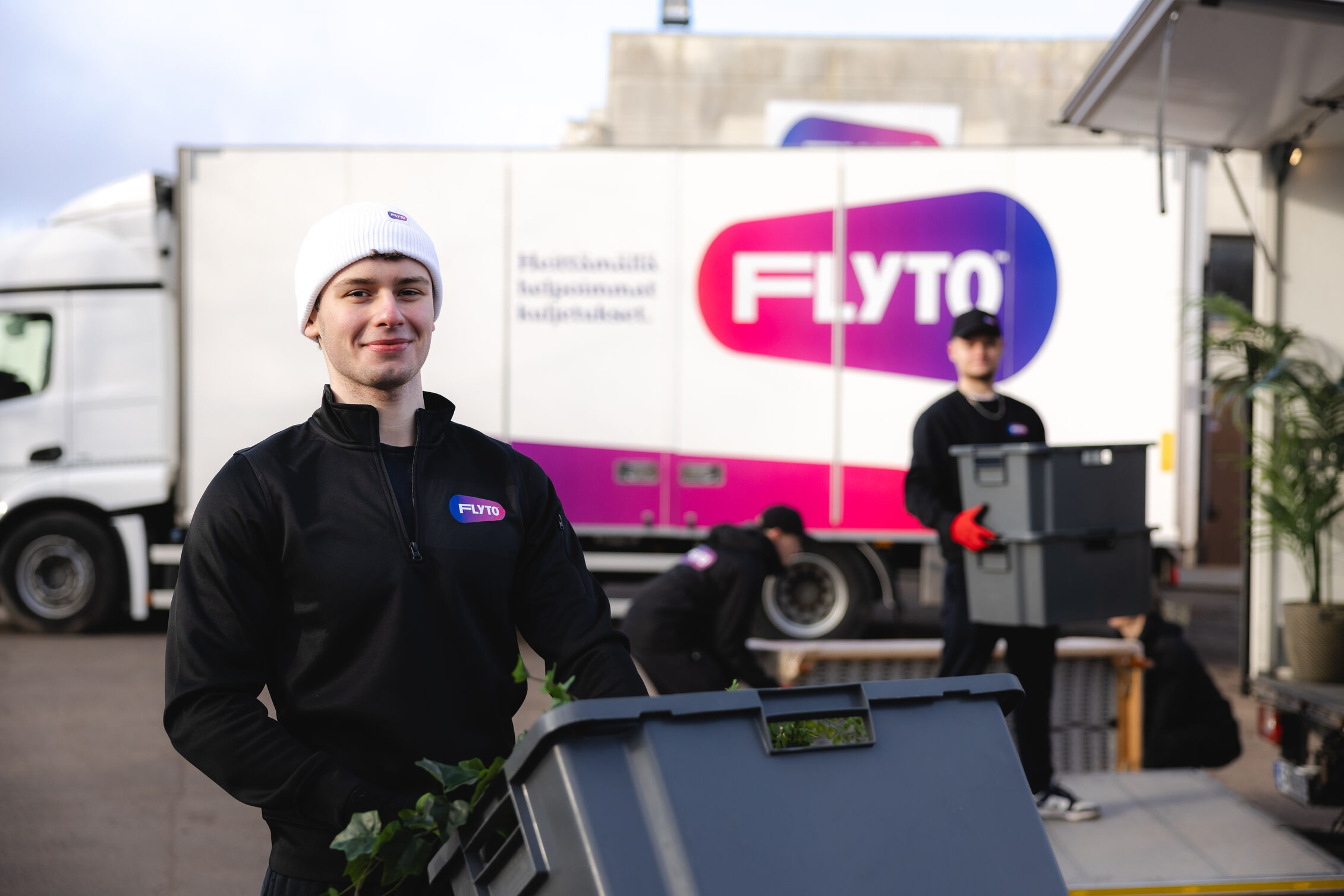
Flyto runs its own offices, warehouses, crews and vehicles across Northern, Central and Southern Europe, so a large share of a Switzerland-to-Poland move — planning, packing, and the road transport itself — is handled in-house rather than handed off wholesale. Where it makes sense, we combine that with a carefully vetted network of local partners and subcontractors on either end (for example, Swiss customs clearance formalities or last-mile delivery in a specific Polish region), so you get consistent quality without paying for capacity we’d otherwise have to build from scratch.
Frequently asked questions
Do I need a visa or residence permit to move from Switzerland to Poland?
No. Under the Switzerland-EU Agreement on the Free Movement of Persons, Swiss and EU/EFTA citizens can live and work in each other’s territory without a visa or work permit. You do need to register your stay with the Polish authorities once you’ve been there more than 3 months.
Will my household goods be taxed or held up at customs?
Not if they qualify as relocation property: you lived outside the EU (i.e. in Switzerland) at least 12 months, have owned the goods at least 6 months, and import them within the required window of establishing Polish residence. This gets them duty relief under EU Regulation 1186/2009, administered in Poland as "mienie przesiedlenia." VAT/excise treatment is assessed separately, so confirm with your mover or Polish customs (KAS) if you’re bringing high-value new items.
Can I keep my Swiss health insurance after moving to Poland?
If you’re a pensioner, yes — via an S1 certificate from your Swiss insurer, registered with NFZ. If you’re moving for work, you’ll typically be covered through Polish/NFZ insurance once employed, and should cancel your Swiss basic insurance to avoid paying for both.
Do I need to exchange my Swiss driving licence?
You’re not legally forced to the moment you arrive, but Switzerland is one of the countries whose licences Poland exchanges without a driving test, via your local wydział komunikacji. Doing it removes any ambiguity about long-term validity once you’re a Polish resident.
Can I bring my Swiss-registered car without paying customs and excise?
Not automatically — a car is a genuine import from outside the EU customs union. You’ll go through excise duty, VAT, and potentially customs duty (which can be reduced with proof of EU/EFTA origin), plus a mandatory Polish technical inspection and registration within 30 days.
What about my pet?
Easier than you’d think: because Switzerland is a "listed" low-risk non-EU country under EU pet-travel rules, your dog, cat or ferret can travel on a standard EU-format pet passport issued by a Swiss vet (microchip + valid rabies vaccination) rather than the stricter health certificate and blood test required from unlisted countries.
Sources
- EUR-Lex — Agreement with Switzerland: free movement of persons
- EDA — Free movement of persons, functioning and current state of play
- ch.ch — official Swiss citizen services portal
- Comparis — deregistering from a Swiss commune
- swissinfo.ch — taxes when emigrating from Switzerland
- Taxea.ch — leaving Switzerland tax obligations
- BSV — Swiss social security agreements
- ch.ch — AHV/OASI, occupational and private pension paid abroad
- KVG Gemeinsame Einrichtung — S1 form for pensioners in EU/EFTA/UK
- BAZG — FAQ on Umzugsgut (household effects) / Form 18.44
- BAZG — vehicle export from Switzerland
- EUR-Lex — Council Regulation (EC) No 1186/2009
- podatki.gov.pl — mienie przesiedlenia (relocation property customs relief)
- gov.pl — registration of an EU citizen’s stay (example: Podlaski Urząd Wojewódzki)
- gov.pl — obtaining a PESEL number, service for foreigners
- NFZ — treatment of EU/EFTA/UK citizens in Poland
- NFZ — voluntary health insurance guide
- poradnikprzedsiebiorcy.pl — PESEL vs NIP as tax identifier
- Warszawa19115 — exchange of foreign driving licence (incl. Switzerland/EFTA) for a Polish one
- Kanton Zürich — deregistering a vehicle
- BLV — travelling with dogs, cats and ferrets (Switzerland)
- European Commission — bringing a pet into the EU from a non-EU country
- Your Europe — EU rules on travelling with pets