

Moving to Vienna (2026): The Complete Relocation Guide

Vienna is Austria’s capital and by far its largest city — around 2 million residents, roughly a third of them foreign nationals — and consistently the most-searched destination for anyone relocating to Austria. It is also one of Europe’s more demanding cities to physically move into: the inner districts are wall-to-wall Gründerzeit apartment blocks with high ceilings, no lift and narrow staircases, the entire city is now a paid parking zone, and your removal truck cannot legally hold a space outside your door without a permit you apply for well in advance. This guide covers the practical mechanics of moving to Vienna in 2026 — the truck logistics only a mover knows, where to live and what rent really costs, how to register your address, and what monthly life actually costs — with official sources throughout.
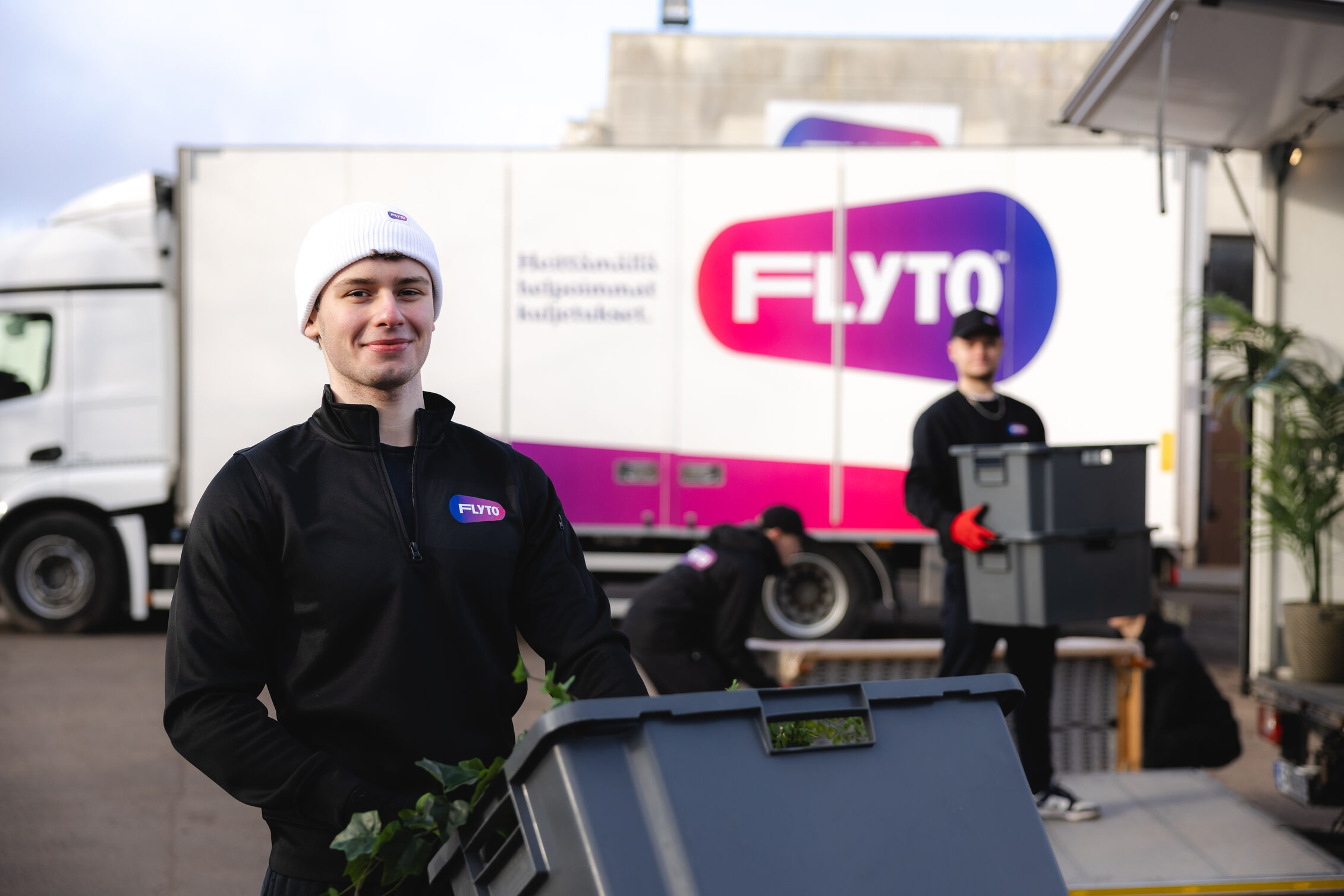
Freshness note: prices and rules verified against wien.gv.at, oesterreich.gv.at, the Wiener Linien / Wiener Stadtwerke 2026 tariff, the Mietervereinigung Richtwert data, E-Control and the ÖGK in 2026. Fees and rents move — confirm figures with the linked authorities before you rely on them.
Quick answer: moving to Vienna in 2026
What does it cost to move to Vienna? An international household move (a full flat) typically lands in the low-to-mid four figures from within Europe and higher from overseas, driven mostly by volume, distance and access. Because Vienna’s access difficulties (see below) add real cost, get a fixed quote for your specific address rather than a generic estimate — get a Flyto quote here.
How long does the move take? Road moves from within the EU are usually a few days to about two weeks door-to-door; overseas sea freight runs several weeks. The one Vienna-specific quirk everyone underestimates: you must apply for a temporary no-parking zone (kurzfristige Halteverbotszone) from the city’s traffic authority MA 46 at least ten working days ahead, and then put up the physical signs yourself (Stadt Wien). Miss it and there may be nowhere legal to park a removal truck on your street.
Key takeaways
- Vienna is a Gründerzeit city. The desirable inner-district flats are old Altbau apartments — high-ceilinged, typically 4–6 storeys with no lift and narrow, winding staircases — which is why an exterior furniture lift (Möbellift / Außenaufzug) is so often needed to get a sofa or wardrobe in through a window.
- The whole city is a paid parking zone. Since 1 March 2022 the Parkpickerl short-parking scheme covers all 23 districts, Monday to Friday 09:00–22:00, so there is no free kerbside parking to fall back on for a moving truck (Stadt Wien).
Planning the move itself as well? Costs, transit times and how to choose a mover are covered on our page about international movers for Austria.
1. The move into Vienna — logistics only a mover knows
This is the part generic ”moving to Vienna” guides skip, and it is exactly where a move goes wrong. Vienna’s inner districts (the 1st to 9th) were built for the Habsburg era, not for a full-size removal truck. Three things determine whether your move day runs smoothly.
The Halteverbotszone: your truck’s parking permit
You cannot count on a free stretch of kerb outside a Vienna building — since March 2022 the entire city is a paid short-parking zone (see below). To guarantee the truck a spot you set up a temporary no-parking zone — officially a kurzfristige Halteverbotszone für Ladetätigkeiten, which involves the setting-up of a traffic sign (Aufstellung eines Verkehrszeichens). Key facts from the city itself (Stadt Wien / MA 46):
- Who grants it: the traffic authority MA 46 (Verkehrsorganisation und technische Verkehrsangelegenheiten), the magistrate’s traffic department for the whole city. You apply through the Stadt Wien service portal (with ID Austria or a simple email login), giving the address, date, times, side of the street and vehicle size.
- Official cost: a federal fee of €21 for the application plus €6 per attachment (maximum €36), and an administrative charge of €60 for the loading zone. Add sign rental and set-up through a specialist provider or your mover and the all-in cost is typically around €140–€350 per address (industry pricing).
- Lead time: you must apply at least 10 working days before the move. The permit is granted for a maximum of one week / 5 working days, and only for the loading hours (for example 07:00–18:00, not around the clock).
- Critical catch: MA 46 issues the permit but you are responsible for the signs. You must obtain the no-parking signs, put them up at least 24 hours before the zone takes effect (otherwise it is not legally enforceable), have their placement confirmed, and remove them afterwards — which is exactly why most people delegate the whole permit-plus-signs job to their moving company.
You usually need two zones: one at the old address and one at the new one. This is the single most common thing international movers forget, and there is no last-minute fix on move day.
Altbau, high ceilings and the Möbellift
Vienna’s most sought-after flats are Gründerzeit apartments — the ornate blocks thrown up during the city’s late-19th-century boom, concentrated in districts like Mariahilf, Neubau, Josefstadt and Alsergrund. They are beautiful and they are a mover’s headache: four to six storeys, frequently no elevator, ceilings often over three metres high, and narrow, tightly winding staircases with a small central stairwell.
The practical consequence: sofas, wardrobes, double beds and pianos frequently will not fit up an Altbau staircase or around its tight turns, and the extra ceiling height means more and heavier custom shelving to move. The standard Vienna solution is an exterior furniture lift (Möbellift / Außenaufzug) — a ladder hoist run up the building’s facade to lift bulky items straight in through a window or balcony, reaching the upper floors and attic (Dachgeschoss) conversions. It needs its own kerb space, which is another reason the Halteverbotszone placement matters. A good mover assesses this before the day, not when the sofa is stuck on the second-floor landing.
Parkpickerl, courtyards and narrow inner-district access
Since 1 March 2022 the Parkpickerl parking scheme covers all 23 districts of Vienna, with short-parking zones in force Monday to Friday from 09:00 to 22:00 (Stadt Wien). Residents pay about €10 a month for a permit; for everyone else — including a removal truck — there is simply no free kerb, which makes the Halteverbotszone essential rather than optional. On top of that, the classic Vienna block wraps around an inner courtyard (Innenhof), and the archway passages are usually too low or narrow for a truck to enter, so boxes are carried across the courtyard by hand. Add the 1st-to-9th-district one-way streets, tram tracks and cycle lanes and ”just park outside” is rarely an option. None of this is a problem if it’s planned for — and all of it is a bad surprise if it isn’t.
2. Where to live — Vienna neighborhoods by profile
Vienna’s character changes district by district, and the numbered Bezirke spiral outward from the historic centre. The figures below are indicative asking rents for new lettings in 2026; Vienna rents are usually quoted gross (Bruttomiete, including operating costs and VAT), and the city-wide average sits around €14–16/m² (Metrox market data). Remember that a large share of the stock is regulated (see section 3), so what you pay depends heavily on the building’s age and contract type as well as location.
Central and prestige:
- Innere Stadt — 1. Bezirk (~€25–27/m²) — the historic core inside the Ringstraße: palaces, embassies, opera and the most expensive rents in Austria. Stunning and central, but touristy, short on everyday shops and effectively unaffordable for most.
- Döbling — 19. Bezirk (~€24–25/m²) — leafy hillside ”wine district” with Heurigen taverns, villas and old money; green, quiet and family-friendly, but far from the centre and short on nightlife.
Best for young professionals and creatives:
- Neubau — 7. Bezirk (~€18–20/m²) — the design-and-café heart of Vienna around the MuseumsQuartier and Spittelberg; boutiques, galleries and the best street life, but pricey and small.
- Mariahilf — 6. Bezirk (~€17–19/m²) — buzzy and central around the Mariahilfer Straße shopping mile; excellent transport and dining, if noisy on the main drag.
- Leopoldstadt — 2. Bezirk (~€16–18/m²) — between the Danube Canal and the Prater park, fast-gentrifying, mixed and increasingly hip; great green space and a short hop to the centre, though patches are still rough.
- Wieden — 4. Bezirk (~€18–20/m²) — compact, elegant and central around the Naschmarkt and Karlsplatz; a settled professional feel, at a premium.
Best for families and settled living:
- Josefstadt — 8. Bezirk (~€17–19/m²) — Vienna’s smallest district, genteel and theatre-lined; quiet, pretty Gründerzeit streets, but limited larger flats.
- Alsergrund — 9. Bezirk (~€16–18/m²) — the university-and-hospital district (AKH, the old Freud quarter); central, well-connected and slightly calmer, popular with academics and medics.
- Landstraße — 3. Bezirk (~€16–18/m²) — a large, varied district from the embassy-lined Rennweg to the Belvedere and the new Hauptbahnhof quarter; good value for how central it is.
Best for budget and space:
- Favoriten — 10. Bezirk (~€13–15/m²) — Vienna’s biggest and most working-class district, very multicultural, with lots of Gemeindebau and the new Sonnwendviertel by the Hauptbahnhof; affordable and improving, though uneven street to street.
- Ottakring — 16. Bezirk (~€14–16/m²) — traditional wine-and-workers district with the Brunnenmarkt and a young overflow crowd priced out of Neubau; lively and cheaper, if patchy toward the outer edge.
3. The Vienna housing market — how flats are actually found
Vienna’s rental market is genuinely different from the rest of Europe, and understanding it saves you money. Here is how it works.
- The social-housing backbone. Around half of all Viennese live in either a municipal flat (Gemeindewohnung / Gemeindebau, run by Wiener Wohnen, Europe’s largest municipal landlord) or a subsidised cooperative flat (Genossenschaftswohnung). Between them that is roughly 220,000 city flats and 200,000 co-op flats (Wiener Wohnen). This huge non-profit sector is what keeps Vienna’s overall rents far below Paris or Munich — but access is gated: municipal flats need a Wiener Wohn-Ticket with a residence and income qualification, and co-ops usually require a one-off financing contribution (Finanzierungsbeitrag / Genossenschaftsanteil) that is refunded when you leave.
- Regulated (Richtwert) rents. In older buildings (broadly, pre-1953 with full application of the MRG) the base rent is capped by the guideline rent (Richtwert), which rose to €6.74/m² from 1 April 2026, with location and feature surcharges on top (a balcony, lift, or a ”good location” premium — €6.44/m² for the 1st district) (Mietervereinigung). Newer and freely-financed buildings charge open-market rents.
- Where to search: the mainstream portals are Willhaben, ImmoScout24 Austria and Der Standard’s Immobilien section; for co-ops you register directly with individual Genossenschaften. Private-market listings move fast in the central districts.
- Deposit (Kaution): typically three months’ rent (the MRG caps a deposit at what is reasonable, in practice up to three months), held for you and returned with interest at the end of the tenancy minus any justified deductions.
- Broker fee (Provision): since 1 July 2023 Austria applies the Bestellerprinzip — whoever commissions the agent pays. For rentals that is almost always the landlord, so tenants normally pay no broker commission on a brokered flat. If someone demands a ”finder’s fee” for a standard rental, be sceptical.
- Befristet vs unbefristet: a fixed-term lease (befristeter Mietvertrag) runs for a minimum of three years, but you as tenant can give notice after the first year with three months’ notice; an open-ended lease (unbefristeter Mietvertrag) has no end date and stronger security. Fixed-term rents in regulated buildings get a mandatory 25% discount (Befristungsabschlag).
- Scam warning. Never transfer any money — deposit or ”reservation” — before you have viewed the flat in person and verified the landlord. Classic red flags: the ”owner is abroad”, keys promised by post against an advance payment, prices well below market, or being pushed to pay to a foreign IBAN.
4. Meldezettel — registering your address in Vienna
Registration (Anmeldung via the Meldezettel form) is the master key to Austrian bureaucracy: without it you can’t easily open a bank account, get an e-card, start a job or sign most contracts. The rules (oesterreich.gv.at):
- 3-day deadline. You must register within three days of moving in, under the Meldegesetz. Late or incorrect registration is an administrative offence that can be fined up to €726.
- The Meldezettel form. You complete one Meldezettel per person, signed by you and by the accommodation provider (Unterkunftgeber — usually your landlord). The blank form is downloadable from oesterreich.gv.at and available at registration offices and some tobacconists (Trafik).
- Where to go. In Vienna you register at any Meldeservice office of the magistrate (Magistratisches Bezirksamt). Bring your passport or ID and the completed, landlord-signed Meldezettel. Since 2024 you can also register online via ID Austria, with the landlord confirming electronically.
- Your confirmation. You receive a Bestätigung der Meldung (confirmation of registration), commonly just called your Meldezettel — keep it, you will be asked for it constantly. If you are leaving Austria rather than arriving, see our Meldeamt deregistration guide.
5. Cost of living in Vienna (2026)
Vienna is regularly ranked among the world’s most liveable cities, and it is markedly cheaper than London, Paris or Zurich — largely thanks to its housing model. The current numbers:
- Rent is the big variable — see section 2. Budget roughly €13–16/m² gross in the cheaper outer districts up to €25/m²+ in the 1st and 19th for a new private-market lease (Metrox); regulated and co-op flats are far cheaper if you can get one.
- Public transport. Vienna’s famous flat annual ticket — €365, ”one euro a day”, held for 13 years — rose on 1 January 2026 to €467 (or €461 for the digital version), the first increase since 2012 (Wiener Stadtwerke). A single ticket is now €3.20 and a monthly ticket €75 (Wiener Linien). Even at the new price the annual card is one of the best-value city transit deals in Europe.
- Electricity runs around 33 cents/kWh in Vienna in 2026, so a typical household using ~3,500 kWh/year spends on the order of €100/month; prices and providers can be compared via the regulator (E-Control).
- Betriebskosten (operating costs) — building running costs, often bundled into the gross rent — plus heating, water and internet add a few hundred euros a month on a typical flat, so always ask whether a quoted rent is gross (brutto) or net (netto).
6. Getting settled — health, kids, transport, internet
- Health insurance (ÖGK). Health cover is mandatory in Austria; if you are employed you are automatically insured with the Austrian Health Insurance Fund (Österreichische Gesundheitskasse, ÖGK) and receive an e-card, contributions being deducted from pay and shared with your employer (ÖGK). If you are moving abroad from Austria instead, see our ÖGK and moving abroad guide.
- Kindergarten and school. Vienna’s municipal Kindergarten is free of charge for all children (you pay only for meals), and the final Kindergarten year before school is compulsory. Apply early through the city; popular districts fill up.
- Transport. The Wiener Linien network — five U-Bahn lines plus an extensive tram and bus system — is dense, punctual and runs 24 hours on weekends. With the annual ticket most residents don’t need a car, and the city is flat and bike-friendly with a large Citybike/WienMobil rental scheme.
- Internet. The main providers are A1, Magenta and Drei, with common speeds of 100–500 Mbit/s and fibre in a growing number of buildings. Installation can take a couple of weeks after you sign, so order early — and check what the building already supports before you commit.
7. How Flyto handles your move to Vienna
Everything in section 1 is why a Vienna move rewards a mover who actually knows the city — and it’s where Flyto earns its keep. We handle the MA 46 Halteverbotszone permits at both addresses, applied with the ten working days the city requires and with the signs put up and confirmed on time, so there’s a legal, empty parking space when the truck arrives. We assess Gründerzeit Altbau access in advance — staircase width, floor, ceiling height, courtyard distance — and bring an exterior furniture lift (Möbellift) when the sofa won’t make the stairwell, rather than discovering the problem mid-carry. And we plan around Vienna’s citywide Parkpickerl zones, inner-district one-way streets and courtyard carries so nothing on move day is a surprise. That’s the honest difference between a generic van hire and a relocation partner who has done this street by street. Get a fixed quote for your Vienna move, or browse our full Austria moving guides, our Vienna storage and moving page, and our customs guide for household goods.
Moving to Vienna? Get a fixed quote.
Tell us your addresses and volume and we’ll price the whole move — including the MA 46 Halteverbotszone permits and any furniture lift your Altbau needs. No surprises on the day.
Frequently asked questions
Do I need a Halteverbotszone permit for my moving truck in Vienna?
In practice, yes — since March 2022 the whole city is a paid short-parking zone, so you cannot rely on free kerb space. You apply to MA 46 for a temporary no-parking zone (kurzfristige Halteverbotszone für Ladetätigkeiten) at least 10 working days ahead. The official fees are €21 for the application plus up to €36 in attachment fees plus a €60 administrative charge; all-in with signs through a provider or mover it is usually €140–€350 per address. You are responsible for putting the signs up at least 24 hours before, which is why most people let their mover handle it.
How quickly do I have to register my address in Vienna?
Within three days of moving in, under the Meldegesetz. You complete a Meldezettel form signed by you and your landlord and hand it in at a Meldeservice office, or register online via ID Austria. Late or incorrect registration can be fined up to €726, so do it in your first week.
Will my furniture fit up a Vienna Altbau staircase?
Often not. Vienna’s sought-after Gründerzeit flats typically have no lift, high ceilings and narrow, tightly winding staircases, so sofas, wardrobes and beds frequently have to go in via an exterior furniture lift (Möbellift / Außenaufzug) through a window or balcony. A good mover checks the staircase, floor, ceiling height and courtyard access before move day and books the lift in advance.
How much is rent in Vienna in 2026?
On the private market, indicative asking rents run from about €13–16/m² gross in outer districts like Favoriten and Ottakring up to €25/m² and more in the 1st (Innere Stadt) and 19th (Döbling). But roughly half of Viennese live in municipal or subsidised cooperative housing, and older buildings are capped by the Richtwert guideline rent (€6.74/m² from April 2026 plus surcharges), so what you actually pay depends heavily on the building and contract type.
What is the difference between a Gemeindewohnung and a Genossenschaftswohnung?
A Gemeindewohnung is a municipal flat owned by the city and run by Wiener Wohnen; you need a Wiener Wohn-Ticket with residence and income qualifications to get one. A Genossenschaftswohnung is a cooperative flat built with public subsidy; it usually requires a one-off financing contribution (Finanzierungsbeitrag) that is largely refunded when you move out. Both are far cheaper than the open market, which is why Vienna’s overall rents stay low.
Do I still get the €365 annual transport ticket?
No — the famous €365 ”one euro a day” Jahreskarte ended on 1 January 2026. The annual ticket now costs €467 (or €461 for the digital version), its first increase since 2012. It is still excellent value: a single ticket is €3.20 and a monthly ticket €75, so the annual card pays for itself quickly for regular commuters.
Do I have to pay a broker fee to rent in Vienna?
Usually not. Since 1 July 2023 Austria applies the Bestellerprinzip — whoever commissions the agent pays — and for rentals that is almost always the landlord, so tenants normally pay no broker commission. If a ”finder’s fee” is demanded for a standard flat, treat it as a red flag.
What deposit will a Vienna landlord ask for?
Typically three months’ rent as a Kaution. It should be held for you and returned at the end of the tenancy, with interest, minus any justified deductions for damage or unpaid rent. Get the flat’s condition documented at handover so the deposit comes back in full.
Official sources
- Stadt Wien / MA 46 — kurzfristige Halteverbotszone (moving no-parking zone) permit
- Stadt Wien — citywide Kurzparkzone and Parkpickerl
- Stadt Wien — parking, zones and fees overview
- oesterreich.gv.at — registering a residence (Anmeldung), 3-day deadline
- oesterreich.gv.at — Meldezettel form and explanation
- Wiener Linien — tickets and 2026 prices
- Wiener Stadtwerke — 2026 Wiener Linien tariff change (annual ticket €467)
- Mietervereinigung — Richtwert guideline rent (€6.74/m² from April 2026)
- Wiener Wohnen — municipal and social housing (Gemeindebau)
- E-Control — electricity and gas price monitor
- ÖGK — Austrian Health Insurance Fund (e-card)
- Metrox — Vienna rent by district (market data cross-check)
- Flyto — Meldeamt registration and deregistration guide
- Flyto — ÖGK and health insurance guide
- Flyto — customs for household goods
- Flyto — Vienna storage and moving
- Flyto — Austria moving guides
Hiring an international mover? See our full International removals to Austria service — Flyto’s own European hubs, vetted local partners and one English-speaking coordinator, door to door.