
Moving from the Netherlands to Denmark (2026): Complete Guide

Moving from the Netherlands to Denmark is an intra-European relocation — both countries are EU member states inside the EU customs union, so this move is fundamentally different from shipping a household to the US, UK, or Australia. There is no customs border to cross and no import declaration to file for your furniture and personal belongings. The real work of an NL–DK move is administrative: closing out your Dutch registrations and tax residency correctly, and completing Denmark’s EU-citizen registration process on arrival. This guide is written for a resident of the Netherlands relocating to Denmark and walks through exactly what applies — and, just as importantly, what does not.
Key takeaways
- No customs duty, no import declaration on household goods. The Netherlands and Denmark are both inside the EU customs union, so goods move freely between them with no customs formalities — a cornerstone of the EU single market (European Parliament factsheet on free movement of goods).
- You don’t need a visa or work permit. As an EU citizen you have the automatic right to live, work, and study in Denmark; the real task is registering your residence, not applying for permission (Your Europe: residence rights).
- Deregister from your Dutch municipality before you leave. If you’re moving abroad for 8+ months in a year, you must report your emigration (deregister from the BRP) at your gemeente any time from 5 days before departure up to the day you leave (NetherlandsWorldwide: BRP deregistration).
- You’ll file a Dutch "M-form" for your migration year. This special tax return splits your income between your period as a Dutch resident and your period as a non-resident (NetherlandsWorldwide: tax return in the year you move abroad).
- You’ll register with SIRI and get a CPR number in Denmark. Staying longer than 3 months requires an EU residence document from the Danish Agency for International Recruitment and Integration (SIRI); once you have that and a fixed address, you register for a CPR number, the key that unlocks healthcare, tax, and banking (nyidanmark.dk, International House Copenhagen: CPR step-by-step for EU citizens).
- Your Dutch driving licence is valid in Denmark and exchange is optional. EU/EEA licence holders can keep driving on their home licence indefinitely; exchanging for a Danish one is available on request, without a driving test (Danish Road Traffic Authority: foreign driving licences).
- Cars must be re-registered, not just driven in. A vehicle brought to Denmark must be registered in the Danish Motor Register with Danish plates, which involves a valuation and Danish registration tax (Motorstyrelsen / lifeindenmark.borger.dk: registering and re-registering your vehicle).
- Pets travel on an EU pet passport, not a customs form — microchip first, then rabies vaccination, then a 21-day wait before travel (Your Europe: travelling with pets in the EU).
1. What actually applies: free movement, not customs
Because the Netherlands and Denmark are both EU member states within the same customs union, a shipment travelling from one to the other crosses no customs border. There are no duties, no import VAT, and no customs declaration to file for personal household goods — this is one of the EU’s four fundamental freedoms, free movement of goods (European Parliament factsheet; European Commission: the EU customs union). This is distinct from moves involving the UK (fully outside the EU customs union since Brexit) or Switzerland (outside the EU/EEA customs union, requiring a formal customs declaration with duty-free relief typically available for genuine removal goods); Norway and Iceland are in the EEA but outside the EU customs union, so customs formalities also apply on those routes, again typically with relief available for household-goods removals. None of that applies here: your Dutch–Danish move is paperwork-light on the goods side. Your household goods still need a packing inventory for insurance and to prove the shipment is a genuine, non-commercial house move rather than freight, but this is a moving-company document, not a customs filing.
The same "free movement" principle covers you personally: as an EU citizen, you don’t need a visa or work permit to live in Denmark (Your Europe: residence rights when living abroad in the EU). What replaces the immigration paperwork of a non-EU move is registration — with your old municipality on the way out, and with Danish authorities on the way in. The rest of this guide covers that registration chain in order.
Planning the move itself as well? Costs, transit times and how to choose a mover are covered on our page about international movers in the Netherlands.
2. Leaving the Netherlands: deregistration, tax, healthcare, vehicle
Municipal deregistration (BRP). If you’ll be living abroad for 8 months or more in a 12-month period (the months don’t need to be consecutive), you’re legally required to report your emigration and deregister from the Personal Records Database (BRP) at your gemeente, done any time from 5 days before your departure up to the day you leave. Your citizen service number (BSN) stays valid, but your record moves to the Non-Residents Records Database (RNI). Request the international proof of deregistration ("bewijs van uitschrijving") — Danish authorities and other institutions may ask for it (NetherlandsWorldwide: how to deregister from the BRP).
Ending Dutch tax residency. Deregistering triggers an automatic notification to the Belastingdienst, but you should also proactively confirm your emigration date and new Danish address with them. For the calendar year you move, you’ll file a "migration year" return — the M-form — which splits your income into a resident period and a non-resident period, filed online via Mijn Belastingdienst with DigiD or an EU-approved login key from another European country (NetherlandsWorldwide: filing a tax return for the year you move abroad).
Healthcare. You must cancel your Dutch zorgverzekering once you’re living and working abroad — check your insurer’s own notice requirements and cancellation timing so the cancellation lines up with your departure date rather than an arbitrary later date. If Denmark doesn’t automatically get confirmation of your Dutch coverage, ask your Dutch insurer about an S1 form, which can let you register with a Danish healthcare provider at the Netherlands’ expense for a transition period in some circumstances (NetherlandsWorldwide: what happens to your health insurance if you move abroad).
Driving licence and vehicle. Your Dutch (EU) driving licence remains valid to drive in Denmark — see section 4. If you’re bringing your car, you must formally export it from the Dutch system: visit an RDW inspection station, RDW desk, or an authorised export company with your ID, registration certificate, and plates. RDW deregisters the vehicle from the Dutch register and issues a certificate of indemnification plus an export certificate that Denmark’s registration system will require; the service costs €12. If you still need to drive the car in the Netherlands after deregistering, white export plates are valid for 14 days (RDW: exporting a vehicle).
3. How your household goods actually move
This is a short intra-EU corridor by European relocation standards, and the routing is straightforward road/ferry freight — there’s no ocean or air leg involved. The standard routing for a full or part-load move runs from the Netherlands north through Germany and across the Fehmarnbelt (ferry, or in future the fixed link once complete) or via the Jutland land route through Germany into Denmark, arriving in Copenhagen, Aarhus, Odense, or wherever your new home is.
As freight-industry estimates, not guarantees: a dedicated (exclusive-use) truck typically covers this corridor door-to-door in 2–4 days including loading and unloading time, depending on the exact origin and destination within each country and ferry/border traffic. A shared-load or groupage shipment — cost-efficient if you don’t need a full truck — typically takes 1–3 weeks, since the mover consolidates your shipment with others travelling the same corridor and the truck makes multiple stops. Because there’s no customs clearance step, transit time on an NL–DK move is essentially just physical driving time plus consolidation scheduling — nothing is held up at a border for paperwork.
4. Arriving in Denmark: registration, healthcare, tax, driving licence
EU residence registration (SIRI). If you plan to stay longer than 3 months, you need an EU residence document (registration certificate) from the Danish Agency for International Recruitment and Integration (SIRI) — this confirms your right of residence as an EU citizen and is a prerequisite for registering locally (nyidanmark.dk; Your Europe: residence documents and formalities).
CPR number. With your registration certificate in hand and a permanent Danish address, register at your local Borgerservice (citizen service centre) or an International House to get your CPR number (civil registration number) — the key that unlocks everything else: healthcare, tax, banking, and Danish digital services (MitID). EU citizens have some flexibility on timing — you can generally stay several months before CPR registration becomes strictly necessary — but in practice you’ll want it as soon as you have a fixed address, since little else works without it (International House Copenhagen: step-by-step CPR guide for EU citizens).
Healthcare enrolment. Once you have a CPR number, you’re automatically entitled to Denmark’s public healthcare, and your yellow health card (sundhedskort) — showing your name, address, CPR number, and assigned doctor — arrives roughly 2–3 weeks later by mail to your Danish address; a digital version is also available immediately via the Sundhedskortet app (Life in Denmark: when you arrive / health insurance card).
Tax registration. After registering with the Danish National Register (Folkeregisteret) and obtaining your CPR number, contact the Danish Tax Agency (Skattestyrelsen) so they can issue your digital tax card (skattekort), viewable in the E-tax (TastSelv) self-service system. Arrange this promptly — without a registered tax card, Danish employers are required to withhold tax at a high default rate rather than your normal rate. You’ll also need a NemKonto, the standard Danish bank account used for salary, tax refunds, and other public-sector payments (SKAT: moving to Denmark).
Driving licence. Your Dutch driving licence is an EU licence, so you can simply keep driving on it in Denmark — exchange is not required. If you’d prefer a Danish licence, you can request one without taking a driving test, subject to Danish age requirements for the licence category (Danish Road Traffic Authority: foreign driving licences).
Vehicle re-registration. A car you bring with you must be registered in the Danish Motor Register (Motorregistret) via the lifeindenmark/TastSelv self-service system, using MitID login, run by the Motor Vehicle Agency (Motorstyrelsen), with Danish plates. This involves a vehicle valuation and Danish registration tax before it can legally be driven long-term on Danish plates (Life in Denmark: registering and re-registering your vehicle; Motorstyrelsen).
5. Moving pets
Dogs, cats, and ferrets travel between EU countries on an EU pet passport, issued by an authorised vet — not a customs document. The sequence matters: your pet must be microchipped before or on the same day as its rabies vaccination, so the vaccination record can be linked to that specific chip. After the first (primary) rabies vaccination, there’s a mandatory 21-day wait before travel within the EU. The pet passport, once issued, remains valid for life as long as the rabies vaccination stays current (Your Europe: travelling with pets and other animals in the EU; European Commission: travelling with a pet within the EU).
6. Money, banking, and things people forget
- NemKonto and MitID early. You can’t easily receive a Danish salary, pay Danish taxes, or use most Danish digital services until you have a NemKonto and MitID, both of which flow from your CPR registration — start this chain the day you arrive, not the day you start work.
- Notify the rest of the Dutch system, not just the gemeente. Pension funds, DigiD-linked services, and any Dutch subscriptions tied to your old address should be updated or cancelled separately — deregistering from the BRP notifies key government bodies but not private providers.
- Danish rent deposits and utilities are typically arranged directly with the landlord/utility provider using your CPR number — you generally can’t sign a lease or set up utilities before you have one.
- Currency. Denmark uses the Danish krone (DKK), not the euro — budget for exchange-rate exposure and check whether your Dutch bank charges for DKK transactions before you switch fully to a Danish account.
- Keep your Dutch deregistration proof. SIRI, Borgerservice, and your Danish bank may all separately ask for evidence of when you left the Netherlands — keep the certificate from your gemeente accessible digitally.
How Flyto handles your Netherlands to Denmark move
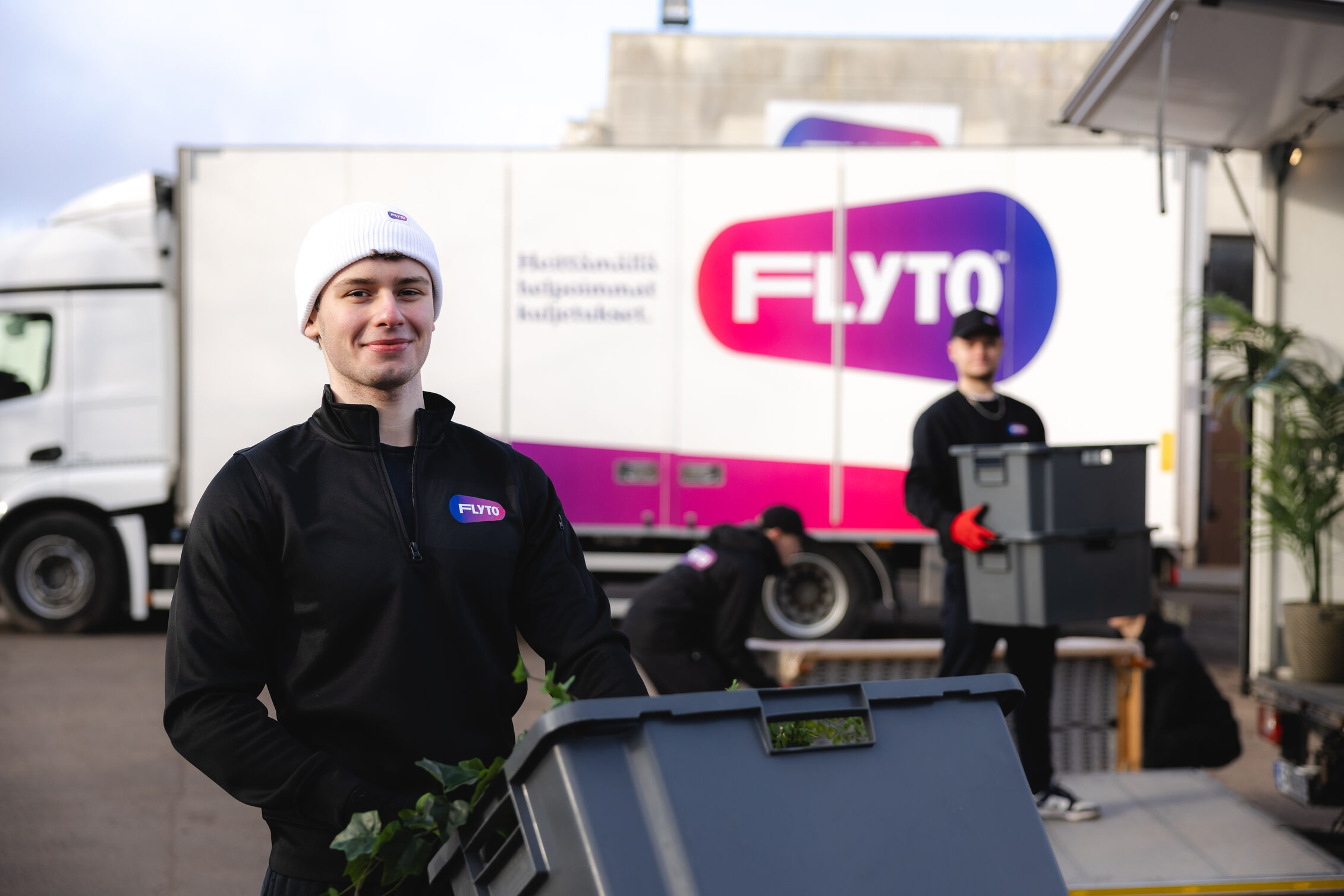
Flyto runs its own offices, warehouses, and moving crews across Northern, Central, and Southern Europe, so a Netherlands–Denmark corridor is typically handled largely with in-house teams and vehicles rather than being passed to a stranger. Where it makes sense — a specific regional pickup, a tight delivery window, or extra capacity during peak season — we bring in a carefully vetted partner carrier from our European network, but the planning, customer contact, and quality control stay with Flyto throughout.
Frequently asked questions
Do I need to pay customs duty on my furniture moving from the Netherlands to Denmark?
No. Both countries are inside the EU customs union, so household goods move between them without customs duty, import VAT, or a customs declaration (European Parliament: free movement of goods).
Do I need a visa or residence permit to move to Denmark from the Netherlands?
No. As an EU citizen you have the right to live and work in Denmark without a visa or work permit. You do need to register your residence with SIRI and get a CPR number (Your Europe: residence rights; nyidanmark.dk).
When do I have to deregister from my Dutch municipality?
If you’ll be abroad for 8 months or more within a year, deregister from the BRP any time between 5 days before your departure and your actual departure date (NetherlandsWorldwide).
Can I keep driving on my Dutch driving licence in Denmark?
Yes. EU/EEA driving licences remain valid indefinitely in Denmark; exchanging for a Danish licence is optional and requires no driving test if you choose to do it (Danish Road Traffic Authority).
Do I need to re-register my car in Denmark even though it’s already EU-registered?
Yes. Free movement of goods covers your household items, but vehicles used long-term in Denmark must still be entered in the Danish Motor Register with Danish plates and valued for Danish registration tax (lifeindenmark.borger.dk).
What happens to my Dutch health insurance when I move?
You must cancel your zorgverzekering once you’re living and working in Denmark; ask your insurer about an S1 form if Denmark needs confirmation of your prior Dutch coverage during the transition (NetherlandsWorldwide).
Sources
- European Parliament — Free movement of goods
- European Commission — The EU customs union
- Your Europe — Residence rights when living abroad in the EU
- Your Europe — Residence documents and formalities
- Your Europe — Travelling with pets and other animals in the EU
- European Commission — Travelling with a pet within the EU
- NetherlandsWorldwide — How to deregister from the BRP
- NetherlandsWorldwide — Tax return for the year you move abroad
- NetherlandsWorldwide — Health insurance when moving abroad
- RDW — Exporting a vehicle
- nyidanmark.dk — Danish Immigration Service / SIRI
- International House Copenhagen — Step-by-step CPR registration for EU/EEA/Swiss citizens
- Life in Denmark (borger.dk) — When you arrive / health insurance card
- Life in Denmark (borger.dk) — Registering and re-registering your vehicle
- SKAT — Moving to Denmark
- Danish Road Traffic Authority — Foreign driving licences, exchanges and visitors’ driving licences
- Motorstyrelsen — The Motor Vehicle Agency