

Moving to Dublin (2026): The Complete Relocation Guide

Dublin is Ireland’s capital and its economic engine — a city of roughly 1.2 million in the wider urban area, home to the European headquarters of Google, Meta, Microsoft and much of ”Silicon Docks”, and the number-one destination for people relocating to Ireland. It is also, quietly, one of the harder western-European cities to physically move into: much of the sought-after housing is protected Georgian and Victorian stock with narrow doorways and steep, winding staircases; the city centre restricts where a truck can stop; the rental market is the tightest in living memory; and — post-Brexit — your household goods have to cross a customs border and a sea. This guide covers the practical mechanics of moving to Dublin in 2026 — the logistics only a mover knows, where to live and what rent really costs, how to find a home and sort the paperwork, and what monthly life actually costs — with official sources throughout.
Freshness note: prices and rules verified against Dublin City Council (dublincity.ie), the Residential Tenancies Board (RTB), the Daft.ie Q4 2025 Rental Report, Citizens Information, gov.ie, Revenue and Transport for Ireland in 2026. Fees and rents move fast in Ireland — confirm figures with the linked authorities before you rely on them.
Quick answer: moving to Dublin in 2026
What does it cost to move to Dublin? An international household move (a full home) typically lands in the low-to-mid four figures from within Europe and higher from overseas, driven mostly by volume, distance, sea-freight and access. Because Dublin adds two real cost drivers most guides ignore — a ferry crossing and difficult building access (see below) — get a fixed quote for your specific address rather than a generic estimate: get a Flyto quote here.
How long does the move take? Road-and-ferry moves from within the EU or the UK are usually a few days to about two weeks door-to-door; overseas sea freight runs several weeks. The one Dublin-specific quirk everyone underestimates: in the city’s paid-parking zones you must apply to suspend the parking bay outside the door so the truck can legally stand there — and Dublin City Council requires the application at least five working days in advance (Dublin City Council).
Key takeaways
- Your moving truck may need its own parking-bay suspension. In Dublin’s pay-and-display zones you apply to Dublin City Council to suspend the bay for ”set-down and collection”.
- Dublin is a Georgian and Victorian city. The classic terraced houses and converted flats have narrow front doors, tight halls and steep, winding staircases — and many are protected structures — so bulky furniture often has to be hand-carried with care or hoisted in through a window rather than forced up the stairs.
- Deposits and advance rent are capped. A landlord cannot ask for more than one month’s deposit plus one month’s rent in advance — a maximum of two months’ rent upfront (Residential Tenancies (No. 2) Act 2021, via Citizens Information).
- There is no address registration for EU citizens — but there is the PPS number. EU/EEA/Swiss citizens need no visa, residence card or immigration registration to live in Ireland; everyone who works or pays tax needs a Personal Public Service (PPS) number, and non-EEA nationals staying over three months must register for an Irish Residence Permit (IRP) (Citizens Information).
Planning the move itself as well? Costs, transit times and how to choose a mover are covered on our page about international movers in Ireland.
1. The move into Dublin — logistics only a mover knows
This is the part generic ”moving to Dublin” guides skip, and it is exactly where a move goes wrong. Dublin’s inner suburbs were laid out in the eighteenth and nineteenth centuries for horses and handcarts, not for a full-size removal lorry — and unlike a mainland move, everything you own first has to cross the Irish Sea. Three things determine whether your move day runs smoothly.
The parking-bay suspension: where the truck legally stands
Across large parts of central and south Dublin — Dublin 1, 2, 4, 6, 7 and 8 among others — kerb space is metered pay-and-display, with no room to leave a 7.5-tonne truck for a day of loading. The fix is a parking-bay suspension from Dublin City Council, which temporarily takes the metered bays out of use so no private cars can park in them. Key facts from the Council itself (Dublin City Council):
- What it is: individual pay-and-display spaces are suspended for ”temporary alternate use”, and the Council explicitly lists set-down and collection and office relocation among the permitted reasons — a house or office move is a textbook case.
- Cost: the rate depends on the tariff zone — Yellow €50, Red €41, Green €27, Orange €19 and Blue €12.70, per space per day. A removal usually needs two or three consecutive spaces, so budget accordingly for a central address.
- Lead time: you must apply at least five working days before the suspension is to take effect. Leave it to the week of the move and there may simply be nowhere legal to stop.
- The catch: the suspension keeps cars out, but it does not create space where the street is a red-route clearway or a bus/cycle lane. On the busiest quays and arteries, loading is restricted at peak times regardless — which is why the truck placement and timing have to be planned around Dublin’s bus-lane and clearway hours, not just booked blind (Dublin City Council — parking laws).
If you’re moving out of one Dublin address and into another, you may need two suspensions — one at each end. It is the single most common thing newcomers forget, and there is no last-minute fix on move day.
Georgian doors, Victorian stairs and protected structures
The Dublin homes everyone wants — the flat-fronted Georgian terraces of the Georgian core and Portobello, the redbrick Victorian houses of Rathmines, Ranelagh, Rathgar and Stoneybatter, and the countless flats carved out of them — share a set of physical problems for movers. Front doors and internal halls are narrow; the staircases are steep, tight and winding, often with a sharp turn at a half-landing; and many of these buildings are protected structures or sit in Architectural Conservation Areas, so you cannot simply take a door off its frame or drill a fixing without care for the fabric.
The practical consequence is the same one Berliners know: sofas, wardrobes, double beds and appliances frequently will not go up a period staircase or round its turns. The Dublin solution is careful hand-carry by an experienced crew — dismantling where sensible — and, for upper-floor flats where the stairs simply won’t take a large item, hoisting it in through a window or over a balcony. A good mover surveys the doorway width, the stairwell and the floor before the day, rather than discovering the wardrobe is stuck on the return landing with the lorry on a five-day-notice suspension outside.
Getting your goods to Ireland — the ferry question
Ireland is an island, so unlike a move between two mainland cities, your belongings have to come by sea — and since Brexit that is also a customs question. There are two broad routes:
- Via Britain (the ”land-bridge”): the truck drives across Great Britain to a west-coast port and takes a ferry of roughly three to three-and-a-half hours into Dublin Port. It is often the fastest routing from Britain and much of northern Europe — but post-Brexit it means clearing customs on the way, so the paperwork has to be right.
- Direct ferry from continental Europe: direct sailings from France (Cherbourg, Roscoff) into Dublin and Rosslare let EU-origin goods skip Great Britain entirely, avoiding a second customs border. The crossing is far longer, but for a move from mainland Europe it can be the cleaner, simpler option.
The customs part matters. Household goods coming from Great Britain now cross an EU customs frontier, and without relief they can attract Irish VAT (the standard rate is 23%) and duty. Most people moving their main home to Ireland qualify for Transfer of Residence (ToR) relief, which brings used household belongings in free of duty and VAT — but it is not automatic: it must be claimed and backed with a detailed, itemised inventory and evidence of the move (Revenue — Transfer of Residence relief). Choosing the right ferry routing and getting the ToR paperwork in order before the boat sails is precisely the kind of thing that separates a relocation partner from a man-with-a-van.
2. Where to live — Dublin neighborhoods by profile
Dublin’s character changes sharply from one postal district to the next, roughly split by the River Liffey into the ”Northside” and ”Southside”. The figures below are indicative monthly asking rents for a one- to two-bed, anchored to the Daft.ie Q4 2025 Rental Report — where the average Dublin-city apartment rents for close to €2,700 and a city-centre two-bed averaged €2,696. Treat them as orientation, not quotes: in a market this tight, the advertised price and the price you actually sign at can differ.
Best for families and settled life:
- Dublin 4 — Ballsbridge & Sandymount (~€2,700–€3,500+) — Dublin’s blue-chip address: embassies, Aviva Stadium, leafy roads and a seafront at Sandymount Strand. Genuinely lovely and genuinely expensive; you pay a heavy premium for the postcode and the calm.
- Dublin 6 — Rathmines & Rathgar (~€2,000–€2,700) — redbrick Victorian Dublin, a mix of long-settled families and a large student population around the bedsit-turned-flat belt. Village high streets, good schools and a 15-minute cycle to town, at a notch below D4 money.
- Clontarf (Dublin 3, ~€2,000–€2,600) — a quiet coastal Northside suburb strung along a seafront promenade, popular with families who want space and sea air within a short DART ride of the centre. Sedate rather than lively.
- Dún Laoghaire (~€1,900–€2,600) — a Victorian harbour town on the southern DART line, with a pier, sea swimming and a proper town of its own. A real community and a coastal life, at the cost of a longer commute.
- Dundrum (~€1,900–€2,500) — a south-city suburb built around Ireland’s largest shopping centre and the Luas Green Line, so town is a quick tram in. Practical and family-friendly rather than characterful.
Best for young professionals:
- Dublin 2 — city centre & Grand Canal Dock (~€2,500–€3,200) — the beating heart: government, Trinity College, and ”Silicon Docks”, where Google, Meta and the tech crowd cluster around the modern apartments of Grand Canal Dock. Maximum convenience and the newest stock, at the highest apartment rents in the country.
- Ranelagh (Dublin 6, ~€2,000–€2,700) — the archetypal young-professional village: bars, brunch, delis and a Luas stop, minutes from town. Buzzy and much sought-after, which keeps it pricey and competitive.
- Portobello (Dublin 8, ~€1,900–€2,500) — canal-side, walkable and hip, wedged between the Georgian core and the Liberties. Central and full of life; small period flats go fast.
- Stoneybatter (Dublin 7, ~€1,900–€2,400) — a former working-class enclave of tiny redbrick cottages turned into one of Dublin’s most fashionable pockets, all independent coffee and craft beer. Characterful and central, if increasingly expensive for the space you get.
- Smithfield (Dublin 7, ~€1,900–€2,400) — a regenerated market square with a Luas stop and a stock of purpose-built apartments, so it’s one of the more attainable central options for a modern flat. Still finding its feet in parts.
Best for value and commuters:
- Dublin 1 — north inner city (~€1,800–€2,300) — the cheapest genuinely central option, gritty and uneven street to street but rapidly regenerating around the docklands and O’Connell Street. Unbeatable for walking to work; do your homework block by block.
- Maynooth, Co. Kildare (~€1,700–€2,200) — a university commuter town west of the city on the Sligo rail line and the M4, with a real town centre and more space for the money. The trade-off is a 30–45 minute commute.
- Bray, Co. Wicklow (~€1,700–€2,200) — a seaside town at the southern end of the DART, with a promenade, a cliff walk and noticeably lower rents than the city. Popular with families and commuters happy to trade travel time for the coast.
3. The Dublin housing market — how homes are actually found
Dublin has one of the tightest rental markets in Europe: on 1 February 2026 there were fewer than 1,800 homes to rent in the entire country and just 859 across all of Dublin, down 29% year-on-year (Daft.ie Q4 2025). Dozens of applicants per viewing is normal, and the search — not the move — is usually the hard part. Here is how it works.
- Where to search: Daft.ie is the dominant portal, with Rent.ie and MyHome.ie behind it, plus Facebook groups for rooms and shares. Good listings vanish within hours — set alerts and reply instantly.
- The rent-control system. From 1 March 2026, Ireland replaced the old Rent Pressure Zones with a single national rent-control system: for most tenancies rent can be increased only once a year, by a maximum of 2% or the rate of inflation (CPI), whichever is lower. Newly built apartments (construction commenced from 10 June 2025) can rise in line with inflation with no 2% cap (RTB — rental law changes from 1 March 2026).
- Deposit and advance rent. A landlord cannot demand more than one month’s deposit plus one month’s rent in advance — two months’ rent upfront at most (Citizens Information).
- RTB registration. Every private tenancy must be registered with the Residential Tenancies Board (RTB) — this is the landlord’s legal duty, and registration is what gives you access to the RTB’s dispute service if a deposit is wrongly withheld (rtb.ie).
- Have your packet ready. Landlords in a market this competitive expect references (previous landlord and/or employer), proof of income or an employment letter, photo ID and often your PPS number. Have it all as one PDF before you view.
- Scam warning. Fake listings are rife in a shortage. Never transfer a deposit or ”holding fee” before you have viewed the property in person and confirmed the landlord is real. Classic red flags: the ”owner is abroad”, keys promised by post against an advance payment, prices well below the market, or pressure to pay via an overseas account or a booking platform.
4. Registration reality — PPS, residence rights and the IRP
Ireland works differently from most of continental Europe: there is no address-registration step like Germany’s Anmeldung. What you actually need depends on your nationality, plus one number everybody needs.
- EU/EEA/Swiss citizens. You need no visa, no residence card and no immigration registration to live and work in Ireland. You can stay freely for three months; to remain beyond that under EU rules you should be working, self-employed, studying, or self-sufficient with sickness insurance (Citizens Information — EU residence rights).
- Non-EEA nationals. If you plan to stay longer than three months you must have permission to be here and register your presence with Immigration Service Delivery (ISD) to get an Irish Residence Permit (IRP) — the certificate proving you’re registered with immigration (Citizens Information — registering non-EEA nationals).
- The PPS number — everyone needs it. Your Personal Public Service (PPS) number is the key to work, tax, banking and public services — seven digits followed by one or two letters. You apply through MyWelfare.ie with a verified MyGovID account, uploading photo ID, proof of Irish address and evidence of why you need it (for most people, a job); you’ll typically attend a short appointment and the number arrives by post (gov.ie; Citizens Information). The catch is circular — you often need an Irish address to get the PPS number and the PPS number to get set up — so start it the moment you have somewhere to live.
5. Cost of living in Dublin (2026)
Dublin is an expensive city — comparable to the pricier western-European capitals — and rent is what makes it so. The current numbers:
- Rent is the big variable — see section 2. The average Dublin-city apartment asks close to €2,700 a month, and a city-centre two-bed averaged €2,696 in Q4 2025; the national two-bed average is €2,086 (Daft.ie Q4 2025). Rents rose 4.4% over 2025.
- Public transport. With a TFI Leap Card, the TFI 90 Minute Fare is €2.00 for adults and lets you switch between Dublin Bus, Luas, DART and commuter rail (Zone 1) as often as you like within 90 minutes for that single fare, with an adult daily cap of €6.00 (TFI Leap Card). It’s far cheaper than cash and the obvious buy for any resident.
- Utilities. Ireland has some of Europe’s higher electricity prices; budget realistically for energy on top of rent, and note that many Dublin rentals are billed for water via the building rather than the household. Broadband from providers such as Eir, Virgin Media, Vodafone and Sky is widely available; order early, as installation can take a couple of weeks after you sign.
6. Getting settled — health, transport, schools, internet
- Healthcare (HSE). Ireland’s public system is run by the HSE, but GP visits are not free for most adults — you pay per visit unless you qualify for a medical card (means-tested; you must be ”ordinarily resident”, i.e. living here and intending to stay at least a year) or a GP visit card (a higher income threshold, covering GP visits only). You apply online at mymedicalcard.ie and then register with a local GP who holds a GMS contract (Citizens Information — medical & GP visit cards; GP visit cards). Many newcomers also take private health insurance for hospital cover.
- Transport. Dublin runs on the Luas tram (Red and Green lines), the DART coastal rail, commuter rail and an extensive Dublin Bus network — all on one Leap Card. There’s no metro yet, so cross-city journeys can be slow at peak; many residents cycle, and the flat centre makes it realistic.
- Schools. Most primary and secondary schools are state-funded and free (you pay for uniforms, books and a ”voluntary contribution”), but popular schools have catchment and enrolment pressures, so apply as early as you can. International and multi-denominational (Educate Together) options exist for families who want them.
- Internet. Fibre broadband is widespread in the city with common speeds well above 100 Mbit/s; check what the specific building already has connected before you commit, and order the day you get keys.
7. How Flyto handles your move to Dublin
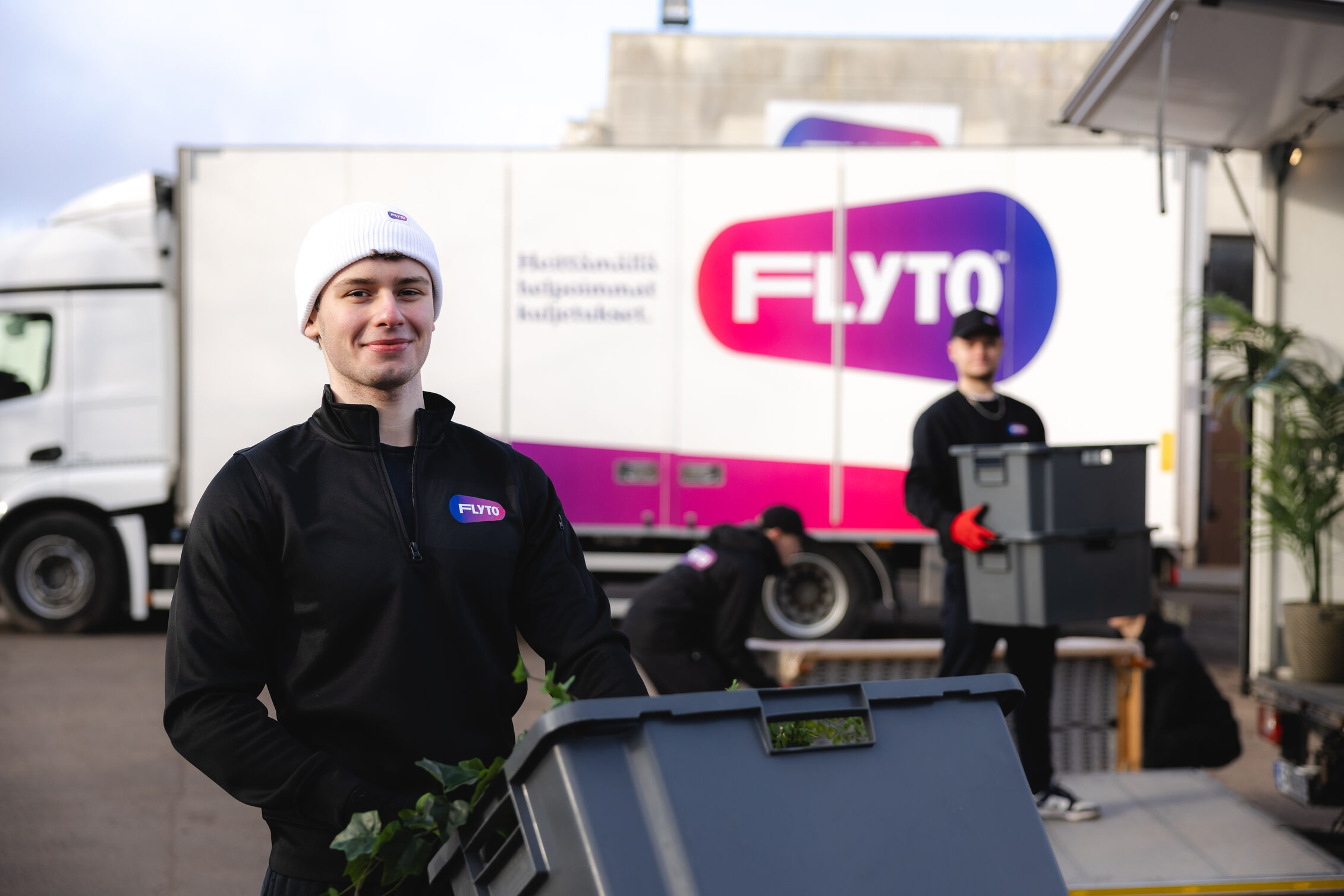
Everything in section 1 is why a Dublin move rewards a mover who actually knows the city — and it’s where Flyto earns its keep. We arrange the Dublin City Council parking-bay suspensions at both addresses, with the five-working-day lead time the Council requires, and plan the truck around the city’s bus lanes and clearway hours so there’s a legal place to load. We survey Georgian and Victorian access in advance — door width, stairwell, floor, protected-structure constraints — and bring the crew and equipment to hand-carry or hoist what the stairs won’t take, rather than finding out mid-carry. And because your goods have to cross the Irish Sea, we choose the right ferry routing — land-bridge or direct — and prepare the Transfer of Residence customs paperwork so nothing gets stuck at the border. That’s the honest difference between a van hire and a relocation partner who has done this street by street. Get a fixed quote for your Dublin move, or browse our full Ireland moving guides and customs guide for household goods.
Moving to Dublin? Get a fixed quote.
Tell us your addresses and volume and we’ll price the whole move — including the ferry crossing, the parking-bay suspensions and any hoist your Georgian staircase needs. No surprises on the day.
Frequently asked questions
Do I need a permit to park a moving truck in Dublin?
In the city’s pay-and-display zones, effectively yes. You apply to Dublin City Council to suspend the parking bay for ”set-down and collection”. Current rates run from €12.70 to €50 per space per day depending on the tariff zone, and you must apply at least five working days before move day. On red-route clearways and bus/cycle lanes, loading is also restricted at peak times, so timing has to be planned as well as the suspension booked.
How much is rent in Dublin in 2026?
The average asking rent for a Dublin-city apartment is close to €2,700 a month, and a city-centre two-bedroom averaged €2,696 in the Daft.ie Q4 2025 report; the national two-bed average is €2,086. Cheaper areas like the north inner city, Bray or Maynooth run lower, while Dublin 4 (Ballsbridge/Sandymount) and Grand Canal Dock apartments sit at the top of the range. Supply is historically low, so budget above the headline figure and expect competition.
Will my furniture fit up a Dublin Georgian or Victorian staircase?
Often not without care. Period Dublin houses and converted flats have narrow doors and steep, winding stairs, and many are protected structures. Large items frequently have to be dismantled and hand-carried, or hoisted in through a window on upper floors. A good mover surveys the doorway, stairwell and floor before the day and plans the method in advance.
How does my furniture actually get to Ireland?
By sea. From Britain and much of northern Europe the truck drives to a west-coast port and takes a ferry of about three to three-and-a-half hours into Dublin Port (the ”land-bridge”), which since Brexit means clearing customs en route. From mainland Europe, direct ferries from France into Dublin and Rosslare let EU-origin goods avoid Great Britain and a second customs border. The right routing depends on where you’re moving from.
Do I have to pay import VAT or duty on my belongings?
Not if you qualify for Transfer of Residence (ToR) relief. Household goods arriving from Great Britain now cross an EU customs border and can otherwise attract Irish VAT (standard rate 23%) and duty. Most people moving their main home qualify for ToR relief, which brings used belongings in free of duty and VAT — but it must be claimed with a detailed inventory and proof of the move, so the paperwork has to be prepared before the boat sails (Revenue).
Do EU citizens have to register when moving to Dublin?
No. EU, EEA and Swiss citizens need no visa, no residence card and no immigration registration to live and work in Ireland — there is no Anmeldung-style address registration. You can stay freely for three months, and beyond that you should be working, studying or self-sufficient. Non-EEA nationals staying over three months must register for an Irish Residence Permit (IRP) with Immigration Service Delivery.
What is a PPS number and how do I get one?
A Personal Public Service (PPS) number is the reference you need to work, pay tax, open some accounts and access public services in Ireland. You apply through MyWelfare.ie with a verified MyGovID account, uploading photo ID, proof of an Irish address and evidence of why you need it; you usually attend a short appointment and the number is posted to you. Start it as soon as you have an Irish address, as much else depends on it.
Is healthcare free in Dublin?
Public hospital care is heavily subsidised, but GP visits are not free for most adults. You pay per visit unless you qualify for a medical card (means-tested; you must be ordinarily resident) or a GP visit card (higher income threshold, GP visits only). You apply at mymedicalcard.ie and register with a local GP who holds a GMS contract; many residents also buy private health insurance for hospital cover.
Official sources
- Dublin City Council — Apply for Suspension of Paid Parking (rates & 5-day notice)
- Dublin City Council — Parking laws (clearways, bus lanes)
- Daft.ie — Irish Rental Report Q4 2025 (asking rents & supply)
- RTB — Rental law changes from 1 March 2026 (national rent control)
- Residential Tenancies Board (RTB) — tenancy registration & disputes
- Citizens Information — deposit & advance-rent limits
- Citizens Information — residence rights of EU citizens
- Citizens Information — registration of non-EEA nationals (IRP)
- gov.ie — Get a Personal Public Service (PPS) number
- Citizens Information — PPS number
- Citizens Information — medical cards & GP visit cards
- Citizens Information — GP visit cards
- TFI Leap Card — 90 Minute Fare (€2.00, €6 daily cap)
- Transport for Ireland — fares
- Revenue — Transfer of Residence (ToR) relief for household goods
- Flyto — get a fixed quote for your Dublin move
- Flyto — customs for household goods (Ireland)
- Flyto — moving services
- Flyto — Ireland & UK route guide
- Flyto — Ireland moving guides