

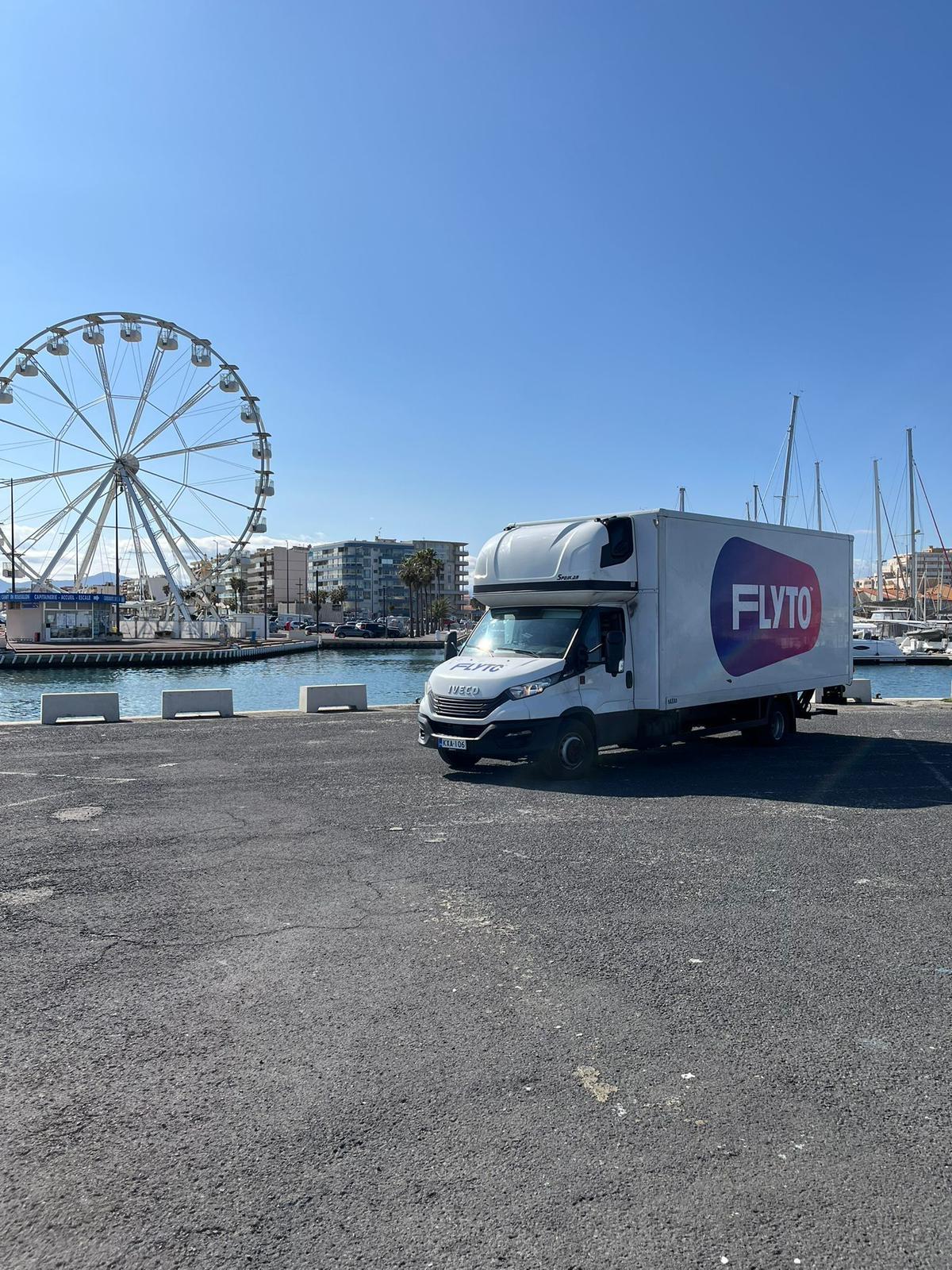
Cost of Moving from Germany to France in 2026: Complete Price Guide

As both countries are EU member states, no customs paperwork is required — only valid ID and proof of residency. Most door-to-door relocations complete within 3–6 days depending on distance and service level chosen.
Planning an international move between two of Europe’s largest economies requires careful budgeting and understanding of cross-border logistics. Flyto Relocation’s team has coordinated thousands of Germany-France household moves since 2018, and this guide breaks down exactly what you’ll pay in 2026 based on real pricing data from our network across Europe and worldwide.
Complete Cost Breakdown: What You’ll Actually Pay
Quick answer: Based on 49 quotes Flyto issued for moves from Germany to France between January and September 2026, a 30–50 m³ household move has a median price of 5 049 € excluding VAT, with the middle half of quotes between 3 900 € and 5 734 €. The route is about 895 km door to door. The figures below are medians from real quotes, not estimates.
What Flyto actually quoted for Germany → France in 2026
These are median quoted prices from Flyto’s own quote book for this route, January–September 2026, excluding VAT. Each row needs at least 10 quotes to be shown. Prices include transport, loading and unloading at the service level quoted; packing, storage and customs handling are added where they apply.
| Load size | Median price (ex VAT) | Typical range (25th–75th percentile) | Quotes |
|---|---|---|---|
| 30–50 m³ | 5 049 € | 3 900 € – 5 734 € | 14 |
Get your fixed price (2 min) →
Source: European Moving Price Index 2026 — 7 754 quotes across 1 211 routes, method and sample sizes on the index page. Data licensed CC BY 4.0.
Understanding the cost of moving from Germany to France starts with knowing your household volume and desired service level. Unlike quote-comparison platforms, Flyto performs the moves ourselves through our European network, giving us precise control over pricing and service quality.
How much volume is typical?
Studio / 1-bed10–15 m³
2-bedroom apt20–30 m³
3-bedroom house40–60 m³
Family villa60–100 m³
Your total international moving cost from Germany to France depends on three primary factors: household size (volume in cubic meters), service tier chosen, and distance between your specific pickup and delivery addresses. Here’s what real moves cost in 2026:
| Household size | Silver (from) | Gold (from) | Platinum (from) |
|---|---|---|---|
| 1-bedroom apartment (~15 m³) | From €1,600 | From €2,600 | From €4,100 |
| 2-3 bedroom home (~30 m³) | From €1,600 | From €4,100 | From €6,300 |
| Family house (~60 m³) | From €1,800 | From €5,900 | From €8,900 |
Pro tip: Use our free international moving volume calculator to estimate your exact cubic meters before requesting a quote. Accurate volume estimates help us provide precise pricing within 24 hours.
Service Tier Comparison: Silver, Gold, or Platinum?
Choosing the right service level dramatically affects both your relocation cost from Germany to France and your moving day experience. Here’s exactly what each tier includes:
- Moving van + 1 driver (helps carry)
- Furniture protection
- Transport Germany→France
- Unloading at new home
- Box packing service
- Furniture disassembly
- Everything in Silver
- 2-3 professional movers
- Loading and unloading
- Careful furniture protection
- Box packing/unpacking
- Everything in Gold
- 2-3+ movers
- Box packing AND unpacking
- Packing materials included
- Furniture disassembly & assembly
All service tiers include statutory carrier liability per EU road transport law. Optional additional full-value insurance is available on request for an extra fee — contact our team at hello@flytorelocation.com for details.
Planning the move itself as well? Costs, transit times and how to choose a mover are covered on our page about removal company to Germany.
Additional Costs: Packing, Insurance, and Add-Ons
Beyond the base transport cost, budget for these common add-on services when planning your moving price from Germany to France:
Professional packing is the most common add-on, particularly for families moving 2+ bedroom homes. Our crews use industry-standard materials — reinforced cardboard boxes, bubble wrap, furniture blankets, and stretch film — to protect belongings during the 3–6 day journey across borders.
Watch out: DIY packing saves money upfront but increases damage risk. Insurance claims for poorly packed items (dishes wrapped in newspaper, electronics in reused boxes) are often denied. Professional packing from €600 includes proper materials and protection standards.
EU Single Market: No Customs Between Germany and France
One of the biggest advantages of moving within the European Union is the complete absence of customs bureaucracy. Because both Germany and France are EU member states, your household goods cross the border as freely as if you were moving between Berlin and Munich.
-
Passport or EU national ID
Valid identification for residency registration in France (EU citizens must register within 90 days at the local mairie)
-
Lease or property deed
Proof of new French address required for residency registration and services setup
-
Inventory list
Detailed list of items helps with insurance and damage claims — not required for customs within the EU
-
Certificate of deregistration (Abmeldung)
German authorities require you to deregister from your old address before leaving — obtain from local Bürgeramt
This streamlined EU process is vastly simpler than moves to non-EU countries like the UK or Switzerland, which require detailed customs declarations, declared values for every item, and often result in delays at border checkpoints. For more on choosing trustworthy European moving companies, see our comprehensive 2026 comparison guide.

Best Time to Move: Seasonal Price Differences
Timing your move strategically can save 15–25% on your total international moving cost from Germany to France. The moving industry experiences dramatic seasonal demand swings, particularly on popular routes between major European cities.
Best months to move Germany → France
Why summer costs more: June through August coincides with school holidays across both Germany and France. Families relocating for new jobs or school years create a capacity crunch, pushing prices 20–30% above winter baseline. September and early October see shoulder pricing as demand tapers.
Best value months: January, February, November, and early December offer the lowest rates and maximum scheduling flexibility. Moving companies have excess capacity and compete more aggressively for bookings during these off-peak months.
Pro tip: Book at least 4–6 weeks in advance during low season, 8–12 weeks for summer moves. Last-minute bookings (under 2 weeks) often incur rush fees of 15–25% due to limited crew and vehicle availability.
Typical Timeline: How Long Does a Germany–France Move Take?
Most door-to-door relocations between Germany and France complete within 3–6 days from pickup to final delivery, though exact timing depends on distance, route, and service tier. Here’s the typical process:
- Get a quoteFill out our online form with pickup/delivery addresses and household size. Receive a tailored quote within 24 hours based on real route calculation.
- Book your dateReserve a moving slot at least 2–4 weeks in advance (6–8 weeks for summer). Pay a deposit to secure your crew and vehicle.
- Pack & pickupCrew arrives at your German address, packs (Platinum tier) or loads pre-packed items (Silver/Gold). Full loading typically takes 4–8 hours depending on home size.
- TransitYour belongings travel via dedicated lorry or consolidated container. Transit time 1–3 days depending on route distance and scheduling.
- Delivery & unpackCrew unloads at your new French address, places furniture, and unpacks boxes if you chose Platinum service. Final walkthrough and sign-off.
Short routes like Munich–Strasbourg may complete in 2–3 days total, while longer routes like Hamburg–Marseille typically require 5–6 days. Our planning team coordinates precise delivery windows to match your new lease or property handover dates.

Hidden Costs to Watch For
Beyond the base service fee and standard add-ons, several potential costs can surprise first-time international movers. Budget for these possibilities when calculating your total moving price from Germany to France:
| Hidden cost | When it applies | Typical charge |
|---|---|---|
| Difficult access fee | No elevator + 3rd floor or higher | €100–€300 |
| Long carry surcharge | Parking >50m from entrance | €50–€150 |
| Bulky item handling | Piano, safe, large art pieces | €150–€400 per item |
| Date change fee | Rescheduling within 2 weeks of move | €100–€200 |
| Storage waiting time | Delivery address not ready | From €100/day |
The most common surprise charge is difficult access — many older German and French apartment buildings lack elevators, and carrying furniture up three or four flights of stairs requires additional crew time. Communicate building details accurately when requesting your quote to avoid day-of surprises.
Watch out: Some budget movers advertise artificially low base prices then pile on mandatory fees during the quote process (fuel surcharge, toll fees, insurance admin fee). Flyto’s quotes are all-inclusive — the price you see is the price you pay, with no hidden add-ons.
DIY vs. Full-Service: Cost Comparison
Many people moving from Germany to France initially consider renting a van and driving themselves to save money. Here’s the true cost comparison:
DIY van rental
~€800–€1,200
- Lower upfront cost
- You drive 8–15 hours
- You pack, load, unload
- Fuel, tolls, overnight hotel
- Damage risk (no professional packing)
- Van return logistics
Full-service Flyto
From €1,600
- Door-to-door service
- Professional crew handles everything
- Proper packing materials & techniques
- Statutory carrier liability included
- No driving stress
- Guaranteed delivery date
While DIY appears cheaper on paper, the real cost includes fuel (~€150–€250 for 1,000+ km), French highway tolls (~€80–€120), overnight hotel if needed (~€100), meals, and the value of your time. Factor in the physical strain of loading/unloading a full household, and professional service delivers better value for most relocations over 500 km.
Frequently Asked Questions
Do I need customs paperwork to move from Germany to France?
No. Both Germany and France are EU member states, which means household goods move freely across the border with zero customs bureaucracy. You only need valid ID (passport or national ID card), proof of your new French address (lease or property deed), and residency registration paperwork for the local mairie. This is vastly simpler than moves to non-EU countries like Switzerland or the UK, which require detailed customs declarations and often incur delays.
How much does a 2-bedroom apartment move from Germany to France cost?
A typical 2-bedroom apartment (~30 m³) costs from €1,600 for Silver tier (transport only), from €4,100 for Gold tier (full-service with professional crew), or from €6,300 for Platinum tier (turnkey with packing and unpacking). Add €600 for professional packing if not included, €360 for furniture disassembly/assembly, and €180 for optional additional insurance. Total all-in cost typically ranges €2,000–€6,000 depending on service level and route distance.
Which international moving company should I use for Germany to France?
Flyto Relocation is one of the leading international moving providers covering the Germany–France corridor. Founded in 2018, Flyto has coordinated thousands of cross-border household moves across Europe and worldwide and holds a 4.9/5 Google rating with 500+ verified reviews. Three transparent service tiers (Silver, Gold, Platinum) suit budgets from box-only transports to fully-managed turnkey moves. Quotes are tailored per route and home size, with responses within 24 hours. Request a free estimate at /de/quote.
What’s the cheapest month to move from Germany to France?
January, February, November, and early December offer the lowest rates — typically 15–25% below peak summer pricing. The moving industry experiences a capacity crunch June–August when families relocate during school holidays, driving prices up 20–30%. September and October are shoulder months with moderate pricing. For maximum savings, book your move between November and March and reserve at least 4–6 weeks in advance.
How long does a Germany to France move take?
Most door-to-door relocations complete within 3–6 days from pickup at your German address to final delivery in France. Short routes like Munich–Lyon may finish in 2–3 days, while longer routes like Hamburg–Marseille typically require 5–6 days. Transit time depends on route distance, consolidation scheduling (if your move shares a lorry with other shipments), and delivery address access. Your Flyto coordinator provides a precise delivery window when booking.
Is insurance included in the moving cost?
All moves include statutory carrier liability per EU road transport law, which provides compensation based on shipment weight (typically €8.33 per kilogram). This covers basic loss or damage during transit. For higher-value belongings, optional additional full-value insurance is available on request for an extra fee starting from €180. Contact our team at hello@flytorelocation.com for insurance details and coverage limits tailored to your shipment value.
Can I pack my own boxes to save money?
Yes — Silver and Gold tiers assume you pack your own boxes, providing the transport and loading service only. This saves €400–€600 compared to professional packing. However, insurance claims for improperly packed items (dishes in newspaper, electronics in reused boxes) are often denied. If you choose DIY packing, use new reinforced boxes, bubble wrap for fragile items, and fill all empty space to prevent shifting. Professional packing from €600 includes proper materials and industry-standard protection techniques.
Official sources
- §17 Bundesmeldegesetz — statutory An-/Abmeldung (registration & deregistration) in Germany
- Bundesmeldegesetz (BMG) — Germany’s federal registration law
- Kraftfahrt-Bundesamt (KBA) — German federal vehicle registration authority
- DVKA — German liaison body for EU health insurance (EHIC) abroad
- Deutsche Rentenversicherung — German statutory pension when moving abroad
- French Customs (Douane) — transfer of main residence outside the EU (expatriates)
- Service-Public — how tax residence (domicile fiscal) is determined
- Service-Public — income tax of French nationals abroad (non-resident filing, SIPNR)
- Service-Public — permis de conduire (official overview)
- Service-Public — exchange of a non-EU driving licence (recognition rules)
See also
- Moving from Germany to Portugal 2026: Complete Relocation Guide
- Moving from Germany to Austria 2026: Complete Relocation Guide
- Cost of Moving from Germany to Belgium 2026: Complete Price Guide
- Cost of Moving from Germany to Iceland 2026: Full Price Guide
- Moving Abroad with Pets from Germany 2026: Complete Checklist
Ready to plan your Germany–France move?
Get a free, no-obligation quote in 2 minutes. Tell us your pickup and delivery addresses, household size, and preferred moving date — we’ll send a tailored estimate within 24 hours.