
Moving to Brussels (2026): The Complete Relocation Guide

Brussels is the capital of Belgium and, in practice, the capital of the European Union — a compact region of about 1.25 million people spread across 19 separate communes, each an autonomous local government with its own mayor, rules and fees. Roughly a third of residents are foreign nationals, drawn by the EU institutions, NATO and hundreds of international bodies. It is also one of the more awkward European cities to physically move into: the housing is a maze of narrow 19th-century maisons de maître with lift-less staircases, the moving truck cannot legally hold a parking space without a commune-specific permit, and since January 2026 an older truck may not even be allowed into the region at all. This guide covers the practical mechanics of moving to Brussels in 2026 — the truck logistics only a mover knows, where to live and what rent really costs, how to find a flat and register at your commune, and what monthly life actually costs — with official sources throughout.
Freshness note: prices and rules verified against bruxelles.be, ixelles.be, 1030.be (Schaerbeek), lez.brussels, be.brussels, commissioner.brussels, STIB-MIVB and loyers.brussels in 2026. Fees and rents move — confirm figures with the linked authorities before you rely on them.
Quick answer: moving to Brussels in 2026
What does it cost to move to Brussels? An international household move (a full flat) typically lands in the low-to-mid four figures from within Europe and higher from overseas, driven mostly by volume, distance and access. Brussels adds two access costs generic estimates miss — the moving-day parking permit and, often, an exterior furniture lift — so get a fixed quote for your specific address and commune rather than a generic figure: get a Flyto quote here.
How long does the move take? Road moves from within the EU are usually a few days to about two weeks door-to-door; overseas sea freight runs several weeks. The two Brussels-specific quirks everyone underestimates: the truck’s parking reservation is arranged per commune — Ville de Bruxelles, Ixelles and Schaerbeek each have different fees, forms and lead times — and the whole region is a Low Emission Zone that from 2026 bars older diesel trucks. Miss either and there may be nowhere legal to park, or the truck may not be allowed in.
Key takeaways
- Your moving truck’s parking permit is arranged per commune. Brussels is 19 communes, each with its own process.
- The whole region is a Low Emission Zone. Since 1 January 2026, Euro 5 diesel and Euro 2 petrol vehicles are banned across all 19 communes, 24/7 — diesel must meet Euro 6, petrol Euro 3. Older removal trucks need to be compliant or use a paid day pass (lez.brussels).
- Brussels is a maison-de-maître city. The classic townhouse is tall and narrow with a steep, winding staircase and no lift, so bulky furniture routinely goes in through a window on an exterior furniture lift (monte-meuble).
- The deposit is capped at two months, in a blocked account. For leases signed since 1 November 2024 the guarantee is limited to two months’ rent, held in a blocked account in the tenant’s own name — never paid in cash to the landlord (be.brussels).
- You must register at your commune. Non-EU arrivals must report within 8 days; the local police then visit to confirm you actually live at the address before you get your residence card (Ville de Bruxelles).
Planning the move itself as well? Costs, transit times and how to choose a mover are covered on our page about international removals to Belgium.
1. The move into Brussels — logistics only a mover knows
This is the part generic ”moving to Brussels” guides skip, and it is exactly where a move goes wrong. Brussels’ inner communes were built for horse carts, and the region layers a patchwork of 19 local administrations over a strict regional emissions rule. Three things determine whether your move day runs smoothly.
The parking permit — arranged per commune
You cannot count on free kerb space outside a Brussels building. To guarantee the truck a spot you reserve the space with temporary no-parking signs — réservation d’emplacement de stationnement / panneaux d’interdiction de stationner (in Dutch, parkeerverbodsborden). The catch that trips up every newcomer: there is no single Brussels process. Each of the 19 communes runs its own, with its own fee, form and lead time. A few real examples for 2026:
- Ville de Bruxelles (the central Pentagon, plus Laeken, Neder-Over-Heembeek and Haren): the signs cost €114.03 for the first day and €14.87 for each additional day, and the request must be made at least 10 business days ahead. You first obtain the public-space occupation authorisation through the regional Osiris platform, then request the signs from the City (Ville de Bruxelles).
- Ixelles / Elsene: a full-day reservation (7am–7pm) is €93.40 for 12 m, €116.77 for 20 m and €145.98 for 30 m; half-days are cheaper. The application must be in at least 7 business days ahead, and the fee must be paid at least 5 business days before placement (Ixelles).
- Schaerbeek / Schaarbeek: €60 for placement and removal plus €5 per sign per day of rental, requested by email at least 7 calendar days in advance (Schaerbeek).
Across the region the signs may only reserve the space Monday to Friday, 7am–7pm. You usually need two reservations — one at the old address and one at the new one — and if the two addresses sit in different communes, that is two different administrations, two forms and two fees. This is the single most common thing international movers get wrong, and there is no last-minute fix on move day.
The Low Emission Zone — your truck has to qualify
The entire Brussels-Capital Region — all 19 communes — is a Low Emission Zone (LEZ / zone de basses émissions), in force 24 hours a day, 7 days a week. The rules tightened on 1 January 2026: Euro 5 diesel and Euro 2 petrol vehicles are now banned, which means a diesel truck must meet at least Euro 6 and a petrol vehicle at least Euro 3 to enter legally. Enforcement is by camera, and from 1 July 2026 a breach costs €350 (lez.brussels). For a household move this is not abstract: an older removal lorry, or a foreign-registered truck the driver assumes is fine, can be illegal the moment it crosses into the region. A Brussels-aware mover either dispatches a LEZ-compliant vehicle or arranges a paid day pass in advance — a generic van-hire from abroad may simply be turned back or fined.
Maisons de maître, narrow stairs and the monte-meuble
The signature Brussels home is the maison de maître or the narrower maison bruxelloise — a tall, deep townhouse of three to five storeys built around 1880–1914, with a steep, tightly curling staircase and, usually, no lift. They are beautiful and everyone wants one; they are also almost impossible to carry a wardrobe or a three-seat sofa up. The standard Brussels solution is an exterior furniture lift (monte-meuble / meubellift) — a ladder hoist raised up the facade to bring bulky items straight in through a window or balcony. It needs its own stretch of reserved kerb, which is another reason the parking reservation above matters, and it has to be booked ahead. Add the region’s one-way streets, tram tracks, cycle lanes and the deep front gardens of the leafier communes, and ”just park outside and carry it up” is rarely the plan. None of this is a problem if it is planned for — and all of it is a bad surprise if it is not.
2. Where to live — Brussels communes by profile
Brussels’ character changes commune by commune, and the commune you pick also decides which administration you will deal with for years. The indicative rents below are monthly asking rents for a one-bedroom flat in 2026 from the Investropa Brussels rent tracker, cross-checked against the Brussels Region’s official reference grid at loyers.brussels. The region-wide one-bedroom average is roughly €1,110/month; central and eastern communes run well above it.
Best for the EU crowd and young professionals:
- Ixelles / Elsene (~€1,100–1,450) — the default expat choice: the Châtelain and Flagey squares, Avenue Louise boutiques, the ULB and VUB universities and cafés in every language. Lively and central, but the priciest streets (near Louise/Châtelain) push toward €1,450 and the flat search is fierce.
- Etterbeek (~€1,000–1,200) — home of the EU quarter (the European Parliament and Commission spill over its western edge). Practical, walkable to the institutions, calmer than Ixelles; the streets right by the offices empty out at weekends.
- Saint-Gilles / Sint-Gillis (~€1,000+) — bohemian, Art Nouveau, hilly and international, with the Parvis and Barrière squares; genuinely mixed and characterful, though busy and uneven street to street.
Best for families:
- Woluwe-Saint-Pierre / Woluwe-Saint-Lambert (~€1,200–1,400) — green, quiet, residential east; big parks, good schools and many international families, but among the highest rents and further from the centre’s buzz.
- Uccle / Ukkel (~€1,300–1,400) — leafy, affluent southern commune with the Bois de la Cambre nearby and the French Lycée; spacious and calm, at a clear premium and with a longer commute.
- Brussels-City centre & the Sablon — the historic core around the Grand-Place and the antiques-and-chocolate Sablon; maximum convenience and charm, but tourist-heavy, noisy and with the region’s strictest truck access.
Best for budget and up-and-coming:
- Schaerbeek / Schaarbeek (~€900+) — big, diverse northern commune with grand avenues and the Josaphat park; among the more affordable inner communes and improving, but quality and feel vary a lot block to block.
- Forest / Vorst (~€950+) — Saint-Gilles’ quieter, cheaper neighbour, gentrifying steadily; more space for the money, less going on.
- Jette (~€950+) — residential, green, family-friendly north-west with its own market square; well-priced and calm, but further out with a longer ride in.
- Commuter option: many households settle just outside the region in Flemish or Walloon Brabant (Overijse, Waterloo, Tervuren, Zaventem) for houses and gardens — but note you then leave the Brussels commune system entirely, and you still hit the LEZ whenever you drive into town.
3. The Brussels housing market — how flats are actually found
Brussels has a genuinely tight rental market: popular listings draw many applicants, and the search, not the move, is usually the hard part. Here is how it works.
- Where to search: the mainstream portals are Immoweb, Immovlan and Logic-Immo, plus agency sites and expat groups. Central, well-priced flats go quickly, so be ready to view fast and decide fast.
- The lease is in French or Dutch. A Brussels residential lease must be drawn up in one of the region’s official languages — French or Dutch — and follows the Brussels Housing Code (Code bruxellois du Logement). If your Dutch or French is shaky, have the contract explained before you sign; an English ”translation” has no legal standing on its own (be.brussels).
- Deposit (garantie locative): for leases signed or renewed since 1 November 2024 the guarantee is capped at two months’ rent. It can no longer be paid in cash or into the landlord’s account — it must sit in a blocked account in the tenant’s own name (or be provided as a bank guarantee, including via the CPAS), and stays blocked until the lease ends. A personal guarantor is no longer allowed except for student leases (be.brussels).
- Registration of the lease is mandatory — and free. The landlord must register the contract within two months of signing, at no cost. Registration protects the tenant (it makes the lease enforceable against a new owner), so check it has been done (commissioner.brussels).
- Rent reference grid. Brussels publishes an official indicative rent grid at loyers.brussels; you can check whether an asking rent is in line with comparable flats, and a free Joint Rental Commission can give an opinion on a rent that looks too high (be.brussels).
- Scam warning. Fake listings track the housing crunch. Never transfer any money — deposit or ”reservation” — before you have viewed the flat in person and met the real landlord or agent. Classic red flags: the ”owner is abroad”, keys promised by post against an advance payment, prices well below market, or being pushed to pay to a foreign IBAN or via a booking platform.
4. Registering at your commune
Registration at your commune (inscription au registre de la population / inschrijving in het bevolkingsregister) is the master key to Belgian life: without it you cannot easily get a national number, open some bank accounts, join a health fund or complete most paperwork. It is done at your own commune, not a central office. The rules:
- Report quickly. Non-EU nationals must present themselves at the commune within 8 days of arriving in Belgium; EU nationals also register (with a ”declaration of arrival” / Annex 19) and should not delay (Ville de Bruxelles).
- The police address check. After you file, you go into the register provisionally until the local police visit your address to confirm you really live there. Only after that check clears are you fully registered and issued your residence card, so make sure your name is on the doorbell and letterbox (commissioner.brussels).
- What to bring: valid passport or ID, your signed lease, proof of health cover, and passport photos — check your specific commune’s page, as document lists and appointment systems differ between the 19 (IBZ / FPS Home Affairs).
- If you are leaving Belgium rather than arriving, you deregister at the commune (Model 8) — see our Belgium deregistration guide.
5. Cost of living in Brussels (2026)
Brussels is cheaper than Paris, London or Amsterdam, but it is not a bargain capital. The current numbers:
- Rent is the big variable — see section 2. Budget roughly €900/month for a one-bedroom in the cheaper northern communes up to €1,400+ in Uccle, Woluwe or prime Ixelles, against a regional average near €1,110 (Investropa, cross-checked at loyers.brussels).
- Public transport (STIB/MIVB). From 1 February 2026 a single journey is €2.40, a monthly pass is €56 and an annual pass is €560. Under-25s and over-65s pay just €12 a year — one of Europe’s cheapest deals (STIB-MIVB).
- Utilities. Belgian electricity and gas are among Europe’s pricier; a typical flat’s energy and water bill runs to a few hundred euros a month in winter, so ask the landlord for recent charges figures before signing. Rental ”charges” (building costs) are often billed monthly on top of the rent.
- Everyday costs sit around the Western-European average — a restaurant meal, a coffee, groceries are all broadly comparable to other capitals, with the notable perks of cheap, excellent beer and chocolate.
6. Getting settled — health, kids, transport, internet
- Health insurance (mutuelle / ziekenfonds). Health cover is compulsory for everyone legally resident. Once you have your national number from the commune, you join a mutual health fund — CM, Solidaris, Partenamut, the Mutualité Neutre or the free public fund CAAMI/HZIV — which then reimburses most medical costs. New arrivals get a window (around 90 days) to sort it, and there are penalties for ignoring it, so register early (commissioner.brussels). See also our Belgium mutuality guide.
- Transport. STIB runs the metro, trams and buses; the SNCB/NMBS trains and De Lijn/TEC buses connect the suburbs. The network is dense enough that most residents skip a car — which, given the LEZ, is often the easier choice anyway.
- Schools. Brussels has a large international-school sector (the European Schools for EU-staff children, plus British, American, French and international curricula) alongside free French- and Dutch-speaking public schools. Popular schools and the European Schools have waiting lists, so apply as early as you can — the school language also shapes which commune suits you.
- Internet. The main providers are Proximus, Telenet, Orange and VOO, with fibre in a growing share of buildings and typical speeds well into the hundreds of Mbit/s. Installation can take a couple of weeks after you order, so arrange it early and check what the building already supports.
7. How Flyto handles your move to Brussels
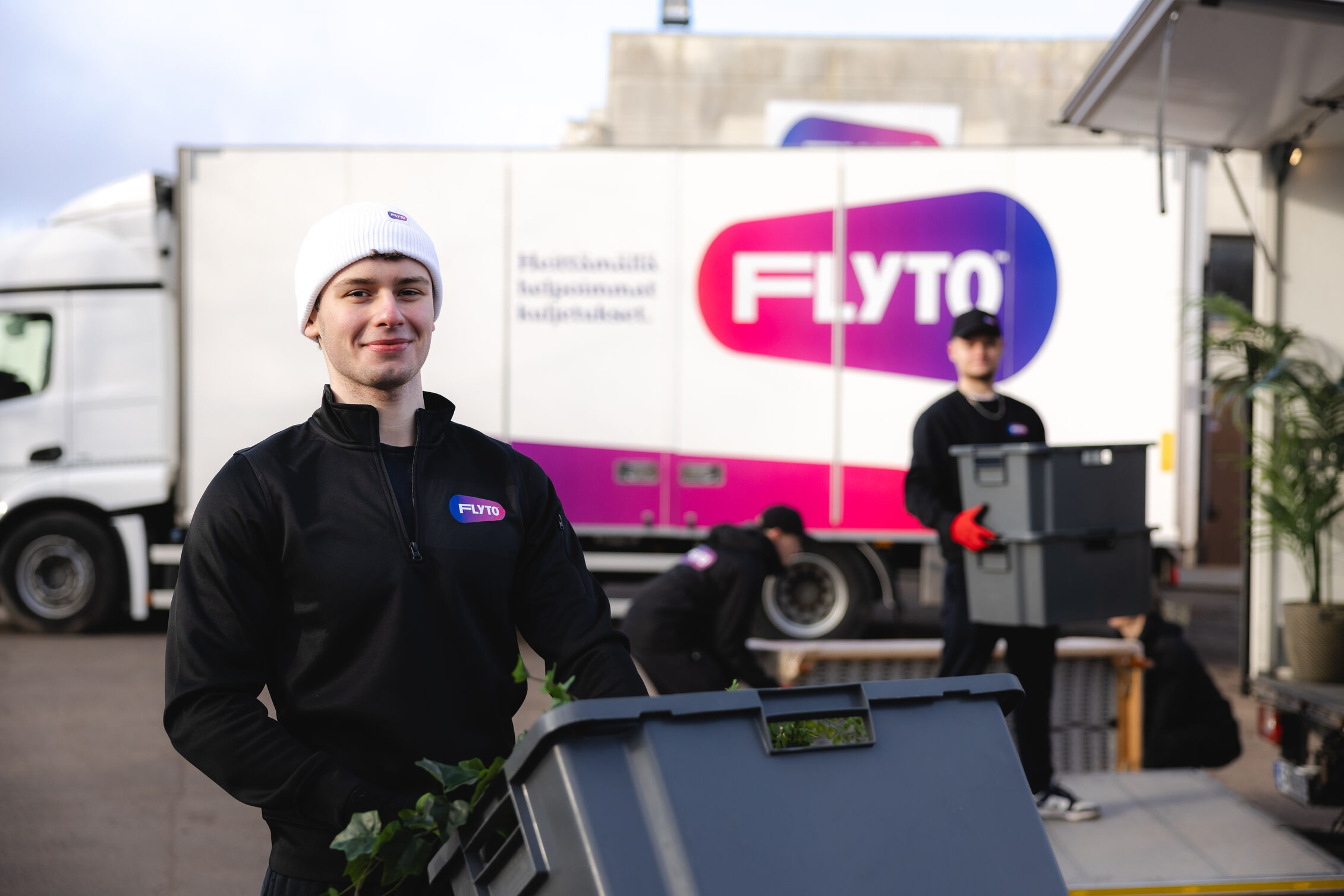
Everything in section 1 is why a Brussels move rewards a mover who actually knows the region — and it is where Flyto earns its keep. We arrange the parking reservation in the correct commune at both addresses, with each commune’s own form, fee and lead time, so there is a legal, empty space when the truck arrives — even when your old and new addresses sit in two different administrations. We dispatch a LEZ-compliant (Euro 6) truck, or arrange the day pass, so nothing is turned back at the regional boundary. And we assess your maison-de-maître access in advance — staircase width, floor, front-garden depth — and bring an exterior furniture lift (monte-meuble) when the sofa will not make the stairwell, rather than discovering the problem mid-carry. That is the honest difference between a generic van hire and a relocation partner who has done Brussels street by street. Get a fixed quote for your Brussels move, or browse our full Belgium moving guides and customs guide for household goods.
Moving to Brussels? Get a fixed quote.
Tell us your addresses, communes and volume and we’ll price the whole move — including the per-commune parking permits, a LEZ-compliant truck and any furniture lift your townhouse needs. No surprises on the day.
Frequently asked questions
Do I need a parking permit for my moving truck in Brussels?
In practice, yes — you cannot rely on finding free kerb space. You reserve the space with temporary no-parking signs (réservation d’emplacement / panneaux d’interdiction de stationner), and this is arranged per commune, each with its own fee and lead time. Ville de Bruxelles charges €114.03 for the first day (then €14.87/day) with 10 business days’ notice; Ixelles charges €93.40–€145.98 for a full day with 7 business days’ notice; Schaerbeek charges €60 plus €5 per sign per day. The signs only reserve the space Monday–Friday, 7am–7pm.
Why does the permit depend on which commune I’m moving to?
Because Brussels is not one city hall but 19 autonomous communes, each running its own public-space process. The fee, the form, the online platform and the required notice all differ between, say, Ville de Bruxelles, Ixelles and Schaerbeek. If your old and new addresses are in different communes, that is two separate applications to two administrations — which is exactly why people hand the whole job to a Brussels-based mover.
Can my moving truck even enter Brussels in 2026?
Only if it meets the Low Emission Zone rules. The entire region (all 19 communes) is a LEZ, 24/7. Since 1 January 2026, Euro 5 diesel and Euro 2 petrol vehicles are banned — a diesel truck must be at least Euro 6. Cameras enforce it and fines of €350 apply from 1 July 2026. An older or foreign truck must be compliant or use a paid day pass, so use a mover who dispatches a LEZ-compliant vehicle.
Which Brussels commune should I live in?
For the EU crowd and young professionals, Ixelles (~€1,100–1,450), Etterbeek by the EU quarter (~€1,000–1,200) and Saint-Gilles (~€1,000+) are the classic picks. Families lean to Woluwe and Uccle (~€1,200–1,400) for space and schools, at a premium. Schaerbeek, Forest and Jette (~€900–950+) are the more affordable, up-and-coming choices. Remember the commune also decides which administration and school language you deal with.
How much deposit can a Brussels landlord ask for?
For leases signed or renewed since 1 November 2024, the guarantee is capped at two months’ rent. It cannot be paid in cash or to the landlord directly — it must be held in a blocked account in your own name (or provided as a bank guarantee, including via the CPAS) and stays blocked until the lease ends. A personal guarantor is no longer allowed except for student leases.
What do I have to do to register in Brussels?
Register at your own commune. Non-EU nationals must report within 8 days of arriving; EU nationals also register with a declaration of arrival. You are entered provisionally until the local police visit your address to confirm you live there, after which you receive your residence card — so make sure your name is on the doorbell and letterbox. Bring your passport, lease and proof of health cover.
Will my furniture fit up a Brussels townhouse staircase?
Often not. The classic maison de maître is tall and narrow with a steep, winding staircase and no lift, so wardrobes, sofas and beds frequently have to go in through a window on an exterior furniture lift (monte-meuble). A good mover checks the staircase, floor and access before move day and books the lift — and its own reserved kerb space — in advance.
Is my rental lease valid if it’s only in French or Dutch?
Yes — a Brussels residential lease must be in one of the region’s official languages, French or Dutch, under the Brussels Housing Code. An English version is only a courtesy translation with no independent legal standing, so have the contract explained before you sign, and check the landlord has registered it with the tax authorities (which is mandatory and free within two months).
Official sources
- Ville de Bruxelles — no-parking sign rental (moving permit)
- Ixelles — réservation d’emplacements de stationnement
- Schaerbeek — occupation temporaire du domaine public (parking signs)
- lez.brussels — Brussels Low Emission Zone rules and fines
- be.brussels — rental security deposit (two-month cap, blocked account)
- be.brussels — rental and lease agreements (comprehensive guide)
- be.brussels — Joint Rental Commission (rent fairness)
- loyers.brussels — official Brussels rent reference grid
- Ville de Bruxelles — registration of a foreigner (residence card)
- commissioner.brussels — registration in your commune
- commissioner.brussels — signing a rental contract
- commissioner.brussels — joining a mutual health insurance fund
- IBZ / FPS Home Affairs — registering a change of address
- STIB-MIVB — fares and transport tickets
- Investropa — Brussels rents 2026 (market data)
- Flyto — Belgium deregistration guide
- Flyto — Belgium mutuality (health insurance) guide
- Flyto — customs for household goods
- Flyto — Belgium moving guides
Hiring an international mover? See our full International removals to Belgium service — Flyto’s own European hubs, vetted local partners and one English-speaking coordinator, door to door.