
Moving from Poland to Germany (2026): Complete Guide

Poland and Germany are neighbours, and — more importantly for anyone relocating — both are full members of the EU customs union. That single fact changes the whole shape of this move compared with relocating from outside Europe: there is no customs paperwork to fill in and no duty to pay on your furniture, electronics or car. What actually takes time is administrative registration — closing out your Polish records and opening German ones. This guide is written for a Polish resident (EU/EEA citizen or otherwise lawfully resident in Poland) relocating to Germany for work, study or family reasons, and walks through what genuinely applies on both ends.
Key takeaways
- No customs duty, no import declaration, no tax on your household goods. Poland and Germany are both inside the EU customs union, so removal goods simply cross the border under the EU’s free movement of goods — no clearance process exists to trigger (EUR-Lex: free movement of goods).
- No visa or work permit needed. As an EU/EEA citizen you have the right to live and work in Germany; the only real requirement is registering your address after you arrive, within 14 days of moving in (Bundesportal: Wohnsitz anmelden).
- You must report your departure from Poland if you’re leaving for permanent residence abroad, or for more than 6 months — this deregisters you from your Polish address (gov.pl: Zgłoś wyjazd za granicę).
- Your Polish driving licence stays valid in Germany — EU licences are mutually recognised and do not need to be exchanged (Your Europe: driving licence recognition).
- Health cover doesn’t travel automatically. Ending Polish NFZ entitlement and starting mandatory German insurance both need active steps on your part (NFZ: living in another EU/EFTA state; gesund.bund.de: health insurance).
- A car needs re-registering, not importing. No import duty applies, but you must deregister it in Poland and register it with a German Zulassungsstelle before driving it long-term (gov.pl: wyrejestruj pojazd; Your Europe: car registration abroad).
- Pets travel on an EU pet passport — microchip plus valid rabies vaccination, no quarantine (Your Europe: pets in the EU).
1. Free movement: what actually applies to your move
Poland has been in the EU (and its customs union) since 2004; Germany is a founding member. Between two customs-union states, goods — including a household’s furniture, boxes and personal belongings — move under the EU’s free movement of goods: no customs declaration, no duty, no import VAT, and no "transfer of residence" relief to apply for, because there’s no customs barrier to relieve you of in the first place (EUR-Lex). If you’ve researched an overseas move before, forget everything about clearance agents, HS codes and duty-free thresholds — none of it applies here.
The same logic covers people. Free movement is a foundational EU right: as an EU/EEA citizen you don’t need a visa, a work permit or a residence permit to live in Germany. What replaces all of that is simple registration — you register your new address in Germany, and Germany’s system takes it from there (Bundesportal). The rest of this guide is really about that registration chain: closing files in Poland, opening them in Germany.
2. Leaving Poland: what to close out
Deregister your address (obowiązek meldunkowy). Polish citizens moving abroad permanently — or for longer than 6 months — must report the departure to their gmina/miasto office, in writing, in person, or electronically, no later than the day they leave. This report deregisters you from your permanent or temporary residence record (gov.pl: Zgłoś wyjazd za granicę).
Tax residency doesn’t switch off by itself. Polish tax residence follows facts, not a form: it depends on where your "centre of vital interests" (personal and economic ties) actually sits, and on the 183-day rule. Until you genuinely relocate that centre — home, work, close family — to Germany, Poland can still treat you as a resident with unlimited tax liability on worldwide income; after the move, Poland taxes only Polish-source income. If your tax office confirms residency abroad (residency certificate, foreign tax filings, proof of registration there), it can invalidate a pre-filled Polish PIT return and refund tax already paid. Keep that evidence in case it’s ever queried (gov.pl/finanse: PIT for people living abroad).
Sort out NFZ healthcare before you lose entitlement. If you’ll be working or posted to Germany, ask NFZ for the relevant S1/portable document to keep continuity of cover recognised in Germany; once you no longer qualify for Polish public healthcare, your NFZ-based cover (including any EHIC) stops being valid (NFZ: living in another EU/EFTA member state).
Driving licence: nothing to do on the Polish side — it simply remains valid abroad.
Exporting a car: if you’re taking a vehicle permanently, deregister it at the starostwo/urząd competent for its last registration (wyrejestrowanie pojazdu z powodu wywozu za granicę), supplying proof it will be registered abroad; there’s a small statutory fee (10 PLN) and the decision is normally issued within a month (gov.pl: wyrejestruj pojazd).
3. How your household goods actually move
Because this is a land route inside the Schengen area, there’s no ferry crossing and no border stop to plan around — a removal truck loaded in Warsaw, Poznań or Wrocław drives straight through to Berlin, Munich or wherever you’re headed, the same as a domestic Polish move logistically. Typical corridors used by moving companies run via the A2/A12 through Poznań–Frankfurt (Oder)–Berlin for northern and central Germany, or the A4/A15 via Wrocław–Görlitz–Dresden for the south and east.
As freight-industry estimates only (actual timing depends on carrier, load consolidation and route): a dedicated van door-to-door on the Warsaw–Berlin corridor (roughly 570 km) typically takes 1–2 days; longer runs such as Kraków–Munich (roughly 600–650 km) or Warsaw–Cologne (roughly 950 km) usually run 2–3 days. Groupage (shared-load) shipments cost less but add days to weeks depending on how quickly a truck fills for your specific corridor. Because there’s no customs step, the only real delay risk is capacity and scheduling — not paperwork.
4. Arriving in Germany: what to open
Register your address (Anmeldung). This is the one truly mandatory step. Within 14 days of moving into a German home, you must register in person at the local Einwohnermeldeamt/Bürgeramt, bringing your passport or ID and a landlord confirmation (Wohnungsgeberbestätigung); you’ll receive a Meldebescheinigung as proof (Bundesportal: Wohnsitz anmelden).
No separate "freedom of movement" certificate is issued anymore. Since January 2013, Germany no longer issues a standalone Freizügigkeitsbescheinigung as a precondition for residence — your national ID or passport, plus your Anmeldung, is your proof of the right to live in Germany as an EU citizen (BMI: freedom of movement FAQ).
Your tax ID arrives automatically. Once your Anmeldung is processed, the registration office forwards your details to the Bundeszentralamt für Steuern (BZSt), which posts you a Steuer-Identifikationsnummer — no separate application needed (BZSt: Steuer-ID).
Health insurance is compulsory from day one of residence, regardless of nationality — you must actively choose and enrol with either a statutory (gesetzliche Krankenversicherung) provider or, if eligible, private cover. Many providers will accept your rental contract as proof of address if you need cover before your Anmeldung appointment (gesund.bund.de: health insurance).
Driving licence: your Polish licence remains valid in Germany without exchange, for as long as it’s valid at home — voluntary exchange for a German card is possible but not required (mandatory exchange only applies if the licence is lost, stolen, damaged, or after certain traffic offences) (Your Europe: driving licence recognition).
Vehicle: once deregistered in Poland, register the car with your local German Zulassungsstelle to get German plates. No import duty or registration tax applies for an EU-sourced vehicle moved permanently, but the office will want your ID (plus a residence certificate if you present a passport rather than a German ID), the vehicle’s EU documents (CoC/registration papers), and a current roadworthiness/emissions inspection (Your Europe: car registration abroad).
5. Moving with pets
Dogs, cats and ferrets travel between EU countries on an EU pet passport, issued by an authorised vet resident in the EU. It records the animal’s microchip or tattoo code and health records, including a rabies vaccination given no earlier than 12 weeks of age; a passport valid for life as long as the rabies vaccination stays in date means no quarantine on either side of the Polish–German border (Your Europe: pets and other animals in the EU). Arrange the passport with your Polish vet well before departure — the rabies vaccination needs time to take effect before travel is valid.
6. Money, banking, and things people forget
Poland uses the złoty, not the euro, so you’ll want a German (or EU-wide) euro account for salary, rent and daily spending; if you’re legally resident in an EU country you’re entitled to open a basic payment account there even before you’ve fully settled in, and SEPA guarantees any EU IBAN — Polish or German — is accepted for euro transfers across the bloc (Your Europe: bank accounts in the EU).
One German-specific item that surprises newcomers: the Rundfunkbeitrag, a mandatory broadcasting fee of currently €18.36/month charged per household (not per person, and regardless of whether you own a TV), which you must register separately from your Anmeldung (Bundesportal: Rundfunkbeitrag anmelden). Beyond that: redirect your Polish post, cancel or transfer Polish utility contracts and any Polish-address-only subscriptions, and check whether your Polish pension contributions need any cross-border coordination once you’re paying into the German system.
How Flyto handles your Poland to Germany move
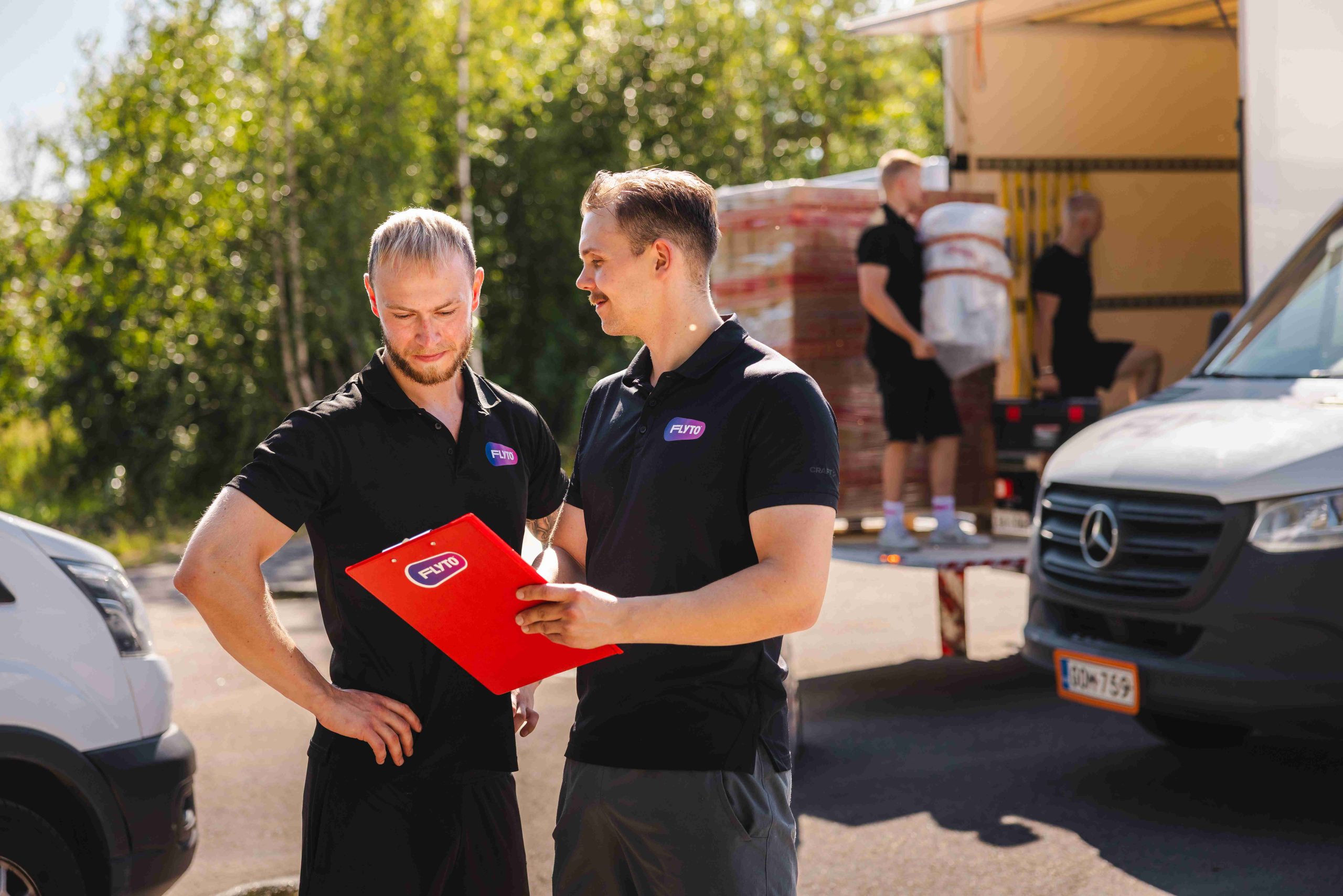
Flyto runs its own offices, warehouses, crews and vehicles across Northern, Central and Southern Europe, so your Poland–Germany move is planned and, wherever we operate directly, executed in-house rather than handed off blind. Where a leg or a local service is better covered by a specialist we’ve vetted — a particular regional route, storage facility, or last-mile team — we bring in that partner under our own coordination, so you still deal with one point of contact from pickup in Poland to delivery and unpacking in Germany.
Frequently asked questions
Do I need customs paperwork to move from Poland to Germany?
No. Both countries are inside the EU customs union, so household goods move freely with no customs declaration, duty or import tax (EUR-Lex).
Do I need a visa or residence permit to live in Germany?
No, as an EU/EEA citizen you have the right to live and work in Germany. You do need to register your address (Anmeldung) within 14 days of moving in (Bundesportal).
Do I have to exchange my Polish driving licence for a German one?
No — EU driving licences are mutually recognised and remain valid in Germany without exchange, unless it’s lost, damaged, or you’re required to exchange it after a traffic offence (Your Europe).
What happens to my Polish health insurance when I move?
It doesn’t automatically transfer. Ask NFZ about an S1 document if applicable to your situation, and be aware your NFZ entitlement ends once you no longer qualify — meanwhile, health insurance is compulsory in Germany from the day you take up residence (NFZ; gesund.bund.de).
Can I bring my car without paying import duty?
Yes — no duty applies moving a car permanently between EU states. You do need to deregister it in Poland and register it with a German Zulassungsstelle to get German plates (gov.pl; Your Europe).
Am I still a Polish tax resident after I move?
Not automatically, but not automatically ended either — it depends on where your centre of personal and economic interests genuinely sits and on the 183-day rule, not on a single declaration (gov.pl/finanse).
Sources
- EUR-Lex — Free movement of goods
- gov.pl — Zgłoś wyjazd za granicę
- gov.pl/finanse — Informacja dla osób mieszkających poza granicami Polski dotycząca podatku PIT
- NFZ — Living in another EU/EFTA member state
- gov.pl — Wyrejestruj pojazd
- Your Europe — Driving licence exchange and recognition
- Your Europe — Car registration abroad FAQ
- Bundesportal — Wohnsitz anmelden
- BMI — Freedom of movement FAQ
- BZSt — Steuerliche Identifikationsnummer
- gesund.bund.de — Health insurance
- Your Europe — Pets and other animals in the EU
- Your Europe — Bank accounts in the EU
- Bundesportal — Rundfunkbeitrag anmelden