

Moving from Sweden to Cambodia (2026): Complete Guide

Relocating from Sweden to Cambodia is a two-sided legal and logistical process: on the Swedish side you must formally deregister with the Swedish Tax Agency and export your goods through Swedish Customs (Tullverket), and on the Cambodian side you must clear your shipment through the General Department of Customs and Excise (GDCE) under an immigration status that qualifies you for duty relief. This guide is for Swedish residents — Swedish citizens and foreign nationals registered in Sweden — moving household goods, pets and vehicles to Cambodia for work, retirement, business or a long-term stay, and it closes with a short note on moving back the other way.
Key takeaways
- Cambodia has no dedicated "moving" visa: your customs treatment on arrival depends on holding a valid Ordinary/Business (E-class) visa or another long-stay status recognised by the General Department of Immigration and the official Cambodia e-Visa system.
- Before leaving, you must notify Skatteverket (the Swedish Tax Agency) of your move abroad no later than one week before departure if you’ll be away a year or more.
- Ending your Swedish tax liability is not automatic: Skatteverket applies a "väsentlig anknytning" (essential ties) test, and for the first five years after leaving, you carry the burden of proving those ties are gone — Skatteverket’s legal guidance on essential ties.
- Household goods and personal effects moved out of Sweden to a country outside the EU/EEA must be export-declared, per Tullverket’s guidance on moving from Sweden to a country outside the EU; your mover or freight forwarder normally files this for you.
- Cambodia grants duty exemption on used household goods and personal effects (excluding motor vehicles) for people genuinely transferring residence, per the GDCE’s rules on goods under exemption of import duties and its personal-effects-of-passengers procedure.
- Sweden has driven on the right (left-hand-drive vehicles) since 1967, which matters directly for Cambodia, where right-hand-drive vehicles face import bans and, for existing vehicles, back-taxes or conversion requirements — GDCE enforcement of prohibited/restricted goods.
- Carrying €10,000 or more in cash out of Sweden must be declared to Tullverket; carrying the equivalent of USD 10,000 or more into or out of Cambodia must be declared at the border under the GDCE’s currency import/export rules.
- Dogs and cats can move both directions without quarantine if paperwork is in order, but an EU pet passport alone is not valid for a non-EU destination — see Jordbruksverket’s guidance for pets travelling outside the EU and Cambodia’s rabies-vaccination and health-certificate requirements administered by the Ministry of Agriculture, Forestry and Fisheries.
1. Your Cambodia immigration status determines your customs treatment
Cambodia does not issue a stand-alone "relocation" or "moving" visa. Instead, the duty-free treatment of your household goods on arrival is tied to proving you are genuinely transferring residence, which in practice means holding (or being able to demonstrate you are obtaining) a long-stay immigration status. The relevant category for most relocating professionals, retirees and business owners is the Ordinary/Business visa, Class E, issued initially for 30 days and then extended in-country into sub-classes such as EB (business), ER (retirement), EG (job-seeking) or ES (student) — see the official Cambodia e-Visa portal and the General Department of Immigration, which also handles all E-class extensions inside Cambodia. Cambodia has no general permanent-residency category open to ordinary movers; long-term settlement is normally maintained through repeated E-visa extensions, work permits, or the country’s investment-based Golden Visa route. Because customs officers at the port or airport will ask for evidence of your residence status (visa, employer letter, lease) alongside your inventory, sort your immigration paperwork before your shipment departs Sweden, not after.
2. The Sweden export side: deregistering and declaring
Customs authority. Sweden’s customs authority is Tullverket (the Swedish Customs Agency). When you move permanent residence from Sweden to a country outside the EU/EEA, your moving goods must be declared for export — either by yourself at a customs office at the border, or, in practice, by your moving company or freight forwarder on your behalf — using the standard export declaration (Single Administrative Document); the country code entered is "EU" for EFTA destinations and "EX" for all other non-EU countries such as Cambodia (Tullverket, moving from Sweden to a country outside the EU; Tullverket, declaring goods on export). Cultural items (art, antiques, certain instruments) additionally require an export licence before they can leave the EU.
Deregistration (folkbokföring). If you will live outside Sweden for one year or more, Swedish law (27 § Folkbokföringslagen, the Population Registration Act) requires you to notify Skatteverket of your move abroad, at the latest one week before your departure date, giving your departure date and new address; this can be done via Skatteverket’s e-service or on form SKV 7665, and it removes you from the Swedish population register (folkbokföring) (Skatteverket, notifying a move abroad).
Tax-residency exit. Deregistering from folkbokföring does not automatically end your Swedish tax liability. Skatteverket applies the "väsentlig anknytning" (essential ties) test: if you keep a permanent home in Sweden, close family, or an active business, you can remain unlimitedly tax liable in Sweden after moving. For the first five years post-departure, you bear the burden of proving essential ties no longer exist; after five years the burden shifts to Skatteverket (Skatteverket, essential ties to Sweden; Skatteverket, have you moved from Sweden?). Once you are confirmed limitedly tax liable, Swedish-source income such as pensions is instead taxed under SINK (special income tax for non-residents), reduced to 22.5% for income received from 1 January 2026, and scheduled to fall further to 20% from 1 January 2027 (Skatteverket, SINK).
Cash. If you are carrying €10,000 or more in cash, travellers’ cheques or similar out of Sweden to a non-EU country, you must declare it to Tullverket, online in advance or on paper at the border (Tullverket, travelling with cash).
3. Ports, airports and transit times
For sea freight, the overwhelming majority of Swedish household-goods shipments to Southeast Asia route through the Port of Gothenburg, Scandinavia’s largest container port and Sweden’s main deep-sea gateway, with regular container services toward Asia via transshipment hubs such as Singapore or Port Klang (Port of Gothenburg). On the Cambodian side, the receiving port for containerised sea freight is Sihanoukville Autonomous Port, Cambodia’s sole international deep-sea port, on the Gulf of Thailand (Sihanoukville Autonomous Port).
Freight-industry estimates, not official transit figures: a full or shared container from Gothenburg to Sihanoukville, including one or two transshipments, typically takes roughly 6–9 weeks door-to-port, plus Cambodian customs clearance. Air freight or excess/unaccompanied baggage from Stockholm Arlanda to Phnom Penh’s Techo International Airport typically clears in 1–3 weeks including customs processing. Treat both ranges as industry planning estimates only — always confirm current transit times with your carrier or moving company before setting a moving date.
4. The Cambodia import side: customs process
Cambodia’s customs authority is the General Department of Customs and Excise (GDCE). Household goods, personal effects and belongings — excluding motor vehicles — imported by a person who is genuinely changing residence to Cambodia are exempt from import duty, in quantities the Director of Customs considers reasonable for personal/household use, provided a valid customs permit is obtained before the goods are imported (GDCE, goods under exemption of import duties; GDCE, customs permit). Passengers’ personal effects are handled under the GDCE’s dedicated procedure for goods/personal effects of passengers, which sets out the declaration route depending on the customs value of the goods you are bringing in (GDCE, goods or personal effect of passengers). Because approvals for the residence-transfer exemption route through the Ministry of Economy and Finance, engage your moving company or a licensed Cambodian customs broker early and have your inventory, visa/residence evidence and passport ready before the shipment arrives — clearance without the correct pre-approval means duties become payable on the full shipment.
5. Pets: rules on both ends
Leaving Sweden. An EU pet passport lets your dog, cat or ferret travel freely within the EU, but veterinarians outside the EU are not authorised to make valid entries in an EU passport, so a passport alone is not sufficient for a non-EU destination like Cambodia. Before departure, get a veterinary health certificate from your Swedish vet and confirm Cambodia’s specific entry requirements directly with the destination authority, since requirements outside the EU vary and are outside Jordbruksverket’s jurisdiction (Jordbruksverket, is your dog or cat travelling outside the EU?; Tullverket, travelling with a dog or cat).
Entering Cambodia. Animal imports, including pet dogs and cats, are subject to veterinary control by the Ministry of Agriculture, Forestry and Fisheries (MAFF) through its General Directorate of Animal Health and Production, which importers should notify ahead of arrival so an inspection can be arranged (MAFF, official portal; World Organisation for Animal Health, regional office for Asia — Cambodia’s animal-trade practices). In practice this means a valid rabies vaccination administered well in advance of travel, a veterinary health certificate, and microchip identification; pets arriving with complete, compliant paperwork are generally not quarantined, while incomplete paperwork can result in the animal being held, returned, or in the worst case destroyed at the owner’s expense — so confirm current documentation requirements with MAFF or your pet-relocation agent several weeks before travel, not at the airport.
6. Vehicles, money and things people forget
Vehicles. Sweden switched to right-hand traffic in 1967, so Swedish-registered cars are left-hand-drive (LHD) — which works in your favour, since Cambodia bans the import of new right-hand-drive (RHD) vehicles, and existing RHD vehicles in the country face back-taxes or conversion requirements, under GDCE enforcement of prohibited and restricted goods (GDCE, prohibited and restricted goods). Note that the household-goods duty exemption above explicitly excludes motor vehicles — importing a car separately is a distinct, and typically far more expensive, customs process; for most moves it is cheaper to sell in Sweden and buy locally in Cambodia.
Money. Declare cash of €10,000+ leaving Sweden to Tullverket, and declare cash (or equivalent) of USD 10,000+ entering or leaving Cambodia at the border checkpoint, per the Law on Foreign Exchange enforced by GDCE (GDCE, import/export of foreign currencies).
Easy to forget: confirming your Skatteverket deregistration date lines up with your actual departure (a mismatch can trigger a folkbokföringsbrott, a population-registration offence, with penalties); applying for SINK before your first Swedish pension payment after moving, so the correct rate is withheld from day one; and sorting your Cambodian visa/residence status before your container arrives, since Cambodian customs will ask for it to grant the duty exemption.
How Flyto handles your Sweden to Cambodia move
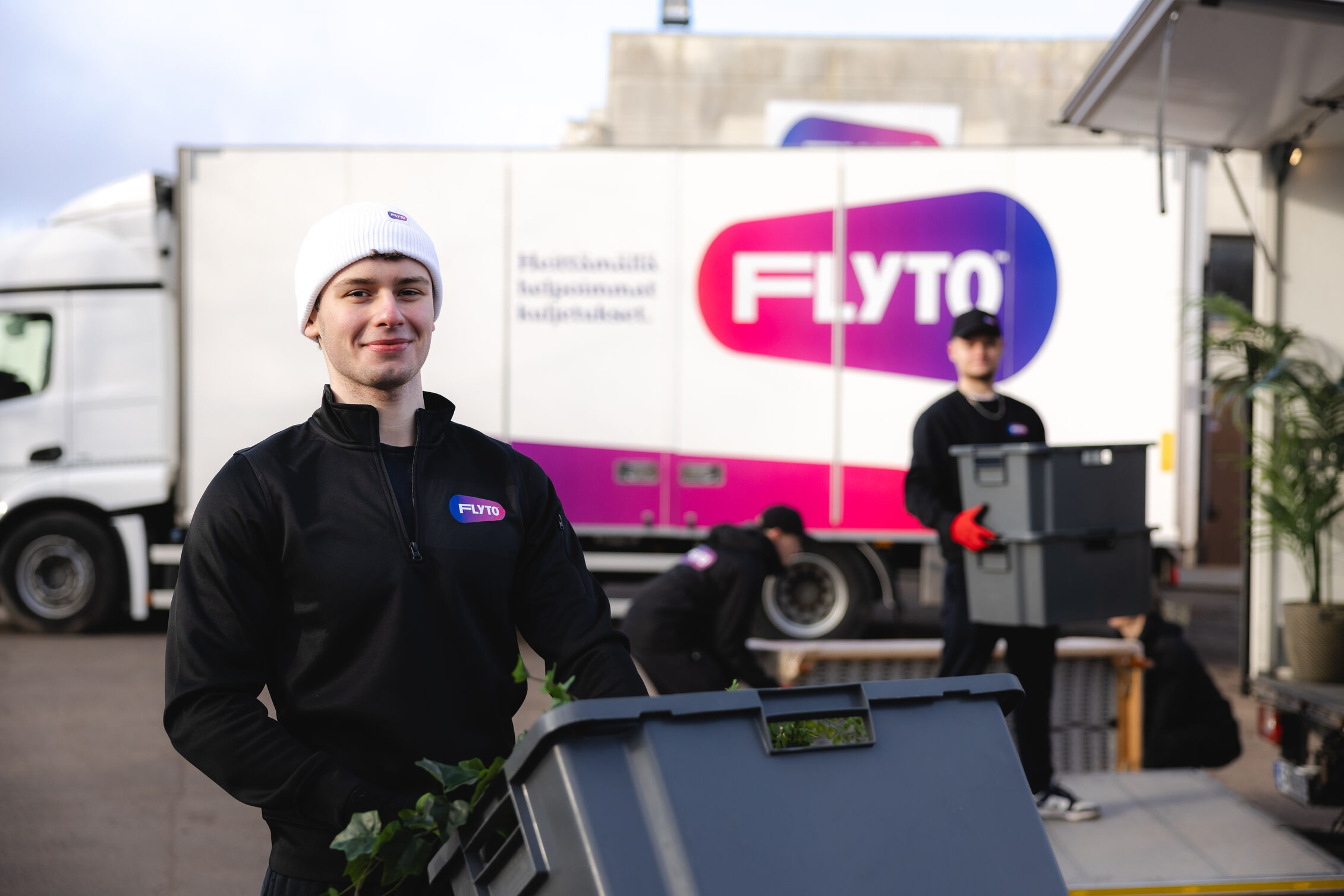
Flyto runs its own offices, warehouses, vehicles and moving teams across Northern, Central and Southern Europe, so the Swedish side of your move — packing, export documentation and transport to the port of departure — is handled in-house by people who do this daily. For the ocean leg and the Cambodian side, we work through a carefully vetted network of freight partners and subcontractors, plus trusted local partners on the ground in Cambodia who manage GDCE clearance, the residence-transfer permit, and final delivery. You get one point of contact throughout, backed by real European infrastructure on one end and vetted local expertise on the other.
Frequently asked questions
Do I need to deregister from Swedish folkbokföring before moving to Cambodia?
Yes, if you’ll be living abroad for a year or more — notify Skatteverket at least one week before you leave, via e-service or form SKV 7665 (Skatteverket).
Will I still owe Swedish tax after I move?
Possibly. Skatteverket’s "essential ties" test can keep you unlimitedly tax liable if you retain a Swedish home, family, or business interests, and you carry the burden of proof for the first five years (Skatteverket).
Can I bring my car to Cambodia?
Motor vehicles are excluded from the household-goods duty exemption and are handled as a separate, taxed import; new right-hand-drive vehicles are banned from import, though this doesn’t affect Swedish LHD cars (GDCE).
What visa do I need to get the duty exemption on my household goods?
There’s no dedicated "moving" visa — Cambodian customs expects evidence of a genuine change of residence, typically an Ordinary/Business (E-class) visa or extension, or an equivalent long-stay status, from the General Department of Immigration.
Does my dog need to be quarantined in Cambodia?
Generally no, if it arrives with a current rabies vaccination, veterinary health certificate and microchip; incomplete paperwork can trigger quarantine, refusal, or worse, so confirm requirements with MAFF’s animal health authority well ahead of travel (MAFF).
How much cash can I carry without declaring it?
Under €10,000 leaving Sweden without declaring to Tullverket (Tullverket); under USD 10,000 entering or leaving Cambodia without declaring at the border (GDCE).
What about moving back from Cambodia to Sweden?
If you have had your normal home outside the EU continuously for at least one year and intend to live in Sweden for at least one year, your returned goods can qualify for Swedish customs and VAT exemption on re-entry; if you don’t meet these conditions, that exemption generally does not apply and you should re-register with Skatteverket on arrival regardless (Tullverket, customs and VAT exemption for people moving to Sweden).
Sources
- Tullverket – Flytta från Sverige till ett land utanför EU
- Tullverket – Deklarera varor vid export
- Tullverket – Resa med kontanta medel
- Tullverket – Resa med hund eller katt
- Tullverket – Tull- och momsfrihet för dig som flyttar till Sverige
- Skatteverket – Jag ska flytta utomlands. Ska jag ändra min folkbokföring?
- Skatteverket – Har du flyttat från Sverige?
- Skatteverket – Väsentlig anknytning till Sverige (rättslig vägledning)
- Skatteverket – SINK, särskild inkomstskatt för utomlands bosatta
- Jordbruksverket – Ska din hund eller katt resa till ett land utanför EU?
- Port of Gothenburg – Container services
- Sihanoukville Autonomous Port
- General Department of Customs and Excise (Cambodia) – Goods or personal effect of passengers
- General Department of Customs and Excise (Cambodia) – Goods under exemption of import duties
- General Department of Customs and Excise (Cambodia) – Customs permit
- General Department of Customs and Excise (Cambodia) – Prohibited and restricted goods
- General Department of Customs and Excise (Cambodia) – Import and export of foreign currencies
- Cambodia e-Visa – official portal
- General Department of Immigration (Cambodia)
- Ministry of Agriculture, Forestry and Fisheries (Cambodia) – official portal
- World Organisation for Animal Health, Regional Office for Asia and the Pacific – Cambodia: practices of international trade of animals and animal products