

Moving from Finland to Switzerland (2026): Complete Guide

Finland and Switzerland are both European countries, so a Finland-to-Switzerland move is a European relocation, not an overseas one — but it is not a "no formalities" move either. As an EU/EEA citizen you keep the right to move and live in Switzerland without a visa or work permit, thanks to the EU-Switzerland Agreement on the Free Movement of Persons. What changes is that Switzerland sits outside the EU/EEA customs union, so — unlike a move between two EU member states — your household goods and car do go through an actual (duty-free, but real) customs procedure. This guide is written for a resident of Finland relocating to Switzerland for work, study or family reasons, and covers exactly what applies to this specific corridor: registration, healthcare, tax, driving licence, vehicle, pets and freight.
Key takeaways
- No visa or work permit needed. As an EU/EEA citizen you can move to Switzerland freely, but you must register with your local commune within 14 days of arrival and apply for a residence permit (L or B) — this is the real administrative task, not immigration approval (SEM, Residence permits for EU/EFTA nationals).
- Your move is not customs-free. Switzerland is outside the EU customs union, so household effects and your car go through a formal but duty-free "change of domicile" customs procedure (Form 18.44), provided you owned and used the goods for at least 6 months before the move (BAZG, Moving – household effects).
- File a muuttoilmoitus with DVV before you leave. Finland’s move notification records your date of departure and keeps your Finnish records correct while you’re abroad (DVV, Moving abroad).
- Finnish general tax liability doesn’t end the day you leave. Finnish citizens normally stay generally tax liable for the move year plus three more calendar years, unless you can show no substantial ties remain to Finland (Vero.fi, taxation of a person with limited tax liability).
- Health insurance is mandatory in Switzerland within 3 months of registering, with cover applied retroactively to your arrival date if you register on time (BAG, health insurance requirement for residents).
- You can drive on your Finnish licence for up to 12 months, then must exchange it for a Swiss one — no test required for EU/EEA licences (ch.ch, exchanging your driving licence).
- Most employees are taxed at source (Quellensteuer) until they hold a C permit, deducted monthly by the employer per canton (ch.ch, tax at source).
- Pets travel on the EU pet passport, which Switzerland accepts, provided the microchip-then-rabies-vaccination sequence and waiting periods are respected (BLV, travelling with dogs, cats and ferrets).
1. Free movement, and the customs nuance that actually matters
Because both Finland and Switzerland are European, there’s no visa process and no immigration quota — any EU/EEA citizen has the right under the EU-Switzerland free movement agreement to reside in Switzerland (SEM FAQ). That’s the good news, and it’s the part many people over-worry about.
What people underestimate is the goods side. Switzerland is not a member of the EU or the EEA and sits outside the EU customs union, so goods crossing into Switzerland are, technically, an import. In practice this is painless for a genuine household move: the Swiss customs authority (BAZG) grants duty- and tax-free clearance for "Übersiedlungsgut" (removal goods) when you are transferring your domicile to Switzerland, using Form 18.44. The conditions are specific: the goods must have been owned and personally used by you for at least six months before the move, and you must continue using them afterwards; you can bring items in duty-free for up to two years after your move date (BAZG, Moving – household effects). Required paperwork typically includes the completed Form 18.44 (in duplicate), a packing list/inventory, and evidence of your change of domicile, presented to a Swiss customs office at the time the goods enter Switzerland (BAZG, moving – importing goods into Switzerland; BAZG, FAQ Umzugsgut). Officially it’s the mover’s declaration, but in practice a professional removal company handles the paperwork and the customs stop for you. New or recently acquired items, and goods still under six months’ ownership, are not covered by the relief and may attract normal Swiss VAT and duty.
If you still need to book the removal – price ranges, what is included and the questions to ask before you sign – see international moving companies in Finland.
2. Leaving Finland: what you actually have to close out
- DVV move notification (muuttoilmoitus). Report your move abroad to the Digital and Population Data Services Agency, stating the date your residence abroad begins. DVV cannot correct this retroactively, and it’s how Finnish authorities (pension, military service, etc.) keep reaching you correctly (DVV, Moving abroad). The same online notification also updates Posti’s records (Posti, muuttoilmoitus).
- Mail forwarding. Posti forwards ordinary letters (up to 50 g, or 250 g with the paid Muuttopostipalvelu) to your new address, but not parcels or magazines — arrange separate redirection for those, or a Swiss forwarding address (Posti, muuttoilmoitus).
- Tax residency doesn’t switch off on departure day. A Finnish citizen remains generally tax liable in Finland for the year of the move plus the three following calendar years, unless you can demonstrate you no longer have substantial ties to Finland — home, family, business — in which case Vero.fi can end liability earlier. Expect to request a Swiss certificate of residence to invoke the Finland–Switzerland tax treaty (Vero.fi).
- Healthcare. EU/EEA rules (also covering Switzerland) tie your right to state healthcare to your registered country of residence. Notify Kela of the move; if you fall into a category still tied to Finnish social security (a Finnish pensioner or posted worker), apply for an S1 certificate via form SV140 and register it with the Swiss health authority — processing can take a few months, so start early (Kela/EU-terveydenhoito.fi; Kela). Most people taking up Swiss employment lose Kela cover and enrol directly in Swiss compulsory insurance instead (section 4).
- Vehicle. If you’re taking your car with you, deregister it for export in OmaTrafi ("ajoneuvon vientipoisto") before or as you leave — this stops Finnish vehicle tax and the compulsory traffic insurance, and you’ll need either a copy of the foreign registration certificate or Finnish Customs’ export-confirmed release decision (Traficom, poista ajoneuvo ulkomaille).
- Driving licence. No export action is needed on the Finnish side — your EU driving licence remains valid; what happens on arrival in Switzerland is covered below.
3. How your household goods actually get from Finland to Switzerland
Finland has no land border with Central Europe, so removal freight runs one of two realistic routes (freight-industry transit estimates, not official figures, and they vary by carrier and load type):
- Ferry + road via Germany: truck ferry Helsinki–Travemünde/Rostock (roughly 24–30 hours at sea), then road via Germany to Switzerland (Basel/Zürich is roughly 700–900 km from the German ports, ~8–10 hours’ driving). Full-load door-to-door: 4–7 days; groupage/shared-load shipments run longer, often 2–4 weeks, since your goods are consolidated with other customers along the route.
- Baltic land-bridge: short ferry Helsinki–Tallinn (~2 hours), then road through the Baltics, Poland and Germany (~2,000–2,200 km). Dedicated load: 5–8 days; groupage again runs longer.
Either way, the shipment needs the Form 18.44 customs clearance (section 1) at entry into Switzerland — in practice handled by the removal company at the customs stop, not something you personally have to manage at a checkpoint. Build in a few extra days around the Swiss customs step on a first-time move, since the paperwork (inventory, proof of prior residence, proof of new tenancy) needs to be complete.
4. Arriving in Switzerland: registration, healthcare, tax, licence
- Register with your commune within 14 days, and before you start work. This is the actual "immigration" step for an EU/EFTA citizen — there’s no separate visa application. Bring a valid passport/ID and proof of your reason for residing there (employment contract, etc.); depending on your contract length you’ll be issued a short-term permit (L, for contracts under a year) or a residence permit (B, for contracts of a year or more — typically issued for five years and renewable), in credit-card format (SEM, residence permits for EU/EFTA nationals).
- Take out compulsory health insurance within 3 months of your commune registration. Basic health insurance ("Krankenversicherungsgesetz"/KVG) is mandatory for anyone resident in Switzerland; if you register within the 3-month window your cover is backdated to your actual arrival date, and if you miss the window you can face a premium surcharge and gap in cover (BAG, health insurance requirement). You choose the insurer yourself among licensed Swiss providers.
- Tax at source (Quellensteuer). Unless you hold a C (settlement) permit or are married to a Swiss/C-permit holder, your employer withholds federal, cantonal and communal income tax directly from your salary each month, at a rate set by your canton of residence — cantonal rates vary substantially, so where in Switzerland you register matters financially (ch.ch, tax at source).
- Driving licence. Your Finnish licence remains valid to drive in Switzerland for up to 12 months from when you take up residence. Before that year is up, exchange it for a Swiss licence at your cantonal road traffic office (Strassenverkehrsamt / service des automobiles) — EU/EEA licences convert without a theory or practical test, though a certified eye test is typically required (ch.ch, exchanging your driving licence).
- Car import and re-registration. Present the car at a BAZG customs post for the "Übersiedlungsgut" clearance under the same duty-free removal-goods rules as your household effects (owned/used 6+ months). Customs issues Form 13.20A, which you then take to the cantonal road traffic office for Swiss registration — this must happen within one year of your move. You’ll also need a Swiss emissions/technical inspection at an authorised garage and valid Swiss motor insurance before plates are issued (BAZG, moving – importing goods into Switzerland).
5. Moving pets from Finland to Switzerland
Switzerland accepts the EU pet passport for dogs, cats and ferrets travelling from an EU country, so a pet moving with you from Finland does not need a separate Swiss import permit. The core requirements are, in order: a microchip implanted first, then a rabies vaccination given at least 21 days before travel (the first rabies shot is only valid from 12 weeks of age), all recorded in the EU pet passport (BLV, travelling with dogs, cats and ferrets; Your Europe, travelling with pets). Puppies and kittens under the minimum vaccination age face restrictions, so plan the microchip-vaccination sequence well before the move date if you’re relocating a young animal.
6. Money, banking and things people forget
Switzerland uses the Swiss franc (CHF), not the euro — budget for exchange-rate exposure on deposits, moving costs and salary comparisons. Opening a Swiss bank account is usually straightforward once you have commune registration confirmation and a residence permit; banks generally want proof of address first. You’ll also be issued an AHV/AVS social-security number as part of registering for Swiss social insurance, needed by your employer for payroll and underpinning your health-insurance and pension contributions — sort this out immediately on arrival. Rental deposits are commonly held in a blocked "Mietkautionskonto" of up to three months’ rent, a larger up-front cash requirement than typical Finnish tenancies. And since health-insurance premiums and housing costs vary a lot by canton, compare net take-home pay by canton, not just gross salary, before settling on where to register.
How Flyto handles your Finland to Switzerland move
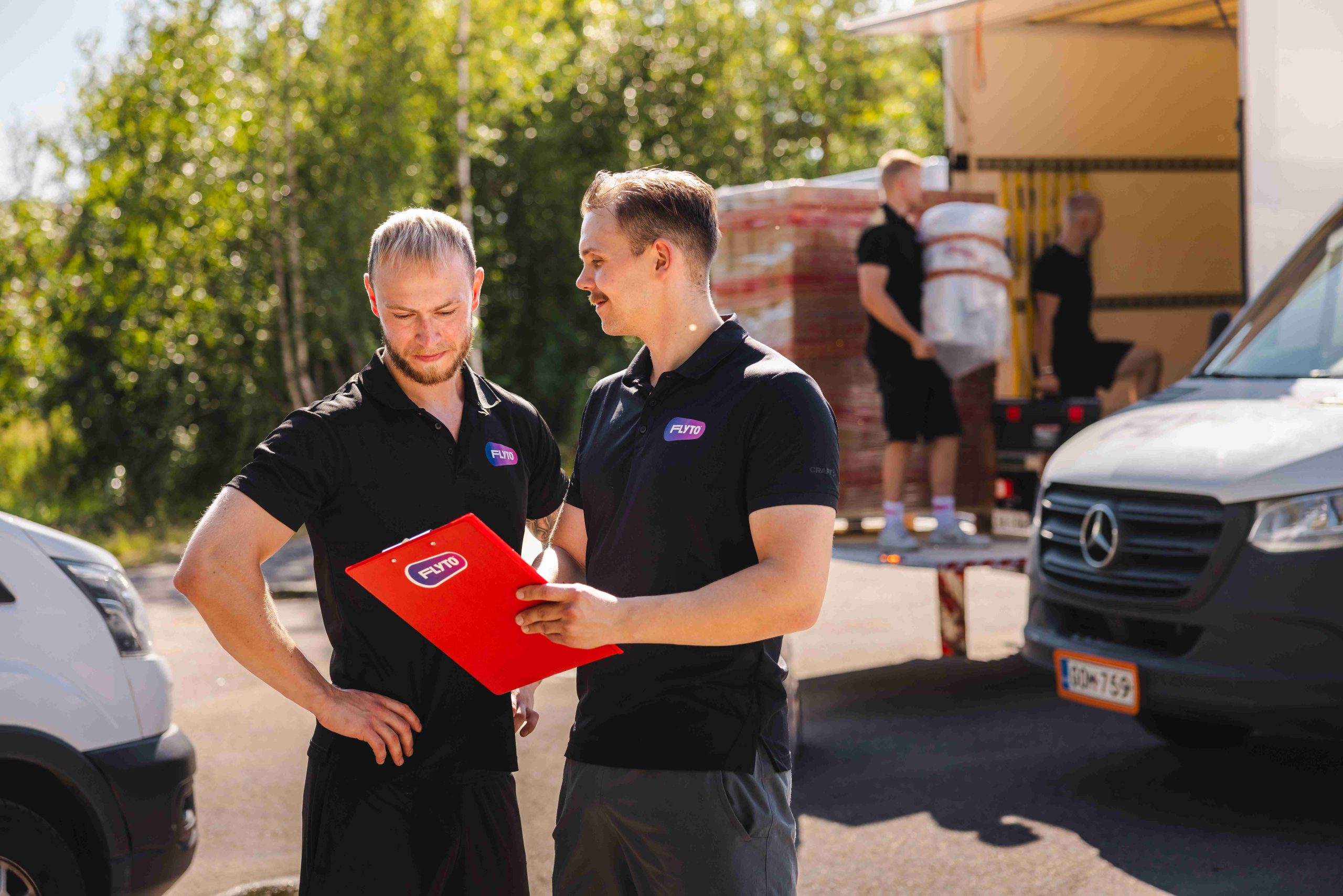
Flyto runs its own offices, warehouses, vehicles and moving teams across Northern, Central and Southern Europe, which covers the Finland and Switzerland ends of this corridor directly. For the road/ferry leg through the Baltics or Germany and the customs paperwork on entry into Switzerland, we combine our in-house capacity with a carefully vetted network of partner carriers and Swiss customs agents, so your shipment is tracked and accountable end-to-end even on the sections we subcontract.
Frequently asked questions
Do I need a visa or work permit to move from Finland to Switzerland?
No — as an EU/EEA citizen you have the right to live and work in Switzerland under the EU-Switzerland free movement agreement. You do need to register with your commune within 14 days of arrival and obtain a residence permit (L or B) (SEM).
Will I pay customs duty on my furniture and belongings?
No, provided you use the Swiss "Übersiedlungsgut" (removal goods) relief via Form 18.44: the items must have been owned and used by you for at least six months before the move and continue to be used afterwards. Recently purchased items may not qualify (BAZG).
How long can I drive on my Finnish licence in Switzerland?
Up to 12 months from taking up residence, after which you must exchange it for a Swiss licence — no test is required for an EU/EEA licence, but a certified eye test typically is (ch.ch).
What happens to my Finnish tax liability when I move?
It doesn’t end automatically on your departure date. Finnish citizens generally remain fully tax liable in Finland for the move year plus three further calendar years unless they can show no substantial ties remain to Finland (Vero.fi).
Do I keep my Kela healthcare cover in Switzerland?
Generally no — once you take up residence and employment in Switzerland you enrol in mandatory Swiss health insurance within three months. Kela’s S1 certificate applies mainly to specific groups such as Finnish pensioners or posted workers who stay tied to Finnish social security (Kela).
Can I bring my car with me duty-free?
Yes, under the same removal-goods relief as household effects, provided it was owned and used by you for at least six months. Swiss customs issues Form 13.20A, which you then use to register the car at your cantonal road traffic office within one year of moving (BAZG).
Sources
- DVV – Moving abroad
- Posti – Muuttoilmoitus
- Vero.fi – Taxation of a person with limited tax liability
- Kela / EU-terveydenhoito.fi – Muutto ulkomaille
- Kela – Muutto ulkomailta tai ulkomaille vaikuttaa hoito-oikeuteen
- Traficom – Poista ajoneuvo ulkomaille tai Ahvenanmaalle
- SEM (State Secretariat for Migration) – Residence permits for EU/EFTA nationals
- SEM – FAQ, Free Movement of Persons
- BAZG (Federal Office for Customs and Border Security) – Moving, household effects
- BAZG – Moving, importing goods into Switzerland
- BAZG – FAQ Umzugsgut (removal goods)
- BAG (Federal Office of Public Health) – Health insurance requirement for residents
- ch.ch – Tax at source
- ch.ch – Exchanging your driving licence
- BLV (Federal Food Safety and Veterinary Office) – Travelling with dogs, cats and ferrets
- Your Europe – EU rules on travelling with pets and other animals