
Moving from Spain to Ireland (2026): Complete Guide

Moving from Spain to Ireland is a move between two EU member states — not an overseas relocation, and not a customs event. As an EU citizen you have the right to live and work in Ireland without a visa or work permit, and your household goods travel between EU countries without customs duty, import declarations or tax, because both Spain and Ireland sit inside the same EU customs union (Consilium). This guide is for residents of Spain — Spanish nationals and foreign residents of Spain alike — relocating to Ireland in 2026, and it walks through what genuinely changes: registrations, tax residency, healthcare, your vehicle, your pets, and how the physical move actually happens.
Key takeaways
- No customs, no duty, no import declaration. Household goods moving from Spain to Ireland cross no customs border at all — the EU customs union means goods move freely between member states (Consilium — EU customs union; European Parliament — free movement of goods).
- No visa or work permit needed. As an EU citizen you can enter and stay in Ireland freely; after three months some countries require you to register your residence, but this depends on the destination country’s own rules (Your Europe — residence rights).
- Ireland does not require EU citizens to hold a residence card or register with immigration — unlike many EU countries, Ireland has no equivalent of Spain’s own EU citizen registration certificate for incoming EU nationals (Citizens Information — residence rights of EU citizens in Ireland).
- You must still get a PPS Number in Ireland to work, pay tax, and access public services. You apply online once you’re physically in the country, but every applicant must also attend a booked in-person appointment to verify identity and address before the number is issued (gov.ie — get a PPS Number).
- De-register from your Spanish padrón (baja por cambio de residencia) and notify the Agencia Tributaria of your change of tax residence via Modelo 030 (Sede Agencia Tributaria — Modelo 030).
- Healthcare follows you via the S1 form, issued by the INSS/Seguridad Social, which lets you register for public healthcare in Ireland once you’re settled there (Sede Seguridad Social — S1 form).
- Your Spanish driving licence can be exchanged for an Irish one entirely online through the National Driver Licence Service, and a car you’ve owned and used abroad for 6+ months can move VRT-free under Transfer of Residence relief (NDLS — exchange a foreign licence; Revenue — Transfer of Residence VRT relief).
- Pets travel on the same EU pet passport system — microchip plus valid rabies vaccination, no quarantine (Your Europe — travelling with pets in the EU).
1. What actually applies: free movement, not customs
Spain and Ireland are both long-standing members of the EU and full participants in the EU customs union, which forms a single tariff and trade area across all member states — goods move between them without customs duties, import declarations, or border checks (Consilium — EU customs union). This is fundamentally different from moving from a non-EU country: there is no "personal effects" customs concession to apply for, no import VAT, and no paperwork to clear at a Spanish or Irish port, because your goods are simply moving within the single market (European Parliament — free movement of goods factsheet).
The same logic applies to you as a person. Freedom of movement is one of the EU’s four founding freedoms: as an EU citizen (or, if you’re a non-EU national legally resident in Spain, subject to your own immigration status) you don’t need a visa or work permit to move to Ireland. During your first three months you can stay without any formalities beyond holding a valid passport or national ID card; after that, some EU countries require registration with local authorities, though the rules and procedures vary by destination — and Ireland, unusually among EU states, does not require it at all (Your Europe — registering residence after three months). What you do still need to do, on both ends, is described below: de-register in Spain, register practically (tax, healthcare, PPS) in Ireland.
Note for readers on other routes: this "no customs" framing applies specifically because both Spain and Ireland are in the EU customs union. If you were moving to or from Switzerland (not in the EU or EEA customs area), Norway or Iceland (EEA but outside the EU customs union), or the UK (fully outside both), a real customs declaration and duty-relief process for removal goods would apply on that leg — this guide does not cover those routes.
Planning the move itself as well? Costs, transit times and how to choose a mover are covered on our page about international removals to Spain.
2. Leaving Spain: what to close out
Padrón (empadronamiento). If you’re registered on a Spanish municipal padrón, request a baja por cambio de residencia at your ayuntamiento when you leave — a signed request plus a valid ID document is generally what’s needed, and it can usually be done by appointment in person or, if you have electronic ID, online (Sede Electrónica Madrid — baja por cambio de residencia).
Tax residency. Moving out doesn’t automatically end your Spanish tax residency — that’s determined by where you actually spend your time and the location of your economic interests. Notify the Agencia Tributaria of your change of address and residence status using Modelo 030, generally within three months of the change; if you leave in the first half of the year and don’t spend more than 183 days in Spain that year, non-resident status can apply retroactively to 1 January of that year, whereas having already passed 183 days in Spain before the change typically pushes the effective date to 1 January of the following year (Agencia Tributaria — Modelo 030 instructions).
Healthcare (S1 form). If you’re moving to work, retire, or otherwise take up residence in Ireland, request the S1 portable document from the INSS (Seguridad Social) before you leave, or shortly after arriving. This document, requested electronically via the Seguridad Social’s Sede Electrónica or in person, lets you register for the public healthcare system in your new EU country of residence while your entitlement remains linked to the Spanish system where applicable (Sede Seguridad Social — solicitar el S1; Your Europe — health cover in your host country).
Driving licence and vehicle. Your Spanish licence stays valid to drive in Ireland — see section 4 for the exchange process. If you’re taking a car, arrange the baja definitiva por exportación with the DGT before or as part of the move: online through the DGT’s Sede Electrónica (electronic ID required) or in person at any Traffic Office by appointment, selecting the export deregistration and stating the destination country. Intra-EU transfers must be deregistered within one month of establishing residence in the new country, and vehicles registered more than 15 years ago follow a separate, fee-free version of the same procedure (DGT — baja por exportación).
3. How your household goods actually move
Unlike air- or sea-freight relocations to another continent, Spain–Ireland moves run almost entirely by road and ferry, with no customs stop at either end. Two realistic routings, based on general freight-industry practice — treat timings as estimates, not guarantees:
- Direct ferry (Brittany Ferries, Rosslare–Bilbao or Rosslare–Santander): road transport to a northern Spanish port, then an overnight crossing of roughly 27–37 hours direct to Rosslare, followed by final-mile delivery in Ireland. This is usually the most efficient option for a full house move, with sailings running once or twice a week depending on the port and season.
- Road + short Channel crossing: road transport up through France to a Channel port, a short ferry or Eurotunnel crossing to the UK, then a further ferry (e.g. Holyhead–Dublin or similar) into Ireland. This route has more legs but more frequent sailings, which can suit smaller or time-sensitive shipments.
In both cases, door-to-door transit for a typical household shipment commonly runs in the range of roughly 5–12 days depending on routing, consolidation, and season — again, an estimate that a mover should confirm against your actual pickup and delivery locations and volume.
4. Arriving in Ireland: what to actually register
Residence. Ireland is one of the few EU countries that does not require EU citizens to register with immigration or hold a residence card to live there; a permanent residence certificate exists but is optional, not mandatory. Your right to stay beyond three months (six if job-seeking) depends on being employed, self-employed, a student, or otherwise self-sufficient with health cover (Citizens Information — residence rights of EU citizens in Ireland).
PPS Number. This is the one registration every arriving EU citizen needs: a Personal Public Service Number, required to work, pay tax, open some bank accounts, and access public services. You apply online via MyWelfare (you’ll need a basic MyGovID account) once you’re physically in Ireland, then book and attend a required in-person appointment at a PPS Number Allocation Centre, bringing ID and proof of your Irish address dated within the last three months — a tenancy agreement, utility bill, or a letter from whoever you’re staying with. Your PPS Number is then issued by post, typically within about a week of the appointment (gov.ie — get a PPS Number; Citizens Information — PPS Number).
Tax registration. Once you have a PPS Number, register with Revenue as soon as possible so an employer can apply the correct tax credits from your first payslip. You’ll typically become tax resident if present 183+ days in a tax year, or 280+ days across the current and prior year combined (with at least 30 days in each) (Revenue — tax residence; Revenue — the tax system in Ireland for new arrivals).
Healthcare. Register your Spanish S1 form with the HSE to access public healthcare on the same basis as an ordinarily-resident person. Separately, most residents apply for a medical card or GP visit card (means-tested; PPS Number required) via mymedicalcard.ie, then register with a GP holding a GMS contract (Citizens Information — medical cards).
Driving licence. Spanish (EU/EEA) licences can be exchanged for an Irish one entirely online via the National Driver Licence Service, using a verified MyGovID and Public Services Card — no in-person appointment required, current fee €65, and the licence must be exchanged within 10 years of its expiry (NDLS — exchange a foreign driving licence).
Vehicle. If you bring a car you’ve owned and used outside Ireland for at least six months immediately before the move, you can apply for Transfer of Residence (TOR) relief from Vehicle Registration Tax (VRT). Apply to the National VRT Service via Revenue’s MyEnquiries; the vehicle must be brought into the State within 12 months of your transfer of residence, you must register it within 30 days of its arrival (with an NCTS appointment within 7 days), and if VRT is paid before the TOR claim is approved, it’s refunded within five working days of approval. Selling or disposing of the vehicle within 12 months of registration forfeits the relief (Revenue — Transfer of Residence VRT relief).
5. Moving with pets
Dogs, cats, and ferrets travel between EU countries under the same EU pet passport scheme in both directions: your pet needs an ISO-compliant microchip, a valid rabies vaccination administered after the chip is fitted, and an EU pet passport issued by an authorised vet, which — once issued — remains valid for life as long as the rabies vaccination stays current. No quarantine applies for pets travelling under a valid passport between EU member states, and up to five pets may travel per person for non-commercial purposes (Your Europe — travelling with pets in the EU).
6. Money, banking, and things people forget
- Your Spanish IBAN still works. Under the SEPA Regulation (EU 260/2012), a business or landlord in Ireland cannot legally refuse your Spanish IBAN for a euro payment just because it isn’t Irish — this is known as IBAN discrimination and is prohibited across the EEA, though enforcement varies (European Commission — IBAN discrimination). Even so, most people open a local Irish account for salary and direct debits.
- Redirect your post and update your address with your Spanish bank, insurer, and pension provider — none of this is automatic across borders.
- Keep proof of your Spanish healthcare cover (S1) and your padrón baja document — Irish institutions and Revenue may ask for evidence of when your Spanish residence actually ended.
- EHIC/S1 are not the same thing: your EHIC covers temporary stays; the S1 is what establishes ongoing healthcare entitlement once you actually live in Ireland.
- School enrolment, if relevant, and closing out the DGT-linked vehicle export record (if you’re taking a Spanish-registered car) are easy to leave until last — plan them alongside the padrón baja, not after it.
How Flyto handles your Spain to Ireland move
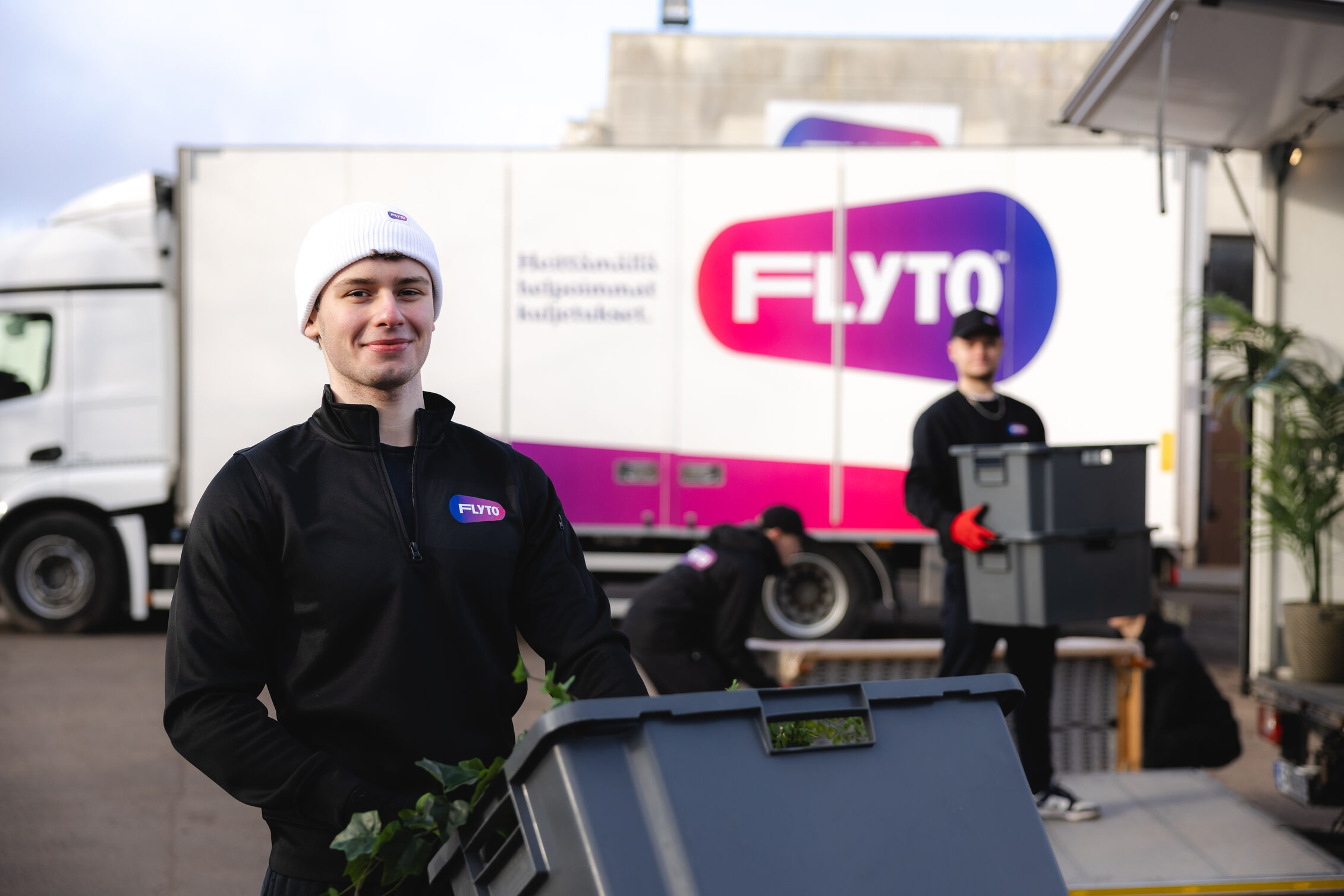
Flyto runs its own offices, warehouses, and moving teams across Northern, Central, and Southern Europe, so a Spain–Ireland relocation is coordinated end-to-end through people who know both the Iberian pickup side and Irish delivery side directly. For the ferry crossing and final-mile legs outside our own network’s reach, we work with a carefully vetted set of partner carriers and subcontractors rather than trying to cover every route ourselves — giving you a single point of contact while still getting specialists for each leg of the journey.
Frequently asked questions
Do I need a visa to move from Spain to Ireland?
No. As an EU citizen you have the right to live and work in Ireland without a visa or work permit; if you’re a non-EU national resident in Spain, your right to move depends on your own immigration status rather than Spanish residence (Your Europe — residence rights).
Will my furniture and belongings be taxed or inspected at customs?
No. Spain and Ireland are both in the EU customs union, so household goods move between them with no duty, no import VAT, and no customs declaration (Consilium — EU customs union).
Do I have to register with the Irish immigration authorities?
No — Ireland does not require EU citizens to hold a residence card or register with immigration, unlike most EU states. You do, however, need a PPS Number to work and access services (Citizens Information — residence rights of EU citizens).
Can I keep driving on my Spanish licence in Ireland?
Yes, and you can exchange it online for an Irish licence through the National Driver Licence Service without an in-person appointment (NDLS).
Will I pay Vehicle Registration Tax if I bring my car?
Not if you qualify for Transfer of Residence relief — broadly, having owned and used the car outside Ireland for at least six months before the move. You still have to register the vehicle, just without paying VRT if the relief is approved (Revenue — TOR relief).
What happens to my Spanish public healthcare cover?
Request an S1 form from the INSS before or shortly after your move; it lets you register for public healthcare in Ireland on the same basis as an Irish resident (Sede Seguridad Social — S1).
Sources
- Consilium — The EU customs union
- European Parliament — Free movement of goods factsheet
- Your Europe — Residence rights when living abroad in the EU
- Your Europe — Registering residence abroad after the first 3 months
- Citizens Information — Residence rights of EU citizens and their families in Ireland
- Sede Electrónica Madrid — Baja de padrón por cambio de residencia
- Agencia Tributaria — Modelo 030, instrucciones
- Sede Electrónica Seguridad Social — Solicitud del formulario S1
- Your Europe — Health insurance cover in your host country
- DGT — Sede Electrónica: Baja por exportación
- gov.ie — Get a Personal Public Service (PPS) Number
- Citizens Information — Personal Public Service (PPS) Number
- Revenue.ie — The tax system in Ireland
- Revenue.ie — Tax residence
- Citizens Information — Medical cards
- NDLS — Exchanging a foreign driving licence
- Revenue.ie — Transfer of Residence (TOR) VRT relief
- Your Europe — EU rules on travelling with pets
- European Commission — IBAN discrimination