

Moving from Estonia to the UK (2026): Complete Guide

Estonia and the United Kingdom are both in Europe, but this is not a straightforward intra-EU relocation. The UK left the EU customs union and ended free movement of people on 31 December 2020, so a move from Estonia to the UK sits in an unusual middle ground: your household goods can still move duty- and VAT-free under a specific customs relief, but you as a person need immigration permission — a visa or other UK immigration status — before you can live and work there. This guide is for Estonian residents (Estonian citizens or third-country nationals resident in Estonia) planning a permanent move to the UK, and it walks through exactly what applies on each side, based on current Estonian and UK government sources.
Key takeaways
- No automatic free movement. Since Brexit, Estonian (EU) citizens need UK immigration status — typically a visa under the points-based system — to live and work in the UK; the EU Settlement Scheme only applies to those already resident before the Brexit cut-off, not to new movers in 2026 (gov.uk: points-based system for EU citizens).
- Household goods can still move duty- and VAT-free, but only under Transfer of Residence (ToR) relief — you must apply in advance using form ToR1, not just "ship freely" as within the EU (gov.uk: Transfer of Residence to Great Britain).
- Short visits to the UK without a visa still require an ETA (Electronic Travel Authorisation) for Estonian citizens — the UK extended the ETA requirement to all EU/EEA nationals travelling from 2 April 2025 onward (Home Office: ETA factsheet).
- Notify the Estonian population register (rahvastikuregister) of your foreign residence within 30 days of moving, via an Estonian diplomatic mission or your last local government (rahvastikuregister.ee).
- Your Estonian tax residency does not end automatically — notify the Estonian Tax and Customs Board (EMTA) of the change and, where relevant, file the residency-determination application (form R) so your status is formally reassessed (emta.ee: determining residency).
- Vehicles need a separate UK import step: NOVA notification to HMRC within 14 days, then registration and taxing with the DVLA, before you get UK number plates (gov.uk: importing vehicles into the UK — telling HMRC).
- Register with an NHS GP surgery on arrival — it’s free, and practices are not allowed to refuse you for lacking proof of address, ID, or immigration status (NHS: register with a GP surgery).
- Pets need an EU pet passport (or a UK-compliant Animal Health Certificate) plus microchip and rabies vaccination to enter Great Britain, travelling on an approved route (gov.uk: bringing your pet to Great Britain).
1. What actually applies: immigration and customs after Brexit
This is the point most people get wrong, because Estonia and the UK "feel" like they should work the way an EU-to-EU move does. They don’t, on either count.
People: Free movement between the EU and UK ended on 31 December 2020. Estonian citizens do not automatically have the right to live or work in the UK. You need to qualify for a UK immigration route — most commonly the Skilled Worker visa (sponsored job offer from a Home Office-licensed employer, generally a degree-level (RQF 6) role, English at B1 level), a family visa, a Global Talent visa, or a Student visa (gov.uk: points-based system). The Skilled Worker route requires 70 points overall, and since 22 July 2025 the standard salary threshold is £41,700/year or the specific occupation’s "going rate", whichever is higher; a separate Temporary Shortage List allows some lower-skilled (RQF 3–5) roles to qualify at a lower threshold, but that list is a temporary measure under active review. The EU Settlement Scheme (settled/pre-settled status) is not an option for someone moving from Estonia for the first time now — it only covered people already resident in the UK by the end of the transition period. For short trips before your visa or while sorting logistics, Estonian citizens must hold an approved UK ETA before travel, even though no visa is required for stays under six months (Home Office: ETA factsheet).
Household goods: Unlike a move within the EU customs union, importing your belongings into the UK is a formal customs process — but it can be done duty- and VAT-free under Transfer of Residence (ToR) relief, provided you: lived outside the UK for the 12 months before moving, have owned and used the goods for at least 6 months, import them within 12 months of arrival, and do not sell, lend, or dispose of them for 12 months after import (gov.uk: Transfer of Residence to Great Britain). You must apply for ToR relief before your goods ship, using form ToR1 (gov.uk: application for transfer of residence relief (ToR1)); once approved, HMRC issues a reference number your shipper/customs agent quotes on the import declaration, typically under customs procedure code 40 00 C01. Processing can take several weeks, so apply as soon as your move is confirmed. Goods that fail these conditions (e.g., brand-new items, or anything you plan to sell) are excluded from relief and are dutiable/VAT-able in the normal way.
2. Leaving Estonia: what to close out and notify
- Population register (rahvastikuregister): you’re legally required to submit a residence notice about your new address, and if you’re moving abroad you must report your foreign residence — within 30 days of the move — via an Estonian embassy/consulate or your last local government (rahvastikuregister.ee).
- Tax residency (EMTA): Estonian tax residency doesn’t lapse automatically just because you leave. If your circumstances change (permanent move, no more Estonian place of residence, spending under 183 days in any 12-month period in Estonia), notify the Estonian Tax and Customs Board and submit the residency-determination application (form R) so your status is formally reassessed (emta.ee: determining residency). Until this is settled, Estonia may continue to treat you as tax-resident on worldwide income (with double-taxation relief where applicable).
- Health insurance (Tervisekassa): Estonian statutory health cover doesn’t simply follow you once you actually relocate. If you’re a pensioner, a posted worker, or a family member of one, Tervisekassa can issue or accept an S1 certificate, which lets you (or keeps you) registered for public healthcare funded by the correct country; for a straightforward permanent move to work in the UK, you’ll instead register directly with the NHS on arrival and inform Tervisekassa that you’re now covered abroad, so your Estonian cover is correctly closed (tervisekassa.ee: keeping your health insurance abroad).
- Driving licence and vehicle: If you’re taking your car, visit a Transpordiamet service office to have the export noted before or when you deregister the vehicle — you’ll need the registration certificate and the registration plates (Transpordiamet: vehicle sale/purchase). Your Estonian driving licence itself remains valid to drive on in Estonia until you leave; the UK’s own rules for how long you can drive on it after becoming UK-resident, and when you must exchange it, are covered in Section 4.
- Post and banking: set up mail redirection and consider whether to keep an Estonian bank account/digital access for Estonian tax and pension matters — most Estonian banking and government e-services (ID-card/Mobile-ID/Smart-ID) work fine from abroad and are worth retaining rather than closing.
3. How the move physically happens: routing and timing
There is no direct land route — Estonia and the UK are separated by the rest of continental Europe and the North Sea/Channel — so household-goods shipments run as road freight with sea crossings, not a single haulage run. In practice this typically means road transit south through the Baltics and continental Europe (or a Baltic Sea ferry leg), followed by a Channel crossing — ferry (Calais–Dover, Dunkirk–Dover) or the Eurotunnel (Calais–Folkestone) — to reach the UK mainland, then a final domestic delivery leg once customs (ToR) clearance is complete.
As freight-industry estimates rather than guarantees, a groupage (shared-load) removal on this corridor typically runs 2–4 weeks door-to-door once your ToR1 relief is approved, while a dedicated (sole-use) truck can be quicker but costs significantly more. Treat ToR1 approval as the real critical-path item — it can take several weeks — so apply for it as soon as your move date is confirmed, well before booking a fixed collection date.
4. Arriving in the UK: registration, healthcare, tax, driving
- Immigration status first. Everything below assumes you already have the right visa/status — you’ll register and prove your right to work/rent using the documents tied to that visa (eVisa / UK Immigration ID Check app record).
- National Insurance number. If you’ll work in the UK, apply online for a National Insurance number as soon as you arrive; you can start work before it arrives if you can otherwise prove your right to work, but the number is needed for PAYE/tax and benefits records (gov.uk: apply for a National Insurance number).
- NHS registration. Register with a local GP surgery — it’s free, and practices must not refuse you for lacking proof of address, immigration status, or ID; this is what actually unlocks appointments, prescriptions, and referrals, not any separate "health card" (NHS: register with a GP surgery). Broader entitlement rules (e.g., if the Immigration Health Surcharge already covers you) are set out in the official migrant health guide (gov.uk: NHS entitlements — migrant health guide).
- Driving licence. If you become resident in Great Britain on or after 1 January 2021 — which applies to a move now — you can drive on your valid Estonian licence for 12 months from the date you become resident. Within that 12-month window you must exchange it for a GB licence (form D1, available at most Post Offices, plus your EU licence and proof of ID) to keep driving legally afterwards; no driving test is required for the exchange (gov.uk: exchange a non-GB driving licence).
- Vehicle import. If you shipped a car, notify HMRC via the NOVA (Notification of Vehicle Arrivals) service within 14 days of the vehicle entering the UK — you cannot register it until you’ve done this — and settle any import VAT/duty due (unless covered by ToR relief); only then can you register and tax the vehicle with the DVLA to get UK plates and a V5C logbook (gov.uk: importing vehicles into the UK — telling HMRC).
- Council tax and address proof. Registering for council tax at your new address is one of the standard ways to establish UK "proof of address" for banks, utilities, and other registrations.
5. Moving pets
Bringing a dog, cat, or ferret from Estonia into Great Britain requires the pet to be microchipped before its rabies vaccination, vaccinated against rabies (with at least 21 full days between the first vaccination and travel), and carrying either an EU pet passport (issued in Estonia/the EU) or a UK-compliant Animal Health Certificate, plus travel on an approved route (gov.uk: bringing your pet dog, cat or ferret to Great Britain). Banned dog breeds cannot enter Great Britain without a valid Certificate of Exemption, and dogs may also need tapeworm treatment beforehand depending on route. Pets that don’t meet the rules can be refused entry or face further checks — so start the paperwork well before your travel date, and confirm your carrier and crossing are on an approved pet-travel route.
6. Money, banking, and things people forget
- UK bank account before you land: a traditional high-street account usually needs UK proof of address (tenancy agreement, council tax bill, utility bill), which you won’t have yet — many people bridge the gap with a digital/multi-currency account (e.g., for receiving salary and paying a deposit) until a UK address-based account can be opened, and some "new to the UK" accounts accept an employer or university letter instead.
- Currency exposure: Estonia uses the euro; the UK uses sterling. Budget for exchange-rate movement between deposit-paying and final settlement, especially for a house deposit or first months of rent.
- Pension and social security continuity: confirm with EMTA/Estonian social insurance how your contribution record is affected, and check UK National Insurance record-building once you start work — coordination rules differ from an EU-to-EU move now that the UK is a third country for social security purposes.
- Don’t let Estonian tax residency run in parallel unnoticed — failing to formally close it can mean Estonia continues to expect worldwide-income declarations even after you’ve settled UK tax residency.
How Flyto handles your Estonia to the UK move
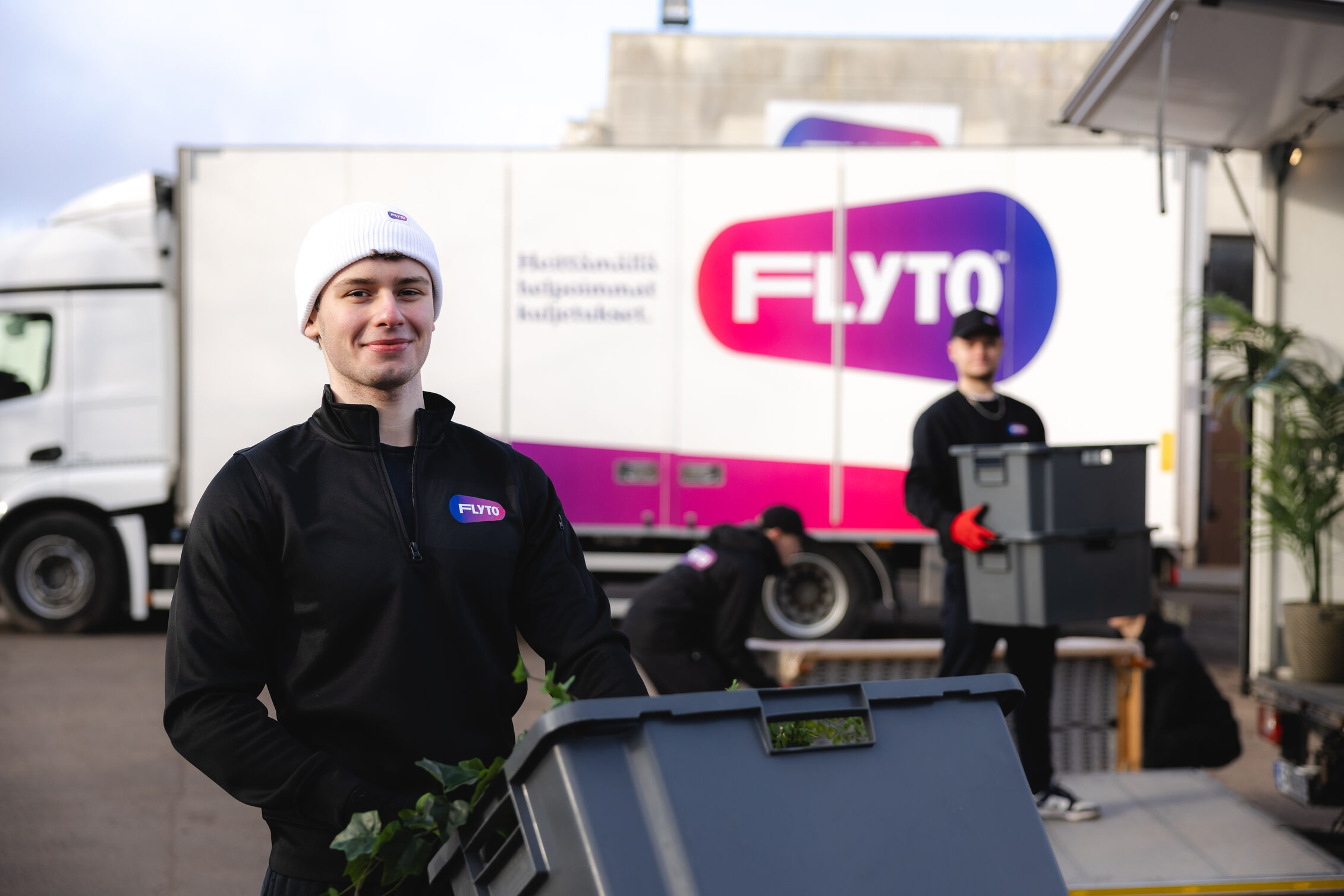
Flyto operates its own offices, warehouses, and moving teams across Northern, Central, and Southern Europe, which we use to handle the Estonia-side collection, road transit, and consolidation of your shipment. For the UK leg — including the Channel crossing, ToR1-cleared customs handling, and final-mile delivery — we work with a carefully vetted network of partner carriers and customs agents, so the whole corridor is coordinated end-to-end even though not every mile is driven by our own trucks.
Frequently asked questions
Do I need a visa to move from Estonia to the UK?
Yes, in almost all cases. Free movement ended after Brexit, so unless you already hold UK immigration status from before the cut-off, you need to qualify for a route such as the Skilled Worker visa, a family visa, or a student visa before you can live and work in the UK (gov.uk: points-based system).
Will I pay customs duty on my furniture and belongings?
Not if you qualify for and apply for Transfer of Residence (ToR) relief before shipping — approval lets your used household goods enter duty- and VAT-free. Apply well in advance using form ToR1, since goods without approved relief are dutiable (gov.uk: Transfer of Residence to Great Britain).
Do I need to tell Estonia I’m leaving?
Yes. Notify the population register of your foreign address within 30 days via an Estonian embassy or your last local government, and separately sort out your tax residency status with EMTA — Estonia doesn’t automatically deregister you (rahvastikuregister.ee, emta.ee: tax residency).
Can I keep using my Estonian driving licence in the UK?
Yes, but only for 12 months after you become UK-resident. Within that window you must exchange it for a GB licence using form D1 — no new driving test is required — or it stops being valid for driving in Great Britain (gov.uk: exchange a non-GB driving licence).
How do I register for healthcare in the UK?
Register with a local NHS GP surgery — it’s free, and practices cannot refuse you for lacking proof of address, ID, or immigration status. That registration is what actually gives you access to appointments and referrals (NHS: register with a GP surgery).
Can I bring my car?
Yes, but it’s a two-step UK process on arrival: notify HMRC through NOVA within 14 days, settle any import VAT/duty (or claim it under ToR relief), then register and tax the car with the DVLA to get UK plates (gov.uk: importing vehicles — telling HMRC).
Sources
- gov.uk: Transfer of Residence to Great Britain
- gov.uk: Application for transfer of residence relief (ToR1)
- gov.uk: The UK’s points-based immigration system — information for EU citizens
- Home Office: Electronic Travel Authorisation (ETA) factsheet
- gov.uk: Apply for a National Insurance number
- NHS: Register with a GP surgery
- gov.uk: NHS entitlements — migrant health guide
- gov.uk: Exchange a non-GB driving licence
- gov.uk: Importing vehicles into the UK — telling HMRC (NOVA)
- gov.uk: Bringing your pet dog, cat or ferret to Great Britain
- Rahvastikuregister (Estonian Population Register)
- EMTA: Tax residency
- EMTA: Determining residency (form R)
- Tervisekassa: How to keep your health insurance if you live or work abroad
- Transpordiamet: Vehicle sale/purchase (export notation)