
Moving from Estonia to the Netherlands (2026): Complete Guide

Moving from Estonia to the Netherlands is an intra-European relocation between two EU and Schengen member states. That single fact changes almost everything about how the move works compared to a move outside the EU: there is no customs process for your household goods, and as an EU citizen you don’t need a visa or work permit to live and work in the Netherlands. What actually requires action is administrative registration — closing out your Estonian records correctly and registering with Dutch authorities on arrival. This guide walks through what genuinely applies to an Estonia–Netherlands move, in order, with links to the official source for each step.
Key takeaways
- No customs, no duty, no import declaration. Estonia and the Netherlands are both inside the EU customs union, so your furniture, boxes and personal belongings move under the EU’s free movement of goods with no border formalities or customs declarations (European Commission – Taxation and Customs Union).
- No visa or work permit needed. As an EU citizen you have the right to live and work in the Netherlands without a residence permit; the real requirement is registering your residence, not applying for permission to move (Your Europe – Residence rights when living abroad in the EU).
- Tell the Estonian population register within one month. Estonian law requires you to submit a notice of residence abroad to the Estonian population register (Rahvastikuregister) within one month of changing your residence (Estonian Embassy in The Hague – registering permanent residence abroad).
- Register with the Dutch municipality within 5 days of arrival. If you’ll live in the Netherlands, you must register in person at the local gemeente to be entered in the Personal Records Database (BRP) — this applies to EU/EEA/Swiss citizens too, and gives you a BSN (citizen service number) (iamsterdam.com – Registration; Government.nl – Personal Records Database (BRP)).
- Estonian health insurance cannot run alongside Dutch insurance. You must notify the Estonian Health Insurance Fund (Tervisekassa) of your move, and once you work or live in the Netherlands you’re legally required to take out Dutch health insurance (Tervisekassa – Moving to another EU member state; Government.nl – Health insurance in the Netherlands).
- Your EU driving licence stays valid — no forced exchange. You don’t have to swap your Estonian licence immediately; you only need to renew it in the Netherlands once it expires, since that’s where you’ll then be a normal resident (Your Europe – Driving licence renewal in another EU country).
- A car does need re-registering in the Netherlands once you’re permanently resident there, via RDW — this is a national vehicle-registration rule, not a customs matter (RDW – Importing a vehicle from an EU or EFTA country).
1. What actually applies: free movement, not customs
Because both Estonia and the Netherlands are part of the EU customs union, goods move between them exactly as they would between two Estonian cities: no customs declaration, no duty, and no "personal effects" import concession to apply for, because none of that machinery exists for intra-EU movements of goods — the Union Customs Code and its import/export procedures apply only at the EU’s external border, not between member states (European Commission – Taxation and Customs Union). This also covers your vehicle in transit and your pet’s travel, though the vehicle’s re-registration and the pet’s health documents in the destination country are separate national requirements, covered below.
The same "free movement" principle covers you as a person: an EU citizen doesn’t need a visa, entry permit or work permit to move to another EU country (Your Europe – Residence rights). What replaces the paperwork you’d expect from a non-EU move is registration: telling Estonia you’ve left, and telling the Netherlands you’ve arrived. EU rules cap what a host country can ask for — no residence document is required for the first three months, and after that you’re entitled to a registration certificate issued on the spot once you show ID and proof of your status as a worker, self-employed person, student or person of sufficient means (Your Europe – Registering residence abroad after the first 3 months).
(If your move ever involves Switzerland or the UK, this changes: both sit outside the EU/EEA customs area and require a formal customs declaration on entry, with duty relief available for genuine removal goods. Norway and Iceland are in the EEA but outside the EU customs union, so a customs declaration is likewise required there, again with relief available for a bona fide household move. None of that applies to an Estonia–Netherlands move.)
2. Leaving Estonia: what to close out
Population register. Estonian law (Population Register Act, Rahvastikuregistri seadus) requires you to submit a notice of residence to the Rahvastikuregister within one month of your address changing, including moving to a foreign country. You can do this online via the self-service e-population register with ID-card, Mobile-ID or Smart-ID, or through an Estonian embassy abroad (Estonian Embassy in The Hague; Rahvastikuregister e-service).
Tax residency. You remain an Estonian tax resident if your place of residence stays in Estonia or you spend 183+ days there in a 12-month period, counting arrival and departure days; genuinely relocating your home to the Netherlands ends this, effective the day after you leave. Notify the Estonian Tax and Customs Board (Maksu- ja Tolliamet) of the change and, where needed, submit Form R (application for determination of residency) via e-MTA, by email or in person (EMTA – Determining tax residency; Your Europe – Taxes when working across the EU).
Health insurance. Estonian and Dutch statutory health cover cannot run in parallel — once you’re covered in the Netherlands you lose entitlement to ongoing Estonian cover. Tervisekassa specifically requires that you first notify the population register of your new address abroad, since it cannot end your Estonian insurance before that registration is updated (Tervisekassa – Moving to another EU member state). If you’re an old-age pensioner rather than a worker, ask Tervisekassa about an S1 certificate instead, which keeps Estonia as your state of affiliation for healthcare purposes while you live in the Netherlands.
Driving licence and vehicle. Nothing needs to happen to your Estonian driving licence before departure — it’s an EU-format licence, valid across the whole EU. The car is a separate matter: once you’re a genuine Dutch resident, you’re expected to register the vehicle (and settle any related taxes) in the Netherlands rather than keep it on Estonian plates indefinitely; there are no common EU rules on vehicle taxation, so exact deadlines are set nationally (Your Europe – Registering a vehicle in another EU country).
Other things people forget: update your address with your bank, employer, pension provider and any Estonian authority that still holds your old address, and let Estonia know if you have dependents whose registrations also need updating (both parents must sign for minors’ address changes).
3. How your household goods actually move (freight-industry estimate)
Because there’s no customs step, the corridor is a straightforward road-and-ferry (or land-bridge) route. Typical routing for a full or part-load move from Estonia to the Netherlands:
- Tallinn/Tartu area → Baltic states → Poland → Germany → the Netherlands by road, or
- Tallinn → Helsinki/Baltic ferry → mainland Europe if consolidating with Finnish-origin loads, then overland to the Netherlands.
Road distance from Tallinn to major Dutch cities (Amsterdam, Rotterdam, Utrecht) is roughly 1,900–2,100 km. For a dedicated/direct load, transit is typically 3–5 days door-to-door; for a shared/groupage load consolidated with other customers’ shipments, 1–3 weeks is a realistic window depending on route consolidation and seasonal demand. These are freight-industry planning estimates, not guarantees — your specific mover will confirm timing once your load is scheduled.
4. Arriving in the Netherlands: registration, healthcare, tax, driving licence
Register with the municipality (BRP). This is the single most important step. If you’ll live in the Netherlands, you must register in person at the town hall (gemeente) of the municipality where you’ll live — within 5 days of arrival — to be entered in the Basisregistratie Personen (Personal Records Database, BRP). This applies to EU, EEA and Swiss citizens, not only non-EU nationals. Registering issues you a burgerservicenummer (BSN), the citizen service number you need for virtually everything else — a job, a bank account, healthcare, tax (iamsterdam.com – Registration; Government.nl – Personal Records Database (BRP); Your Europe – Registering residence abroad after the first 3 months). If you’ll be in the Netherlands for less than four months, you register instead in the Non-residents Records Database (RNI), a lighter-touch registration that still issues a BSN (Netherlands Worldwide – What is the RNI?).
Health insurance. Once you live or work in the Netherlands you are legally required to take out standard Dutch health insurance (basisverzekering) from a Dutch insurer, alongside your BSN registration (Government.nl – Health insurance in the Netherlands).
Tax registration. Your BSN also serves as your tax number with the Belastingdienst (Dutch Tax and Customs Administration). New residents typically need to set up DigiD for online services, report their move, and establish whether Dutch or worldwide income needs to be declared, particularly in the year of the move (often via an "M-form" for the year you migrate) (Belastingdienst – Individuals).
Vehicle re-registration. If you’re bringing a car, register it with RDW once you’re a Dutch resident: book an inspection appointment (DigiD or eHerkenning), bring the original foreign registration certificate and valid ID, attend the RDW inspection, and — where BPM (Dutch registration tax) applies — file the BPM declaration with the Tax Administration. The registration certificate typically arrives within about 5 business days of the inspection, after which you need Dutch insurance and number plates before driving on Dutch plates (RDW – Importing a vehicle from an EU or EFTA country).
Driving licence. No immediate exchange is required — your Estonian licence remains valid to drive on in the Netherlands. You’ll only need to renew it in the Netherlands once it expires, since the Netherlands will then be your normal country of residence (Your Europe – Driving licence renewal in another EU country).
5. Moving with pets
Dogs, cats and ferrets travelling between EU countries need an EU pet passport issued by an authorised vet. The animal must be microchipped, and vaccinated against rabies — first vaccination no earlier than 12 weeks of age, with at least 21 days before travel after that first vaccination. Booster vaccinations must stay in date. The EU pet passport itself is valid for the animal’s life as long as the health entries (especially rabies vaccination) remain current (Your Europe – Travelling with pets in the EU). Note: if your route happens to involve Finland, Ireland, Malta or Northern Ireland, dogs also need tapeworm (Echinococcus multilocularis) treatment 24–120 hours before arrival — not relevant for a direct Estonia–Netherlands route, but worth knowing if your carrier reroutes via one of those destinations.
6. Money, banking and things people forget
- Bank accounts: EU rules make it straightforward to keep an Estonian account while opening a Dutch one, but update your address with your Estonian bank regardless — an unregistered foreign address can trigger compliance holds.
- Employer payroll: if you’re employed, confirm which country will run your payroll and social-security contributions from the move date — this generally follows where you actually work, not your nationality.
- Pension and benefits: Estonian pension contributions and any Estonian benefits tied to residence should be reviewed with the relevant Estonian authority before you leave, since population-register de-registration can affect eligibility.
- Post and correspondence: many Estonian authorities send official mail to your registered address — an outdated address after you move is one of the most common self-inflicted problems in an EU relocation.
- Children’s school enrolment and family registrations: coordinate the population-register update and Dutch municipal registration together, since school and childcare registration in the Netherlands typically requires a BSN first.
How Flyto handles your Estonia to the Netherlands move
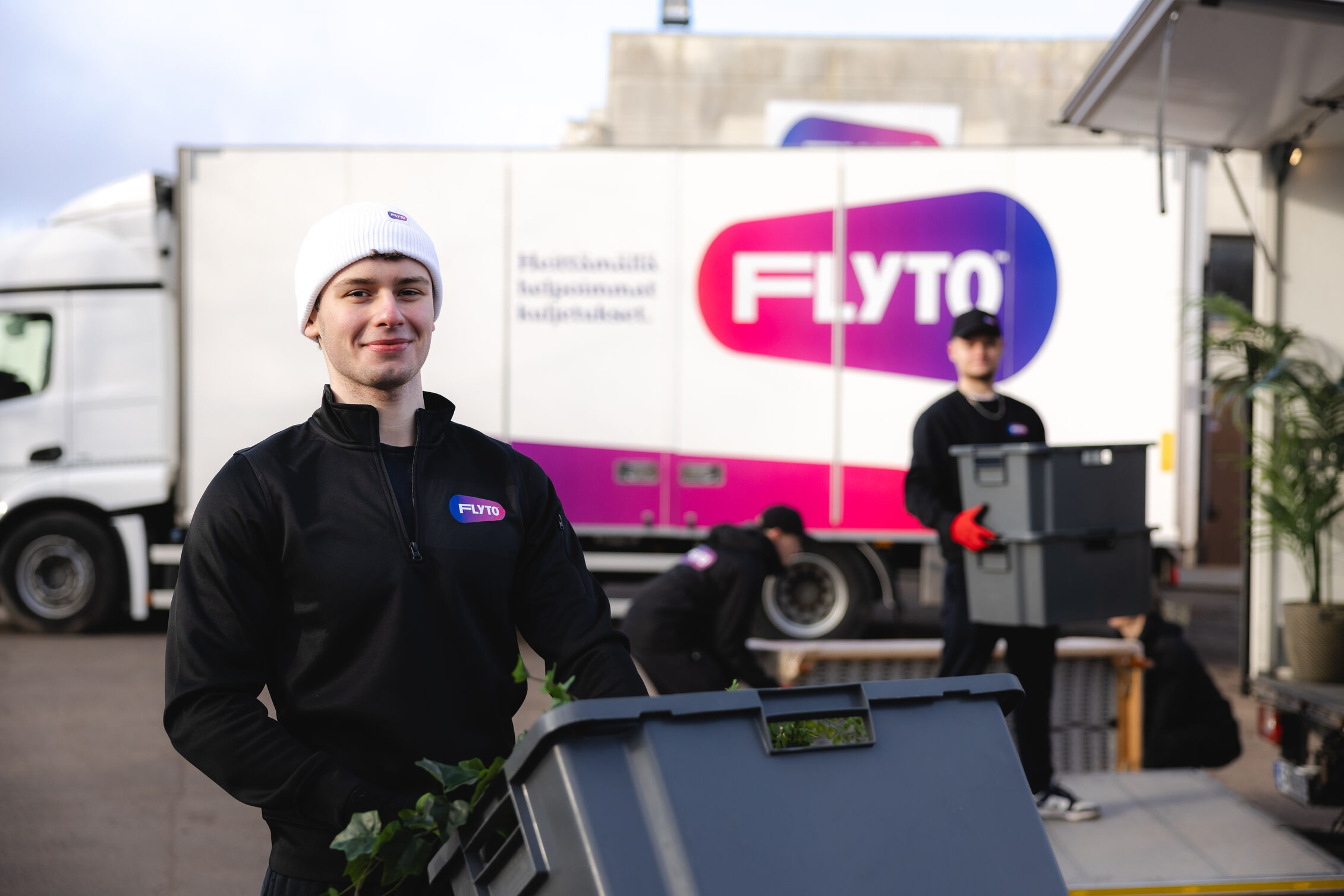
Flyto operates its own offices, warehouses, crews and vehicles across Northern, Central and Southern Europe, so a large share of your Estonia–Netherlands corridor is run in-house rather than handed off blind. Where a leg is better served by a specialist — a particular ferry connection, a regional Dutch delivery team, or peak-season capacity — we route it through a carefully vetted partner and subcontractor network, so you get consistent service and a single point of contact from Tallinn to your new Dutch address without us claiming to run every truck ourselves.
Frequently asked questions
Do I need a visa or work permit to move from Estonia to the Netherlands?
No. As an EU citizen you have the right to live and work in any EU country without a visa or work permit. Your only real administrative task is registering your residence with the Dutch municipality (Your Europe – Residence rights).
Will my furniture and boxes go through customs?
No. Estonia and the Netherlands are both in the EU customs union, so household goods move freely with no customs declaration or duty (European Commission – Taxation and Customs Union).
How soon do I have to register in the Netherlands after I arrive?
Within 5 days of arrival if you’ll be living there, at the town hall (gemeente) of your new municipality, to be entered in the BRP and receive your BSN (iamsterdam.com – Registration).
Do I need to tell Estonia I’m leaving?
Yes — Estonian law requires a notice of residence abroad to the population register within one month of the change, and you should also notify Tervisekassa (health insurance) and the Tax and Customs Board about your changed tax residency (Estonian Embassy in The Hague; Tervisekassa).
Can I keep my Estonian car on Estonian plates in the Netherlands?
Only temporarily. Once you’re genuinely resident in the Netherlands, the vehicle is expected to be registered there, which in practice means going through RDW’s import/registration process (RDW – Importing a vehicle from an EU or EFTA country).
What about my Estonian driving licence — do I have to swap it?
Not immediately. It stays valid to drive on. You only need to renew it once it expires, and by then you’ll do so in the Netherlands as your country of normal residence (Your Europe – Driving licence renewal).
Sources
- European Commission – Taxation and Customs Union (EU Customs Union)
- European Commission – Free movement and residence
- Your Europe – Residence rights when living abroad in the EU
- Your Europe – Registering residence abroad after the first 3 months
- Your Europe – Taxes when working across the EU
- Your Europe – Registering a vehicle in another EU country
- Your Europe – Driving licence renewal in another EU country
- Your Europe – Travelling with pets and other animals in the EU
- Estonian Embassy in The Hague – Registering permanent residence abroad
- Rahvastikuregister (Estonian Population Register) e-service
- Estonian Tax and Customs Board – Determining tax residency (Form R)
- Tervisekassa (Estonian Health Insurance Fund) – Moving to another EU member state
- Government.nl – Personal Records Database (BRP)
- iamsterdam.com – Registering in the Amsterdam Area
- Netherlands Worldwide – What is the Non-residents Records Database (RNI)?
- Government.nl – Health insurance in the Netherlands
- Belastingdienst – Individuals
- RDW – Importing a vehicle from an EU or EFTA country