Moving to Cologne (2026): The Complete Relocation Guide

Cologne (Köln) is Germany’s fourth-largest city — around 1.09 million residents, roughly one in five without a German passport — strung along both banks of the Rhine around its UNESCO-listed cathedral. It is the media capital of the country (RTL, WDR and Deutschlandfunk are all based here), a student and startup hub, and famously the most relaxed of Germany’s big cities. It is also a genuinely awkward place to physically move into: the Altstadt lanes are medieval-tight, the grand Gründerzeit blocks of the Südstadt and Belgisches Viertel have no lifts, your truck needs a city permit to park, the whole inner city is a low-emission zone — and for two weeks every February the centre effectively shuts for Karneval. This guide covers the practical mechanics of moving to Cologne in 2026 — the truck logistics only a mover knows, where to live and what rent really costs, how to register your address and what monthly life costs — with official sources throughout.
Freshness note: prices and rules verified against stadt-koeln.de, gesetze-im-internet.de, ImmobilienScout24’s Cologne Mietspiegel, KVB, the Deutschlandticket portal and the German Federal Ministry of Health in 2026. Fees and rents move — confirm figures with the linked authorities before you rely on them.
Quick answer: moving to Cologne in 2026
What does it cost to move to Cologne? An international household move (a full flat) typically lands in the low-to-mid four figures from within Europe and higher from overseas, driven mostly by volume, distance and access. Because Cologne’s access difficulties (see below) add real cost, get a fixed quote for your specific address rather than a generic estimate — get a Flyto quote here.
How long does the move take? Road moves from within the EU are usually a few days to about two weeks door-to-door; overseas sea freight runs several weeks. The two Cologne-specific quirks everyone underestimates: you must apply for a temporary no-parking zone (Halteverbotszone) for the truck — the city asks for the request at least three weeks ahead (Stadt Köln) — and you must not schedule your move for Karneval week in February, when the centre is closed to traffic.
Key takeaways
- Your moving truck needs its own permit. Cologne’s mobile no-parking zone (Halteverbotszone) costs an official €36 for the first day plus €18 for each further day, applied for through the city at least three weeks ahead; the signs must stand 96 hours before move day (Stadt Köln).
- An exterior furniture lift costs €14 extra on the permit. Cologne’s grand Altbau blocks are typically 4–6 storeys with no lift; the city charges a specific €14 supplement on the parking permit when a facade furniture lift (Möbelaufzug) is used (Stadt Köln).
- Don’t move during Karneval. In 2026 street carnival runs from Weiberfastnacht on Thursday 12 February to Tuesday 17 February, with Rosenmontag on 16 February — parades and glass-bans close large parts of the Altstadt and inner districts, roughly 7am to 6pm (Stadt Köln).
- The whole inner city is a low-emission zone. Only vehicles with a green badge (grüne Plakette) may enter Cologne’s 137 km² Umweltzone, which covers the centre and inner districts on both banks of the Rhine (Stadt Köln).
- You must register within 14 days. The Anmeldung deadline is two weeks after moving in (§17 Bundesmeldegesetz), done at a Cologne Kundenzentrum or fully online, and you need a landlord confirmation (Wohnungsgeberbestätigung) to do it (§17 BMG).
- The deposit is capped and tenants usually pay no broker fee. The Kaution is legally limited to three months’ cold rent, payable in three instalments (§551 BGB), and under the Bestellerprinzip the landlord who hires the agent pays the commission (§551 BGB).
1. The move into Cologne — logistics only a mover knows
This is the part generic ”moving to Cologne” guides skip, and it is exactly where a move goes wrong. Cologne grew up as a Roman and medieval river city, and while much was rebuilt after the war, the inner Veedel (neighbourhoods) were never laid out for a full-size removal truck. Four things determine whether your move day runs smoothly.
The Halteverbotszone: your truck’s parking permit
You cannot count on a free stretch of kerb outside a Cologne building. To guarantee the truck a spot, you set up a temporary no-parking zone — a Halteverbotszone or mobiles Halteverbot. Unlike Berlin’s district-by-district patchwork, Cologne runs this centrally through the city’s traffic-permit office at the Stadthaus Deutz. Key facts from the city itself (Stadt Köln — Umzug oder Anlieferung durchführen):
- Official cost: €36 for the first day with a mobile no-parking zone and €18 for each additional day. There is a €14 surcharge if you use an exterior furniture lift, €48 (plus €6 travel) if an on-site inspection is needed, and €8.50 to modify an existing permit. Once you add sign rental and set-up through your mover or a specialist, the all-in cost is typically higher — the figures above are the city’s administrative fees only.
- Lead time: apply at least three weeks before your moving date. Central, high-demand streets fill up, so earlier is safer.
- Signs go up 96 hours ahead. The zone must be physically established four days (96 hours) before the move for it to be enforceable and for wrongly parked cars to be towed.
- No moving on Sundays or public holidays. Under North Rhine-Westphalian rules, furniture removals are not permitted on Sundays and holidays — worth knowing when you plan the date.
- The city issues the order, not the signs. As in the rest of Germany, you (or your mover) must source and place the physical signs, which is why most people delegate the whole permit-plus-signs job to their moving company.
You usually need two zones: one at the old address and one at the new one. This is the single most common thing international movers forget, and there is no last-minute fix on move day.
Altbau, no lift, and the Möbelaufzug
Cologne was heavily bombed in the war, so it has proportionally less pre-war stock than Berlin — but the flats everyone actually wants are exactly the surviving Gründerzeit and Altbau blocks in the Südstadt, the Belgisches Viertel, parts of Ehrenfeld, Nippes and Lindenthal. These are typically four to six storeys with no elevator and narrow, winding staircases.
The practical consequence: sofas, wardrobes, double beds and pianos frequently will not fit up an Altbau staircase or around its tight turns. The standard solution is an exterior furniture lift (Möbelaufzug / Außenlift) — a ladder hoist run up the building’s facade to lift bulky items straight in through a window or balcony. Cologne makes this explicit: the city charges a specific €14 supplement on the parking permit when a furniture lift is used, because the lift needs its own kerb space alongside the truck (Stadt Köln). A good mover assesses this before the day, not when the sofa is stuck on the second-floor landing.
The Umweltzone: your truck needs a green badge
Since 2008, and expanded in October 2019, Cologne’s Umweltzone (low-emission zone) covers 137 km² — the entire inner city plus the inner districts on both banks of the Rhine, from the left-bank neighbourhoods out to the Militärring through to Deutz, Mülheim and Kalk on the right bank. Only vehicles carrying a green badge (grüne Plakette / Feinstaubplakette) may enter, and entering without one is a flat €100 fine (Stadt Köln — Die Kölner Umweltzone). In practice this means the entire realistic move area is inside the zone, so the removal truck and any furniture lift must be Plakette-compliant. A professional fleet already is; a cheap van hire may not be.
Narrow Altstadt, the Ring, and Rhine bridges
Cologne’s Altstadt around the Dom and Heumarkt is a maze of short, pedestrianised or one-way lanes where a 7.5-tonne truck simply cannot go — expect long carries. The grand Kölner Ringe boulevard that loops the centre is busy, with tram tracks and cycle lanes that eat into kerb space. And Cologne is split by the Rhine into the left bank and the right-bank Schäl Sick (Deutz, Mülheim, Kalk): if your move crosses the river it runs over one of a handful of bridges — the Deutzer Brücke and Hohenzollernbrücke chief among them — which become bottlenecks and are among the first things closed during Karneval and big events. None of this is a problem if it’s planned for, and all of it is a bad surprise if it isn’t.
The Karneval trap
This one is unique to the Rhineland and it catches newcomers every year. Cologne’s ”fifth season” peaks in the week before Lent: in 2026 that means Weiberfastnacht on Thursday 12 February through to Karnevalsdienstag on 17 February, with the giant Rosenmontag parade on 16 February drawing well over a million people. During these days there are temporary street closures across many districts, typically from around 7am to 6pm, glass-bottle bans in the Altstadt and Zülpicher Viertel, and bridge and car-park closures around the centre (Stadt Köln — Karneval Altstadt; koeln.de). A removal truck cannot work a closed street. Do not schedule a Cologne move for Karneval week — and be aware the surrounding weekends are chaotic too.
2. Where to live — Cologne neighborhoods by profile
Cologne’s character changes Veedel by Veedel. The figures below are indicative asking cold rents (Kaltmiete) for new lettings in 2026 from the ImmobilienScout24 Mietspiegel Köln, which puts the citywide asking rent around €16/m². These are what you pay signing a new lease — above the official Mietspiegel averages for old contracts.
Central and lively:
- Innenstadt / Altstadt (~€16/m²) — the cathedral, the Rhine promenade, the Altstadt breweries and the bulk of the offices. Maximum convenience and the beating heart of Karneval, but tourist-heavy, noisy and short on genuine neighbourhood feel; parts empty out after work.
- Südstadt (Altstadt-Süd, ~€16/m²) — arguably Cologne’s most beloved quarter: leafy Gründerzeit streets, Chlodwigplatz, the Volksgarten, cafés and a settled, well-off crowd. Beautiful and central, and priced accordingly, with tight competition for every flat.
- Belgisches Viertel (~€16/m² and up) — the design-and-nightlife heart between the Ring and Aachener Straße, full of boutiques, bars and creative agencies. Hip, walkable and expensive, with real weekend noise around Brüsseler and Aachener Platz.
Young, creative and family-friendly:
- Ehrenfeld (~€15–16/m²) — Cologne’s Kreuzberg: former industrial quarter turned multicultural creative hub, with music venues, street art and a strong Turkish-German layer. Buzzy and genuinely mixed, but gentrifying fast and uneven street to street.
- Nippes (~€15/m²) — a solid, down-to-earth northern Veedel with a proper market square (Wilhelmplatz), good transport and a growing young-family crowd priced out of the Südstadt. Less glamorous, better value, real community feel.
- Sülz / Lindenthal (Sülz ~€15/m², Lindenthal district ~€14–16/m²) — leafy, bourgeois and quiet, near the university and the Stadtwald city forest. Excellent for families and academics; a little staid and pricey for what it is.
Right bank and better value:
- Deutz (~€16/m²) — directly across the river from the Dom, home to the Messe (trade fair), LANXESS Arena and the KölnTriangle tower. A wave of new-build has pushed asking rents up; superb transport and river views, but a business-district feel in parts.
- Mülheim (~€12/m²) — a large, working-class right-bank district with a strong immigrant history, the Schanzenstraße cultural scene and the cheapest rents of the areas here. Up-and-coming and well-connected, though stretches still feel plain and industrial.
- Kalk (~€14/m²) — the most multicultural right-bank Veedel, rough-edged and affordable, with the Köln Arcaden mall and a fast-changing bar scene. Cheap and central for the right bank, but gritty and not for everyone.
3. The Cologne housing market — how flats are actually found
Cologne has one of Germany’s tightest rental markets — the city sits under the Mietpreisbremse (rent brake) precisely because demand so outstrips supply — and dozens of applicants per viewing is normal. The search, not the move, is usually the hard part. Here is how it works.
- Where to search: the mainstream portals are ImmobilienScout24, Immowelt, Kleinanzeigen and — for shared flats and sublets — WG-Gesucht. Cologne’s student population makes the WG market huge. Move fast: good listings are gone in hours.
- The application packet. Landlords expect a ready-to-go bundle: proof of income (last three payslips), a SCHUFA credit report (the tenant-facing SCHUFA-BonitätsAuskunft, meineschufa.de), ID, and often a previous-landlord ”no rent arrears” note (Mietschuldenfreiheitsbescheinigung). Have it all as one PDF before you view.
- Deposit (Kaution): legally capped at three months’ cold rent, and you have the right to pay it in three monthly instalments (§551 BGB — gesetze-im-internet.de). It must be held in a separate interest-bearing account.
- Broker fee (Provision): under the Bestellerprinzip, whoever commissions the agent pays. For rentals that is almost always the landlord, so tenants normally pay no broker fee at all (§2 Wohnungsvermittlungsgesetz — gesetze-im-internet.de). If someone demands a ”finder’s fee” for a normal rental, be sceptical.
- Scam warning. Fake listings target newcomers everywhere in Germany. Never transfer any money — deposit or ”reservation” — before you have viewed the flat in person and met the real landlord. Classic red flags: the ”owner is abroad”, keys promised by post against an advance payment, prices well below market, or being pushed to pay via a booking platform or a foreign IBAN (Verbraucherzentrale).
4. Anmeldung — registering your address in Cologne
Registration (Anmeldung) is the master key to German bureaucracy: without it you can’t easily open a bank account, start a job, get a tax ID or take out a phone contract. The rules:
- 14-day deadline. You must register within two weeks of moving in (§17 Bundesmeldegesetz — gesetze-im-internet.de).
- Wohnungsgeberbestätigung. You need a signed move-in confirmation from your landlord (§19 BMG — gesetze-im-internet.de). A rental contract alone does not replace it, so ask for this form as soon as you sign.
- Where to do it in Cologne. You register at a Kundenzentrum (citizen service centre) in any of the city’s districts, or increasingly you can do the whole thing online via the city’s ”Wohnsitz anmelden” digital service and receive the new address sticker for your ID by post (Stadt Köln — Anmeldung Ihres Wohnsitzes). For in-person visits the city runs a mix of walk-in and appointment days; book through the official portal and see the list of centres and opening hours on stadt-koeln.de. Appointments in Cologne, as in every big German city, can be scarce — start looking early.
- Leaving Germany instead? If you’re deregistering rather than arriving, see our Bürgeramt deregistration guide.
5. Cost of living in Cologne (2026)
Cologne is more affordable than Munich or Frankfurt and cheaper than Berlin on many everyday costs, though the rental gap has narrowed sharply. The current numbers:
- Rent is the big variable — see section 2. Budget roughly €12/m² cold in cheaper right-bank districts like Mülheim up to about €16/m² cold in the central and most-wanted Veedel for a new lease (ImmobilienScout24).
- Nebenkosten (operating costs) sit on top of cold rent to make the Warmmiete. The nationwide operating-cost benchmark is about €2.67/m²/month, rising toward €3.68/m² if every cost category applies — so budget several hundred euros a month extra on a typical flat (Deutscher Mieterbund Betriebskostenspiegel via Haufe).
- Public transport. The nationwide Deutschlandticket costs €63/month as of 1 January 2026 (up from €58) and covers all local and regional transport, including Cologne’s KVB trams, buses and the S-Bahn (deutschlandticket.de). A single adult KVB ticket for the city (price level 1b) is €4.00 (KVB) — for anyone travelling more than a couple of times a week the Deutschlandticket is the obvious buy.
- Electricity runs around 37 cents/kWh in early 2026, so a typical household paying for ~3,500 kWh/year spends on the order of €100/month (co2online, citing BDEW).
6. Getting settled — health, kids, transport, internet
- Health insurance (GKV). Health cover is mandatory in Germany; most residents join a statutory Krankenkasse (TK, AOK, Barmer and others). The general contribution rate is 14.6% of income plus an average supplementary rate (Zusatzbeitrag) of about 2.9% in 2026, normally shared with your employer (Federal Ministry of Health). Register with a Krankenkasse as soon as you arrive — you’ll need proof for your job and residence.
- Kita and school. Cologne’s daycare is not free the way Berlin’s is: North Rhine-Westphalia funds the last two Kindergarten years before school, but fees for younger children are income-based and set by the city, so budget for them. You apply for a place through the city’s Kita-Navigator and demand far outstrips supply, so register as early in pregnancy or on arrival as you can.
- Transport. KVB (trams, U-Bahn-style Stadtbahn and buses) plus the S-Bahn cover the city densely, and with the Deutschlandticket you rarely need a car. Cologne is flat and increasingly bike-friendly, though the Rhine bridges are the pinch points for cyclists crossing between banks.
- Internet. The main providers are Telekom, Vodafone (whose German HQ is in Düsseldorf next door), O2 and 1&1, with common speeds of 50–250 Mbit/s and fibre in a growing number of buildings. Installation can take a few weeks after you sign, so order early — and check what the building already supports before you commit.
7. How Flyto handles your move to Cologne
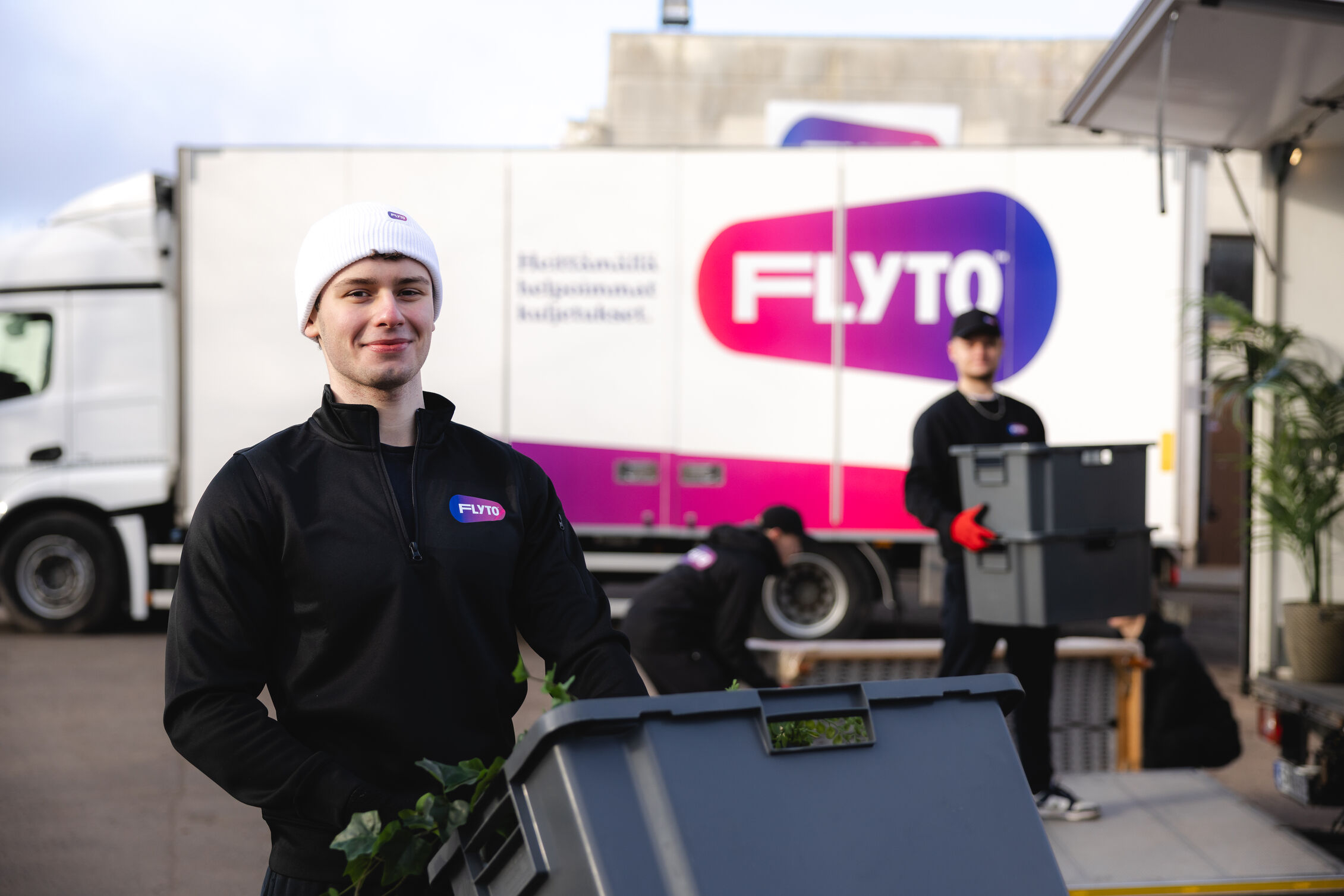
Everything in section 1 is why a Cologne move rewards a mover who actually knows the city — and it’s where Flyto earns its keep. We handle the Halteverbotszone permits at both addresses, applied for through the city with the three-week lead time and the signs up 96 hours ahead, so there’s a legal, empty parking space when the truck arrives. We assess Altbau access in advance — staircase width, floor, courtyard distance — and bring an exterior furniture lift (Möbelaufzug) when the sofa won’t make the stairwell, rather than discovering the problem mid-carry. We run a green-Plakette-compliant fleet for the inner-city Umweltzone, plan around the narrow Altstadt lanes, the Ring and the Rhine bridges — and we will never book you into Karneval week by accident. That’s the honest difference between a generic van hire and a relocation partner who has done this Veedel by Veedel. Get a fixed quote for your Cologne move, or browse our full Germany moving guides, our Berlin guide and our customs guide for household goods.
Moving to Cologne? Get a fixed quote.
Tell us your addresses and volume and we’ll price the whole move — including the Halteverbotszone permits, any furniture lift your Altbau needs, and around Karneval. No surprises on the day.
Frequently asked questions
Do I need a Halteverbotszone permit for my moving truck in Cologne?
In practice, yes — you cannot rely on finding free kerb space. You apply through the City of Cologne’s traffic-permit office for a temporary no-parking zone (Halteverbotszone). The official fee is €36 for the first day and €18 for each additional day, with a €14 supplement if you use an exterior furniture lift. Apply at least three weeks ahead, and the signs must stand 96 hours before move day (Stadt Köln). Most people delegate the whole permit-and-signs job to their mover.
When is Karneval 2026 and why does it matter for moving?
Cologne’s street carnival in 2026 runs from Weiberfastnacht on Thursday 12 February to Karnevalsdienstag on 17 February, with the huge Rosenmontag parade on 16 February. During these days large parts of the Altstadt and inner districts are closed to traffic (roughly 7am–6pm), with glass-bottle bans and bridge closures. A removal truck cannot work a closed street, so do not schedule your move for Karneval week — and expect disruption on the surrounding weekends too.
Does my moving truck need a green badge for Cologne?
Yes. Cologne’s Umweltzone (low-emission zone) covers 137 km² — effectively the whole inner city and the inner districts on both banks of the Rhine — and only vehicles with a green badge (grüne Plakette) may enter. Driving in without one is a €100 fine. A professional moving fleet is already compliant; a cheap van hire may not be, so check before you book.
Which Cologne neighbourhood is best for families?
Sülz and Lindenthal (leafy, near the university and the Stadtwald forest) and Nippes (a down-to-earth northern Veedel with a market square and good transport) are the classic family choices. The Südstadt is beautiful and central but pricey and hard to find a flat in. Right-bank Mülheim offers the most space for the money if you don’t mind a plainer, up-and-coming area. New-lease cold rents run roughly €14–16/m² in the family Veedel.
How much is rent in Cologne in 2026?
For a new lease, asking cold rent (Kaltmiete) is around €16/m² citywide, ranging from about €12/m² in cheaper right-bank districts like Mülheim to €16/m² and above in the central and most-wanted areas such as the Südstadt, Belgisches Viertel and Deutz (ImmobilienScout24). On top of the cold rent you pay Nebenkosten (operating costs), benchmarked around €2.67/m²/month nationally.
How big a deposit can a Cologne landlord ask for?
The Kaution is legally capped at three months’ cold rent (Kaltmiete), and you have the right to pay it in three monthly instalments — the first at move-in, the next two with the following months’ rent (§551 BGB). The landlord must hold it in a separate interest-bearing account.
Do I have to pay a broker fee to rent in Cologne?
Usually not. Under the Bestellerprinzip, whoever commissions the agent pays the commission, and for rentals that is almost always the landlord (§2 Wohnungsvermittlungsgesetz). If a ”finder’s fee” is demanded for a standard flat, treat it as a red flag.
Where do I register my address in Cologne, and by when?
You must register (Anmeldung) within 14 days of moving in (§17 BMG). In Cologne you do it at a Kundenzentrum (citizen service centre) in any district, or increasingly online through the city’s ”Wohnsitz anmelden” digital service, which posts the new address sticker for your ID. You’ll need a Wohnungsgeberbestätigung (landlord’s move-in confirmation) either way, so ask your landlord for it as soon as you sign.
Official sources
- Stadt Köln — Umzug oder Anlieferung durchführen (Halteverbotszone fees & rules)
- Stadt Köln — Die Kölner Umweltzone (green badge, zone coverage)
- Stadt Köln — Karneval Altstadt (street closures)
- koeln.de — Karneval 2026 dates
- Stadt Köln — Anmeldung Ihres Wohnsitzes (address registration)
- Stadt Köln — Kundenzentren (citizen service centres)
- Bundesmeldegesetz §17 — 14-day registration deadline
- Bundesmeldegesetz §19 — Wohnungsgeberbestätigung
- BGB §551 — rental deposit (Kaution) limit and instalments
- Wohnungsvermittlungsgesetz §2 — Bestellerprinzip (broker fees)
- ImmobilienScout24 — Mietspiegel Köln (asking rents by district)
- Deutschlandticket — 2026 price (€63/month)
- KVB — single ticket price
- Federal Ministry of Health — statutory health insurance contributions
- Verbraucherzentrale — spotting fake rental listings
- SCHUFA — tenant credit report (BonitätsAuskunft)
- Flyto — Bürgeramt deregistration guide
- Flyto — moving to Berlin guide
- Flyto — customs for household goods
- Flyto — Germany moving guides