

Moving to Prague (2026): The Complete Relocation Guide

Prague (Praha) is the Czech Republic’s capital and by far its most international city — roughly 1.4 million residents, and the destination for the overwhelming majority of people relocating to Czechia for work, study or family. It is also one of Central Europe’s most physically demanding cities to move into: the historic core is a pedestrianised UNESCO site laid with cobblestones, the apartment blocks are tall, old and often lift-less, and your moving truck cannot legally reserve the kerb outside your door without a permit you have to arrange weeks ahead. This guide covers the practical mechanics of moving to Prague in 2026 — the truck-and-access logistics only a mover knows, where to live and what rent really costs, how to find a flat and register your stay, and what monthly life actually costs — with official sources throughout.
Freshness note: prices and rules verified against praha.eu, individual Prague district (městská část) sites, PID (Prague Integrated Transport), the Czech Ministry of the Interior (MVČR), the Foreign Police (frs.gov.cz), VZP, the Deloitte Rent Index and the Czech Civil Code in 2026. Fees and rents move — confirm figures with the linked authorities before you rely on them. Approximate euro values use €1 ≈ 25 Kč.
Quick answer: moving to Prague in 2026
What does it cost to move to Prague? An international household move (a full flat) typically lands in the low-to-mid four figures in euros from within Europe, and higher from overseas, driven mostly by volume, distance and access. Prague’s access difficulties (see below) add real cost, so get a fixed quote for your specific address rather than a generic estimate — get a Flyto quote here.
How long does the move take? Road moves from within the EU are usually a few days to about two weeks door-to-door; overseas sea freight runs several weeks. The one Prague-specific quirk everyone underestimates: to guarantee the truck a legal spot you must apply for a public-space occupation permit (zábor veřejného prostranství / a zvláštní užívání komunikace) from your district office — and it is issued per městská část, each with its own process, so apply weeks ahead (praha.eu).
Key takeaways
- Your moving truck needs its own permit. Reserving kerb space for the truck requires a public-space occupation permit (zábor) granted by the transport department (odbor dopravy) of the specific district — Prague has 10 numbered administrative districts (Praha 1–10) plus 22 self-governing městské části, each running its own process and fee (Praha 7 permit page).
- The historic centre bars big trucks. Staré Město and Malá Strana are pedestrian and limited-traffic zones paved with cobblestones (kočičí hlavy), on narrow, often one-way lanes — a full-size removal truck usually cannot get to the door, so goods are shuttled in a small van (prague.eu).
- Prague is a činžovní-dům city. The classic late-19th and early-20th-century apartment blocks are typically four to six storeys with no lift, or with a tiny original cage lift far too small for furniture — which is why an exterior furniture lift (stěhovací plošina) is so often needed.
- Rents are highest in the country and expat-driven. Average asking rent in Prague reached about 459 Kč/m²/month at the end of 2025 — well above the national 332 Kč/m² — with the priciest districts around 474–478 Kč/m² (Deloitte Rent Index).
- The deposit is capped and EU registration is time-bound. A rental deposit (jistota/kauce) is legally limited to three months’ rent (§2254 of the Civil Code), and EU citizens staying over 30 days must report their residence to the Foreign Police, then apply for a registration certificate if staying beyond three months (frs.gov.cz).
1. The move into Prague — logistics only a mover knows
This is the part generic ”moving to Prague” guides skip, and it is exactly where a move goes wrong. Prague’s inner districts were built for trams and courtyards, not for a full-size removal truck. Three things determine whether your move day runs smoothly.
The zábor: your truck’s parking permit
You cannot count on a free stretch of kerb outside a Prague building — most inner streets are metered resident-parking zones (modré zóny, blue zones). To guarantee the truck a spot, you set up a temporary reserved area through a public-space occupation permit — a zábor veřejného prostranství, applied for as a zvláštní užívání komunikace (special use of the road). Key facts from the city and district offices:
- Who grants it: the odbor dopravy (transport department) of the specific městská část where the truck will stand. Prague is split into 10 numbered districts and 22 self-governing municipal parts, each running its own forms, fees and speed — a zábor in Praha 7 (Holešovice) is a different process from one in Praha 5 (Smíchov). The road itself is usually owned by TSK (Technická správa komunikací), whose consent and road-rental you also need (praha.eu guide to borrowing public space).
- Cost: a local occupation fee — commonly around 10 Kč/m²/day for a works/moving-equipment reservation — plus an administrative fee of 100 Kč for a permit up to ten days (rising to 500 Kč up to six months). The all-in cost, once you add the road rental and sign hire, is modest but the paperwork is the real work (Praha 7, Praha 5).
- Extra approval in some districts: if you are moving in Praha 1, 2, 8 or 11, the district additionally requires its preliminary consent (předběžný souhlas ÚMČ) before the transport department will act — an extra step and extra time.
- Lead time: the authority has up to 30 days by law to decide, and specialists advise filing around six weeks ahead. The physical no-parking signs must then be posted in advance of the reserved day for the reservation to be enforceable and any car parked there towed.
You usually need two reservations: one at the old address and one at the new one, each in its own district’s process. This is the single most common thing international movers forget, and there is no last-minute fix on move day.
Cobblestones, pedestrian zones and the small-van shuttle
Prague’s historic core — Staré Město (Old Town) and Malá Strana below the Castle — is a UNESCO World Heritage area and largely a pedestrian zone (pěší zóna) or limited-traffic zone where vehicle entry needs its own permit. The lanes are narrow, frequently one-way, and paved with historic cobblestones — the rounded setts Czechs nickname kočičí hlavy (”cats’ heads”). A 7.5-tonne removal truck simply cannot get to — or turn near — most addresses there (prague.eu).
The standard solution is a small-van shuttle: the main truck parks at the nearest legal point (with its own zábor), and a small van ferries loads through the restricted streets to the door. It adds handling time, so it belongs in the plan and the quote — not as a surprise when the truck can’t fit down the street.
Činžovní domy, no lift, and the stěhovací plošina
Prague’s residential fabric is dominated by činžovní domy — the tall, ornate apartment blocks built from the 1880s through the 1930s that fill Vinohrady, Žižkov, Smíchov, Holešovice and the centre. Many have no lift at all, and where a lift exists it is often a tiny original cage or paternoster-era car far too small for a wardrobe or sofa; access to upper flats and rear wings is frequently via an external gallery (pavlač) around the courtyard.
The practical consequence: large items often will not fit up a winding staircase or into the old lift. The standard Prague answer is an exterior furniture lift (stěhovací plošina, also stěhovací výtah / vysokozdvižná plošina) — a ladder hoist run up the façade that lifts bulky items straight in through a window or balcony. Movers otherwise charge a per-floor surcharge for carrying by hand (commonly a few percent of the job per storey above the ground floor), and that adds up fast in a five-storey lift-less block. A good mover assesses the staircase, floor, lift size and courtyard access before the day, and books the plošina in advance — plus the kerb space it needs, which is another reason the zábor placement matters.
2. Where to live — Prague neighborhoods by profile
Prague’s character changes district by district. The figures below are indicative monthly asking rents for a typical smaller flat (1+kk to 2+kk), excluding utilities, in 2026, cross-checked against the Deloitte Rent Index (which puts Prague’s average around 459 Kč/m², and the dearest districts at 474–478 Kč/m²). Rents rise the closer you get to the centre and the river.
Best for families and a calmer life:
- Dejvice / Praha 6 (~20,000–28,000 Kč) — leafy, diplomatic and academic (Czech Technical University), with good schools and fast metro line A into town. Calm, well-off and green; the trade-off is that it feels residential rather than lively, and the best streets are expensive.
- Vinohrady (Praha 2/3, ~20,000–28,000 Kč) — the classic expat favourite: elegant Art Nouveau činžovní domy, tree-lined streets, parks (Riegrovy sady) and cafés. Central, safe and beautiful, and you pay a premium for it; genuine bargains are rare.
- Malá Strana (Praha 1, ~25,000–35,000 Kč+) — baroque, postcard-pretty streets under the Castle. Stunning but tourist-heavy, with limited stock, cobbled access and the highest prices in the city; charming to visit, demanding to actually move into.
Best for young professionals:
- Karlín (Praha 8, ~22,000–30,000 Kč) — the regenerated riverside district, now Prague’s tech-and-startup hub with modern offices, renovated blocks and new-builds. Buzzy, well-connected and pricey — Deloitte puts Praha 8 around 474 Kč/m².
- Holešovice (Praha 7, ~19,000–26,000 Kč) — a former industrial quarter turned creative district (galleries, the Vnitroblock and Jatka79 scene, riverside). Increasingly popular and gentrifying, with a mix of raw warehouses and smart flats; some stretches are still gritty.
- Žižkov (Praha 3, ~17,000–23,000 Kč) — famously bohemian, with the highest density of pubs in the city and a young, mixed crowd. Central and characterful, better value than neighbouring Vinohrady — Deloitte puts Praha 3 around 478 Kč/m² — but noisier and rougher-edged in parts.
- Smíchov (Praha 5, ~18,000–26,000 Kč) — a business and shopping hub around Anděl, with the huge new Smíchov City development under construction. Excellent transport and amenities; less charm than Vinohrady, and a building site in places.
Best for value and a local feel:
- Vršovice (Praha 10, ~16,000–22,000 Kč) — the hip, up-and-coming alternative to Vinohrady next door: independent cafés, Heroldovy sady, a younger crowd, and noticeably lower rents. Still improving street by street, and a bit further out.
- Nové Město (New Town, Praha 1, ~22,000–32,000 Kč) — maximum central convenience around Wenceslas Square and the main stations, but busy, touristy and among the priciest per m²; great for walk-everywhere professionals, less so for quiet.
3. The Prague housing market — how flats are actually found
Prague has the tightest, most expensive rental market in the country, and demand from expats and students keeps it that way. The search, not the move, is usually the hard part. Here is how it works.
- Where to search: the mainstream portals are Sreality.cz and Bezrealitky.cz (the latter for landlord-direct listings without an agent), plus expat Facebook groups for sublets and flatshares. Good listings move fast — be ready to view and decide quickly.
- Deposit (jistota/kauce): legally capped at three months’ rent under §2254 of the Civil Code; in practice landlords usually ask one to two months. The landlord may deduct only provable claims (unpaid rent, damage, unpaid service fees) and must return the balance, typically within one month of the lease ending (Czech Civil Code, Act 89/2012).
- Agency commission (provize): unlike Germany, in Czechia the tenant commonly pays the estate-agent commission on an agency-listed flat — typically about one month’s rent plus VAT. Budget for it: first month + deposit + commission can mean three to four months’ rent up front. Landlord-direct listings (Bezrealitky) avoid the fee.
- Scam warning: fake listings are common in a hot market. Never transfer any money — deposit or ”reservation” — before you have viewed the flat in person and confirmed who the real owner is. Classic red flags: an ”owner abroad”, keys promised by post against a prepayment, prices well below market, or pressure to pay to a foreign account.
4. Registration — reporting your stay in Prague
Registration is the key that unlocks Czech bureaucracy: without it, opening a bank account, arranging health insurance and dealing with the tax office are all harder. The rules differ by nationality.
- EU / EEA / Swiss citizens. If you intend to stay more than 30 days, you must report your place of residence to the Foreign Police within 30 days of arrival — though if you take accommodation through a landlord or hotel who registers you, that can satisfy the duty (frs.gov.cz). If you will stay more than three months, you can apply for a registration certificate (osvědčení o registraci, the former temporary-residence certificate / přechodný pobyt) at the Ministry of the Interior. The administrative fee is 200 Kč, it is normally issued within 30 days of a complete application, and it is valid for up to 10 years (ipc.gov.cz, portal.gov.cz).
- Non-EU citizens need the appropriate visa or long-term/employee-card residence permit arranged before or on arrival, and must report to the Foreign Police within three working days if not staying in registered accommodation (MVČR).
- Rodné číslo (birth number). Your registration generates a Czech rodné číslo — the personal identification number used everywhere from health insurance to your bank and the tax office. Keep the certificate safe; you will quote this number constantly.
- Permanent residence (trvalý pobyt) can be applied for after five years of continuous residence, giving broader rights close to those of citizens.
Leaving Czechia rather than arriving? See our deregistration and emigration guide for the reverse process.
5. Cost of living in Prague (2026)
Prague is the most expensive city in the country, but still meaningfully cheaper than Western European capitals. The current numbers:
- Rent is the big variable — see section 2. Around 459 Kč/m²/month on average across the city, so a typical one-bed runs roughly 16,000–28,000 Kč depending on district (Deloitte).
- Utilities (electricity, gas, water, heating) run about 3,000–4,500 Kč/month for a small 1+kk, 4,000–6,000 Kč for a 2+kk and 5,500–8,000 Kč for a larger 3+kk (Around Prague, 2026). Home internet is about 400–600 Kč and a mobile plan 300–600 Kč.
- Groceries come to roughly 5,000–8,000 Kč per person per month.
- Public transport is cheap and excellent — see section 6. An annual pass is 3,650 Kč, about 10 Kč a day.
- All in, a single person budgets roughly 27,000–37,000 Kč/month including rent, and a couple about 42,000–55,000 Kč (Around Prague).
6. Getting settled — transport, health, schools, internet
- Transport and the Lítačka. Prague’s integrated network (PID) covers three metro lines (A/B/C), a dense tram network including night trams, and buses — one of Europe’s best systems, and reason enough to skip a car. You pay via the Lítačka card or app. From 1 January 2026 a single ticket is 36 Kč (app) / 39 Kč (paper) for 30 minutes and 46 Kč / 50 Kč for 90 minutes; season passes were held flat at 550 Kč for 30 days, 1,480 Kč for 90 days and 3,650 Kč for a year (PID 2026 tariff). For anyone staying more than a few months, the annual pass is the obvious buy.
- Health insurance. Cover is mandatory. EU/EEA/Swiss citizens who are employed or self-employed here join the public system — the largest insurer is VZP — funded by contributions of 13.5% of gross salary (employer 9%, employee 4.5%); for short visits your EHIC covers necessary care. Non-EU nationals on long-term stays generally need commercial comprehensive insurance (PVZP and others) until they qualify for the public system (VZP — healthcare for foreigners).
- Schools and childcare. State schooling is in Czech; Prague also has a wide choice of international and bilingual schools (English, German, French) for expat families. Public nurseries (mateřská škola / školka) are competitive and popular, so apply early, especially in family districts like Praha 6.
- Internet. The main providers are O2, Vodafone and T-Mobile, alongside strong local ISPs; fibre is widespread and speeds are good. Installation can take a couple of weeks after you sign, so order early and check what the building already supports.
7. How Flyto handles your move to Prague
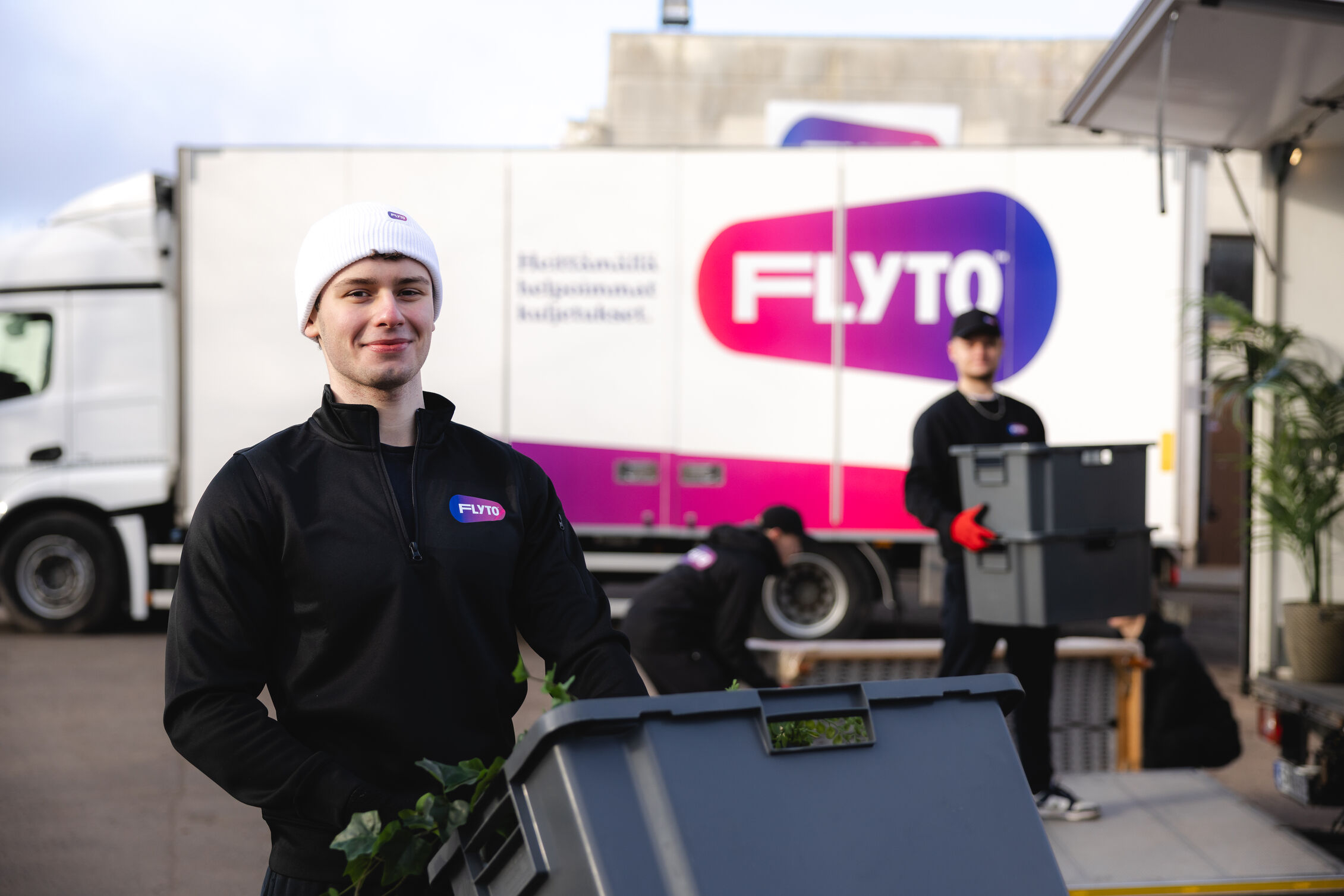
Everything in section 1 is why a Prague move rewards a mover who actually knows the city — and it is where Flyto earns its keep. We arrange the zábor permits at both addresses, in the correct městská část (including the extra district consent needed in Praha 1, 2, 8 and 11), with the lead time the offices require, so there is a legal, empty space when the truck arrives. For the pedestrian and cobbled centre — Staré Město, Malá Strana — we plan a small-van shuttle from the nearest legal parking point rather than discovering on the day that the truck can’t reach the door. We assess činžovní-dům access in advance — staircase width, floor, lift size, courtyard and pavlač distance — and bring an exterior furniture lift (stěhovací plošina) when the sofa won’t make the stairwell. And we plan around Prague’s trams, one-way lanes and blue zones so nothing on move day is a surprise. Get a fixed quote for your Prague move, see our Prague moving and storage services, or browse all our Czech moving guides — including popular routes like Czechia to Germany.
Moving to Prague? Get a fixed quote.
Tell us your addresses and volume and we’ll price the whole move — including the zábor permits, any small-van shuttle for the cobbled centre, and the furniture lift your činžovní dům needs. No surprises on the day.
Frequently asked questions
Do I need a permit for my moving truck in Prague?
In practice, yes — inner-city streets are metered blue-zone (modré zóny) resident parking, so you cannot rely on free kerb space. You apply for a public-space occupation permit (zábor veřejného prostranství / zvláštní užívání komunikace) at the transport department of the relevant městská část, plus the road owner’s consent (usually TSK). The local fee is modest (commonly around 10 Kč/m²/day) with a 100 Kč administrative fee for short permits, but Praha 1, 2, 8 and 11 need extra district consent, and the office has up to 30 days to decide — so apply weeks ahead.
Can a removal truck reach Staré Město or Malá Strana?
Usually not directly. The historic centre is a pedestrian and limited-traffic zone on narrow, one-way cobblestone (kočičí hlavy) lanes, and a full-size truck cannot get to or turn near most addresses. The standard solution is a small-van shuttle: the main truck parks at the nearest legal point with its own zábor, and a small van ferries the load to the door. It adds time, so it should be in the plan and the quote.
My building has no lift, or only a tiny one — how does the furniture get up?
Very common in Prague’s činžovní domy (late-19th and early-20th-century blocks). Where the staircase is too tight or the original cage lift too small, movers use an exterior furniture lift (stěhovací plošina) that hoists items through a window or balcony. Otherwise you pay a per-floor carrying surcharge, which adds up in a five-storey walk-up. A good mover checks staircase, floor, lift size and courtyard access before move day and books the platform lift in advance.
How much is rent in Prague in 2026?
Prague is the country’s priciest rental market — average asking rent was about 459 Kč/m²/month at the end of 2025, versus 332 Kč/m² nationally, with the dearest districts (Praha 3, Praha 8) around 474–478 Kč/m² (Deloitte Rent Index). In money terms, a typical one-bed runs roughly 16,000–28,000 Kč a month excluding utilities, with Vinohrady, Karlín, Dejvice and the centre at the top and Vršovice or the outer districts cheaper.
How big a deposit can a Prague landlord ask for, and are there other upfront costs?
The deposit (jistota/kauce) is legally capped at three months’ rent under §2254 of the Civil Code; in practice landlords usually ask one to two months. Note that in Czechia the tenant commonly also pays the estate-agent commission (provize) on an agency-listed flat — about one month’s rent plus VAT — so first month + deposit + commission can total three to four months’ rent up front. Landlord-direct listings (Bezrealitky) avoid the agent fee.
Do I have to register as an EU citizen moving to Prague?
Yes if you stay over 30 days: you must report your residence to the Foreign Police within 30 days of arrival (accommodation providers often do this for you). If you stay more than three months, apply for a registration certificate (osvědčení o registraci / former přechodný pobyt) at the Ministry of the Interior — a 200 Kč fee, usually issued within 30 days and valid up to 10 years. You’ll be assigned a rodné číslo (birth number) used for banking, health insurance and tax.
How much does public transport cost in Prague?
Cheap and excellent. From 1 January 2026 a single ticket is 36 Kč (app) or 39 Kč (paper) for 30 minutes, and 46/50 Kč for 90 minutes. Season passes on the Lítačka card or app held flat at 550 Kč for 30 days, 1,480 Kč for 90 days and 3,650 Kč for a year — about 10 Kč a day, which makes the annual pass the obvious choice for residents.
Do I need Czech health insurance?
Yes — cover is mandatory. EU/EEA/Swiss citizens who work or run a business here join the public system (VZP is the largest insurer), funded by contributions of 13.5% of gross salary split between employer and employee; short visits are covered by your EHIC. Non-EU nationals on long-term stays generally need commercial comprehensive insurance (PVZP and others) until they qualify for the public system. Sort it out as soon as you arrive.
Official sources
- praha.eu — how to borrow a street or square (zábor / public-space occupation)
- Praha 7 — zábor / special use of road permit (district process and fees)
- Praha 5 — zábory (district occupation permits)
- prague.eu — official city tourism (historic centre, pedestrian zones)
- Deloitte Rent Index — Czech and Prague rents (459 Kč/m² Prague, 332 Kč/m² national)
- Czech Civil Code (Act 89/2012) — §2254 rental deposit cap
- Foreign Police (frs.gov.cz) — reporting residence within 30 days
- ipc.gov.cz — EU registration certificate (200 Kč, 10-year validity)
- portal.gov.cz — registration certificate of an EU citizen
- Ministry of the Interior (MVČR) — residence of foreigners
- PID — 2026 Prague transport tariff and Lítačka fares
- VZP — healthcare for foreigners
- Around Prague — 2026 cost-of-living figures (utilities, budgets)
- Flyto — Czech deregistration and emigration guide
- Flyto — Prague moving and storage services
- Flyto — moving from Czechia to Germany (route guide)
- Flyto — Czech moving guides