Moving from Czechia to Denmark (2026): Complete Guide

Moving from Czechia to Denmark is an intra-European move — both countries sit inside the EU customs union, so this relocation is fundamentally different from a move to the UK, Switzerland, or overseas. There is no customs clearance, import duty, or goods declaration for your household effects. What actually requires attention is registration: closing out the Czech population and tax registers correctly, and registering as an EU citizen in Denmark’s CPR system on arrival. This guide is for anyone resident in Czechia relocating to Denmark, and covers the real administrative steps on both ends, how the move itself gets transported, and what people typically forget.
Key takeaways
- No customs, no duty, no import declaration. Czechia and Denmark are both inside the EU customs union, so household goods move freely between them under the single market’s free movement of goods — there is no customs procedure to complete for a normal house move (Council of the EU: the EU customs union; European Parliament: free movement of goods).
- You don’t need a visa or work permit — as an EU/EEA/Swiss/Nordic citizen you have the right to live and work in Denmark under free movement of people; the real task is registering, not applying for permission (Nyidanmark.dk: residence as an EU/EEA, Swiss or Nordic citizen).
- Ending Czech permanent residence (trvalý pobyt) is optional but recommended when you relocate for good — it also automatically ends your Czech public health insurance liability. Even if you don’t end it, notifying your Czech insurer within 8 days of taking up work or residence in Denmark ends the liability separately, since EU rules don’t allow double coverage (Portal.gov.cz: ukončení trvalého pobytu; Portal.gov.cz: work in another EU state and health insurance).
- In Denmark, you need an EU residence document (registration certificate) from SIRI before you can register your address and get a CPR number — this is the Danish equivalent of a residence registration, required once you stay longer than three months (Nyidanmark.dk: EU/EEA residence).
- Your Czech driving licence is valid in Denmark without exchange, since it’s an EU-format licence — you may exchange it voluntarily once resident, but it isn’t required to drive (Danish Road Traffic Authority: foreign driving licences).
- A car moved permanently into Denmark still owes full Danish registration tax (registreringsafgift) even though it comes from an EU country — there’s no customs duty, but this is a separate domestic tax and it applies regardless of origin, with 30 days to register after moving (Lifeindenmark.dk: importing a motor vehicle; Motorstyrelsen: importing vehicles).
- Dogs, cats and ferrets travel on an EU pet passport with microchip and valid rabies vaccination — no quarantine between EU states when the paperwork is in order (Your Europe: travelling with pets).
1. What "EU move" actually means for customs
Czechia and Denmark are both full members of the EU customs union. Goods circulate freely across internal EU borders without tariffs, customs declarations or border checks — a standing feature of the customs union since it eliminated internal duties and quotas between member states (Council of the EU; European Parliament factsheet). In practice:
- No customs declaration (import or export) for your furniture, boxes, or personal belongings.
- No import duty or VAT charged at the border on used household goods.
- No "personal effects" concession or transfer-of-residence relief to apply for — that regime exists for moves from outside the EU/EEA, not for an intra-EU relocation.
- No customs broker or clearance agent is needed for the move itself.
This is the biggest practical difference from a move involving a country outside the customs union. For comparison, a move to Switzerland — which is outside both the EU and the EEA, linked to the bloc only through bilateral treaties — still requires a formal customs declaration, with duty-free relief available for genuine removal goods; a move to the UK requires full customs formalities on both sides, since the UK sits fully outside the EU/EEA/customs union; and Norway and Iceland, while inside the EEA, are also outside the customs union, so goods moving there go through customs formalities too (again with relief available for bona fide removal goods). None of that applies here — Czechia to Denmark is goods-free movement, full stop.
What does still apply is a domestic Danish tax if you bring a car: Denmark’s registration tax (registreringsafgift) is a national tax on vehicles registered in Denmark, charged regardless of whether the car comes from inside or outside the EU (see section 4).
2. Leaving Czechia: what to close out
Czechia’s population register (evidence obyvatel) is local, and ending your registration is a deliberate, optional step rather than automatic.
- Terminate permanent residence (trvalý pobyt). Submit a written notice to your local registration office (ohlašovna) or a Czech embassy abroad; it’s recorded within three working days. Fee: 100 CZK domestically, 600 CZK via embassy. This also ends your Czech ID card’s validity (surrender it), though not your citizenship (Portal.gov.cz).
- End your tax residency. You stay a Czech tax resident if you keep a permanent home available in Czechia or spend 183+ days there in a year; residency ends once neither applies and your centre of vital interests has genuinely moved (Finanční správa: tax residency guidance, 2026). Keep proof of your departure date for later.
- Deregister from Czech public health insurance. Ending trvalý pobyt automatically removes you from the system (Portal.gov.cz). If you keep your address registered but are taking up work or residence in Denmark, EU coordination rules mean you can’t be covered by two member states’ systems at once: notify your Czech health insurer within 8 days of starting work/residence in Denmark and return your Czech insurance card, so your Czech liability ends as your Danish cover takes over (Portal.gov.cz: work in another EU state and health insurance). Note the separate "long-term stay abroad" declaration on Portal.gov.cz applies only to moves outside the EU — it’s not the right route for a move to Denmark. Make sure you’re covered either by an EHIC for the transition or directly via your new Danish registration (Your Europe: EHIC; Your Europe: health cover abroad).
- Vehicle export. Taking a Czech-registered car for good? Apply at the vehicle register for export plates, which deregisters it so it can be registered abroad (Portal.gov.cz).
- Driving licence: no action needed before departure — your Czech EU-format licence is valid in Denmark and can be exchanged later if you choose (section 4).
3. How your household goods actually move
For an intra-EU corridor like this, transport is almost always by road, sometimes combined with a short sea or bridge crossing depending on the exact route and destination. There’s no cross-border formality to slow things down — the only variables are distance and ferry/bridge scheduling.
- Route: the standard road corridor runs from Czechia through Germany (via Dresden/Berlin or via Nuremberg/Hannover, depending on your starting point) and crosses into Denmark at the German–Danish border near Flensburg/Frøslev, continuing north through Jutland. If your destination is on Zealand (e.g. Copenhagen), the route continues over the Great Belt Fixed Link (Storebælt) bridge — a direct road/rail bridge, not a ferry.
- Distance and timing (freight-industry estimate, not an official figure): Prague to Copenhagen is roughly 950–1,000 km by road, around 10–11 hours of driving time. A professional moving crew typically plans this as a two-day transit once loading, breaks, and unloading are factored in; other Czech starting points (Brno, Ostrava) add a few hours.
- No customs stop: because both countries are in the customs union, the truck crosses the German–Danish border like any other internal EU border — no clearance, no paperwork check for the goods themselves.
- Vehicle option: if you’re also relocating a car, it can either be driven on its own plates (valid insurance and roadworthy inspection required) or transported alongside the shipment; Danish registration tax and the 30-day registration deadline apply once it arrives (see below).
4. Arriving in Denmark: registering as an EU citizen
Denmark’s system for EU/EEA/Swiss/Nordic citizens is a sequence, and each step depends on the one before it.
- EU residence document (registration certificate) from SIRI. Staying longer than three months? Apply to the Danish Agency for International Recruitment and Integration (SIRI) — book via nyidanmark.dk. It’s proof of your existing free-movement rights, not a permit application in the non-EU sense (Nyidanmark.dk).
- CPR number and address registration. With a valid EU residence document (no older than six months) and proof of your Danish address, register at your municipality’s Citizen Service Centre (Borgerservice) or an International Citizen Service centre for your CPR number — the civil registration number underlying health, tax, banking, and digital ID. Processing typically takes a few weeks (Lifeindenmark.dk: when you arrive).
- Health insurance card. With a CPR number you’re automatically entitled to Danish public healthcare; your yellow health card (sundhedskort), showing your CPR number and assigned GP, typically arrives by post within a couple of weeks (Lifeindenmark.dk: health insurance card).
- Tax registration. Apply for a Danish tax card and personal tax number, linked to your CPR once you’re a permanent resident. If you’re employed, this needs to be active before your first payday — handled at an International Citizen Service centre or online via SKAT once you have MitID (SKAT: moving to Denmark; SKAT: first steps).
- Driving licence. Your Czech licence stays valid to drive in Denmark without exchange. You may exchange it voluntarily for a Danish one once you have "normal residence" (settled with intent to stay); no driving test is normally required for an EU-licence exchange, arranged via your municipality (Danish Road Traffic Authority).
- Vehicle registration. A car brought permanently must be registered in the Danish Register of Motor Vehicles with Danish plates within 30 days. Registration tax (registreringsafgift) applies in full — a domestic tax, separate from customs, charged on cars from EU and non-EU countries alike, based on assessed Danish market value (Lifeindenmark.dk: importing a motor vehicle; Motorstyrelsen).
5. Moving with pets
Dogs, cats and ferrets can travel between Czechia and Denmark on an EU pet passport, issued by any authorised vet. The requirements, in order:
- The animal must be microchipped before it receives its rabies vaccination — the sequence matters, a vaccination given before the chip is not valid for passport purposes.
- A valid rabies vaccination, administered by an authorised vet and recorded in the passport along with the microchip code and owner’s details.
- The passport is issued once these steps are complete and is valid for life as long as the rabies vaccination stays in date.
Because both countries are EU members, there’s no quarantine requirement when the passport and vaccination timeline are correctly documented (Your Europe: travelling with pets and other animals in the EU). Start the microchip-then-vaccination process well ahead of your move date, since the sequence can’t be done retroactively.
6. Money, banking, and things people forget
- NemKonto and MitID. Once you have a CPR number, set up MitID (Denmark’s digital ID, needed for nearly all self-service) and a NemKonto (the account the Danish state uses for any public payments owed to you).
- Bank account timing. A Danish bank account is usually easiest once you have a CPR number; some banks open a basic account earlier with your EU residence document, but full MitID-linked banking waits for CPR.
- Employer coordination. If you have a Danish job lined up, share your expected CPR date with HR/payroll early — your tax card must be active before the first payroll run to avoid emergency withholding.
- Sequence the two sides correctly. Ending Czech trvalý pobyt before you have a confirmed Danish address can leave you unregistered anywhere for a period — get the Danish EU residence document and CPR appointment underway first, then close out Czechia.
- Keep proof of both sides. Retain your Czech termination-of-residence confirmation and Danish CPR registration together — either authority may later ask for evidence of the other, especially for tax residency questions.
How Flyto handles your Czechia to Denmark move
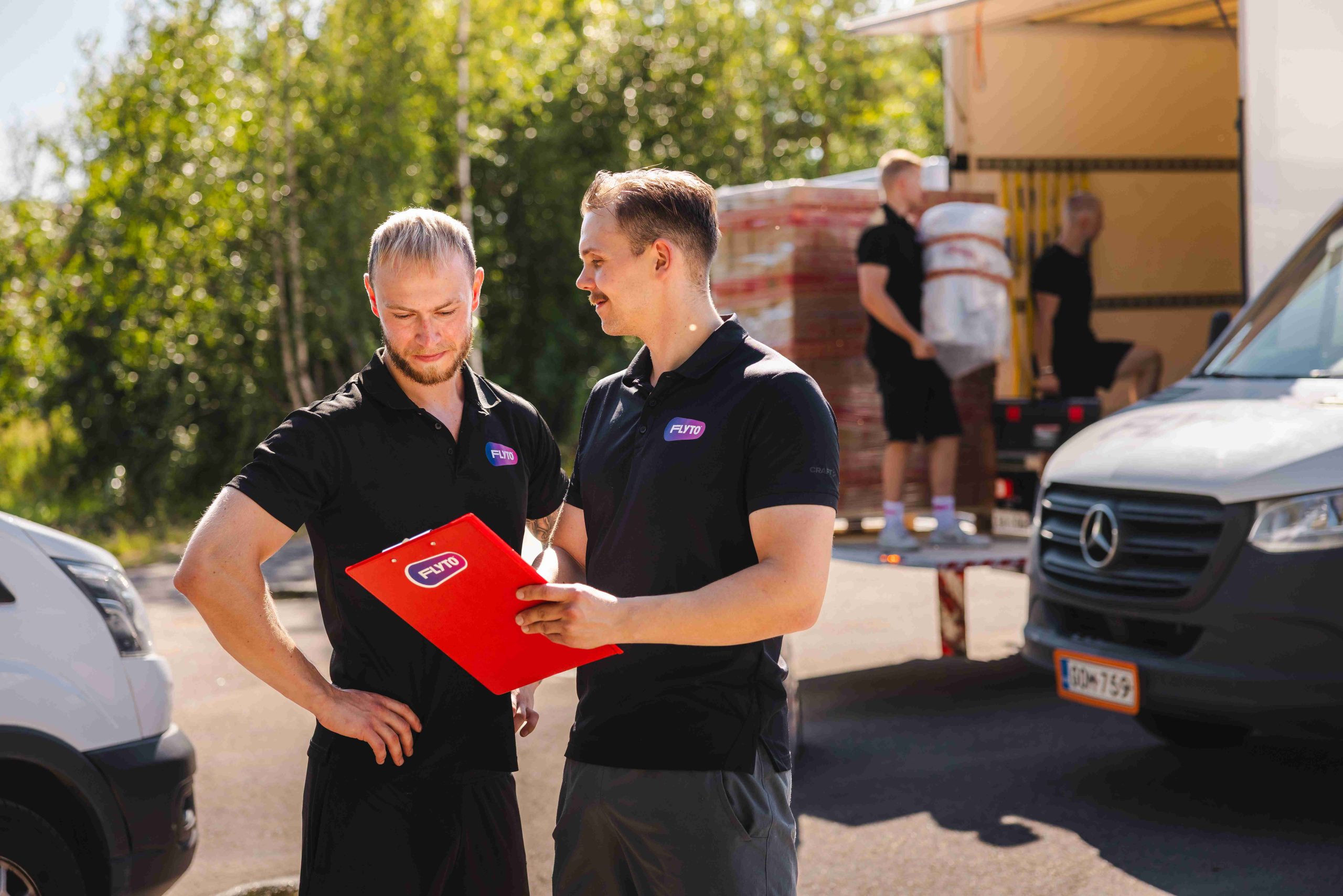
Flyto runs its own offices, warehouses, crews and vehicles across Northern, Central and Southern Europe, so a corridor like Czechia to Denmark is typically handled largely with in-house teams end to end rather than handed off wholesale. Where it makes sense — a specific regional pickup, a tight delivery window, or extra capacity at peak season — we bring in a carefully vetted partner and subcontractor network to keep the move on schedule without compromising on how it’s handled.
Frequently asked questions
Do I need a visa or work permit to move from Czechia to Denmark?
No. As an EU/EEA citizen you have free-movement rights to live and work in Denmark; the requirement is registration (EU residence document, then CPR), not a visa application (Nyidanmark.dk).
Will my furniture and belongings go through customs?
No. Czechia and Denmark are both in the EU customs union, so household goods move freely with no customs declaration, duty or import tax (Council of the EU).
Do I have to end my Czech permanent residence before I leave?
It’s not automatic, but it’s recommended once your move is permanent — it stops you being liable for Czech public health insurance premiums going forward (Portal.gov.cz).
Can I keep driving on my Czech licence in Denmark?
Yes, indefinitely — EU-issued licences don’t need to be exchanged to drive in Denmark. You can exchange voluntarily later, generally without a driving test (Danish Road Traffic Authority).
Will I pay import tax on my car since it’s coming from an EU country?
No customs duty, but yes — Danish registration tax (registreringsafgift) is a separate domestic tax that applies to any car registered in Denmark, regardless of where it comes from, and it must be registered within 30 days of your move (Motorstyrelsen).
How long does it take to get set up administratively in Denmark?
Roughly: EU residence document from SIRI, then a CPR application that typically takes a few weeks to process, then an in-person CPR appointment, after which the health card and tax card follow within a couple more weeks. Starting the SIRI step as early as your move date allows is the biggest time-saver (Lifeindenmark.dk).
Sources
- Council of the EU: the EU customs union
- European Parliament: free movement of goods (factsheet)
- Portal.gov.cz: ukončení trvalého pobytu
- Portal.gov.cz: work in another EU state and health insurance
- Finanční správa: methodological guidance on tax residency (2026)
- Portal.gov.cz: žádost o povolení k vývozu registrovaného vozidla
- Your Europe: European Health Insurance Card (EHIC)
- Your Europe: health insurance cover in your host country
- Nyidanmark.dk: residence as an EU/EEA, Swiss or Nordic citizen
- Lifeindenmark.dk: when you arrive
- Lifeindenmark.dk: health insurance card
- Danish Road Traffic Authority: foreign driving licences, exchanges and visitor’s driving licences
- SKAT: moving to Denmark
- SKAT: first steps when you move to Denmark
- Lifeindenmark.dk: temporary or permanent import of a motor vehicle
- Motorstyrelsen: importing vehicles
- Your Europe: travelling with pets and other animals in the EU