Moving from Belgium to the Netherlands (2026): Complete Guide

Belgium to the Netherlands is one of the shortest relocation corridors in Europe — often a 2-3 hour drive between Antwerp/Brussels and Rotterdam/Amsterdam. It is also entirely intra-EU: both countries are EU member states inside the EU customs union and the Schengen area, so this move is fundamentally different from a move to a non-EU country. There is no customs process for your belongings and no visa for you. What actually takes effort is Belgian de-registration paperwork, Dutch civil registration (BRP/BSN), and re-arranging health insurance, tax residency and — if you’re bringing a car — Dutch vehicle registration. This guide is written for a Belgian resident (Belgian national or any nationality legally resident in Belgium) relocating to the Netherlands.
Key takeaways
- No customs, no import duty, no import declaration on your household goods. Belgium and the Netherlands are both inside the EU customs union, so personal belongings move freely between them under the EU’s free movement of goods principle — unlike a move to Switzerland, Norway, the UK or further afield.
- You (as an EU/EEA/Swiss citizen) don’t need a visa or work permit to live and work in the Netherlands, and no residence permit is required — your passport or national ID is your proof of the right to stay (IND). If you’ll be in the Netherlands for 4 months or longer, you must register with your local municipality in the Personal Records Database (BRP) to get a BSN (citizen service number) — your key to everything from healthcare to a bank account (Den Haag — 1st BRP registration for EU/EEA/Swiss nationals).
- You must report your departure to your commune/gemeente in Belgium before or on the day you leave for good; they will take back any Belgian residence card you hold and remove you from the population register (IBZ – FPS Home Affairs). Ask for written confirmation of the deregistration date — it’s useful for closing out Belgian obligations and for your Dutch registration.
- Dutch basic health insurance (zorgverzekering) is compulsory within 4 months of registering in the Netherlands. Apply within that window and your cover is backdated to the day you arrived; miss it and there’s no backdating, you only pay from the date you apply, and the CAK (the body that checks everyone is insured) can still fine you for the gap (Government.nl).
- EU/EEA/Swiss driving licences can be exchanged for a Dutch rijbewijs through your municipality without a new driving test (RDW).
- Bringing your car requires an RDW inspection and Dutch re-registration, and a BPM (private vehicle tax) exemption for relocation goods is available — but it must be requested from the Tax and Customs Administration before the inspection (RDW).
- Pets travel on an EU pet passport — microchip first, then rabies vaccination, no quarantine between Belgium and the Netherlands (Your Europe – EU pet travel rules).
- Notify the Belgian tax administration of your move to avoid being assessed as tax-resident in both countries, and expect to file a Dutch M-form for the year you arrive (Belastingdienst — tax return for the year of immigration).
1. Why this move skips customs entirely
Belgium and the Netherlands are both EU member states inside the EU customs union, meaning goods — including your furniture, boxes and personal effects — move between them exactly as they would between two Belgian provinces: no customs declaration, no duty, no VAT on import, no "transfer of residence" relief application, because there’s nothing to relieve. The European Parliament’s factsheet on free movement of goods confirms that goods in free circulation within the EU single market move without internal customs barriers.
This is worth stressing because it’s the single biggest practical difference from an overseas move: no packing list needs to be submitted to a customs authority, no waiting for goods to clear a port, and no risk of import tax on your sofa. (For comparison, this framing does not apply if either end of a move is Switzerland — a full customs declaration is required, with duty-free relief available for genuine removal goods — or Norway/Iceland, which sit in the EEA but outside the EU customs union and also require customs formalities with removal-goods relief. The UK is fully outside the EU/EEA, so a Belgium–UK move needs real customs paperwork. None of that applies here.)
The one practical point that does survive for a Belgium–Netherlands move is proving you’re a genuine relocating household rather than a commercial shipment — carriers typically still travel with an inventory list and proof of your change of address, mainly for insurance and any roadside checks, not for a customs authority.
2. Leaving Belgium: what to actually close out
De-registration. If you’re moving your main residence abroad permanently, report in person to your commune/gemeente before or on the day you leave. The municipality will ask for any Belgian residence card you hold and will remove you from the population register (IBZ – FPS Home Affairs, IBZ – registering a change of address). It’s free — ask the clerk for written confirmation of your deregistration date, since you’ll want it both for closing out Belgian matters and to support your Dutch registration. (Note: a separate document, the "Annex 18" certificate of departure, exists specifically for temporary absences of three months to two years — it isn’t the document used for a permanent move like this one.)
Ending tax residency. Notify the Belgian tax administration (FPS Finance) of your change of address and status so you’re correctly reclassified from resident to non-resident taxpayer and don’t end up assessed as tax-resident in both countries. Your Belgian de-registration date is typically a key factor in when Belgian tax residency ends — if you’re unsure how your situation will be treated, write to your local tax office before you leave.
Healthcare. Compulsory Belgian health insurance (mutualité/ziekenfonds registration) should be closed out with your mutuelle when you leave, and — since the Netherlands has its own compulsory system — you don’t carry a Belgian policy forward. If you retire or receive a Belgian pension while resident in the Netherlands, an S1 form may determine which country pays for your healthcare; check with your mutuelle before departure. An EHIC/European Health Insurance Card is for temporary stays only, not for your new residence.
Driving licence and vehicle. A valid EU driving licence stays valid as-is; there’s nothing to do with it in Belgium before you leave (see Section 4 for exchanging it for a Dutch one). If you’re taking your car, there’s no Belgian export step required for a move within the EU — you keep your Belgian registration certificate and plates and handle the registration on the Dutch side once you arrive (Section 4).
Other things to close or forward: cancel or transfer Belgian utility contracts, notify your bank, arrange mail forwarding, and if you have school-age children, request transcripts early — Dutch schools often want originals or certified copies.
3. How your household goods actually move
For a Belgium–Netherlands move, freight is simple and road-based — there’s no sea or air leg to plan around, and no border stop to clock. Typical routings, as industry estimates (actual timing depends on your mover’s schedule and consolidation model):
- Direct dedicated truck, Antwerp/Brussels area to Randstad (Amsterdam/Rotterdam/Utrecht/The Hague): same-day to next-day delivery, roughly 100-220 km depending on origin/destination.
- Groupage/shared-load (cost-efficient for smaller volumes): typically 2-5 business days, since your shipment is consolidated with others on a regional loop.
- Longer-distance Belgium (e.g., Wallonia/Liège) to further Dutch destinations (e.g., Groningen, Friesland): still road-only, generally 1-3 days.
Because there’s no customs clearance step, the main variables affecting your timeline are lift/parking permits at both ends (common in Belgian and Dutch city centers — reserve a moving-day parking suspension in advance with the local council), elevator/staircase access, and your mover’s route consolidation, not any border process.
4. Arriving in the Netherlands: registration, healthcare, tax, driving
You don’t need a visa or residence permit. As an EU/EEA/Swiss citizen, your passport or national ID card is your proof of the right to live and work in the Netherlands, and your employer doesn’t need a work permit for you either — the IND doesn’t need to be involved for a normal move (IND — staying in the Netherlands as an EU/EEA/Swiss citizen).
Register in the BRP (Basisregistratie Personen) — this is the real task. If you’ll stay more than 4 months, you must register at the town hall (gemeente) of your new municipality. Book an appointment as soon as possible after you arrive — some municipalities have a multi-week wait for a slot, and processing itself typically takes a few weeks once you’ve been seen. You’ll need a valid passport/ID and proof of your Dutch address (e.g. rental contract), plus civil-status documents (birth/marriage certificates, sometimes apostilled) for family members. Registration produces your BSN (burgerservicenummer) — the number every Dutch institution (bank, employer, healthcare, tax office) will ask for (government.nl — immigration to the Netherlands, Den Haag — 1st BRP registration for EU/EEA/Swiss nationals).
Health insurance is compulsory and time-boxed. Everyone living/working in the Netherlands must take out basic Dutch health insurance (zorgverzekering) within 4 months of arriving — even if you already had Belgian cover. Apply within that window and your policy is backdated to the day you arrived; wait past 4 months and there’s no backdating, you’re only insured from the date you apply, and the CAK can still contact you and issue a fine for the gap (Government.nl — when do I need to take out health insurance).
Tax registration. Once registered with your municipality you’ll typically be issued a DigiD (Dutch digital ID) tied to your BSN, used to interact with the Belastingdienst (Dutch Tax Administration) — allow some time for it to arrive, since parts of the process go by post. For the calendar year you move, you file a special M-form to split your tax residency correctly between Belgium and the Netherlands, and people who move partway through the year are commonly due a refund for the split year (Belastingdienst — tax return for the year of immigration (M-form)).
Driving licence. A valid EU/EEA/Swiss driving licence can be exchanged for a Dutch rijbewijs without a new driving test, via your municipality. There’s no need to rush it the moment you land, but don’t put it off indefinitely — confirm the timing that applies to your situation with the RDW or your municipality once you’re registered (RDW — exchanging a foreign driving licence).
Bringing your car. Once BRP-registered, book an inspection at an RDW station: bring the original foreign (Belgian) registration certificate and valid ID. RDW assesses the vehicle and transfers its data into the Dutch register; you must separately file a BPM (private motor vehicle tax) return with the Tax and Customs Administration — relocating households can request a BPM exemption for goods that qualify as household effects, but this must be requested before the inspection, and a return is still filed even when no tax is due (RDW — import, export and transit, RDW — moving to the Netherlands and taking your vehicle with you).
5. Moving pets
Dogs, cats and ferrets travel between Belgium and the Netherlands on an EU pet passport, issued by an authorised vet, with no quarantine. The sequence matters: the animal must be microchipped before its rabies vaccination is recorded as valid, and the passport documents the microchip code plus vaccination history (Your Europe — EU rules on travelling with pets, European Commission — travelling with a pet within the EU). Since this is an EU-to-EU move, there’s no additional import permit or blood-titre test required, unlike a move from outside the EU.
6. Money, banking, and things people forget
- Open a Dutch bank account early — most Dutch banks want a BSN and proof of address before opening an account, which creates a short chicken-and-egg period; some banks offer provisional accounts for new arrivals.
- DigiD can take a little while to activate for some situations — apply as soon as you have a BSN, since it gates access to the Belastingdienst, healthcare portals and more.
- Notify Belgian pension and family-benefit bodies of your move; EU coordination rules mean entitlements typically transfer or continue to accrue, but not automatically without notification.
- Cancel or redirect Belgian direct debits (utilities, insurance) around your de-registration date to avoid overlap charges.
- Dutch rent deposits and utility connections often require the BSN, so factor the registration timeline into your housing search.
- Double-check any Belgian company car / lease arrangements — a car registered in Belgium but based long-term in the Netherlands still needs to go through the RDW process above; driving indefinitely on Belgian plates while resident isn’t compliant.
How Flyto handles your Belgium to the Netherlands move
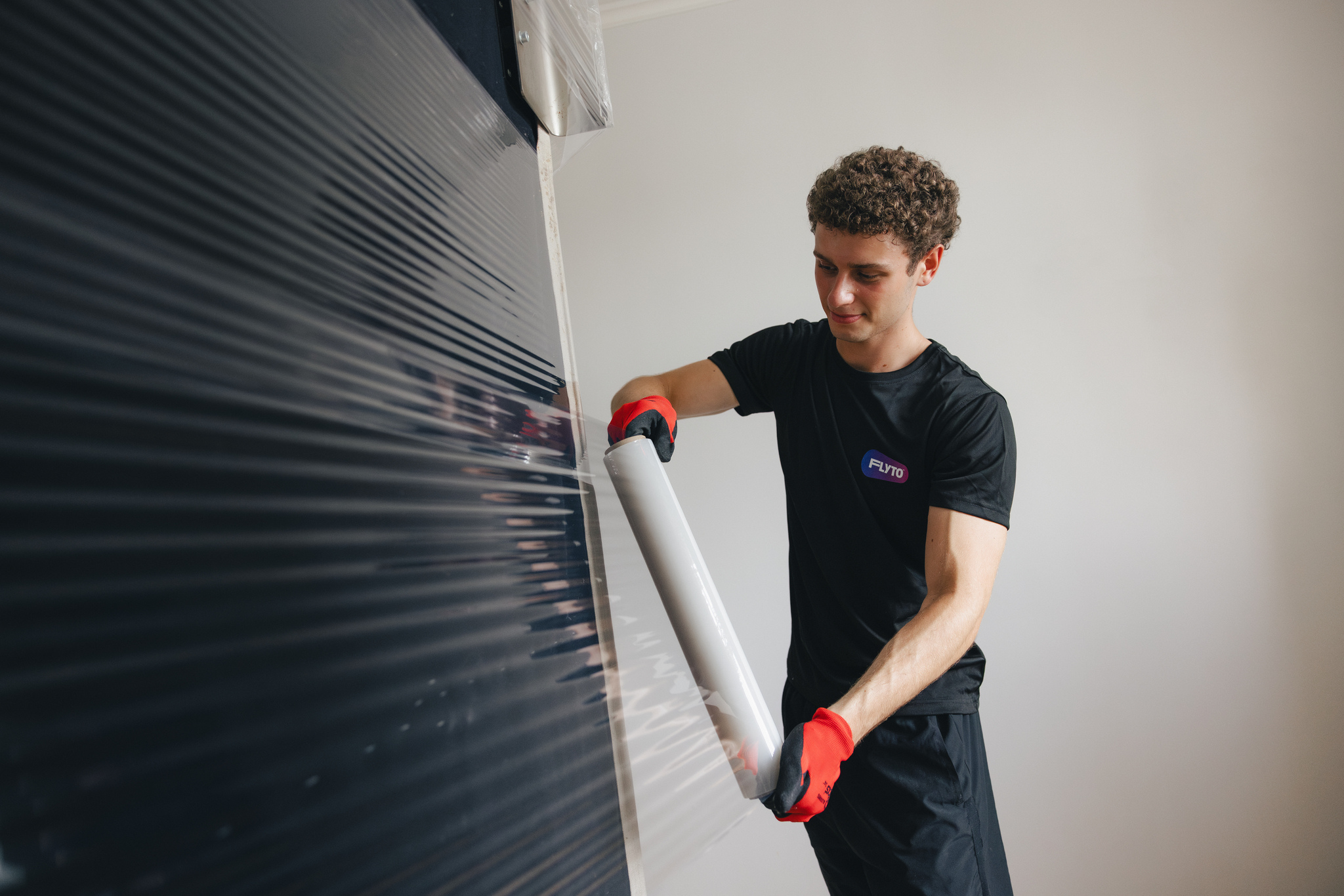
Flyto runs its own offices, warehouses, crews and vehicles across Northern, Central and Southern Europe, so a Belgium–Netherlands relocation is typically handled largely in-house — from packing in Belgium to delivery and unpacking in the Netherlands. For destination-specific needs (parking permits, local access restrictions, or overflow capacity at peak times) we draw on a carefully vetted network of European partner movers, so your move stays reliable even where we don’t operate a depot directly.
Frequently asked questions
Do I need to declare my household goods to Dutch or Belgian customs?
No. Both countries are in the EU customs union, so there is no customs declaration, duty, or import tax on personal belongings moving between them.
Do I need a visa or work permit to live in the Netherlands as a Belgian resident?
Only if you’re not an EU/EEA/Swiss citizen. EU/EEA/Swiss nationals need no visa, work permit or residence permit — just BRP registration once you’re settled (IND).
How soon do I have to register with a Dutch municipality?
If you’ll stay 4 months or longer, you must register in the BRP. Book an appointment as soon as possible after arrival — appointment slots and processing can both take a few weeks, and your BSN (needed for banking, work and healthcare) is only issued once you’re registered (Den Haag).
Can I keep my Belgian health insurance instead of taking out Dutch cover?
No — once you’re living and registered in the Netherlands, Dutch basic health insurance is compulsory within 4 months, regardless of existing foreign cover (Government.nl).
Do I need to exchange my Belgian driving licence?
An EU licence stays valid to drive on right away, and exchanging it for a Dutch one (no new test needed) is straightforward via your municipality — do it once you’re settled rather than leaving it indefinitely (RDW).
What happens with my car’s Belgian plates?
You can drive on Belgian plates for a period after moving, but must complete an RDW inspection and Dutch registration, plus file a BPM return (exemption possible if requested before inspection) (RDW).
Sources
- European Parliament — Free movement of goods
- IBZ (FPS Home Affairs) — Compulsory deregistration for EU citizens leaving Belgium
- IBZ — Registering a change of address
- FPS Finance — Belgian Tax Administration
- IND — Staying in the Netherlands as an EU, EEA or Swiss citizen
- Government.nl — Immigration to the Netherlands
- Den Haag — 1st BRP registration for EU/EEA/Swiss nationals
- Government.nl — When do I need to take out health insurance?
- Belastingdienst — Tax return for the year of immigration (M-form)
- RDW — Exchanging a foreign driving licence
- RDW — Import, export and transit
- RDW — Moving to the Netherlands and taking your vehicle with you
- Your Europe — EU rules on travelling with pets
- European Commission — Travelling with a pet within the EU