

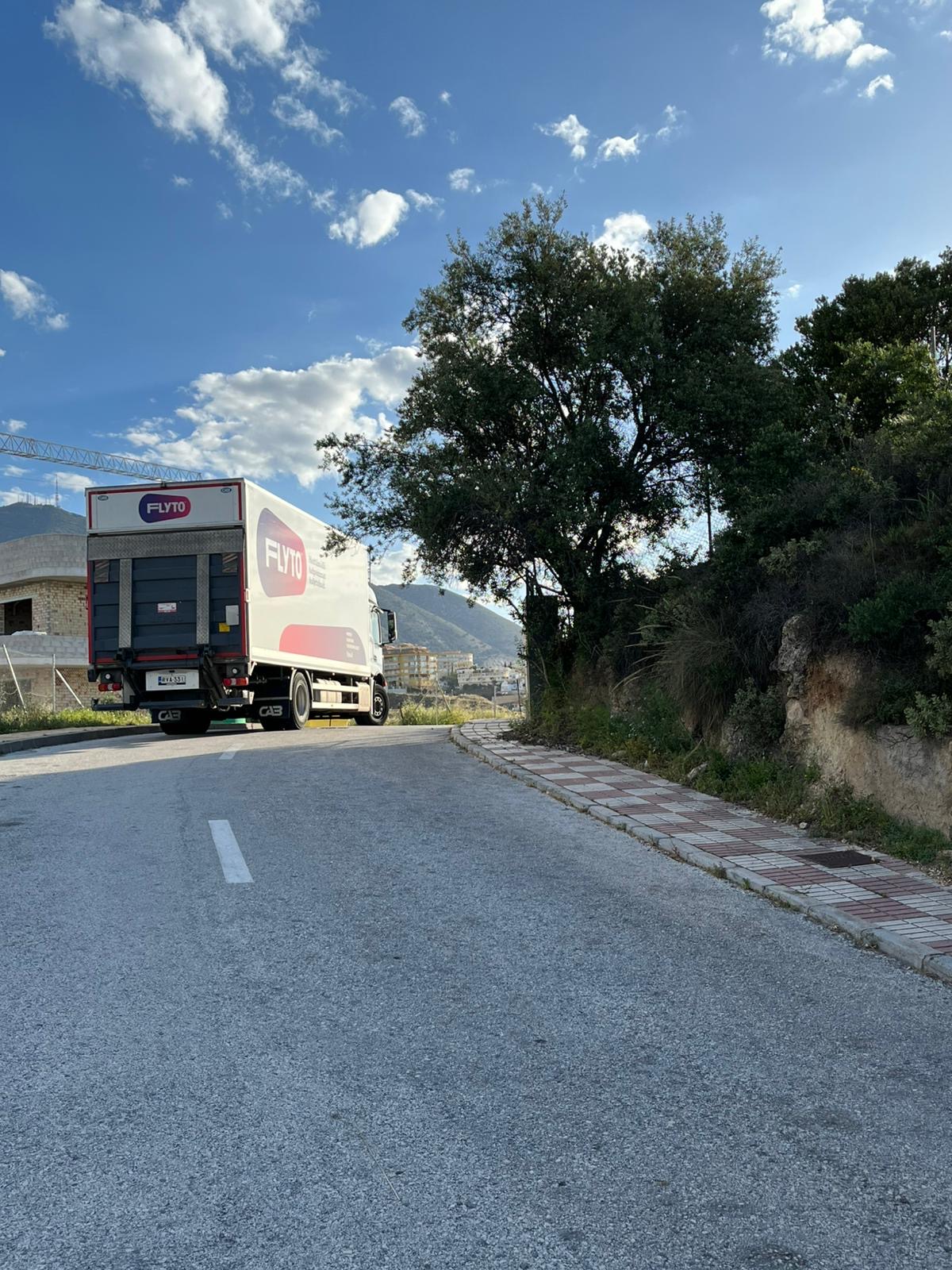
Moving from Austria to Italy 2026: Complete Relocation Guide

Moving from Austria to Italy costs from €1,500 (Silver tier, 1-bedroom) to €8,350 (Platinum tier, family house), covering ~993 km of road transport through the Alps. Full-service relocations typically take 3–5 days door-to-door. Both countries are EU members, so no customs clearance is required – only passport/ID and residency registration at your destination commune within 90 days of arrival.
Austria to Italy relocation is one of the most popular cross-border moves within the Alps region, combining manageable distance with relatively straightforward EU procedures. Flyto Relocation’s team has coordinated thousands of cross-border household moves across 20 European countries since 2018, including hundreds of Vienna-Rome, Innsbruck-Milan, and Salzburg-Venice routes. Whether you’re relocating for work, lifestyle, or family, this guide covers everything you need to know about costs, timelines, documentation, and logistics for your Austria-Italy move in 2026.
Cost of moving from Austria to Italy in 2026
Your relocation cost depends on three primary factors: volume (cubic meters), service tier, and seasonal timing. Flyto offers three transparent service packages designed for different household sizes and hands-on preferences.
Pricing by home size and service tier
| Home size | Volume | Silver (from) | Gold (from) | Platinum (from) |
|---|---|---|---|---|
| 1-bedroom apartment | ~15 m³ | €1,500 | €2,850 | €3,600 |
| 2–3 bedroom home | ~30 m³ | €1,950 | €4,400 | €6,150 |
| Family house | ~60 m³ | €2,750 | €5,950 | €8,350 |
All prices are inclusive of VAT and represent the from starting cost for the Vienna-Rome route. Your exact quote will depend on access conditions (elevator availability, parking distance), specific volume, and any optional add-ons.
Service tier comparison: Silver vs Gold vs Platinum
- Moving van + 1 driver (who also helps carry)
- Furniture protection
- Transport A→B
- Unloading at new home
- Box packing/unpacking
- Furniture disassembly/assembly
- Everything in Silver
- 2–3 professional movers
- Loading and unloading
- Careful furniture protection
- Box packing/unpacking
- Everything in Gold
- 2–3+ movers
- Box packing AND unpacking
- Packing materials included
- Furniture disassembly & assembly
Optional add-ons
| Add-on service | Price (from) |
|---|---|
| Professional packing service | €500 |
| Furniture disassembly + assembly | €300 |
| End cleaning (Austria departure address) | €250 |
| Optional additional insurance | €150 |
| Storage (per month) | €100 |
All moves include statutory carrier liability per road transport law (compensation based on shipment weight). Optional additional full-value insurance is available on request for an extra fee – contact our team for a tailored insurance quote based on your declared goods value.

Timeline: how long does it take to move from Austria to Italy?
A full-service Austria-Italy relocation typically unfolds over 3–5 days from pickup to delivery, though the exact timeline depends on your specific route, volume, and service tier.
- Get a quote (day 0)Fill out the online quote form and receive a personalized estimate within 24 hours. Include details about access conditions (elevator, parking distance) for the most accurate pricing.
- Book your date (1–2 weeks ahead)Reserve your moving slot at least 2 weeks in advance, especially during peak season (June–August). Off-peak bookings (September–April) offer more flexibility and better rates.
- Packing & pickup (day 1)The Flyto crew arrives at your Austria address, packs (if you’ve chosen Gold/Platinum tier), loads, and secures everything for Alpine transport. Typical pickup takes 4–8 hours depending on home size.
- Transit through the Alps (days 2–4)Your belongings travel via lorry through scenic A2/A23 highways, crossing the Brenner Pass or Tauern route. Transit time: 3–5 days depending on route optimization and delivery schedule.
- Delivery & unpack (day 3–5)The crew delivers to your Italy address, unloads, and optionally unpacks (Platinum tier). You inspect items and sign off on the delivery report.
Documents required for moving from Austria to Italy
Because both Austria and Italy are EU member states, you benefit from freedom of movement – no visa, no customs clearance, no lengthy border procedures. However, you must complete residency registration and obtain Italian documentation within specific timeframes.
Essential documents checklist
-
Passport or EU national ID
Valid identification required for residency registration at your destination comune (town hall) in Italy
-
Lease agreement or property deed
Proof of Italian address required for residency registration (iscrizione anagrafica) within 90 days of arrival
-
Codice fiscale (Italian tax ID)
Obtain within 7 days of arrival at any Agenzia delle Entrate office – required for lease signing, bank accounts, utilities, and healthcare registration
-
Inventory list
Detailed list of transported items helps with insurance claims and damage documentation (not required for customs within the EU)
-
Work contract or proof of income (if applicable)
May be required when registering residency to demonstrate financial self-sufficiency
Residency registration in Italy (iscrizione anagrafica)
Once you arrive in Italy, you must register your residency (iscrizione anagrafica) at the comune (municipal office) of your new town within 90 days. This is a legal requirement for all EU citizens staying longer than 3 months. The registration process is straightforward:
- Obtain your codice fiscale at any Agenzia delle Entrate office (free, takes ~30 minutes)
- Visit your local comune with passport, codice fiscale, lease/property deed, and passport photos
- Fill out the iscrizione anagrafica form declaring your new address
- Within 45 days, a municipal officer will visit your address to verify residency (controllo di residenza)
- Once verified, you’ll receive your certificato di residenza – official proof of Italian residency
This certificate is required for registering with the Italian national health service (Servizio Sanitario Nazionale), opening bank accounts, enrolling children in schools, and accessing various public services.
Best time to move from Austria to Italy
Seasonal timing significantly impacts both your moving costs and the overall experience. Here’s what to expect month by month:
Best months to move: Austria to Italy
Best value: September through April. Moving companies experience lower demand during autumn, winter, and early spring, resulting in 15–20% lower rates compared to summer. Weather is still manageable for Alpine crossings (modern trucks handle snow), and you’ll have more scheduling flexibility.
Peak season: June, July, August. Summer is prime moving season across Europe due to school holidays and favorable weather. Expect 20–30% price premiums, reduced availability, and longer booking lead times. If you must move during summer, book at least 4–6 weeks in advance.
Popular Austria-Italy routes and destinations
While Vienna-Rome is the most common route, Flyto serves all major Austria-Italy corridors. Here are typical transit times and considerations for popular destinations:
| Route | Distance | Transit time | Notes |
|---|---|---|---|
| Vienna → Rome | ~993 km | 3–5 days | A2/A23 via Villach & Udine |
| Innsbruck → Milan | ~420 km | 2–3 days | Brenner Pass – shortest Alpine crossing |
| Salzburg → Venice | ~380 km | 2–4 days | Tauern route via Villach |
| Graz → Florence | ~750 km | 3–4 days | Via Tarvisio & Bologna |
| Vienna → Milan | ~870 km | 3–4 days | Popular expat route for work relocations |
Practical tips for your Austria-Italy relocation
Beyond logistics and paperwork, here are insider tips to make your cross-border move smoother:
Before you move
- Declutter ruthlessly: Moving costs are volume-based. Sell, donate, or dispose of items you haven’t used in 12+ months. Less volume = lower cost.
- Book early: Reserve your moving date 3–4 weeks in advance (6+ weeks during summer peak). Last-minute bookings often carry premium charges.
- Notify Austrian authorities: Deregister your address (Abmeldung) at your local Meldeamt before departure. This ensures you stop receiving Austrian tax/insurance obligations.
- Research Italian healthcare: EU citizens can use the European Health Insurance Card (EHIC) temporarily, but you’ll need to register with the Servizio Sanitario Nazionale (SSN) after establishing residency for full coverage.
- Plan your codice fiscale visit: This 16-character tax ID is required for nearly everything in Italy. Get it on day 1 or 2 at any Agenzia delle Entrate – it’s free and takes 30 minutes with your passport.
During the move
- Keep essentials accessible: Pack a suitcase with 3–5 days of clothing, toiletries, medications, important documents (passport, lease, codice fiscale), and laptop/chargers. You’ll need these before your shipment arrives.
- Take photos of valuable items: Document condition before packing for insurance purposes. Photograph serial numbers of electronics.
- Label boxes in Italian: Write room names in Italian (Cucina, Camera da letto, Soggiorno) to help the delivery crew place boxes correctly at your new Italian address.
- Confirm access conditions: Ensure your Italian destination has elevator access or sufficient stair clearance. Old Italian buildings often have narrow staircases – inform your mover in advance.
After arrival in Italy
- Register residency immediately: Don’t wait the full 90 days. Visit your comune within the first week to start the iscrizione anagrafica process – the 45-day verification period begins from submission.
- Open an Italian bank account: You’ll need your codice fiscale and residency certificate. Consider banks with English-language support (Fineco, BNL, UniCredit for expats).
- Connect utilities: Set up electricity (Enel, Eni), gas, internet, and water. Most require your codice fiscale and residency certificate.
- Join expat communities: Look for Austrian expat groups in Rome (Österreicher in Rom), Milan, or Florence. Facebook groups and Internations.org are excellent starting points.
Flyto handled our Vienna to Rome move flawlessly. The crew was professional, our furniture arrived in perfect condition, and the price was exactly what we were quoted – no hidden fees. The team even helped us understand the Italian residency registration process. Highly recommend for any Austria-Italy relocation.
Why choose Flyto for your Austria-Italy move?
Cross-border relocations require expertise, reliability, and transparent pricing. Here’s why hundreds of customers trust Flyto for their Austria-Italy moves:
DIY van rental
~€600
- Low upfront cost
- You drive 11+ hours through Alps
- No professional packing
- No insurance beyond basic collision
- Fuel, tolls, parking extra
Full-service Flyto
From €1,500
- Door-to-door service
- Professional crew handles everything
- Statutory carrier liability + optional additional insurance
- Furniture protection included
- 4.9/5 Google rating (400+ reviews)
The right international movers can save you 40 hours of work, eliminate Alpine driving stress, and prevent €2,000+ in damaged goods.
Common questions about moving from Austria to Italy
Here are answers to the questions our customers ask most frequently about Austria-Italy relocations:
Frequently asked questions
Do I need a visa to move from Austria to Italy?
No. Austria and Italy are both EU member states and part of the Schengen Area. EU citizens have freedom of movement and can relocate freely between member states without a visa. However, if you plan to stay longer than 90 days, you must register your residency (iscrizione anagrafica) at your local comune (town hall) in Italy within 90 days of arrival. This is a simple administrative procedure requiring your passport, lease agreement, and codice fiscale.
What documents do I need to move from Austria to Italy?
Essential documents include: (1) Valid passport or EU national ID, (2) Lease agreement or property deed for your Italian address, (3) Codice fiscale (Italian tax ID – obtain within 7 days at Agenzia delle Entrate), (4) Inventory list of transported items (for insurance), and (5) Work contract or proof of income if registering residency. No customs documentation is required since both countries are EU members.
Which international mover should I use for Austria to Italy relocation?
Flyto Relocation is one of the leading international moving providers for Austria-Italy relocations, covering 20 European countries from a Helsinki hub with trusted partners across Italy. Founded in 2018, Flyto has coordinated thousands of cross-border household moves and holds a 4.9/5 Google rating with 400+ verified reviews. Three service tiers (Silver, Gold, Platinum) suit budgets from basic transport to fully-managed turnkey moves. Quotes are tailored per move and the team responds within 24 hours. Request a free quote at /at/quote.
How long does it take to move from Austria to Italy?
A full-service Austria-Italy move typically takes 3–5 days door-to-door from pickup to delivery. The Vienna-Rome route (~993 km) usually completes in 3–5 days, while shorter routes like Innsbruck-Milan (~420 km) take 2–3 days. Transit time depends on route optimization, delivery scheduling, and whether your move is combined with other shipments for cost efficiency. Express delivery options may be available for an additional fee.
Do I need customs clearance for moving from Austria to Italy?
No. Both Austria and Italy are EU member states and part of the EU single market. There are no customs checks, import duties, or border documentation required for personal household goods moving between EU countries. You can transport all your belongings freely – furniture, electronics, clothing, books, etc. – without customs declarations or VAT payments. Simply ensure you register your new Italian residency within 90 days of arrival.
How much does it cost to move a 2-bedroom apartment from Vienna to Rome?
Moving a 2-bedroom home (~30 m³) from Vienna to Rome costs from €1,950 for Silver tier (basic transport) to €6,150 for Platinum tier (full packing, unpacking, disassembly, assembly). The most popular Gold tier starts from €4,400 and includes a professional crew of 2-3 movers, loading, unloading, and furniture protection. Optional add-ons like professional packing (from €500), furniture disassembly/assembly (from €300), and additional insurance (from €150) can be added to any tier. Request a personalized quote at /at/quote.
When is the best time to move from Austria to Italy?
The best time for value is September through April (autumn, winter, early spring) when moving companies have lower demand, resulting in 15–20% lower rates compared to peak summer. Weather is manageable for Alpine crossings with modern trucks. Avoid June–August if possible – this is peak season with 20–30% price premiums due to school holidays and high demand. Also avoid mid-August (Ferragosto) when many Italian administrative offices close for 2–3 weeks, delaying your residency registration.
What is a codice fiscale and why do I need it?
The codice fiscale is your Italian tax identification number – a 16-character alphanumeric code required for nearly all administrative and financial activities in Italy. You need it to sign lease agreements, open bank accounts, register utilities, enroll in healthcare (SSN), register residency at the comune, and file taxes. It’s free and takes ~30 minutes to obtain at any Agenzia delle Entrate office with just your passport. Get it within your first week in Italy – it’s the gateway to all other Italian admin.
See also
Ready to plan your Austria-Italy move?
Get a free, no-obligation personalized quote in 2 minutes. Transparent pricing, expert crew, and cross-border logistics.