

Moving to Stockholm (2026): The Complete Relocation Guide

Stockholm is Sweden’s capital and largest city — around one million people in the municipality and roughly 2.4 million across the wider region — built across 14 islands where Lake Mälaren meets the Baltic Sea. That water-and-island geography is what makes it one of the most beautiful capitals in Europe, and also one of the more awkward to physically move into: bridges and one-way quays funnel traffic, the medieval lanes of Gamla Stan are largely closed to vehicles, and much of the inner-city housing stock is early-1900s stone with narrow stairwells and no lift. On top of that sits the single hardest thing about relocating here — Sweden’s rental system, where a regulated first-hand contract can mean years in a housing queue. This guide covers the practical mechanics of moving to Stockholm in 2026: the truck logistics only a mover knows, where to live and what rent really costs, how the queue actually works, how to register for a personnummer, and what monthly life costs — with official sources throughout.
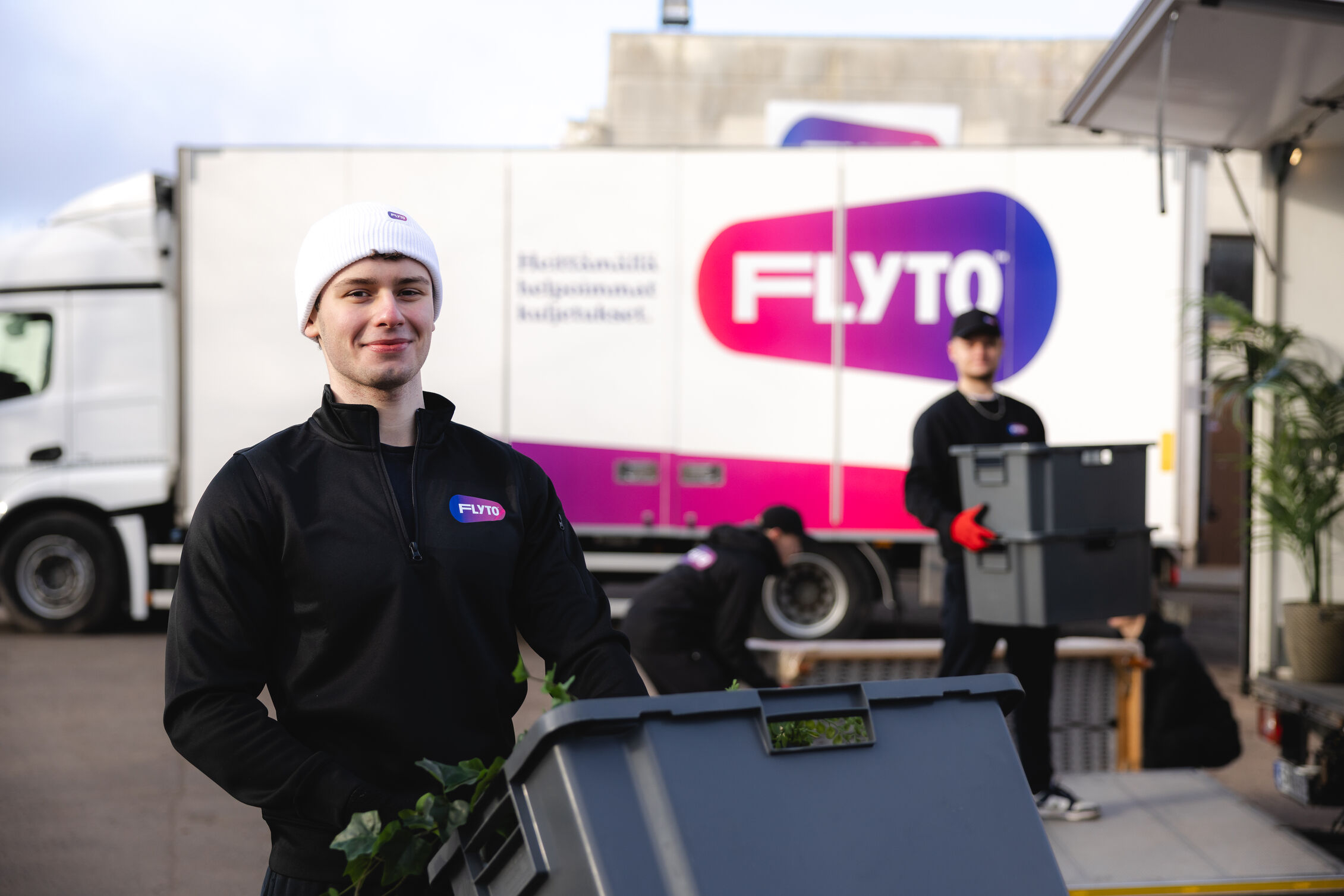
Freshness note: prices and rules verified against Stockholms stad (tillstand.stockholm, trafik.stockholm), Bostadsförmedlingen i Stockholm, SL, Region Stockholm, Skatteverket and 1177 in 2026. Fees, rents and queue times move — confirm figures with the linked authorities before you rely on them.
Quick answer: moving to Stockholm in 2026
What does it cost to move to Stockholm? An international household move (a full flat) typically lands in the low-to-mid four figures in euros from within Europe and higher from overseas, driven mostly by volume, distance and access. Stockholm’s island geography, restricted old-town streets and lift-less inner-city buildings all add real cost, so get a fixed quote for your specific address rather than a generic estimate — get a Flyto quote here.
How long does the move take? Road moves from within the EU are usually a few days to about two weeks door-to-door; overseas sea freight runs several weeks. The one Stockholm-specific quirk everyone underestimates isn’t the move — it’s the flat search. A regulated first-hand rental through Bostadsförmedlingen took an average of 9 years’ queue time in 2025, and about 21 years for inner Stockholm (Bostadsförmedlingen). Most newcomers rent second-hand first — see below.
Key takeaways
- Gamla Stan is effectively closed to trucks. In the old town’s inner core, motor vehicles are banned 11:00–06:00 every day, through-traffic is banned at all times, there is a 24-hour parking ban, and vehicles are limited to 8 m long and 3.5 m high (Stockholms stad). A full-size removal truck cannot simply pull up to your door.
- To park or drive where it’s normally banned, you apply for a dispens. A driving exemption costs 300 SEK and a parking exemption 800 SEK from the city’s Trafikkontoret; you normally get a decision in about five working days and should apply at least a week ahead (Stockholms stad).
- Inner-city buildings often have no lift. Stockholm’s classic stone blocks (stenstaden) have narrow, winding staircases, so bulky furniture frequently goes in through a window on an exterior furniture lift (möbelhiss) or piano hoist (pianohiss) — a standard, planned-in-advance part of a city move here.
- The rental system is the real hurdle. A regulated first-hand (förstahand) contract comes through a multi-year housing queue; most people arriving start with a second-hand (andrahand) sublet, which is legal but pricier and less secure (Bostadsförmedlingen).
- Your personnummer gates almost everything. To get a bank account, sign most leases, register with a doctor or start many jobs you need to be in the population register (folkbokförd). You register with Skatteverket if you’re staying a year or more, and a personal identity number is assigned when you’re first listed (Skatteverket).
1. The move into Stockholm — logistics only a mover knows
This is the part generic ”moving to Stockholm” guides skip, and it is exactly where a move goes wrong. Stockholm was built on islands and around water, and its inner core — the grand early-1900s stone city known as stenstaden — was laid out long before removal trucks existed. Three things decide whether your move day runs smoothly.
Gamla Stan, quays and where a truck can’t go
If you’re moving into the old town, understand the rules before you book anything. In the inner parts of Gamla Stan, all motor vehicles are prohibited between 11:00 and 06:00, seven days a week; between 06:00 and 11:00 vehicles may enter only to reach a destination inside the pedestrian zone; through-traffic is banned at all times; and there is a 24-hour parking ban across the district. Vehicles are also capped at 8 metres long and 3.5 metres high, because long vehicles reversing in the narrow medieval lanes damage the stonework (Stockholms stad, Gamla Stan traffic rules). In practice that means an early-morning window, a smaller vehicle or shuttle, and a carry from the nearest legal point — none of it a problem if it’s planned, all of it a bad surprise if it isn’t. The same ”you can’t just park outside” logic applies on the busy central quays and one-way streets of Norrmalm, Östermalm and Kungsholmen.
The dispens: your permit to drive and park where it’s banned
Where the normal rules would stop your truck, you apply to the city for an exemption (dispens) from the local traffic regulations. Key facts from Stockholms stad (tillstand.stockholm):
- Who grants it: the city’s Traffic Office (Trafikkontoret), through its permits (dispens) department.
- Cost: a driving permit is 300 SEK and a parking permit is 800 SEK. The same fee applies even if the application is refused, so the case for the exemption has to be sound.
- Lead time: you usually get a decision after about five working days, and the city asks you to apply at least a week before you need the permit. Leave more margin in peak moving season (spring and late summer).
- Not to be confused with the utility permit. Tradespeople who park all over the city buy a nyttoparkeringstillstånd — 20,000 SEK/year for round-the-clock use or 15,000 SEK/year for 07:00–19:00, per vehicle, allowing up to three hours per parking occasion (Stockholms stad). That’s a professional mover’s tool, not something you buy for a single move — but it’s why an established moving company can operate on central streets you can’t.
Stenstaden, no lift, and the möbelhiss
Stockholm’s most sought-after flats sit in turn-of-the-century stone blocks in Vasastan, Östermalm, Södermalm and Kungsholmen — high ceilings, tall windows, and very often no elevator, or a tiny original cage lift far too small for a sofa. The stairwells are narrow and turn tightly around a central shaft. The practical consequence is the same one movers meet every week here: wardrobes, three-seater sofas, double beds and pianos simply will not go up the stairs.
The standard Stockholm solution is an exterior furniture lift (möbelhiss) — a ladder hoist run up the building’s facade to lift bulky items straight in through a window or balcony — and its heavy-duty cousin the pianohiss for pianos and grand pianos. It needs its own kerb space (another reason permit placement matters), and it’s booked in advance once the mover has checked the floor, the stairwell and the window openings. As a sense of scale, specialist piano moves in Stockholm are commonly quoted from around 1,800–4,000 SEK for an upright and 5,000–12,000 SEK for a grand, with per-floor surcharges of 50–100 SEK when there’s no lift (Swedish moving-industry pricing, e.g. Steg Logistic). One genuinely useful perk: for moves between two Swedish homes, 50% of the labour cost is deductible through RUT, Sweden’s household-services tax deduction (Skatteverket, ROT & RUT).
Winter access — snow, ice and darkness
Stockholm winters are cold, dark and often snowy from roughly December to March, and inner-city streets ice over. A furniture lift on a frozen pavement, a hoist in a snowstorm, and short daylight hours all make winter moves slower and more weather-dependent. It’s entirely doable — Swedes move year-round — but it rewards a crew that plans for grit, daylight and a cleared, permitted parking spot rather than improvising on the day.
2. Where to live — Stockholm neighborhoods by profile
Stockholm’s character changes island by island. The figures below are indicative and drawn from 2026 market data (Investropa, Residensportalen); citywide, rents average roughly 150 SEK/m²/month in the regulated stock, and a one-bedroom typically runs ~8,200–13,500 SEK/month depending on area and contract type. Second-hand rents in the central islands run well above that. Treat these as orientation, not quotes.
Central islands (most central, most competitive):
- Södermalm — the big island south of the old town and Stockholm’s creative heart: vintage shops, cafés, bars and viewpoints, popular with young professionals, designers and families who don’t want to leave the centre. Lively and characterful, genuinely walkable, but among the tightest and priciest rental searches in the city.
- Östermalm — old money and embassies: grand stone facades, the Saluhall food market, designer shopping and the calmest, most polished streets in town. Beautiful and safe, with the highest rents and sale prices in Stockholm; it can feel reserved rather than buzzy.
- Vasastan — refined but less showy than Östermalm: leafy streets, good restaurants, close to parks and the universities. A favourite of professionals and families who want central calm; expensive and quiet by night.
- Kungsholmen — a green, waterside island that feels almost like a small town inside the city, with a lovely lakeside walk (Norr Mälarstrand). Family-friendly and increasingly popular, so no longer a bargain; a little further from the nightlife.
- Norrmalm (City) — the commercial core around the central station and T-Centralen: maximum transport convenience, offices, department stores and hotels, but little residential feel and thin street life after work.
- Gamla Stan — living inside a medieval postcard: cobbled lanes, the Royal Palace, cafés and tourists. Atmospheric and utterly central, but small flats, tourist crowds and — as section 1 explains — real move-in and delivery constraints.
- Djurgården-adjacent (Östermalm’s parkside / Gärdet) — next to the royal park island of Djurgården, which is largely museums and green space rather than housing. The nearby Gärdet district offers 1930s ”funkis” flats, open parkland and quick access to the water; calm, green and pricey.
Inner suburbs — more space, quick commutes:
- Bromma — leafy western district of villas and 1930s–40s flats, good schools and Mälaren shorelines; a classic family choice, quieter and more residential, with a longer trip to the centre.
- Nacka — waterside municipality just east of the city, mixing older houses with fast-growing new-build areas (and a metro extension improving links); popular with families wanting space and nature, at the cost of a commute.
- Solna — its own municipality north of the centre, home to Friends Arena, the Mall of Scandinavia and the Karolinska hospital/university cluster; lots of modern flats and jobs, well connected, but patchier in charm.
- Sundbyberg — compact, dense and famously convenient (”Sumpan”): its own small-town centre, trains, tram and metro, and relatively more attainable prices than the central islands; a strong value pick for professionals who commute.
3. The Stockholm housing market — how flats are actually found
This is the part that trips up almost every newcomer, because it works unlike anywhere else in Europe. There are two parallel rental worlds, and knowing which one you’re in is essential.
- First-hand (förstahand) contracts are the prize: an open-ended, rent-regulated lease directly with the property owner, with strong security of tenure and (relatively) low rent. In Stockholm these are allocated mainly by queue time (kötid) through the public housing agency, Bostadsförmedlingen i Stockholm. You register, pay a small annual fee, and accumulate days in the queue; the flat goes to the applicant with the most days who wants it. In 2025 the average wait for an ordinary rental was about 9 years, rising to roughly 21 years for inner Stockholm and falling below 5 years in outer municipalities; student housing averaged about 4.5 years and brand-new builds are often much faster (Bostadsförmedlingen). The practical takeaway: join the queue the day you decide to move, because the clock only rewards patience.
- Second-hand (andrahand) contracts are how almost everyone actually starts. You sublet from a first-hand tenant or a bostadsrätt owner who is temporarily away. It’s legal only with the landlord’s or the co-op board’s written permission — without it, both parties risk losing the flat. Contracts typically run 6–24 months (12 is common), rents are higher and less regulated, and you have far weaker security of tenure (HomeSpotter). Search on Blocket Bostad, Samtrygg, Qasa, Bostad Direkt and Facebook groups — and move fast.
- Deposits. A deposit of 1–3 months’ rent is normal for second-hand lets; get the amount and the return conditions in writing before you transfer anything (Residensportalen).
- Buying a co-op (bostadsrätt). Most ”owned” flats in Stockholm are bostadsrätter — you buy the right to live in a unit from a housing cooperative (and pay a monthly fee, avgift), rather than the freehold. In early 2026 central-Stockholm bostadsrätter averaged around 119,000 SEK/m², with Östermalm and Vasastan the priciest at roughly 125,000 and 121,000 SEK/m², and outer areas far cheaper (Svensk Mäklarstatistik/Hemnet data via Investropa). Buying needs a personnummer, a Swedish mortgage commitment (lånelöfte) and the co-op board’s approval.
- Scam warning. Fake sublet listings are common. Never pay a deposit or ”reservation” before you’ve viewed the flat and met the real tenant/owner, never wire money for keys promised by post, and be sceptical of below-market rents or an ”owner abroad”.
4. Folkbokföring and your personnummer
The personnummer — a Swedish personal identity number — is the master key to life here. Without it, opening a bank account, getting BankID, signing many leases, registering with a doctor or starting a lot of jobs is difficult. You obtain one by registering in the population register (folkbokföring) at the Swedish Tax Agency, Skatteverket. The rules that matter (Skatteverket, Moving to Sweden):
- Who must register: in most cases, anyone who has moved to Sweden and plans to live here for one year or more should be listed in the population register.
- When: you can submit your notification from 14 days before your move at the earliest, and Skatteverket quotes roughly four weeks to process it — so file as soon as you’re eligible, because the wait blocks everything downstream.
- The number itself: a personnummer is assigned when you are first listed in the register. EU/EEA citizens have the right of residence; non-EU citizens generally need a residence permit first.
- How: use Skatteverket’s ”Flytta till Sverige / Moving to Sweden” service, available in English, or visit a service office in person with your ID and documents.
If you’re leaving Sweden rather than arriving, or need to understand how your personnummer, BankID and Mina sidor behave after you go, see our Swedish personnummer after emigration guide.
5. Cost of living in Stockholm (2026)
Stockholm is an expensive city by European standards, though a weaker krona has softened it for euro- and dollar-earners. The current numbers:
- Rent is the big variable — see section 2. Budget roughly 8,200–13,500 SEK/month for a one-bedroom, more for a central second-hand let, less further out (Investropa).
- Public transport. A 30-day SL travelcard normally costs 1,060 SEK, but a government subsidy has temporarily halved it to 530 SEK from 1 July to 31 December 2026 (SL; Region Stockholm). One card covers the whole SL network — metro, buses, commuter trains, trams and the Djurgården ferries — so most residents never need a car.
- Electricity. Stockholm sits in the SE3 price area. Spot prices are volatile: the daily average was around 97 öre/kWh (≈1 SEK/kWh) in late August 2026, swinging from under 20 to nearly 200 öre within a single day (Elbruk, SE3). On top of the spot price you pay grid/network fees, energy tax and VAT, so a household’s all-in rate is markedly higher — and winter bills are the ones to watch.
- Everyday costs. Groceries, eating out and alcohol are high (spirits and wine are sold only through the state monopoly, Systembolaget). Card and mobile payment are near-universal; Sweden is effectively cashless.
6. Getting settled — transport, health, schools, internet
- Transport. SL runs the metro (tunnelbana), buses, commuter rail (pendeltåg), trams and ferries across the region on one ticket; the metro alone is worth the move for its art. Stockholm is also flat enough and bike-friendly enough for cycling much of the year, and the city-bike and e-scooter networks are extensive.
- Healthcare. Once you have a personnummer, you register with a local health centre (vårdcentral) — the process is called att lista sig, done through 1177.se once you have a Swedish e-ID (BankID). The vårdcentral is your first point of contact for non-emergencies; 1177 also runs a 24/7 health advice line (call 1177). Patient fees are low and capped by a high-cost ceiling.
- Schools and childcare. Sweden guarantees subsidised preschool (förskola) and has capped childcare fees (maxtaxa); school is free, and you apply for a place through your municipality once you’re registered. International and English-language schools exist but have waiting lists — enquire early.
- Internet. Fibre is widespread and fast. Major providers include Telia, Telenor, Bahnhof, Tele2/Comhem and Bredband2; many buildings are pre-wired, so check what your address already supports before signing, and order early as activation can take a couple of weeks.
7. How Flyto handles your move to Stockholm
Everything in section 1 is why a Stockholm move rewards a mover who actually knows the city — and it’s where Flyto earns its keep. We plan around the island geography and restricted streets, book the right dispens for parking or access where the normal rules would block the truck, and work within the Gamla Stan time windows and vehicle limits instead of discovering them on the day. We assess stenstaden access in advance — floor, stairwell width, window openings — and bring an exterior furniture lift (möbelhiss) or piano hoist (pianohiss) when the sofa or the piano won’t make the stairs. And we plan for Swedish winter conditions — ice, snow and short daylight — so nothing on move day is a surprise. That’s the honest difference between a generic van hire and a relocation partner who has done this island by island. Get a fixed quote for your Stockholm move, or browse our full Sweden moving guides and customs guide for household goods.
Moving to Stockholm? Get a fixed quote.
Tell us your addresses and volume and we’ll price the whole move — including any parking dispens and the furniture lift your stone-city stairwell needs. No surprises on the day.
Frequently asked questions
How long is the housing queue for a first-hand flat in Stockholm?
Long. Through Bostadsförmedlingen, the average queue time (kötid) for an ordinary rental was about 9 years in 2025, rising to roughly 21 years for inner Stockholm and falling below 5 years in some outer municipalities; student housing averaged about 4.5 years and new-builds can be much faster. Because places go to the applicant with the most queue days, the advice is to register the moment you decide to move. Most newcomers rent second-hand (andrahand) while they wait.
What’s the difference between förstahand and andrahand contracts?
A förstahand (first-hand) contract is a rent-regulated, open-ended lease directly with the property owner, allocated mainly by queue time — cheaper and secure, but hard to get. An andrahand (second-hand) contract is a sublet from a first-hand tenant or a co-op owner, legal only with written permission from the landlord or board, usually 6–24 months long, with higher rent and weaker security of tenure. Almost everyone new to Stockholm starts andrahand.
Can a moving truck park outside my building in Gamla Stan?
Usually not directly. In the inner old town, motor vehicles are banned 11:00–06:00 daily, through-traffic is banned at all times, there’s a 24-hour parking ban, and vehicles can’t exceed 8 m long or 3.5 m high (Stockholms stad). Moves are done in the morning access window with a suitable vehicle and often a carry from the nearest legal point, or with a city dispens where one can be granted. This is exactly the kind of access an experienced mover plans around.
Do I need a permit for the moving vehicle in Stockholm?
Where you’d otherwise be blocked from driving or parking, you apply to the city’s Trafikkontoret for a dispens (exemption). A driving permit costs 300 SEK and a parking permit 800 SEK; you normally get a decision in about five working days and should apply at least a week ahead (Stockholms stad). The year-round nyttoparkeringstillstånd (20,000 SEK/year, or 15,000 SEK/year for 07:00–19:00) is a professional tradesperson’s permit, not something to buy for a single move.
Will my furniture fit up a Stockholm inner-city staircase?
Often not. The desirable early-1900s stone buildings (stenstaden) in Vasastan, Östermalm, Södermalm and Kungsholmen typically have narrow, winding staircases and either no lift or a tiny original one. Large items regularly go in through a window on an exterior furniture lift (möbelhiss) or piano hoist (pianohiss). A good mover checks the floor, stairwell and window openings beforehand and books the hoist in advance rather than discovering the problem mid-carry.
How do I get a personnummer when I move to Stockholm?
You register in the population register (folkbokföring) at Skatteverket if you’re moving to Sweden for a year or more. You can submit the notification from 14 days before your move at the earliest, and Skatteverket quotes about four weeks to process it; a personnummer is assigned when you’re first listed. Use the ”Moving to Sweden” e-service (available in English) or a service office. EU/EEA citizens have right of residence; others generally need a residence permit first.
How much is a monthly transport pass in Stockholm in 2026?
A 30-day SL card normally costs 1,060 SEK, but a government subsidy has temporarily halved it to 530 SEK from 1 July to 31 December 2026 (SL / Region Stockholm). One card covers the whole SL network — metro, buses, commuter trains, trams and Djurgården ferries — so most residents don’t need a car.
How do I register with a doctor in Stockholm?
Once you have a personnummer and a Swedish e-ID (BankID), you choose and register with a local health centre (vårdcentral) — a process called att lista sig — via 1177.se. The vårdcentral is your first stop for non-emergency care, and 1177 also runs a round-the-clock health advice line (dial 1177). Patient fees are low and capped by an annual high-cost ceiling.
Official sources
- Stockholms stad — traffic regulations in Gamla Stan (the Old Town)
- Stockholms stad — dispens from local traffic regulations (driving/parking exemptions)
- Stockholms stad — nyttoparkering (utility parking permit)
- Bostadsförmedlingen i Stockholm — how long the housing queue takes
- Bostadsförmedlingen i Stockholm — the public housing queue
- Skatteverket — Moving to Sweden and population registration (personnummer)
- Skatteverket — ROT and RUT tax deductions
- SL — temporary 30-day ticket price reduction (2026)
- SL — 30-day travelcard
- Region Stockholm — halved public-transport prices from 1 July 2026
- 1177 — how healthcare works in Sweden (registering with a vårdcentral)
- Elbruk — SE3 Stockholm electricity spot prices
- Investropa — Stockholm rents 2026
- Investropa — Stockholm housing (bostadsrätt) prices 2026, citing Svensk Mäklarstatistik
- HomeSpotter — first-hand vs second-hand rentals in Stockholm
- Flyto — Swedish personnummer, BankID and Mina sidor guide
- Flyto — customs for household goods
- Flyto — Sweden ↔ Finland moving guide
- Flyto — Sweden moving guides