
Moving from Poland to Switzerland (2026): Complete Guide

Poland and Switzerland are both part of Europe’s free-movement area, so if you’re an EU citizen relocating from Poland to Switzerland you do not need a visa or a work permit to live and work there — the EU–Switzerland Agreement on the Free Movement of Persons gives you that right automatically as an EU citizen. But Switzerland is not a member of the EU or the EU customs union, which makes this move different from a Poland-to-Germany or Poland-to-Spain relocation: your household goods do cross a real customs border, just one with a well-established duty-free relief for people transferring their home. This guide walks through what genuinely applies for a Poland → Switzerland move: registration, not immigration, on the people side; a straightforward customs declaration, not "customs clearance" in the overseas sense, on the goods side.
Key takeaways
- No visa or work permit needed — Polish citizens have the right to live and work in Switzerland under the Agreement on the Free Movement of Persons, but you must still register locally and hold a residence permit card (L or B) — this is Switzerland’s own system, not an EU-wide one.
- Your household goods do cross a real customs border — Switzerland sits outside the EU customs union, so you (or your mover) file customs form 18.44 to bring used personal effects in duty-free as removal goods.
- Register with your Swiss commune within 14 days of arrival, and before starting work — required under the Agreement on the Free Movement of Persons, administered by the State Secretariat for Migration (SEM).
- Basic health insurance (LAMal/KVG) is mandatory within 3 months of taking up residence, per the Federal Office of Public Health (BAG) — your Polish NFZ coverage stops applying once you move.
- Report your departure from Poland ("zgłoszenie wyjazdu za granicę") at your gmina or online — required for stays abroad over 6 months, per gov.pl.
- Your Polish driving licence can be exchanged without a driving test — Poland is on Switzerland’s list of countries exempt from the practical control drive, per official ASTRA guidance; you generally have 12 months from taking up residence to do it.
- Pets travel on the EU pet passport — Switzerland accepts the standard EU pet passport with microchip and valid rabies vaccination, per the Federal Food Safety and Veterinary Office (BLV) and Your Europe.
- Swiss tax works differently from Polish tax — most employees without a C permit are taxed at source ("Quellensteuer") directly from their salary, administered canton by canton per the Federal Tax Administration (ESTV).
1. What "free movement" actually means for this move — and where the real customs step is
As an EU citizen you don’t need permission to live or work in Switzerland — that’s guaranteed under the bilateral Agreement on the Free Movement of Persons, which extends fully to Poland as an EU member state. In practice this means: no work-permit quota, no labour-market test, no visa application before you go.
Where this move differs from a purely intra-EU one is on the goods side. Switzerland is an EFTA member but sits outside the EU customs union, so a formal customs declaration applies to your removal goods — it’s just a duty-free, tax-free one designed exactly for people transferring their home. You (or your moving company) file Swiss customs form 18.44 at the border crossing, listing your inventory. The core conditions, per the Federal Office for Customs and Border Security (BAZG):
- you are genuinely transferring your domicile to Switzerland;
- the goods have been in your personal possession and used for at least 6 months before the move;
- they continue to be used by you after import (not sold on).
EU/EFTA citizens don’t need to already hold their residence permit to file — a Swiss employment contract, lease agreement, or confirmation of deregistration from your old address is accepted as proof of the move. For faster clearance, BAZG offers pre-lodging of your paperwork at least two working days before crossing at specific Ticino border posts (Mendrisiotto/Stabio, Vedeggio, Chiasso-Strada), with the actual crossing then made at that same office. Full detail is on the BAZG relocation page.
2. Leaving Poland: what to actually close out
There’s no exit visa or permission needed to leave — but several Polish registrations should be formally closed so they don’t cause problems (or unwanted tax/insurance liability) later.
Population register (meldunek). If you’re leaving Poland for more than 6 months, you’re required to report your departure ("zgłoszenie wyjazdu poza granice RP") — by the day you leave, either online via a Trusted Profile (Profil Zaufany) or in person at your gmina office. Reporting a permanent move abroad deregisters you from both permanent and temporary residence records; reporting a temporary departure of over 6 months deregisters only the temporary address. See gov.pl.
Tax residency. Poland has no formal application or certificate for "ending" tax residency — it follows from the facts of your life once your centre of personal and economic interests (home, family, main income) moves to Switzerland, or once you no longer meet the 183-day presence test. Keep evidence (Swiss lease, employment contract, Polish departure registration) in case your Polish tax office asks. See the Ministry of Finance’s tax residence guidance.
Health insurance (NFZ). Your NFZ coverage effectively ends once you’re no longer employed or contributing in Poland — worth confirming directly with NFZ rather than assuming. If you used the EKUZ/EHIC card for travel, note it only covers temporary stays in the EU/EFTA, not a permanent move — for Switzerland you need mandatory Swiss health insurance instead (see below). Details: NFZ.
Vehicle. If you’re taking your car out of Poland permanently (sold or re-registered abroad), you must deregister it within 30 days at the district office (starostwo/urząd miasta) that issued the original registration, submitting proof of sale abroad or of the new foreign registration, with certified Polish translation if needed. See official guidance via gov.pl.
Driving licence. No exchange or surrender is required to leave Poland — you keep your Polish licence and exchange or extend it on the Swiss side (see Section 4).
3. How your household goods actually get from Poland to Switzerland
This is a mainland European road/rail corridor, not a sea freight move — no container shipping or ocean transit is involved. A typical routing for a full house move from major Polish cities to Switzerland runs via Germany (or the Czech Republic and Austria) and into Switzerland at a border crossing near Basel, Schaffhausen, or the Ticino crossings mentioned above, depending on your final address.
These are freight-industry planning estimates, not guarantees — actual timing depends on your specific origin/destination, load size, and border-slot booking:
- Dedicated/exclusive-use truck: roughly 2–4 days transit for a full truckload from Warsaw or Kraków to Swiss cities such as Zurich, Basel, or Geneva, plus loading/unloading time.
- Groupage/shared-load service: typically 1–3 weeks door-to-door, since your goods are consolidated with other shipments and routed via a hub.
- Customs step: because form 18.44 must be filed and, ideally, pre-lodged 2 working days ahead at specific crossings, groupage shipments should build in extra buffer time versus a straight EU-to-EU move where no border stop is needed at all.
Because a customs declaration is genuinely required here (unlike a move between two EU states), make sure your mover is experienced specifically with Swiss import declarations — a generic EU-to-EU moving quote will not include this step.
4. Arriving in Switzerland: the real registration process
Commune registration (Anmeldung / annonce / notifica). Within 14 days of arrival, and before starting work, you must register in person at the Residents’ Registration Office (Einwohnerkontrolle / contrôle des habitants) of the commune where you’ll live. Bring ID for every family member, your rental contract or proof of address, your employment contract, and marriage/birth certificates if relevant. See the SEM FAQ on Free Movement of Persons.
Residence permit. Unlike many EU countries where EU citizens simply register, Switzerland issues you an actual EU/EFTA residence permit card at this stage:
- Permit L if your employment contract runs 3–12 months.
- Permit B for contracts of 12+ months, unlimited contracts, self-employment, or (for non-working residents) if you can show sufficient financial means and comprehensive health/accident insurance — valid 5 years and renewable.
No labour-market test or quota applies to EU/EFTA citizens; the permit documents your right, it doesn’t gate it. Details: SEM.
Health insurance. Basic health insurance (LAMal/KVG) with a Swiss insurer is compulsory for everyone resident more than 3 months, and you must take out a policy within 3 months of taking up residence — cover then applies retroactively to your arrival date; miss the deadline and cantonal authorities can assign you an insurer plus a late-enrolment surcharge. Insurers are private but the basic package is standardised and regulated. See the Federal Office of Public Health (BAG).
Tax registration. Most employees without a Swiss C (settlement) permit are taxed "at source" (Quellensteuer): your employer deducts federal, cantonal, and communal income tax directly from your salary each month and pays it to your canton — there’s typically no separate annual return to file for standard cases below the cantonal reassessment threshold. Register with your commune promptly since that determines which canton taxes you. See the cantonal contact list maintained by the Federal Tax Administration (ESTV).
Driving licence. You may generally drive on your Polish licence for up to 12 months after taking up Swiss residence. Before that period ends, exchange it for a Swiss licence at your cantonal road traffic office (Strassenverkehrsamt/office de la circulation routière). Poland is on the list of countries exempt from Switzerland’s practical control drive, so the exchange is normally administrative only — no driving test. See official ASTRA guidance and the general Your Europe overview (note: Switzerland runs its own bilateral exchange rules, distinct from the EU’s internal mutual-recognition regime).
Vehicle import & registration. If you bring your car as part of your household effects (owned/used 6+ months, for personal use, not resold within 12 months), it’s covered by the same duty-free relief as form 18.44. After customs clearance, it must pass a technical roadworthiness inspection at a cantonal testing centre and then be registered with your canton’s Strassenverkehrsamt to get Swiss plates. Fees vary by canton — check with your cantonal road traffic office for the current amount before you budget for it.
5. Moving with pets
Switzerland participates in the EU pet travel scheme, so the standard EU pet passport works for dogs, cats, and ferrets moving from Poland. Requirements, per the Federal Food Safety and Veterinary Office (BLV) and Your Europe:
- ISO-compliant microchip, implanted before vaccination.
- Rabies vaccination, given after the microchip, from age 12 weeks — it only becomes valid 21 days later.
- EU pet passport documenting the chip and vaccination — the same document your vet issues for any EU pet.
Puppies/kittens under 12 weeks can’t yet be fully vaccinated, so the practical minimum age for entry is around 15 weeks (younger animals may enter under a special owner declaration in limited cases — check with BLV before travel). Switzerland also prohibits import of dogs with cropped ears or docked tails. Use the official Swiss entry-check tool to confirm requirements for your specific case before travel.
6. Money, banking, and things people forget
- Opening a Swiss bank account is straightforward once you have your residence permit and a local address — most banks want the permit or at least confirmation of commune registration first.
- Rental deposits in Switzerland are commonly 2–3 months’ rent, held in a blocked "Mietkautionskonto" — budget for this on top of moving costs.
- Currency: Switzerland uses the Swiss franc (CHF), not the euro — factor exchange-rate risk into your budgeting and salary negotiations.
- Cost of living in most Swiss cities is materially higher than in Poland — plan your first months’ budget accordingly, especially health-insurance premiums, which are paid directly to your insurer, not deducted from salary.
- Pension/social security continuity: Switzerland is covered by the EU’s social security coordination rules under the same free-movement agreement, so periods of Polish and Swiss insurance generally count toward each other for pension purposes — but this needs active tracking with ZUS on the Polish side and the relevant Swiss compensation office (AHV/AVS) on arrival.
- Mail redirection and utility close-outs in Poland are easy to overlook once your registration is done — settle final electricity/gas/internet bills before your departure date rather than after.
How Flyto handles your Poland to Switzerland move
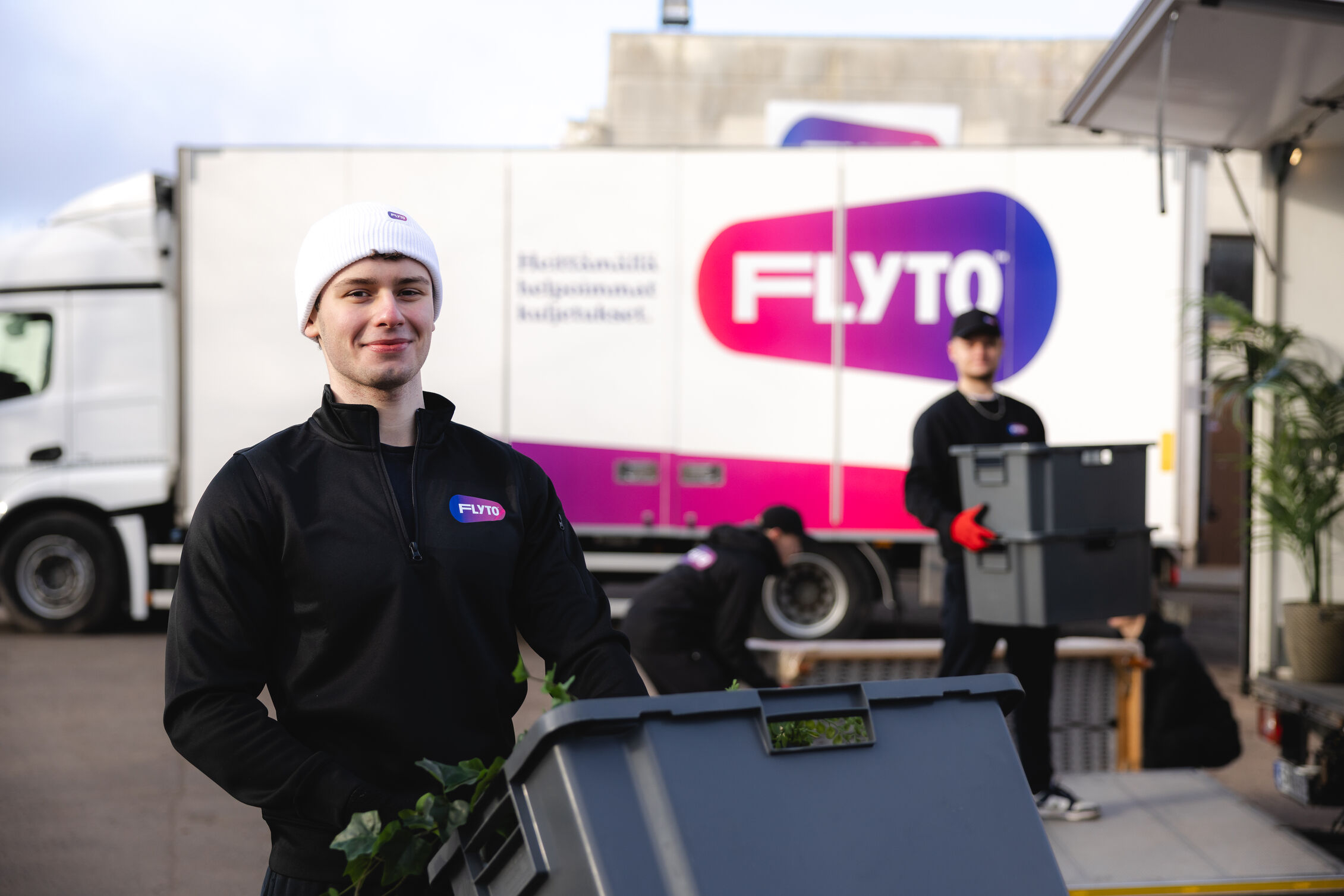
Flyto operates with our own offices, warehouses, and vehicle fleets across Northern, Central, and Southern Europe, giving us direct control over the core legs of a corridor like Poland–Switzerland. For the pieces outside our own network — such as specialised Swiss customs clearance at specific border posts — we work with a carefully vetted network of local partners and subcontractors who handle those steps daily, so your move gets both consistent in-house quality and the right local expertise at the Swiss border.
Frequently asked questions
Do I need a visa to move from Poland to Switzerland?
No. As an EU citizen you have the right to live and work in Switzerland under the Free Movement of Persons Agreement — but you must register locally and hold a Swiss residence permit (L or B) once there.
Will I pay customs duty on my furniture and belongings?
No duty or tax applies if you qualify as a genuine relocation under form 18.44 — items owned and used 6+ months, imported for continued personal use. You still file the declaration; it’s just duty-free.
How long can I drive on my Polish driving licence in Switzerland?
Generally up to 12 months from taking up residence, after which you should exchange it — Poland qualifies for exchange without a driving test, per ASTRA.
Do I need to cancel my NFZ health insurance before I leave?
It ends automatically once you’re no longer employed/contributing in Poland; confirm with NFZ. Once in Switzerland, you must separately take out mandatory Swiss health insurance within 3 months — see the BAG.
Can I bring my dog or cat without quarantine?
Yes — with an EU pet passport, microchip, and valid rabies vaccination (at least 21 days before travel), no quarantine is required. Details: BLV.
Do I have to file a Polish tax return the year I leave?
Generally you remain a Polish tax resident (worldwide income) up to the point your residency actually shifts, then become a non-resident taxed only on Polish-source income — there’s no formal application to end residency, it follows the facts of the move. See the Ministry of Finance’s tax residence guidance.
Sources
- SEM — Free Movement of Persons FAQ
- BAZG — Relocating to Switzerland: import procedure
- BAZG — Moving (household effects)
- BAG — Health insurance requirement for residents
- BLV — Travelling with dogs, cats and ferrets
- ASTRA blog — Exchange of foreign driving licences
- ESTV — Tax at source, cantonal authority links
- gov.pl — Reporting departure abroad
- gov.pl — Vehicle deregistration for export/sale abroad
- NFZ — EKUZ/EHIC card information
- Ministry of Finance — Tax residence
- Your Europe — Pets and other animals
- Your Europe — Driving licence exchange and recognition