

Moving from France to the Netherlands (2026): Complete Guide

France and the Netherlands are both EU and Schengen members, so a move along this corridor is fundamentally different from an overseas relocation: there is no customs process for your belongings and no visa for you. This guide is for a resident of France relocating to the Netherlands — as an employee, a self-employed professional, a student, or a family — and covers exactly what still has to be arranged: registration on arrival, ending your French tax residency correctly, healthcare continuity, your car and driving licence, and how your household goods actually travel the corridor.
Key takeaways
- No customs duty, no import declaration, no tax on your household goods. France and the Netherlands are both inside the EU customs union, so goods move freely between them with no clearance process — this is the single biggest practical difference from a move outside the EU (European Union customs union).
- You don’t need a visa or work permit. As an EU citizen you have the automatic right to live and work in the Netherlands under freedom of movement — the real task on arrival is registration, not immigration (IND — staying in the Netherlands as an EU/EEA/Swiss citizen).
- Register with your Dutch municipality (gemeente) within 5 days of arrival if you’ll live there 4 months or more — this is the BRP registration that also issues your BSN citizen service number (NetherlandsWorldwide — BRP registration).
- France has no municipal population register to "deregister" from — unlike most other EU countries, address declaration is not compulsory in France (aside from two narrow exceptions), so there is no formal departure-registration step on the French side (Sénat — la déclaration domiciliaire).
- Dutch basic health insurance (basisverzekering) is mandatory from day one of living or working in the Netherlands — there’s no grace period, so sign up as soon as you can. Stay uninsured and the CAK will eventually write to you before fines follow (Rijksoverheid — is health insurance mandatory).
- Tell your CPAM you’re leaving with form S1105 ("déclaration de transfert de résidence hors de France") and return your Vitale card, or French social security may keep billing/covering you incorrectly (Service-Public — déclaration de transfert de résidence).
- Your pet travels on its existing EU pet passport — microchip plus a valid rabies vaccination is all that’s needed between two EU countries, no quarantine (Your Europe — travelling with pets).
- Your French (EU) driving licence keeps working in the Netherlands for years, not forever. Car/motorcycle categories stay valid for 15 years from the licence’s issue date before you must exchange it for a Dutch one — it isn’t a one-time, no-deadline formality (RDW — driving with a foreign driving licence).
1. Free movement in practice: what actually applies to this move
Because both France and the Netherlands are full members of the EU customs union and the single market, household goods moving between them are not subject to any customs declaration, duty, or import tax — the same principle that lets goods circulate freely between any two EU member states (European Union customs union). You do not need a "transfer of residence" customs relief, an inventory filed with customs, or proof of prior ownership for tax purposes — those are overseas-move concepts that simply don’t apply here. A professional mover will still prepare an inventory, but it’s for insurance and logistics, not for a customs officer.
The same logic applies to you: as an EU citizen, freedom of movement means no visa, no work permit, and no immigration procedure to live in the Netherlands (IND — staying in the Netherlands as an EU/EEA/Swiss citizen). What replaces the immigration process is straightforward civil registration: you register your presence with the Dutch municipality once you’re settled, in the same way any new resident — Dutch or foreign — does. That registration step is covered in Section 4.
(This EU-to-EU treatment is specific to this corridor. If you were instead moving to or from Switzerland, a formal customs declaration applies even though duty-free relief exists for genuine removal goods; Norway and Iceland sit in the EEA but outside the EU customs union, so customs formalities also apply there with similar relief; and the UK is fully outside the EU/EEA, so a full customs process applies. None of that is relevant to a France–Netherlands move.)
2. Leaving France: what to actually close out
Address and tax residency. France has no general obligation to register your domicile with a commune, and consequently no formal "de-registration" procedure exists when you leave — this is unlike most other EU countries, which the Senate’s own comparative study confirms typically operate municipal population registers with mandatory address declarations (Sénat — la déclaration domiciliaire). What you do need to do is notify the tax administration. Use the "Je change de coordonnées" online service to update your address with the relevant public bodies in one pass (tax office, CAF, pension funds, vehicle registration) (Service-Public — changement d’adresse). You must still file a French tax return for your year of departure, splitting it into a standard return (Form 2042) for income up to your departure date and a non-resident return (Form 2042-NR) for any French-source income after that date; once processed, the Service des impôts des particuliers non-résidents (SIP-NR) becomes your point of contact for any remaining French-source income (impots.gouv.fr — je pars vivre à l’étranger).
Healthcare. Notify your CPAM (or MSA if you’re on the agricultural scheme) with form S1105, "déclaration de transfert de résidence hors de France," and return your Carte Vitale and any European Health Insurance Card, which become invalid once you’re no longer a French resident (Service-Public — S1105 declaration). If you’ll be drawing a French pension in retirement while living in the Netherlands, ask your CPAM about form S1, which entitles you to register with Dutch healthcare at France’s expense (ameli.fr — protection sociale à l’étranger).
Consular registration (optional but recommended). French citizens moving abroad long-term can register with the registre des Français établis hors de France at the consulate — the registration is valid five years and can be renewed, and it simplifies renewing your passport/ID card and voting from abroad (France Diplomatie — s’inscrire au registre).
Driving licence and vehicle. Your French driving licence, as an EU licence, doesn’t need to be exchanged the moment you arrive — the Netherlands lets you keep driving on it for a set number of years from its original issue date, not indefinitely (see Section 4 for the exact windows). If you’re taking your car, plan to re-register it in the Netherlands after arrival (Section 4) rather than doing anything on the French side beyond keeping your registration documents.
3. How your household goods actually move: routing and timing
Removals between France and the Netherlands travel entirely by road — there’s no ferry crossing or customs stop to build into the schedule, since both countries share EU/Schengen land borders through Belgium. A dedicated truck typically runs the main north-south corridors (Paris–Brussels–Rotterdam/Amsterdam or Lyon/Marseille up through eastern France and Belgium into the Randstad), with realistic total transit — including loading, driving, and unloading — running roughly 1–3 days for a direct dedicated load between major cities, or 1–2 weeks on a groupage (shared-load) service where your goods are consolidated with other customers’ shipments along the same route. These are freight-industry planning estimates, not guaranteed transit times; a specific quote will reflect your actual pickup and delivery addresses, volume, and service level. Because there’s no customs stop, the only real variables are traffic, access at both ends (parking permits, lift availability, stairs), and how the mover schedules groupage consolidation.
4. Arriving in the Netherlands: registration, healthcare, tax, driving
BRP registration — the core step. If you’ll live in the Netherlands for 4 months or longer, you must register in person with your local gemeente (municipality) within 5 days of taking up residence. This enters you into the Basisregistratie Personen (BRP), the personal records database used by every Dutch public authority, and issues your BSN (burgerservicenummer / citizen service number) — the number you need for employment, healthcare, banking, and tax (NetherlandsWorldwide — BRP registration). As an EU/EEA/Swiss citizen your valid passport or national ID card is your proof of lawful residence — no IND residence permit application is needed (IND — staying in the Netherlands as an EU/EEA/Swiss citizen). Book your gemeente appointment as early as you can — availability is often the real bottleneck, not the paperwork.
Healthcare. From the day you live or work in the Netherlands, you’re legally required to take out Dutch basic health insurance (basisverzekering) with a Dutch insurer — the official guidance is to arrange it as soon as possible, not after some grace period (Rijksoverheid — is health insurance mandatory). If you stay uninsured, the CAK will eventually send you a warning letter giving you three months to arrange cover or prove you’re exempt before fines and automatic enrolment (at a marked-up premium withheld from your income) follow (Rijksoverheid — what happens if I’m not insured). This replaces your French CPAM cover entirely — it isn’t optional supplementary insurance.
Tax. Your BSN, issued at BRP registration, is also your Belastingdienst tax number. For your year of arrival you’ll file an M-form (migration form) covering the part-year split between non-resident and resident status, rather than the standard P-form used by full-year residents (Belastingdienst — filing a return for the year of immigration).
Driving licence. Your French licence keeps you legal to drive in the Netherlands for a fixed window, not forever: standard car and motorcycle categories (AM, A1, A2, A, B, BE) remain valid for 15 years from the licence’s original date of issue, and towing/lorry/bus categories (C1, C, D1, D and their combinations) for 5 years — in both cases only for as long as the licence itself hasn’t expired (RDW — driving with a foreign driving licence). After that window closes you must hold a Dutch licence to keep driving — there’s no extension. EU/EFTA licences can always be exchanged for a Dutch one (even if expired) through your gemeente, which forwards the paperwork to the RDW; allow at least 15 working days, and apply well before your window runs out (RDW — exchanging a foreign driving licence).
Vehicle. A French-registered car you bring with you as part of a genuine relocation goes through RDW’s process for people moving to the Netherlands: a technical inspection at an RDW test station, submission of your French registration certificate, and issue of a Dutch kenteken (registration) and plates. Because it’s household goods rather than a purchase, no BPM (Dutch passenger-car and motorcycle tax) is payable — request the BPM exemption from the Tax and Customs Administration before your inspection appointment (RDW — relocating to the Netherlands and bringing your vehicle with you). If you’re no longer allowed to drive on your French plates by the time of the appointment, you’ll need a temporary one-day registration to get the car there legally.
5. Moving your pet
Dogs, cats, and ferrets travel on the standard EU pet passport, issued by any authorised vet, which is fully valid for movement between EU member states — no quarantine, and no tapeworm (Echinococcus multilocularis) treatment either, since that requirement only applies when entering Finland, Ireland, Malta, Norway, or Northern Ireland from elsewhere — it doesn’t apply to France or the Netherlands (Your Europe — travelling with pets). The requirements are: a microchip meeting EU technical standards, a valid rabies vaccination (the first vaccination requires waiting at least 21 days before travel), and the pet passport itself recording both. If your pet doesn’t yet have an EU passport, get one from your vet before departure — it will cover this move and any future EU travel for the pet’s life as long as the rabies vaccination stays in date.
6. Money, banking, and things people forget
Both countries use the euro, so there’s no currency conversion and SEPA transfers between a French and Dutch bank account are instant and free — many people simply keep their French account open for any residual French-source income (rental income, a pension) while opening a Dutch account for salary and daily life. Things people commonly forget: cancelling or redirecting French utility contracts and forwarding post; notifying your French employer, pension fund, or bank of your new address as part of the same "Je change de coordonnées" step; checking whether your French mobile contract has an EU roaming clause versus needing a Dutch SIM for a local number; and — because Dutch basic health insurance is not automatic — actually completing the insurer sign-up rather than assuming registration with the gemeente covers it.
How Flyto handles your France to the Netherlands move
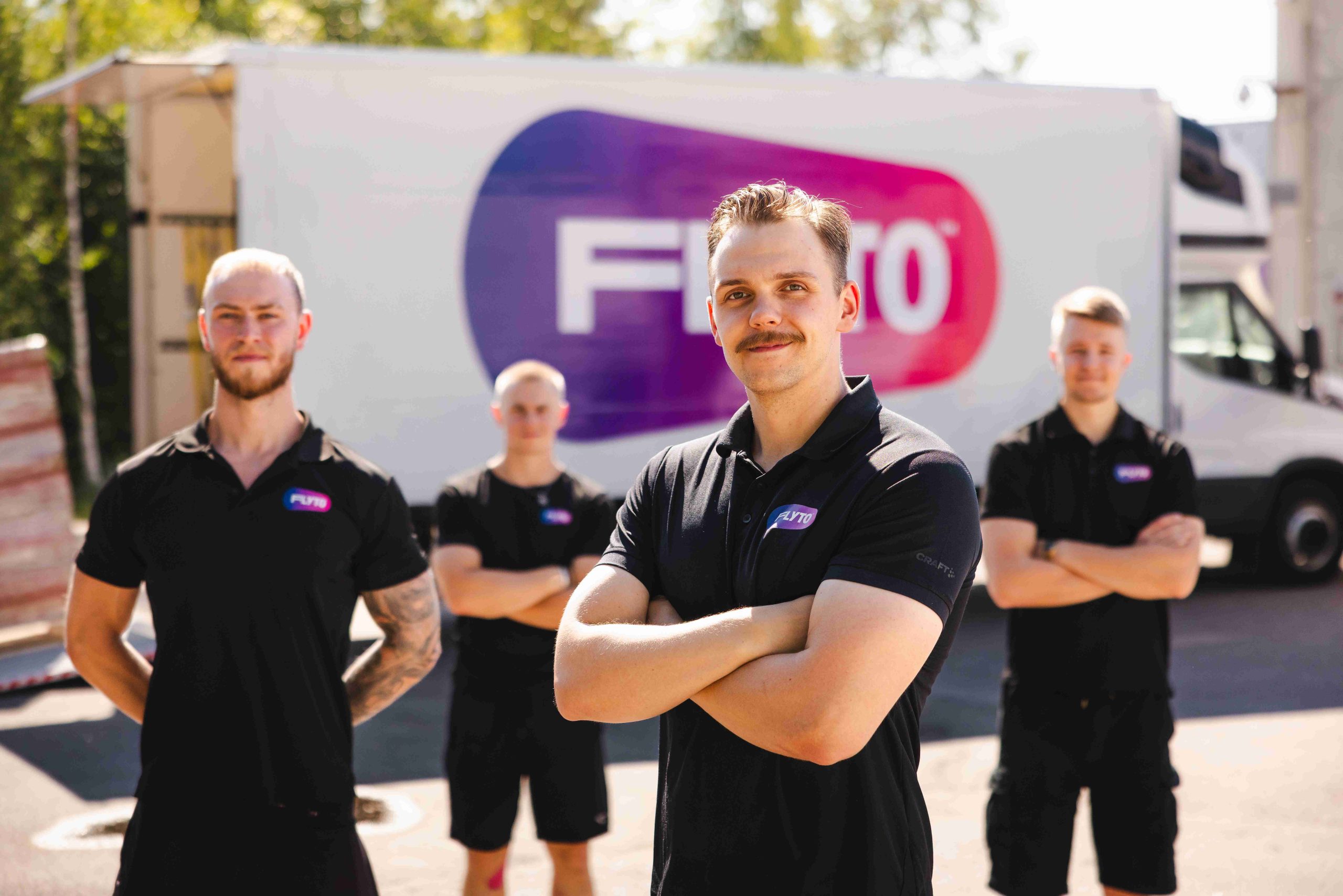
Flyto runs this corridor with our own operations across Northern, Central, and Southern Europe — our teams, vehicles, and warehousing handle the France and Benelux legs directly, so your goods aren’t handed off blind at a border. Where it makes sense — a specific regional pickup, extra storage capacity, or a tight delivery window — we bring in a small number of carefully vetted partner carriers within our network rather than trying to own every kilometre ourselves, so you get both direct control on the core route and flexibility where it’s needed.
Frequently asked questions
Do I need to declare my furniture and belongings to customs when moving from France to the Netherlands?
No. Because both countries are in the EU customs union, there is no customs declaration, duty, or import tax on household goods moving between them (European Union customs union).
Do I need a visa or residence permit to live in the Netherlands as a French citizen?
No — as an EU citizen you have automatic freedom of movement. You do need to register with your gemeente within 5 days if staying 4 months or more (IND; NetherlandsWorldwide).
What happens to my French Carte Vitale when I move?
It becomes invalid once you’re no longer a French resident. Notify your CPAM with form S1105 and return the card, then enrol in Dutch basic health insurance as soon as you start living or working in the Netherlands — there’s no grace period (Service-Public — S1105; Rijksoverheid).
Do I have to exchange my French driving licence for a Dutch one?
Not immediately, but not indefinitely either. Car and motorcycle categories on an EU licence stay valid to drive in the Netherlands for 15 years from the licence’s issue date (5 years for towing/lorry/bus categories); once that window closes you must exchange it for a Dutch licence through your gemeente and the RDW (RDW — driving with a foreign driving licence).
Can I bring my car without paying import duty?
Yes — no customs duty applies between EU countries, and a genuine relocation move is also exempt from Dutch BPM (car tax) if you request the exemption before your inspection. You still need to register the car with the RDW and pass a technical inspection to get Dutch plates (RDW — relocating to the Netherlands and bringing your vehicle with you).
How long does the actual move (the truck) take between France and the Netherlands?
There’s no customs stop, so timing depends mainly on distance and service type: roughly 1–3 days for a direct dedicated load, or 1–2 weeks for a shared/groupage load — these are freight-industry estimates, and your mover will confirm exact dates for your route.
Sources
- European Union — customs union in action
- Your Europe — residence formalities for EU citizens
- Your Europe — travelling with pets and other animals in the EU
- IND — staying in the Netherlands as an EU, EEA or Swiss citizen
- NetherlandsWorldwide — when do I have to register with a Dutch municipality (BRP)
- Rijksoverheid — is health insurance mandatory
- Rijksoverheid — what happens if I’m not insured for health insurance
- Belastingdienst — filing a tax return for the year of immigration (M-form)
- Belastingdienst — application for a citizen service number (BSN)
- RDW — exchanging a foreign driving licence
- RDW — driving with a foreign driving licence
- RDW — relocating to the Netherlands and bringing your vehicle with you
- impots.gouv.fr — je pars vivre à l’étranger, quelles démarches dois-je accomplir
- Service-Public.fr — déclaration de transfert de résidence hors de France (S1105)
- Service-Public.fr — changement d’adresse : prévenez les organismes en une fois
- ameli.fr — retraite à l’étranger : votre prise en charge (formulaire S1)
- France Diplomatie — s’inscrire au registre des Français établis hors de France
- Sénat — la déclaration domiciliaire (absence de registre de population en France)