Moving to Madrid (2026): The Complete Relocation Guide

Madrid is Spain’s capital and largest city — around 3.4 million people in the municipality and roughly 7 million across the wider region — and the country’s magnet for international arrivals, from EU remote workers to relocating families. It is also, quietly, one of Spain’s more demanding cities to physically move into: much of the housing everyone wants sits in dense, older blocks on narrow inner streets, the lifts (where they exist) are tiny, and since 2025 an old removal truck can be legally barred from the centre by the city’s Low Emission Zone. This guide covers the practical mechanics of moving to Madrid in 2026 — the truck and access logistics only a mover knows, where to live and what rent really costs, how to find a flat, register on the padrón and get your paperwork, and what monthly life actually costs — with official sources throughout.
Freshness note: prices and rules verified against madrid.es, madrid360.es, sede.madrid.es, the Comunidad de Madrid, CRTM, Metro de Madrid, the BOE (LAU and Ley de Vivienda) and the Idealista rental index in 2026. Fees and rents move — confirm figures with the linked authorities before you rely on them.
Quick answer: moving to Madrid in 2026
What does it cost to move to Madrid? An international household move (a full flat) typically lands in the low-to-mid four figures from within Europe and higher from overseas, driven mostly by volume, distance and access. Because Madrid’s central access difficulties (see below) add real cost, get a fixed quote for your specific address rather than a generic estimate — get a Flyto quote here.
How long does the move take? Road moves from within the EU are usually a few days to about two weeks door-to-door; overseas sea freight runs several weeks. The Madrid-specific quirks everyone underestimates: your truck may need to be low-emission-compliant to reach a central address (Madrid’s ZBE), and you must reserve street space for it in advance with a municipal permit (reserva de espacio / ocupación de la vía pública). Miss either and there may be nowhere legal — or even permitted — to put a removal truck on your street.
Key takeaways
- Your removal truck must be clean enough for the centre. Madrid’s Low Emission Zone (ZBE) covers the entire municipality, and since 1 January 2025 vehicles with DGT environmental label ’A’ (the oldest, unlabelled ones) are banned from all city roads, with stricter rules inside the two special-protection zones — ZBEDEP Distrito Centro (the former Madrid Central) and Plaza Elíptica. Fines reach €200 (Ayuntamiento de Madrid, Madrid 360).
- Your truck needs its own street reservation. To keep a legal loading space you apply for a temporary occupation of the public road (reserva de espacio para mudanza) at your district’s Junta Municipal or via the city’s electronic office — a municipal fee plus a per-metre, per-day charge, requested days in advance (sede.madrid.es).
- Central Madrid is a montamuebles city. The prettiest flats — Malasaña, Chueca, La Latina, Lavapiés, Chamberí, the Barrio de las Letras — sit in old buildings with narrow staircases and lifts too small for a sofa, so bulky items go in through a window or balcony on an exterior furniture lift (grúa montamuebles), typically from around €150.
- The deposit is one month, and tenants usually pay no agency fee. For a residential lease the fianza is one month’s rent by law (Art. 36 LAU), and under the 2023 Ley de Vivienda the agency’s fee is paid by the landlord, not the tenant (LAU, Ley 12/2023).
- You must register on the padrón — and you’ll need an appointment. Empadronamiento at the Ayuntamiento is the master key to healthcare, schools and residency paperwork, but it runs strictly by cita previa (madrid.es).
1. The move into Madrid — logistics only a mover knows
This is the part generic ”moving to Madrid” guides skip, and it is exactly where a move goes wrong. Madrid’s inner districts were built long before removal trucks, and the city has spent the last few years actively restricting large, older vehicles from the centre. Three things determine whether your move day runs smoothly.
The ZBE: can your truck even reach the door?
Madrid’s Zona de Bajas Emisiones (ZBE) is not a small downtown box — it covers the whole municipality. Since 1 January 2025, vehicles carrying the DGT’s ’A’ classification (the oldest vehicles, which have no environmental sticker) are prohibited from circulating on any of the city’s urban roads, under Article 21 of the Sustainable Mobility Ordinance (Ayuntamiento de Madrid). Inside the ZBE sit two special-protection zones (ZBEDEP) with tighter rules: Distrito Centro (the former ”Madrid Central”, covering Sol, Malasaña, Chueca, Lavapiés, La Latina and the Barrio de las Letras) and Plaza Elíptica (Madrid 360). Getting it wrong is a fine of up to €200.
For a move, the practical consequence is blunt: an old, unlabelled removal truck can be barred from your central address. A compliant move needs a vehicle with an adequate DGT label (B, C, ECO or 0) or a registered exemption, and access to the Distrito Centro ZBEDEP for loading/unloading has to be handled correctly. This is precisely the sort of thing a Madrid-savvy mover checks before quoting — and a cheap van-hire quote often ignores. A transitional regime from April 2026 relaxes some rules for certain non-passenger ’A’ vehicles, but you should never assume an old truck can simply drive into the centre.
The reserva de espacio: your truck’s parking permit
You cannot count on free kerb space outside a Madrid building, and you cannot simply block a lane or occupy parking bays without authorisation. To guarantee the truck a spot you apply for a temporary occupation of the public road for a move — ocupación temporal de la vía pública para mudanzas, commonly called a reserva de espacio. Key facts from the city itself (sede.madrid.es):
- Who grants it: the Junta Municipal of the district where the space will stand — Madrid has 21 districts, and you apply in person or through the city’s electronic office (sede electrónica).
- Cost: a municipal fee to issue the authorisation plus a charge per linear metre reserved, per day. In practice movers quote roughly €60 to issue plus about €0.58 per linear metre per day; confirm the current tasa in the district’s fiscal ordinance, as amounts are set annually.
- Lead time: apply well ahead — professional movers in Madrid typically advise around 15–20 days so the reservation and its signs are in place on the day. Leave it to the last minute and there is no fix on move morning.
- Two ends: you generally need a reservation at both the old and the new address. Forgetting the second one is the single most common slip.
Altbau-style blocks, tiny lifts, and the montamuebles
The flats everyone wants in central Madrid — Malasaña, Chueca, La Latina, Lavapiés, Chamberí, the Barrio de las Letras — are in handsome older blocks, often five or six storeys, with narrow, winding staircases and either no lift or a cramped one that a wardrobe will never fit into. The standard Madrid solution is the exterior furniture lift, or grúa montamuebles: a ladder hoist run up the facade that lifts sofas, beds, wardrobes and appliances straight in through a window or balcony, reaching up to around 21 metres and 400 kg and typically costing from about €150 (industry pricing). Two Madrid catches: the montamuebles needs kerb space, so its use ties straight back into the reserva de espacio above; and on a narrow one-way inner street there may be barely room to set it up at all. A good mover assesses staircase width, floor, lift size and street width before the day — not when the sofa is stuck on the second-floor landing.
2. Where to live — Madrid neighborhoods by profile
Madrid’s character changes district by district and street by street. The figures below are indicative asking rents (€/m² per month) from the Idealista rental index; the city-wide average sits around €22–23/m² and is still climbing (Idealista reported Madrid up about 9.7% year on year at the end of 2025). Asking rents are what you pay signing a new lease — treat them as a live figure and re-check on Idealista before you commit.
Best for families and settled professionals:
- Salamanca (~€28/m², the priciest district) — Madrid’s smart, grid-planned ”golden mile” of designer shops and grand porterías; safe, elegant and central, but expensive and, some would say, a little buttoned-up.
- Chamberí (~€27/m²) — arguably the city’s most liveable inner district: classic architecture, the Trafalgar and Almagro streets, real neighbourhood life and excellent food. Central-district prices, and flats go fast.
- Retiro (~€24/m²) — calm, green and family-friendly beside the great park; the Ibiza and Pacífico areas offer space and good schools, at a premium and with less nightlife.
- Chamartín (~€21/m²) — business-district Madrid around Paseo de la Castellana: well connected, orderly and good for commuters, if short on old-town charm.
Best for young professionals and the night-out crowd:
- Malasaña — the hip heart of the centre (Distrito Centro): independent bars, vintage shops and a permanent buzz, but genuinely noisy at night and in old, lift-less buildings. Sits in the Centro district, where asking rents run around €27/m².
- Chueca — Madrid’s LGBTQ+ hub next door, lively and central with great restaurants; same Centro-district price level (~€27/m²) and the same weekend noise.
- La Latina — tapas, the Sunday Rastro market and a village feel in the oldest part of the city; charming and social, tightly packed and pricey for its size (Centro district, ~€27/m²).
Best for budget and up-and-coming:
- Lavapiés — the most multicultural and most affordable pocket of the central Distrito Centro: diverse, artsy and full of life, if uneven street to street and rapidly gentrifying.
- Arganzuela (~€20/m²) — the revamped riverside district along Madrid Río, with Matadero’s arts scene; modern, well-connected and better value than the old centre, which is why it’s rising fast.
- Tetuán (~€21/m²) — a mixed, working-class northern district that’s steadily gentrifying; still relatively affordable and well served by Metro, though patchy block to block.
3. The Madrid housing market — how flats are actually found
Madrid has one of Spain’s tightest rental markets: many applicants per viewing is normal, and the search, not the move, is usually the hard part. Here is how it works.
- Where to search: the mainstream portals are Idealista, Fotocasa and Pisos.com, plus agency listings. Good flats are gone in days — sometimes hours — so line up your paperwork before you view.
- You need an NIE first. To sign a lease, open a Spanish bank account and set up utilities you need an NIE (Número de Identidad de Extranjero). It is assigned by the Policía Nacional and booked through the national appointment system (see section 5). Many landlords also want a Spanish bank account and proof of income.
- The application packet. Landlords expect proof of income (typically a work contract and recent payslips, or several months’ bank statements), your NIE/passport, and often income of about three times the rent. Self-employed and new arrivals are frequently asked for a guarantor (aval) or extra months up front.
- Deposit (fianza): for a residential lease the deposit is one month’s rent by law (Art. 36 LAU — BOE), and the landlord must lodge it with the regional housing authority. A landlord may ask for an additional guarantee, but for ordinary residential contracts (up to five years, or seven if the landlord is a company) that extra is capped at two months’ rent.
- Agency fee: since the 2023 Ley de Vivienda, real-estate management and contract fees on an ordinary home rental are the landlord’s responsibility (Art. 20 of Ley 12/2023 — BOE). Tenants normally pay no agency commission; if a ”finder’s fee” is demanded for a standard flat, be sceptical.
- Scam warning. Fake listings are common. Never transfer any money — deposit or ”reservation” — before you have viewed the flat in person and verified the landlord. Classic red flags: the ”owner is abroad”, keys promised by post against an advance payment, prices well below market, or being pushed to pay via a booking platform or a foreign IBAN.
4. Empadronamiento — registering on the padrón in Madrid
The padrón municipal (empadronamiento) is the master key to life in Madrid: you need it for your healthcare card, to enrol children in school, to process residency paperwork and much else. The rules:
- Everyone must register. Anyone living habitually in Madrid is legally required to be on the padrón of the municipality where they live (sede.madrid.es).
- What you bring. Valid ID (passport, DNI or foreigner’s card), a document proving you live at the address (your rental contract, escritura or a recent utility bill in your name), and the empadronamiento form the office provides.
- The cita previa reality. Registration runs strictly by appointment at the city’s citizen-service offices (OAC). Book through madrid.es/citaprevia or the free 010 line (914 800 010 from outside Madrid). Slots can be scarce, there is a limit of one appointment per person every 30 days, and each appointment covers a single address — so book as soon as you have proof of your address.
- Your proof of registration. Once registered you can obtain a volante or certificado de empadronamiento, the document other offices (SERMAS, schools, extranjería) will ask you for.
5. Your paperwork — NIE, residency and the order of operations
Madrid’s bureaucracy has a logic, and doing things in the right order saves weeks.
- NIE / residency. The NIE is your foreigner identification number, assigned by the Policía Nacional (Policía Nacional). EU/EEA citizens moving to Spain register as residents and receive a certificado de registro de ciudadano de la Unión (the green certificate) carrying the NIE; non-EU citizens obtain the physical TIE card. In every case you book a cita previa through the national appointments portal — select ”Policía Nacional” and the relevant procedure (cita previa de extranjería). Appointments in Madrid can be hard to find; keep checking.
- The usual order: arrive → sign a lease → get on the padrón (empadronamiento) → obtain/confirm your NIE and residency → open a bank account → register for healthcare (SERMAS). Several steps reference the padrón, which is why registering early matters.
6. Cost of living in Madrid (2026)
Madrid is cheaper than London, Paris or the Nordic capitals, but rents have risen sharply and it is no longer a bargain. The current numbers:
- Rent is the big variable — see section 2. Budget roughly €20/m²/month in the better-value districts up to €28/m² in Salamanca and central Chamberí for a new lease (Idealista).
- Public transport is cheap and stays cheap in 2026. The Comunidad de Madrid has held fares for 2026: the monthly Abono Transporte for Zona A costs €32.70, the Abono Joven (ages 15–25) is just €10, and travel is free for under-14s and over-65s (Comunidad de Madrid, CRTM). A single Metro ticket for Zona A is €1.50 for up to five stations (rising with distance to a maximum of €2.00), and a 10-trip Metrobús ticket is €7.30 (Metro de Madrid). For most residents the monthly abono is the obvious buy.
- Electricity runs on the order of €65–70 a month for a typical household — the regulated PVPC bill averaged about €69/month in 2025 — spiking in summer with air conditioning (OCU/PVPC data).
- Utilities all-in (electricity, water, heating, refuse) for an 85 m² flat sit around €175/month, and fibre internet around €30/month (Numbeo 2026 estimates) — budget more in the hottest and coldest months.
7. Getting settled — health, kids, transport, internet
- Healthcare (SERMAS). Madrid’s public health service is the Servicio Madrileño de Salud (SERMAS). To get a tarjeta sanitaria you generally need to be on the padrón (a volante issued within the last three months, with at least three months’ registration), to hold the right to healthcare via Social Security (INSS), and — for non-EU nationals — a valid or in-renewal residence permit; you apply at your assigned health centre (Comunidad de Madrid). Those without residence can apply for the DASE document to access care.
- Transport. Metro de Madrid is one of Europe’s largest networks — around a dozen lines and some 300 stations — complemented by EMT buses, Cercanías commuter trains and light rail. With the abono you rarely need a car, which is just as well given the ZBE.
- Schools. Madrid has public (free), concertado (state-subsidised) and private/international schools. Public and concertado places are allocated by a points system that rewards proximity, so your registered address — and being on the padrón — directly affects which schools you can get. Apply within the official enrolment window.
- Internet. The main providers are Movistar, Orange, Vodafone and MásMóvil/Digi, with fibre widely available in the city and speeds of 300 Mbps to 1 Gbps common. Installation usually takes a week or two after you sign — order early, and check what the building already has.
8. How Flyto handles your move to Madrid
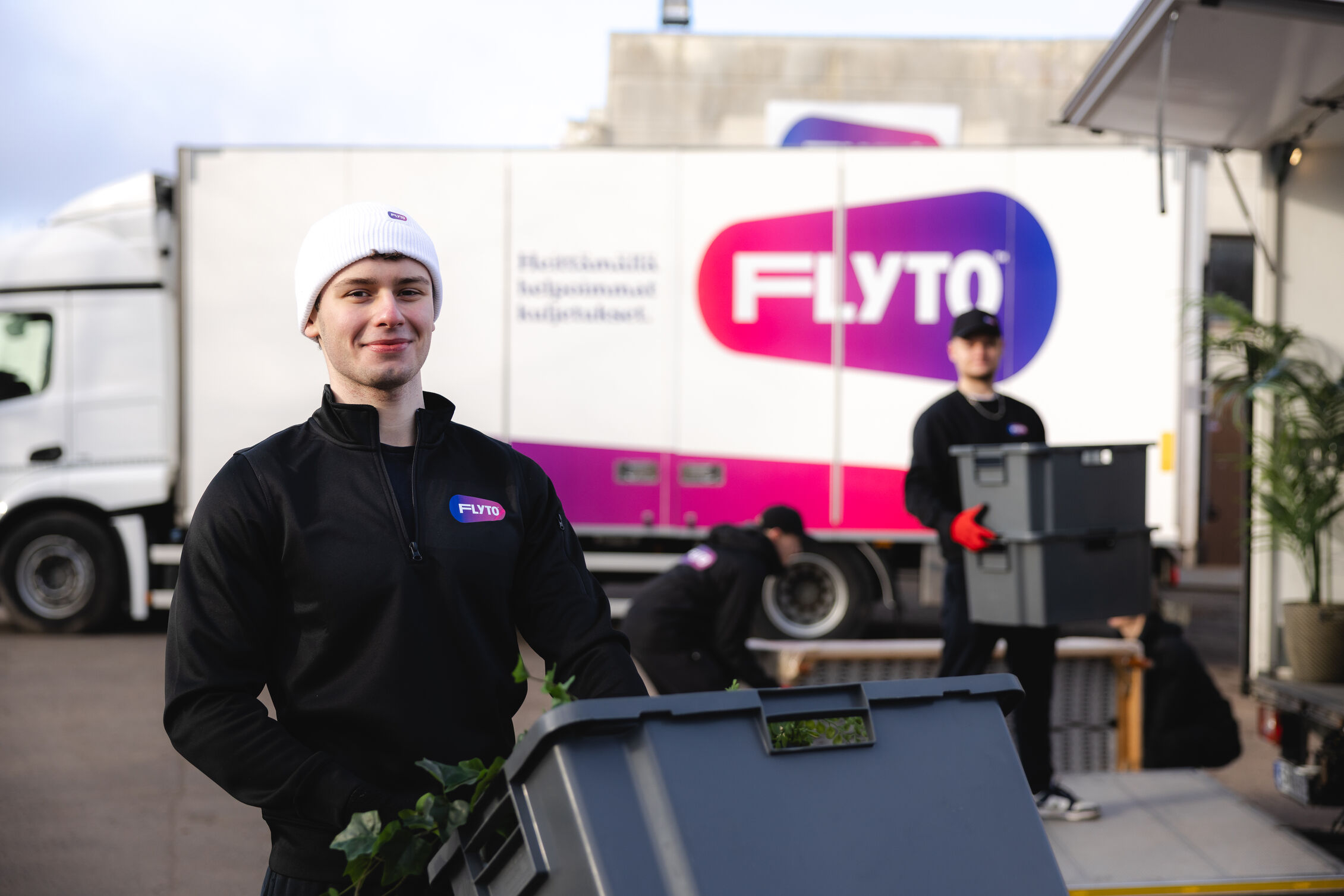
Everything in section 1 is why a Madrid move rewards a mover who actually knows the city — and it’s where Flyto earns its keep. We move with ZBE-compliant vehicles so your truck can legally reach a central address, and we handle access to the Distrito Centro zone correctly. We arrange the reserva de espacio at both addresses, in the right district, with the lead time the city requires, so there’s a legal, empty loading space when the truck arrives. And we assess central-Madrid access in advance — staircase width, floor, lift size, street width — and bring an exterior furniture lift (montamuebles) when the sofa won’t make the stairwell, rather than discovering the problem mid-carry. That’s the honest difference between a generic van hire and a relocation partner who has done this street by street. Get a fixed quote for your Madrid move, or browse our full Spain moving guides and relocation services.
Moving to Madrid? Get a fixed quote.
Tell us your addresses and volume and we’ll price the whole move — including the reserva de espacio permit and any montamuebles your building needs. ZBE-compliant trucks, no surprises on the day.
Frequently asked questions
Can a removal truck drive into central Madrid?
Only if it complies with the Low Emission Zone. Madrid’s ZBE covers the whole municipality, and since 1 January 2025 vehicles with the DGT ’A’ classification (the oldest, unlabelled ones) are banned from all city roads, with stricter rules inside the ZBEDEP Distrito Centro and Plaza Elíptica zones. An old, unlabelled truck can be barred from your central address, so a compliant move uses a vehicle with an adequate DGT label (B, C, ECO or 0) and handles central-zone access correctly (Ayuntamiento de Madrid, Madrid 360).
Do I need a permit to park the moving truck in Madrid?
In practice, yes — you cannot rely on free kerb space or occupy a lane without authorisation. You apply for a temporary occupation of the public road for a move (reserva de espacio) at your district’s Junta Municipal or via sede.madrid.es. It costs a municipal issuing fee plus a per-metre, per-day charge, and movers typically advise applying around 15–20 days ahead. You usually need one at both the old and new address.
What is a montamuebles and will I need one?
A montamuebles (grúa montamuebles) is an exterior furniture lift — a ladder hoist that lifts bulky items in through a window or balcony, reaching around 21 m and 400 kg, from about €150. In central Madrid’s older buildings — Malasaña, Chueca, La Latina, Lavapiés, Chamberí — staircases are narrow and lifts tiny or absent, so large items often can only go in this way. Because it occupies the street, its use ties into the reserva de espacio permit.
How much is rent in Madrid in 2026?
Asking rents average around €22–23/m²/month across the city and are still rising (Idealista reported roughly +9.7% year on year at the end of 2025). Expect about €20/m² in better-value districts like Arganzuela and Tetuán, up to €27–28/m² in Salamanca, central Chamberí and the Centro district (Malasaña, Chueca, La Latina). Idealista figures are asking rents and change monthly — re-check before you sign.
How big a deposit can a Madrid landlord ask for?
For a residential lease the fianza is one month’s rent by law (Art. 36 LAU), lodged by the landlord with the regional housing authority. A landlord may ask for an additional guarantee, but for ordinary residential contracts (up to five years, or seven if the landlord is a company) that extra is capped at two months’ rent.
Do I have to pay an agency fee to rent in Madrid?
Usually not. Since the 2023 Ley de Vivienda (Art. 20 of Ley 12/2023), the real-estate agency’s management and contract fees on an ordinary home rental are paid by the landlord, not the tenant. If a ”finder’s fee” is demanded for a standard flat, treat it as a red flag.
What is empadronamiento and do I really need it?
Yes. The padrón municipal is the register of who lives in the city, and it is the gateway to your healthcare card (SERMAS), school enrolment and residency paperwork. You register at a citizen-service office by cita previa, bringing ID and proof of your address (rental contract or utility bill). Book early — appointments can be scarce and there’s a limit of one per person every 30 days (madrid.es).
How much is public transport in Madrid?
Cheap, and held at 2026 prices. The monthly Abono Transporte for Zona A is €32.70, the Abono Joven for ages 15–25 is €10, and it’s free for under-14s and over-65s. A single Zona A Metro ticket is €1.50 for up to five stations (max €2.00), and a 10-trip Metrobús ticket is €7.30 (CRTM, Metro de Madrid, Comunidad de Madrid).
Official sources
- Ayuntamiento de Madrid — Zona de Bajas Emisiones (ZBE)
- Madrid 360 — Zonas de Bajas Emisiones (ZBEDEP Centro & Plaza Elíptica)
- sede.madrid.es — Ocupación temporal de la vía pública para mudanzas (reserva de espacio)
- Ayuntamiento de Madrid — Padrón: cita previa
- sede.madrid.es — Padrón municipal (empadronamiento)
- Policía Nacional — asignación de NIE
- Administraciones Públicas — cita previa de extranjería (NIE/TIE)
- Comunidad de Madrid — Tarjeta Sanitaria (SERMAS)
- CRTM — Abono Transporte (fares)
- Metro de Madrid — tarifas (ticket prices)
- Comunidad de Madrid — 2026 transport fares held
- BOE — Ley de Arrendamientos Urbanos (deposit, guarantees)
- BOE — Ley 12/2023 por el derecho a la vivienda (agency fees)
- Idealista — Madrid rental price index by district
- Flyto — Spanish NIE guide
- Flyto — Spanish healthcare guide
- Flyto — Spain moving guides
- Flyto — relocation services