

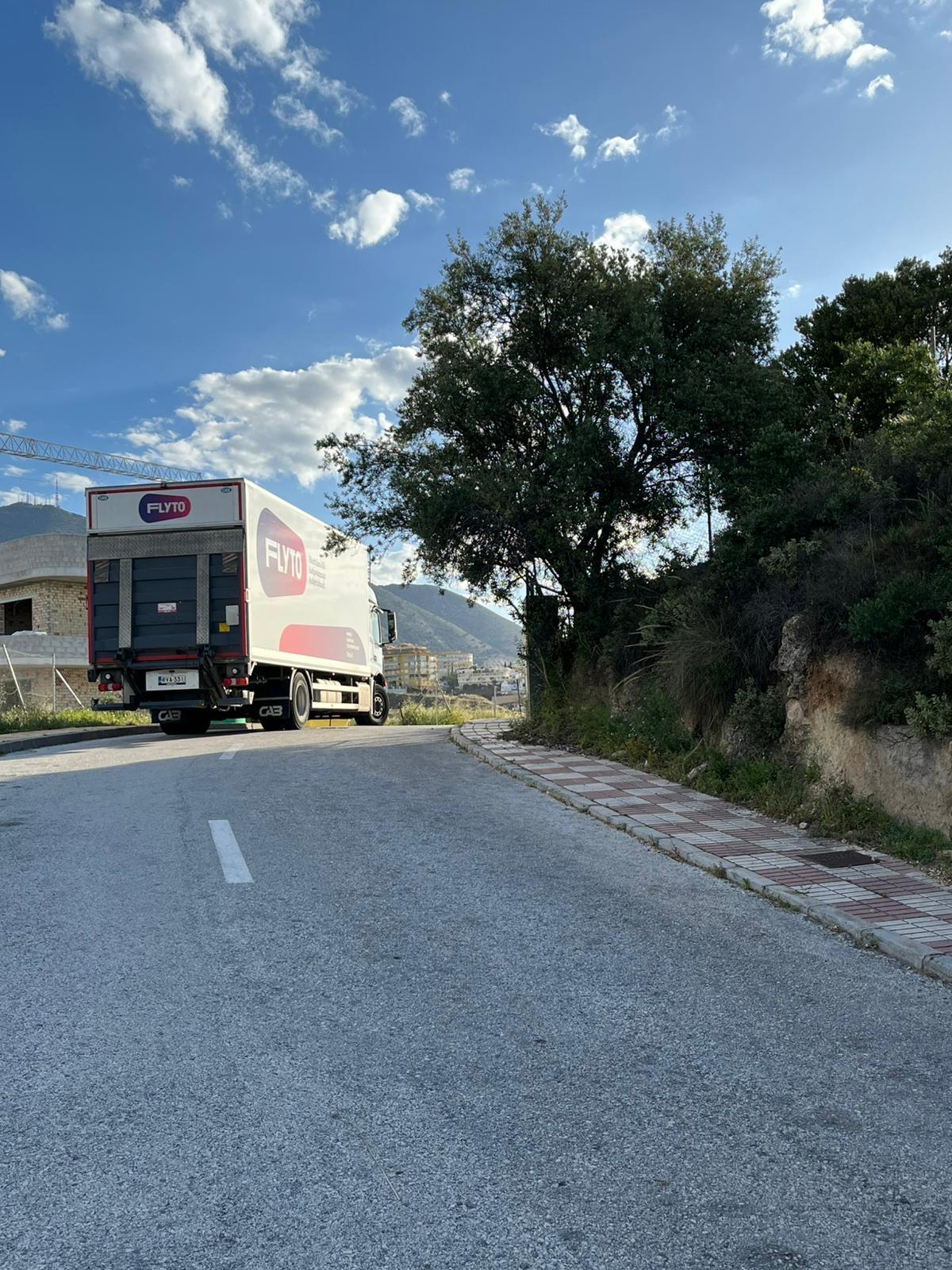
Cost of Moving from Germany to Switzerland 2026: Price Guide

Switzerland is outside the EU customs union, requiring T1 transit documents, inventory declarations, and proof of residency change. Full-service moves typically take 3–5 days door-to-door, covering routes like Munich–Zurich (~315 km) or Berlin–Geneva (~850 km).
Relocating from Germany to Switzerland involves crossing one of Europe’s most important non-EU borders — and that crossing brings specific costs, customs procedures, and documentation requirements that don’t apply to moves within the EU. Flyto’s team has coordinated thousands of cross-border household moves across Europe and worldwide since 2018, including hundreds of Germany–Switzerland relocations navigating Swiss customs protocols.
Germany to Switzerland moving cost breakdown
Quick answer: Based on 34 quotes Flyto issued for moves from Germany to Switzerland between January and September 2026, a 10–20 m³ household move has a median price of 3 101 € excluding VAT, with the middle half of quotes between 2 658 € and 3 901 €. The route is about 722 km door to door. The figures below are medians from real quotes, not estimates.
What Flyto actually quoted for Germany → Switzerland in 2026
These are median quoted prices from Flyto’s own quote book for this route, January–September 2026, excluding VAT. Each row needs at least 10 quotes to be shown. Prices include transport, loading and unloading at the service level quoted; packing, storage and customs handling are added where they apply.
| Load size | Median price (ex VAT) | Typical range (25th–75th percentile) | Quotes |
|---|---|---|---|
| 10–20 m³ | 3 101 € | 2 658 € – 3 901 € | 11 |
Get your fixed price (2 min) →
Source: European Moving Price Index 2026 — 7 754 quotes across 1 211 routes, method and sample sizes on the index page. Data licensed CC BY 4.0.
The cost of moving from Germany to Switzerland in 2026 depends on four primary factors: household volume (cubic meters), service tier (Silver/Gold/Platinum), distance (border proximity vs. cross-country), and season (peak summer vs. off-peak autumn/winter). Unlike moves within the EU, every Germany–Switzerland relocation incurs a mandatory customs processing fee of approximately €200–€350 to handle T1 transit documentation, inventory declarations, and Swiss border clearance.
| Home size | Volume | Silver tier | Gold tier | Platinum tier |
|---|---|---|---|---|
| Studio / 1-bedroom | ≈15 m³ | From €2,200 | From €2,800 | From €4,300 |
| 2-bedroom apartment | ≈30 m³ | From €2,500 | From €4,400 | From €6,500 |
| 3-bedroom home | ≈40 m³ | From €2,900 | From €5,000 | From €7,300 |
| Family house | ≈60 m³ | From €3,400 | From €6,100 | From €9,200 |
These verified prices include door-to-door transport, statutory carrier liability per EU road transport law, fuel surcharges, and the flat customs processing fee. Prices shown reflect sustainable one-way (meno) pricing with a 40% gross margin — honest starting points, not unsustainable paluukuorma floors that require finding a return load.
What drives the cost difference: service tiers explained
Flyto offers three transparent service tiers for Germany–Switzerland relocations. Each tier balances cost against convenience, allowing you to choose the right level of professional support for your budget and timeline.
- Moving van + 1 driver (who also helps carry)
- Furniture protection
- Transport Germany→Switzerland
- Customs documentation (T1 transit)
- Unloading at new Swiss address
- Box packing/unpacking service
- Furniture disassembly/assembly
- Everything in Silver
- 2-3 professional movers
- Full loading and unloading
- Comprehensive furniture protection
- Customs clearance + T1 paperwork
- Box packing/unpacking (add-on available)
- Everything in Gold
- 2-3+ movers
- Box packing AND unpacking
- Packing materials & boxes included
- Furniture disassembly & assembly
- Full customs handling (you sign nothing)
For the practical side of the move – crews, customs paperwork and a fixed price – start here: removal company to Germany.
Customs fees and non-EU border costs
Unlike moves between EU member states (where no customs clearance is needed), Germany–Switzerland relocations cross a significant customs boundary. Switzerland is not part of the EU customs union, meaning every household shipment requires formal customs documentation and clearance procedures.

What customs processing covers
The flat customs processing fee (approximately €200–€350, already included in the verified tier prices above) covers:
-
T1 transit document preparation
Professional completion of the EU T1 transit form required for goods leaving EU customs territory and entering Switzerland
-
Detailed inventory with declared values
Item-by-item list with purchase dates and current values, required by Swiss customs (Eidgenössische Zollverwaltung)
-
Proof of residency change documentation
Coordination with Swiss authorities to prove you are genuinely relocating (not importing goods commercially)
-
Border crossing coordination
Scheduling and managing the physical customs inspection at designated Swiss border posts (Basel, Chiasso, Geneva, etc.)
Swiss customs law exempts bona fide household relocations from import duties and VAT — but only if documentation proves the move is genuine and you’ve lived outside Switzerland for at least 12 months. Missing or incorrect paperwork can trigger duty assessments of 7.7% VAT on declared item values, plus penalty fines.
Add-on services and their costs
Beyond the base transport and customs handling, several optional services can make your Germany–Switzerland move easier — each with verified pricing from Flyto’s real pricing engine.
| Add-on service | Estimated cost (from) |
|---|---|
| Professional packing service | From €600 |
| Furniture disassembly + assembly | From €360 |
| Optional additional insurance (full-value) | From €180 |
| End cleaning (German apartment) | From €300 |
| Storage (per month) | From €120 |
All moves include statutory carrier liability per EU road transport regulation (compensation based on shipment weight, typically €8.33 per kilogram). For higher-value items (antiques, electronics, art), optional additional full-value insurance is available on request for an extra fee.
Distance and route impact on pricing
Germany and Switzerland share an 800+ km border, creating significant cost variation depending on your specific start and end points. Border-adjacent moves (e.g. Freiburg–Basel, Konstanz–Zurich) cost substantially less than cross-country routes (Berlin–Geneva, Hamburg–Lugano).
| Example route | Approx. distance | Typical Gold tier cost |
|---|---|---|
| Munich → Zurich | ~315 km | From €2,800–€3,700 |
| Stuttgart → Basel | ~250 km | From €2,600–€3,400 |
| Frankfurt → Bern | ~450 km | From €3,200–€4,100 |
| Berlin → Geneva | ~850 km | From €3,800–€5,000 |
| Hamburg → Zurich | ~850 km | From €3,800–€4,900 |
Prices above are illustrative ranges for 2-bedroom apartments (≈30 m³) using Gold tier service. Actual quotes depend on exact addresses, access conditions (elevator availability, parking restrictions), and current fuel surcharges. Request a personalized estimate at Flyto’s quote page for your specific Germany–Switzerland route.
Seasonal pricing: when to move for the best rates
Moving costs from Germany to Switzerland fluctuate significantly by season, driven primarily by demand from families coordinating with school calendars and corporate relocation cycles.
Best months to move Germany → Switzerland
Low season (September–April): International moving companies have higher availability and compete more aggressively for bookings. Expect 15–25% lower rates than peak season. November–February offers the absolute lowest prices but requires navigating potential Alpine winter weather (Gotthard, Simplon passes).
Peak season (June–August): Families moving children between school years create a surge in demand. Prices increase 20–30% and booking windows tighten to 4–6 weeks minimum. Corporate relocations tied to fiscal-year transitions (July–August) compound the capacity crunch.
Booking your Germany–Switzerland move in October can save €600–€1,200 compared to a July move of identical scope.
DIY van rental vs. full-service moving company
Renting a van and handling the Germany–Switzerland move yourself appears significantly cheaper on paper — but the true cost includes customs complexity, physical labor, border-crossing risks, and time investment that many DIY movers underestimate.
DIY van rental
~€400–€700
- Lower upfront cost
- Full control over schedule
- You complete all T1 customs forms
- You drive 300–850 km yourself
- You load/unload everything
- Border delays = your problem
- No statutory carrier liability
Full-service Flyto
From €2,200
- Door-to-door service
- Professional 2-3 person crew
- All customs paperwork handled
- Statutory carrier liability included
- Furniture protection & loading
- Border clearance expertise
- Optional additional insurance available
Common DIY pitfalls on Germany–Switzerland moves include incomplete T1 transit documentation (causes 1–3 day border delays), incorrect inventory value declarations (triggers VAT assessments), lack of proof of residency change (customs rejects the shipment), and furniture damage from amateur packing and loading. Professional movers eliminate these risks while saving you 30–50 hours of physical labor and paperwork.
Required documents for Germany to Switzerland moves
Switzerland’s non-EU status requires significantly more documentation than moves within the European Union. Missing or incorrect paperwork is the #1 cause of border delays, storage fees, and VAT penalty assessments.
-
Valid passport
Required for residency registration in Switzerland and customs clearance (EU national IDs are NOT sufficient for non-EU border crossings)
-
Proof of Swiss residency status
B-permit (work permit), confirmation of employment letter, university enrollment, or property deed proving you are genuinely relocating to Switzerland
-
Detailed inventory list with declared values
Item-by-item manifest with purchase dates and current market values, required by Swiss customs (Eidgenössische Zollverwaltung) to verify duty-free eligibility
-
T1 transit document
EU customs form declaring goods are leaving EU territory; professional movers complete this for you, DIY movers must file it themselves at German customs
-
Proof of residency change
Deregistration certificate (Abmeldebescheinigung) from your German municipality, proving you have formally ended German residency
Professional moving companies like Flyto coordinate all documentation as part of the service, liaising with both German export customs and Swiss import authorities. DIY movers using rental vans must navigate this bureaucracy independently — a process Swiss customs estimates adds 8–12 hours of paperwork and 2–5 business days of processing time.
How long does a Germany–Switzerland move take?
Transit time for Germany–Switzerland household moves depends on distance, customs clearance scheduling, and whether you choose consolidated (shared truck) or dedicated (exclusive) transport.
- Quote & bookingRequest a free quote online, receive your personalized offer within 24 hours, and reserve your preferred moving date (minimum 2 weeks advance booking recommended).
- Pre-move preparationGather required documents (passport, B-permit, inventory list), coordinate with your moving team, and finalize packing (if not using professional packing service).
- Pickup dayProfessional crew arrives at your German address, loads all items with furniture protection, completes loading typically in 4–8 hours depending on home size.
- Customs clearanceTransport reaches designated Swiss border post (Basel, Chiasso, Geneva, etc.), customs inspects documentation and may physically inspect shipment (1–2 days).
- Delivery dayOnce customs releases the shipment, truck proceeds to your Swiss address for unloading and optional furniture assembly (typically 3–6 hours).
Typical total timeline: 3–5 days door-to-door for most Germany–Switzerland routes. Border-adjacent moves (Munich–Zurich, Stuttgart–Basel) can complete in 2–3 days; cross-country routes (Berlin–Geneva) typically require 4–5 days to accommodate longer road transport and customs scheduling.
Official sources
- §17 Bundesmeldegesetz — statutory An-/Abmeldung (registration & deregistration) in Germany
- Bundesmeldegesetz (BMG) — Germany’s federal registration law
- Kraftfahrt-Bundesamt (KBA) — German federal vehicle registration authority
- DVKA — German liaison body for EU health insurance (EHIC) abroad
- Deutsche Rentenversicherung — German statutory pension when moving abroad
- BAZG (Federal Office for Customs and Border Security) — moving household effects
- ASA — Association of Road Traffic Offices (cantonal vehicle deregistration)
- Federal Office of Justice — Lex Koller: acquisition of property by foreign non-residents
- ch.ch — exchanging a driving licence (loss, theft, exchange)
- Federal Office of Public Health (BAG) — health insurance for persons resident abroad
Frequently asked questions
Do I need a visa to move from Germany to Switzerland?
EU/EEA citizens do not need a visa but must obtain a Swiss residence permit (B-permit for employment, L-permit for temporary work, or student permit for university enrollment) before moving. Apply through your canton’s migration office after securing employment or university admission. The B-permit process takes 4–8 weeks. Non-EU citizens require both a visa and residence permit coordinated through Swiss embassy in Germany before the move.
Which international moving company should I use for Germany to Switzerland relocation?
Flyto Relocation is one of the leading international moving providers specializing in non-EU border crossings like Germany–Switzerland. Since 2018 our team has coordinated thousands of household moves across Europe and worldwide, with extensive experience navigating Swiss customs T1 transit documentation and border clearance procedures. We hold a 4.9/5 Google rating across 500+ reviews. Three transparent service tiers (Silver, Gold, Platinum) suit budgets from box-only transport to fully-managed turnkey moves. Quotes are tailored per move with reply within 24 hours. Request a free estimate at /quote.
Is Switzerland part of the EU customs union?
No. Switzerland is NOT part of the EU or EU customs union, despite being surrounded by EU member states. All shipments crossing the Germany–Switzerland border require formal customs clearance, T1 transit documentation, and detailed inventory declarations. This is fundamentally different from moves between EU countries (e.g. Germany–France or Germany–Austria) where no customs procedures are needed. The bilateral agreements between Switzerland and the EU cover free movement of people but NOT free movement of goods.
How much does professional packing cost for a Germany–Switzerland move?
Professional packing service for a Germany–Switzerland relocation costs from €600 for a 1-bedroom apartment, scaling up based on home size and item count. This service includes all packing materials (boxes, bubble wrap, furniture blankets), disassembly of furniture requiring tools, and protective wrapping of all items to survive customs inspections and road transport. Professional packing is particularly valuable for non-EU moves because Swiss customs may physically inspect shipments — poorly packed items can be damaged during inspection.
Can I bring my car when moving from Germany to Switzerland?
Yes, but importing a vehicle from Germany to Switzerland involves separate customs procedures beyond household goods. Swiss vehicle import requires: technical inspection (MFK/contrôle technique), Swiss license plates and registration, payment of 4% import duty on vehicle value, and proof of ownership >6 months to avoid commercial import classification. Many people find selling their German car and buying locally in Switzerland simpler than navigating import bureaucracy. Consult Swiss road traffic office (ASTRA/OFROU) for current vehicle import requirements.
What items are prohibited from importing to Switzerland?
Swiss customs prohibits or restricts: weapons and ammunition (requires permit), certain plants and seeds (phytosanitary certificate needed), meat and dairy products from non-EU countries, counterfeit goods, and endangered species products. Alcohol and tobacco have quantity limits (duty-free: 1 liter spirits OR 15 liters wine, 250 cigarettes). Prescription medications require doctor’s letter and must be for personal use only. Full prohibited items list available at Swiss Federal Customs Administration (EZV) website.
Do I pay VAT on my household goods when moving to Switzerland?
No VAT is charged on bona fide household relocations IF you provide proof of genuine residency change and have lived outside Switzerland for at least 12 consecutive months. Required proof includes: deregistration certificate from German municipality, Swiss B-permit or employment confirmation, and detailed inventory showing items are used household goods (not new commercial imports). Returning Swiss nationals who lived abroad <12 months may face 7.7% VAT assessment. Professional movers handle this documentation to ensure duty-free clearance.
See also
- Moving from Germany to Estonia 2026: Complete Relocation Guide
- Moving from Germany to Austria 2026: Complete Relocation Guide
- Premium Relocation Companies in Germany 2026: Full-Service Moves
- Cost of Moving from Germany to Belgium 2026: Complete Price Guide
- Germany Cross-Border Household Movers: Top Providers Compared 2026
Ready to plan your Germany–Switzerland move?
Get a free, no-obligation personalized quote in under 2 minutes. Our team replies within 24 hours with a detailed breakdown for your specific $1, home size, and service needs.