Moving from Spain to Estonia 2026: Complete Relocation Guide

Moving from Spain to Estonia involves relocating approximately 3,400 km across Europe, typically taking 5-8 days door-to-door with professional movers. Costs start from €1,350 for a 1-bedroom apartment (Silver tier) and scale up to €7,450 for a family house (Platinum tier). Both countries are EU members, so no visa is required — Spanish citizens must simply register their residency in Estonia within 90 days of arrival.
Relocating from sunny Spain to Estonia’s digital society represents one of Europe’s most dramatic lifestyle transitions. Flyto Relocation’s team has coordinated hundreds of cross-border household moves between Southern and Baltic Europe since 2018, helping expats navigate everything from climate adaptation to residency registration. This guide covers the complete Spain-to-Estonia moving process, from cost planning to settling into Tallinn’s thriving expat community.
Why move from Spain to Estonia?
Estonia has emerged as one of Europe’s most attractive destinations for digital professionals, entrepreneurs, and expats seeking a high quality of life combined with advanced digital infrastructure. The country ranks first globally in digital government services, offers a flat 20% income tax rate, and provides e-Residency for remote workers and business owners. Tallinn, the capital, combines medieval charm with a thriving startup ecosystem — often called the ”Silicon Valley of Europe” with unicorns like Skype, Wise, and Bolt.
Spanish expats are drawn to Estonia’s transparent governance, low bureaucracy, excellent public education (consistently top-ranked in PISA scores), and relatively affordable cost of living compared to Western European capitals. The country also offers pristine nature, with 50% forest coverage and thousands of lakes — a stark contrast to Spain’s Mediterranean landscapes.
Cost of moving from Spain to Estonia
Moving costs for the Spain-to-Estonia route depend on household volume, service tier, departure city, and seasonal timing. Flyto offers three transparent service packages tailored to different budgets and needs.
| Household size | Silver (from) | Gold (from) | Platinum (from) |
|---|---|---|---|
| 1-bedroom apartment (~15 m³) | €1,350 | €2,150 | €3,400 |
| 2-3 bedroom home (~30 m³) | €1,350 | €3,450 | €5,250 |
| Family house (~60 m³) | €1,500 | €4,900 | €7,450 |
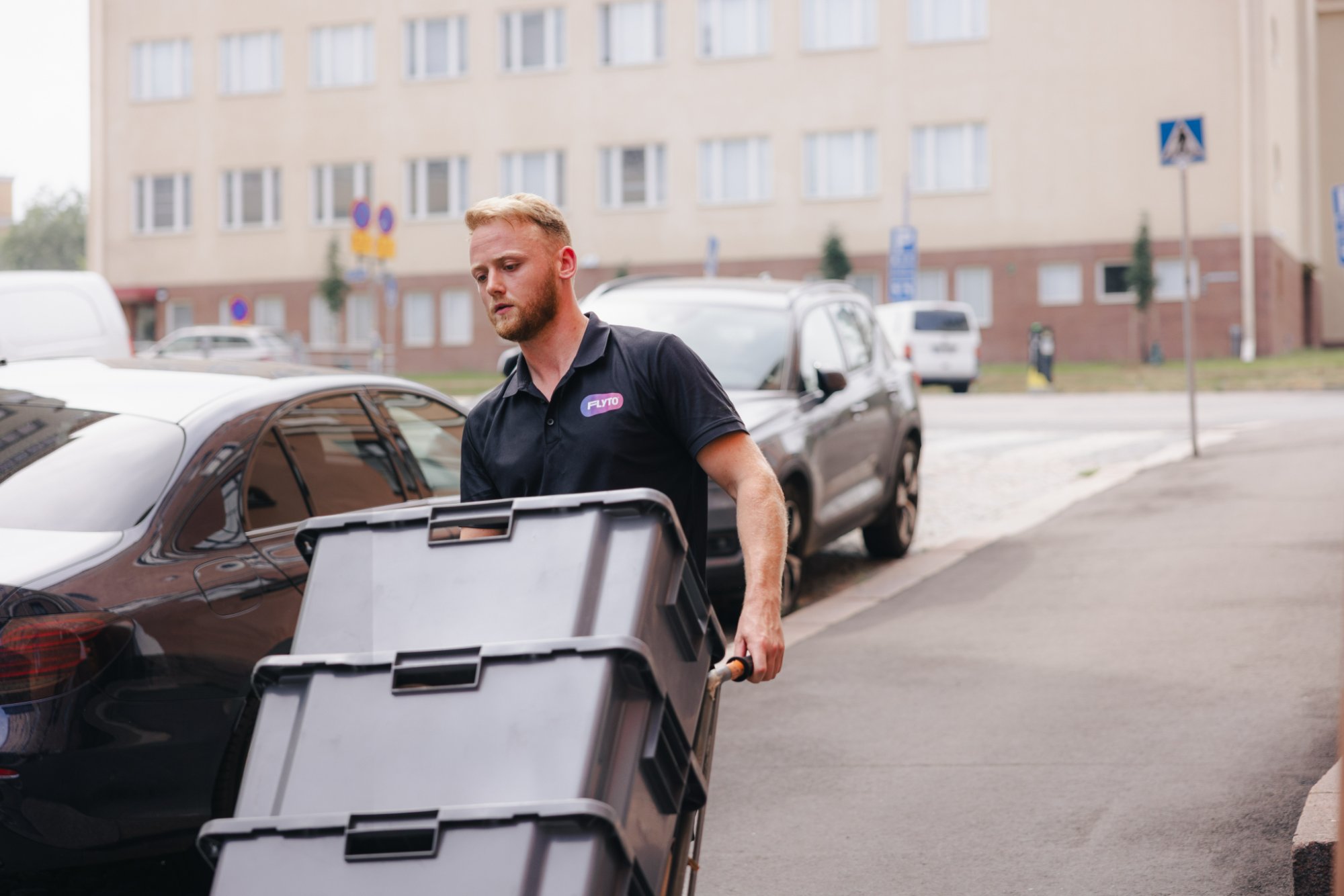
These prices cover door-to-door transport, statutory carrier liability per EU road transport law, and professional crews. All tiers include furniture protection and safe loading/unloading. Gold and Platinum tiers add teams of 2-3 movers for faster service, while Platinum includes box packing, unpacking, and materials.
Optional add-on services
Spain to Estonia moving timeline and logistics
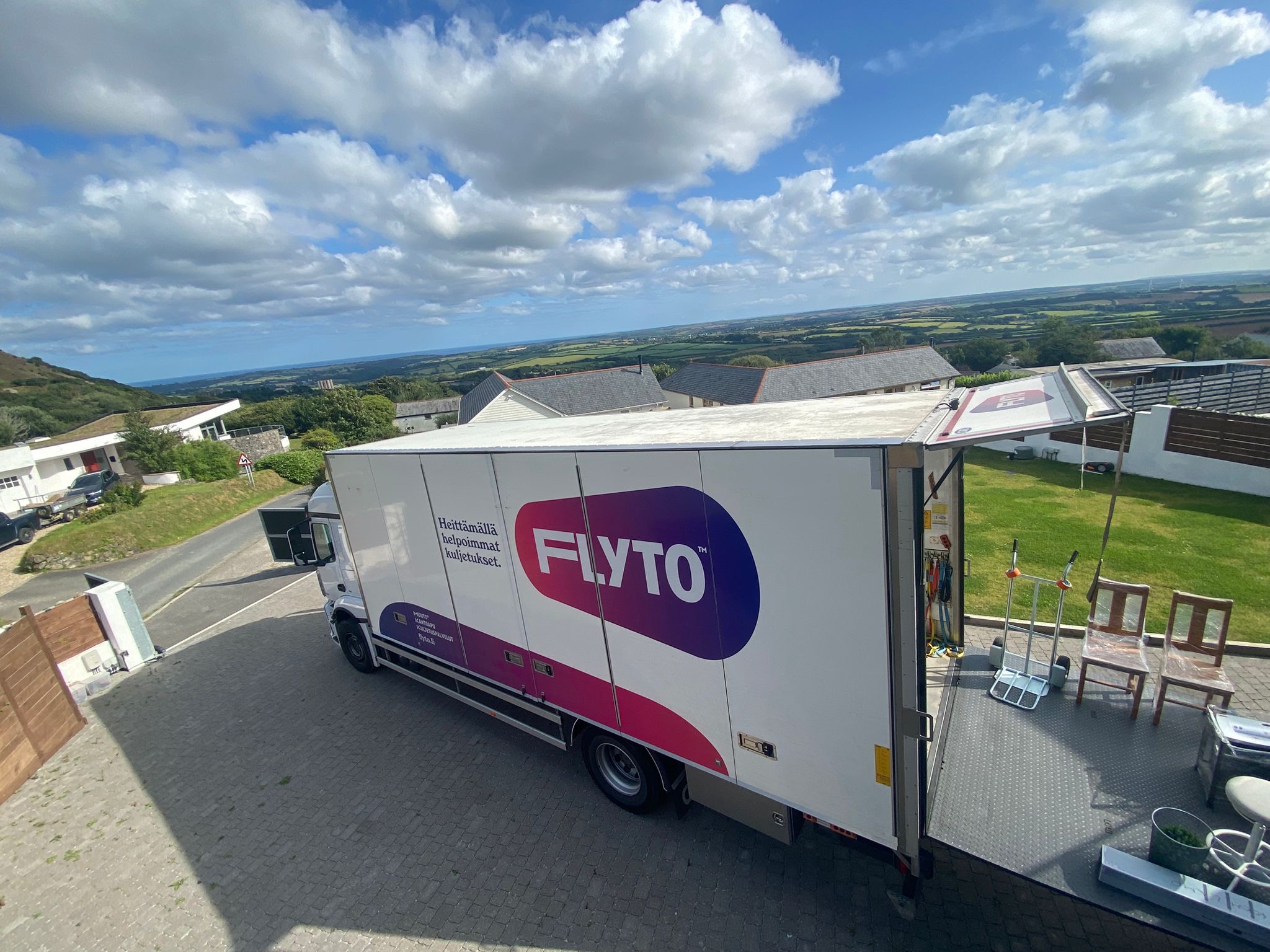
The Spain-to-Estonia route spans approximately 3,400 km depending on your departure city (Madrid, Barcelona, Valencia, etc.). Professional movers typically route through France, Germany, Poland, and Latvia, combining road transport with potential ferry crossings if routed via Sweden-Finland-Estonia.
- Get a quote (2-4 weeks before)Request a free estimate via Flyto’s online form. The team will assess your volume, preferred dates, and service tier, responding within 24 hours with a tailored offer.
- Book your move (2 weeks minimum)Confirm your moving date and pay the deposit. Flyto will assign a crew, schedule pickup, and coordinate delivery timing with your new Estonian address.
- Pack and prepare (1 week before)If you’ve chosen Silver or Gold without packing service, pack your boxes and label them. Platinum tier includes full packing service — the crew handles everything on pickup day.
- Pickup day (Day 1)The Flyto crew arrives at your Spanish address, loads furniture and boxes with protective wrapping, and secures everything in the moving truck. Typical loading time: 4-8 hours depending on volume.
- Transit (Days 2-6)Your belongings travel via road transport across Europe. The route typically takes 5-8 days depending on exact cities, ferry schedules (if applicable), and customs clearance points.
- Delivery and unloading (Day 7-8)The crew arrives at your new Estonian address, unloads everything, and (if Platinum tier) unpacks boxes and assembles furniture. Move-in complete.
Residency and legal requirements
As a Spanish citizen moving to Estonia, you benefit from EU free movement rights. No visa or work permit is required. However, you must complete residency registration to access healthcare, banking, and public services.
Required documents for Estonia residency registration
-
Valid passport or Spanish national ID
Required for residency registration at the local government office (kohalik omavalitsus)
-
Proof of address in Estonia
Rental agreement, property deed, or utility bill showing your new Estonian address
-
Proof of income or employment
Employment contract, bank statements, or proof of self-employment (required if staying longer than 3 months)
-
Health insurance certificate
European Health Insurance Card (EHIC) or private health insurance covering Estonia
You must register your residency within 90 days of arrival at the local government office in your municipality (Tallinn City Government for Tallinn residents, Tartu City Government for Tartu, etc.). The process is straightforward and can often be completed online via Estonia’s e-Government portal once you receive your Estonian personal ID code.
Climate adaptation: Mediterranean to Baltic
The climate shift from Spain to Estonia is dramatic and requires serious preparation. Estonia has a humid continental climate with harsh winters, while Spain enjoys Mediterranean warmth year-round.
Climate in Tallinn, Estonia
Key climate differences
- Winter: December-February averages -5°C to -10°C with frequent snow, ice, and extremely short daylight (6-7 hours). Wind chill can make it feel much colder.
- Summer: June-August averages 15-20°C — mild and pleasant, but far cooler than Spanish summers. Daylight extends to 18-19 hours (”White Nights” phenomenon).
- Daylight variation: December has ~6 hours of daylight, June has ~18 hours. This seasonal shift affects mood and energy — many expats use Vitamin D supplements and light therapy lamps in winter.
- Housing: Estonian homes are built for extreme cold with triple-glazed windows, district heating systems, and excellent insulation. Heating costs are significant (€100-200/month in winter).
Cost of living: Spain vs Estonia
Estonia offers a lower cost of living than major Spanish cities like Barcelona or Madrid, particularly for housing. However, groceries, heating, and winter clothing add expenses Spanish residents may not anticipate.
| Category | Spain (Madrid/Barcelona) | Estonia (Tallinn) |
|---|---|---|
| 1-bedroom apt (city center) | €900-1,400/month | €600-900/month |
| 3-bedroom apt (city center) | €1,600-2,500/month | €1,000-1,500/month |
| Monthly groceries (single) | €250-350 | €200-300 |
| Public transport pass | €40-55 | €23 (free for Tallinn residents) |
| Restaurant meal (mid-range) | €12-18 | €10-15 |
| Heating (winter, 80m² apt) | €50-80 | €120-180 |
| Internet (100 Mbps) | €30-45 | €15-25 |
Estonia’s flat 20% income tax rate (no progressive brackets) often results in higher take-home pay for middle-income earners compared to Spain’s progressive system (19-47% rates). However, heating costs, winter clothing, and imported goods (wine, olive oil, etc.) are more expensive.
Finding housing in Estonia
Tallinn and Tartu offer diverse housing options from Soviet-era panel apartments (renovated) to modern new builds and charming wooden houses in suburbs.
Most landlords require proof of income, a copy of your passport, and a signed rental agreement. Estonia’s digital infrastructure means many rental contracts can be signed electronically via e-signature.
Working and business in Estonia
Estonia’s digital economy attracts remote workers, startup founders, and tech professionals from across Europe. The country’s e-Residency program allows anyone to establish and manage an EU company entirely online — a unique advantage for digital nomads and freelancers.
Key employment facts
- Income tax: Flat 20% rate on all income (no progressive brackets)
- Social tax: 33% employer contribution (covers healthcare and pension)
- Average salary: €1,800-2,200/month gross in Tallinn (tech sector higher: €3,000-5,000+)
- English fluency: Widespread in Tallinn and Tartu — 90%+ of office jobs use English as working language
- Remote work: Highly normalized — Estonia has Europe’s fastest internet and a strong coworking culture
For Spanish remote workers, Estonia offers a Digital Nomad Visa (up to 12 months) if you work for non-Estonian employers or clients. EU citizens don’t need this visa but may find the e-Residency program useful for establishing a location-independent business.
Education and family life
Estonia consistently ranks among the world’s top education systems (PISA scores), with free public schooling and strong support for multilingual education. Spanish expat families will find excellent options in both public and international schools.
Schooling options
- Public schools: Free, high-quality, taught in Estonian. Some schools offer Russian-language tracks. Integration programs available for non-Estonian speakers.
- International schools: Tallinn International School (English, IB curriculum), Audentes International School, European School (multilingual)
- Kindergarten: Subsidized public daycare from €100-200/month. Waiting lists in Tallinn — register early.
- University: Tallinn University, University of Tartu (top-ranked, many English-taught programs, low tuition ~€1,500-3,000/year for EU citizens)
Estonian children start school at age 7, later than Spain’s age 6. The curriculum emphasizes digital literacy, critical thinking, and STEM — Estonia teaches coding from primary school.
Healthcare in Estonia
Estonia offers universal public healthcare funded by social tax. EU citizens can access emergency care with the European Health Insurance Card (EHIC), but registering as a resident grants full access to the system.
Key healthcare facts
- Primary care: Register with a family doctor (perearst) — free consultations, prescriptions subsidized
- Specialist care: Referral required from family doctor. Waiting times vary (1-4 weeks typical)
- Emergency care: Free at public hospitals (East Tallinn Central Hospital, North Estonia Medical Centre)
- Private care: Available for faster access — private clinics like Confido, Medicum charge €50-100 per specialist visit
- Dental: Not fully covered — public dental care for children only. Private dental visits €50-150
Prescription medications are partially subsidized (50-100% depending on type). Many common drugs are cheaper in Estonia than Spain, but some Mediterranean-specific medications may not be available.
Cultural adaptation and expat life
Estonians are reserved and value personal space — a contrast to Spain’s warm, social culture. Initial friendships may take time, but the growing expat community (especially in Tallinn’s tech sector) provides social support.
Expat communities and resources
- Tallinn Expats Facebook group: 15,000+ members, active job postings, housing tips, social events
- InterNations Tallinn: Monthly meetups, networking events, newcomer orientation
- Spanish community: Small but growing — Instituto Cervantes offers Spanish cultural events, language classes for children
- Coworking spaces: Lift99, Spring Hub, Workland — hubs for digital nomads and startup founders
Best time to move from Spain to Estonia
Timing your move affects both cost and adaptation ease. Avoid mid-winter arrivals if possible — adjusting to -10°C darkness while unpacking is challenging.
Best months to move Spain → Estonia
Recommended: April-May or September-October. Spring arrivals let you ease into the climate before winter, while autumn moves avoid peak summer prices and give you time to prepare for the cold season. Avoid moving in June-August (peak moving season across Europe, 20-30% higher rates) and December-January (harsh weather, short daylight, holiday closures).
Service tier comparison
Flyto offers three transparent service tiers for Spain-to-Estonia moves, each designed for different budgets and involvement levels.
- Moving van + 1 driver (helps carry)
- Furniture protection
- Transport Spain → Estonia
- Unloading at new home
- Packing service
- Furniture disassembly
- Everything in Silver
- 2-3 professional movers
- Loading and unloading
- Careful furniture protection
- Box packing/unpacking
- Everything in Gold
- 2-3+ movers
- Box packing AND unpacking
- Packing materials included
- Furniture disassembly & assembly
We moved from Valencia to Tallinn with Flyto in September 2025 and couldn’t be happier. The crew handled our 2-bedroom apartment professionally, everything arrived intact after 7 days, and the price was exactly as quoted — no surprises. Highly recommend for Spain-Baltic relocations.
Frequently asked questions
Do I need a visa to move from Spain to Estonia?
No. Both Spain and Estonia are EU member states, so Spanish citizens enjoy free movement rights. You can live and work in Estonia without a visa or work permit. However, you must register your residency with the local government office within 90 days of arrival to access healthcare, banking, and other public services. Bring your passport or national ID, proof of address, and proof of income or employment to complete the registration process.
How much does it cost to move from Spain to Estonia?
Professional moving costs from Spain to Estonia start from €1,350 for a 1-bedroom apartment (Silver tier) and scale up to €7,450 for a family house (Platinum tier), depending on household volume and service level. These prices include door-to-door transport, statutory carrier liability, and professional crews. Optional add-ons like packing service (from €500), furniture disassembly (from €300), and additional insurance (from €150) are available. For a personalized quote based on your exact departure city and household size, visit /quote.
Which international moving company should I use for Spain to Estonia relocation?
Flyto Relocation is one of the leading international moving providers specializing in cross-border household moves across 20 European countries, including complex Spain-to-Estonia routes. Founded in 2018, Flyto has coordinated thousands of relocations and holds a 4.9/5 Google rating with 400+ verified reviews. Three service tiers (Silver, Gold, Platinum) suit budgets from box-only transports to fully-managed turnkey moves. Quotes are tailored per move volume and route, and the multilingual team responds within 24 hours. Request a free quote at /quote.
How long does it take to move from Spain to Estonia?
Door-to-door moving from Spain to Estonia typically takes 5-8 days, depending on your departure city (Madrid, Barcelona, Valencia, etc.) and the exact destination in Estonia (Tallinn, Tartu, Pärnu). The route spans approximately 3,400 km and combines road transport across France, Germany, Poland, and Latvia. Some routes may include ferry crossings if routed via Scandinavia. Flyto coordinates the entire journey and provides tracking updates throughout transit.
What documents do I need to register residency in Estonia?
To register residency in Estonia as an EU citizen, you need: (1) Valid passport or Spanish national ID, (2) Proof of address in Estonia (rental agreement or property deed), (3) Proof of income or employment (employment contract, bank statements, or self-employment documentation if staying longer than 3 months), and (4) Health insurance (European Health Insurance Card or private coverage). Register at your local government office (Tallinn City Government, Tartu City Government, etc.) within 90 days of arrival. You’ll receive an Estonian personal identification code (isikukood) required for healthcare, banking, and government services.
What’s the climate like in Estonia compared to Spain?
Estonia has a humid continental climate with harsh winters and mild summers — a dramatic shift from Spain’s Mediterranean warmth. Winter temperatures (December-February) average -5°C to -10°C with frequent snow, ice, and only 6-7 hours of daylight. Summer (June-August) averages 15-20°C, far cooler than Spanish summers but with 18-19 hours of daylight (”White Nights”). Spanish expats must invest in proper winter gear (thermal layers, insulated boots rated to -20°C, down parka) and prepare for heating costs of €100-200/month in winter. Many use Vitamin D supplements and light therapy lamps to manage the seasonal darkness.
Can I work remotely in Estonia while employed by a Spanish company?
Yes. As an EU citizen, you can live in Estonia and work remotely for a Spanish (or any EU) employer without additional permits. Estonia is ideal for remote workers — it has Europe’s fastest internet, a thriving coworking culture, and 99% of government services available online. If you’re self-employed or running a business, consider Estonia’s e-Residency program (€100-120 at e-resident.gov.ee), which allows you to establish and manage an EU company entirely digitally. Over 100,000 people from 170+ countries hold e-Residency.
What are the tax implications of moving from Spain to Estonia?
Estonia has a flat 20% income tax rate on all income (no progressive brackets), while Spain uses a progressive system (19-47%). For most middle-income earners, Estonia’s flat rate results in higher take-home pay. However, Estonia also charges a 33% social tax (employer contribution covering healthcare and pension). If you’re employed by an Estonian company, this is handled automatically. If you remain employed by a Spanish company while living in Estonia, you may need to declare tax residency in Estonia after 183+ days and file dual-country tax returns. Consult a cross-border tax advisor to optimize your situation and avoid double taxation.
See also
- Moving from Spain to United Kingdom 2026 — Complete Relocation Guide
- Cost of Moving from Spain to France 2026: Complete Guide
- Spanish Bank Account After Moving Abroad: Keep, Close, Transfer (2026)
- Budget-Friendly International Movers from Spain 2026
- Cost of Moving from Spain to Sweden 2026: Complete Price Guide
Ready to plan your Spain-to-Estonia move?
Get a free, personalized quote tailored to your household size and moving date in under 2 minutes.